You can open your bank app ten times a day and still not know what’s okay to spend before payday.
That’s not a math problem on your end. Your bank balance shows what’s in the account right now. It hasn’t taken out rent, the card payment or the utility bill that lands next Tuesday.
So you do the subtraction in your head, on the fly, at the checkout. The new Amppfy does that subtraction for you and shows the result as one number.
What changed: one number, one word, and the math under it
Today now opens on your Safe-to-Spend™ number. That’s cash on hand, minus bills due before your next payday, minus planned savings, minus a safety cushion you pick. It’s a different idea from a running budget. It answers one question: what can you spend between now and the next paycheck?
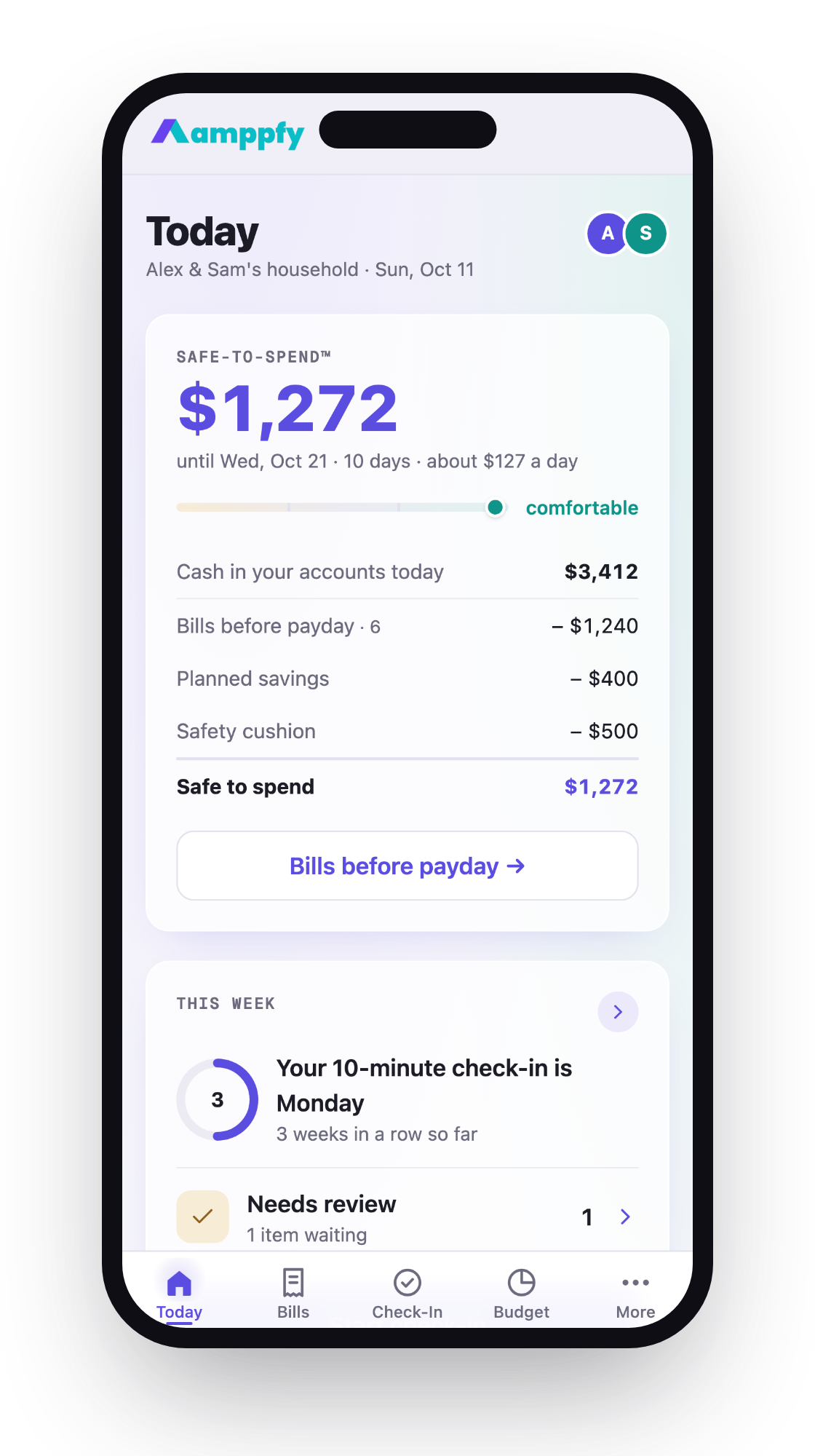
Here’s one household’s Today screen:
- Safe-to-Spend™: $1,272
- Holds until: Wed, Oct 21 (10 days)
- Status: comfortable
- Per day: about $127
Under the number sits the status scale. It gives the week one word: comfortable, tight, or dips into cushion. Beside it you see the date the number holds until and what it works out to per day.
How the math actually works
The number comes with a receipt printed underneath, so you can always check it. For this household it reads:
$3,412 joint checking − $1,400 rent − $145 credit card − $95 utilities − $500 cushion = $1,272
| Receipt line | Amount |
|---|---|
| Joint checking | $3,412 |
| Rent (before payday) | −$1,400 |
| Credit card (before payday) | −$145 |
| Utilities (before payday) | −$95 |
| Cushion | −$500 |
| Safe-to-Spend™ | $1,272 |
Take-home pay of $2,350 lands on payday. It isn’t in the number yet, because you don’t have it yet.
Under the receipt, Now to payday lists each bill on the day it lands. It shows the cash left after each one, down to the lowest point before the paycheck. That lowest point is what the status word describes.
Finding your number takes about five minutes
Start on the welcome screen. The headline reads “One number tells you what’s safe to spend.” The line under it says: enter your balances, bills and paydays, ten minutes a week keeps it honest, free, for two people.
Want a look first? Tap See an example. The app opens read-only on an example household, so you can poke around before entering anything.
When you’re ready, sign in:
- Continue with Apple, Google or an email address.
- If you use email, type it into the one address field.
- Enter the six-digit code that confirms it.
Onboarding is titled “Let’s find your number. About five minutes.” It runs six screens. A running receipt strip sits under the progress bar: cash, until payday, minus bills, minus cushion, the number. You watch the math build as you go.
Each chip on that strip is a button. Typed the wrong bill amount? Tap the bills chip and you’re back on that step. Fix it, move on.
The last screen counts the number up and says “That’s your number.” Tap Go to Today.
The check-in is four short steps
A number is only as good as the bank balances behind it. That’s why the check-in exists. Today tells you when it’s due (“Your 10-minute check-in is Monday”) and shows a This week ring.
Weekly works better than daily for most people.Here’s how the check-in runs:
- Where we stand. See the number, what came in this week and what went out.
- Confirm bills. Each bill has a circle on the right. Tap the circle to confirm, tap the bill to change it. Changes apply this time only: Different amount this time, Not due this time, or Already paid.
- Settle what was flagged. For each flagged item, pick Settle or Push to next week.
- Close the week. Answer the optional question, “About how much did you spend this week?” Then tap Close the week.
Three cards follow. The first shows the number and what moved it. The second lists bills confirmed and pushed. The third shows the week strip with your streak. If you share a household, the last card says your partner will see this when they open the app.
Bills, Income and Goals read the same way
Learn one list and you know all three. Every row has the same shape:
- Icon tile on the left
- Name of the bill, paycheck or goal
- Amount
- When, in plain words, like “in 2 days”
Every add and every edit opens as a sheet. Rows that open a sheet say Edit, so you always know what a tap does.
Bills come in four tabs:
| Tab | What it shows |
|---|---|
| Before payday | Bills that hit before your next paycheck |
| This month | Everything due this calendar month |
| Subscriptions | Recurring charges with next-charge dates |
| All | Every bill you’ve entered |
Bills roll forward on their own after you confirm them. Add one and the number updates on the spot. Say the car registration comes up: adding a $186 bill moves the number from $1,272 to $1,086.
Goals each get their own page. You see progress with a by-today marker, plus two buttons: Add money and Adjust. Savings come out first, like a bill. That way the goal gets funded before the spending money is counted, not with whatever’s left.
Budget, Calendar and Net worth
These three screens answer the bigger-picture questions. The number tells you about this week. These tell you about the month and the year.
Budget has a month pill at the top. Tap it to pick a month: October, back to September, and so on. The page shows This month, Savings and Bills by group. Tap a group like Housing and a page opens with month-by-month bars, so you can see if rent and insurance crept up.
Calendar shows the full month grid. Dots mark bills and paydays, with amounts where there’s room. Under the grid, the whole window is listed line by line, with the cash left after each one. It’s the easiest way to spot your lowest-cash day before you get there.
Net worth and Accounts use the same rows:
- What you own: checking, savings and other accounts
- What you owe: cards and loans
- Views: 3, 6 and 12 months
Think of it as a slow-moving gauge next to a fast one. The number moves every week. Net worth shows the direction over months.
Your partner lands on your number
Shared money usually means one person does the chore and the other asks “are we okay?” The Household page is built to end that.
Here’s how to add your partner:
- Open Household and tap Invite.
- Share the link or show the QR code.
- Your partner scans or taps, then signs in.
- They open the app on the same number, greeted with “You’re in.”
Your partner gets their own login. You both see the same Safe-to-Spend™ number, while private bank balances stay private. That works for joint, hybrid or separate setups. If your partner uses Android or a laptop, the web app covers them with the same account and the same number.
Also in this release
Two smaller changes round out the redesign:
- Widget. The status scale shows as a ring with the number inside. The medium size also lists your next bills.
- Light mode on every screen. The number, the status word and the amber heads-ups read the same way everywhere.
Neither adds upkeep. They show what the check-in already keeps current.
Know what’s safe to spend before payday
Your bank balance tells you what’s there. It doesn’t tell you what’s spoken for. That gap is where most “wait, can we afford this?” moments come from.
A good safe to spend app closes the gap with plain subtraction you can read. The new Amppfy puts that one number on Today, gives the week one word, and prints the receipt underneath. The four-step check-in keeps it honest in about ten minutes. Your partner sees the same number without doing the work twice.
Try it this way. Take five minutes tonight to find your number. Then put the Monday check-in on your calendar and keep the appointment for a month. You’ll know before every purchase whether it fits, and you won’t need the mental math.
Get Amppfy, free on iPhone and the web.
Good to know
Do I have to link my bank?
No. The app runs on the bank balances you enter, and updating an account takes about thirty seconds. The weekly check-in reminds you when it’s time.
What do comfortable, tight and dips into cushion mean?
The three words describe the lowest point between now and payday. Comfortable means cash stays well above the cushion the whole way, and tight means it stays above the cushion with less room. Dips into cushion means some of the cushion is in use at the lowest point until the paycheck lands, and the receipt shows which line is doing it.
Why is every screen light?
Light mode on every screen keeps the number, the status word and the amber heads-ups readable the same way everywhere. You never have to relearn what a color means when you switch screens or devices.
Is it really free?
Yes. The app is free, supported by disclosed partner offers. Those offers never change your number.