

Payday arrives, you open the Huntington app, and the balance looks the same as last night. Or a coworker at another bank already has their pay and you don’t. Either way, you want a straight answer, not a guess.
This guide covers what Huntington actually publishes about deposit timing, how its Early Pay feature works, why the first few paychecks may not arrive early, and what to do if payday passes with nothing posted. It also covers the step most people skip: deciding how much of a fresh deposit is truly yours to spend.
Every Huntington detail below comes from the bank’s own Early Pay page. Where Huntington doesn’t publish a number, this guide says so. It won’t fill the gap with a forum rumor.
If you bank somewhere else too, the bank-by-bank guide to direct deposit posting times covers other institutions in one place.
What time Huntington posts direct deposits
Huntington does not publish a specific posting time for direct deposits, as of October 2026. Its Early Pay page describes access “up to two days early.” It gives no clock time, no overnight window, and no hour by time zone. If you see a precise time quoted elsewhere, it didn’t come from Huntington’s own site.
What you can rely on is a national rule. Under new NACHA rules effective September 18, 2026[1], banks must make standard ACH credits available for withdrawal no later than 9:00 a.m. local time on the settlement date. That applies to direct deposits industry-wide, as of October 2026.
Here’s how the two pieces fit:
| Line | What it is |
|---|---|
| Settlement date | Usually your official payday. Standard ACH pay must be available by 9:00 a.m. local time (NACHA rule, as of October 2026). |
| Early Pay | Huntington may release qualifying pay up to two days before payday (as of October 2026). |
| Exact posting hour | Not published by Huntington. |
So “early” at Huntington means days, not hours. Your money can show up as early as two days ahead, but no specific hour is promised. A fair way to read your Huntington direct deposit time: expect it by 9:00 a.m. on payday at the latest, and treat anything earlier as a bonus of timing.
Does Huntington pay early? The policy as published
Yes, if you qualify. Huntington’s Early Pay page describes access to your pay up to two days early with a qualifying recurring direct deposit to a Huntington personal checking account. It’s automatic and free, as of October 2026. You don’t flip a switch or pay a fee.
The published requirements are short, as of October 2026:
- A Huntington personal checking account. Business accounts aren’t part of this offer.
- A recurring, qualifying direct deposit. One-off transfers don’t count, and Huntington notes some deposit types are not eligible.
- A valid email address on file. Huntington sends an alert when you’re enrolled.
Three more lines on that page shape your expectations. First, “it may take up to 90 days” to be enrolled and for Huntington to identify which deposits qualify. Second, Huntington says it “cannot guarantee” the service. Third, early arrival depends on your employer, not just the bank.
That last point explains most confusion. Huntington can only release money early if it knows the money is coming. If the payroll file arrives the night before payday, there’s nothing to release two days ahead.
If you’d rather not use Early Pay, you can opt out at a branch or by calling (800) 480-2265, as of October 2026. Some people do this to keep a steady payday rhythm, which comes up again below.
Weekends, holidays, and the first deposit from a new employer
This is where the 90-day rule matters most. Huntington says enrollment and qualifying-deposit identification may take up to 90 days, as of October 2026. Think of it like a new employee badge: the system has to see you come through the door a few times before it opens the gate automatically.
In practice, that means:
- New account: your first paychecks may arrive on the regular payday, not early.
- New employer: even with an old account, a new payroll source has to be recognized as recurring.
- Changed payroll provider: if your company switches processors, the deposit can look new again.
Until you get the enrollment alert by email, plan as if pay lands on payday itself. If you’re paid every two weeks, 90 days covers about six or seven paychecks. Most people won’t wait that long, but the page allows for it.
Weekends and holidays follow the settlement calendar. ACH settles on business days, so when payday falls on a Saturday, Sunday, or federal holiday, your employer usually moves the settlement date. Huntington doesn’t publish a weekend or holiday posting schedule, as of October 2026. Ask your payroll team which date they’re submitting for. That one email answers the question better than any guess.
Why a deposit shows as pending
A pending deposit means Huntington has a record the money is coming but hasn’t fully posted it yet. It’s a receipt in the mail slot, not cash in the drawer. The amount may show in your activity while your available balance stays lower.
Huntington doesn’t publish when pending deposits become available, as of October 2026. Two things still give you a usable answer. If you’re enrolled in Early Pay and the deposit qualifies, Huntington may make it available up to two days early. If not, the NACHA rule says standard ACH credits must be available by 9:00 a.m. local time on the settlement date, as of October 2026.
The number that matters is “available balance,” not “current balance.” Checks and card payments clear against what’s available. If the two numbers differ, go by the lower one until the deposit fully posts.
For a fuller walk-through of what pending means across banks, see pending direct deposit: what it means and when you can spend it.
What to do if payday passed and nothing landed
First, a calm check. If Early Pay didn’t arrive early, Huntington’s page gives the reason plainly: “your employer is not submitting your direct deposit information in advance of your payday.” That’s not a problem with your account. It’s a payroll timing choice outside Huntington’s control.
If payday itself has passed and nothing shows, work through this in order:
- Check the date. Did payday fall on a weekend or holiday? Settlement may have shifted.
- Check your pay stub. Confirm the routing and account numbers match your Huntington checking account.
- Check your email. No enrollment alert usually means you’re still inside the up-to-90-day window, as of October 2026.
- Ask payroll for the trace number. Your employer can confirm when the file was sent and to which account.
- Call Huntington. With the trace number in hand, the bank can look for the incoming credit.
Why is my Early Pay not working?
Huntington’s page points to four possible causes, as of October 2026:
- Not enrolled yet. It can take up to 90 days.
- Employer timing. Your payroll file isn’t sent ahead of payday.
- Not recurring. The deposit doesn’t repeat on a schedule.
- Ineligible type. Some deposit types don’t qualify.
Huntington also says it cannot guarantee the service. So even an enrolled account can see an occasional regular-day deposit.
The deposit landed. What is actually safe to spend?
Early money feels like extra money. It isn’t. A deposit two days ahead is the same paycheck, just sooner. The real risk is the windfall effect: you treat early cash like a bonus, spend loosely, and come up short before the next check.
A second risk is losing your rhythm. If pay arrives Wednesday some weeks and Friday others, your mental payday drifts. Bills scheduled around Friday can feel covered when they aren’t.
Here’s the arithmetic that keeps it steady. Say $2,400 lands on Wednesday:
- Available after deposit: $2,400 plus your $300 starting balance = $2,700
- Minus bills due before next payday: rent $1,350, phone $85, car insurance $140 = $1,575
- Minus planned savings: $200
- Minus a cushion you choose: $150
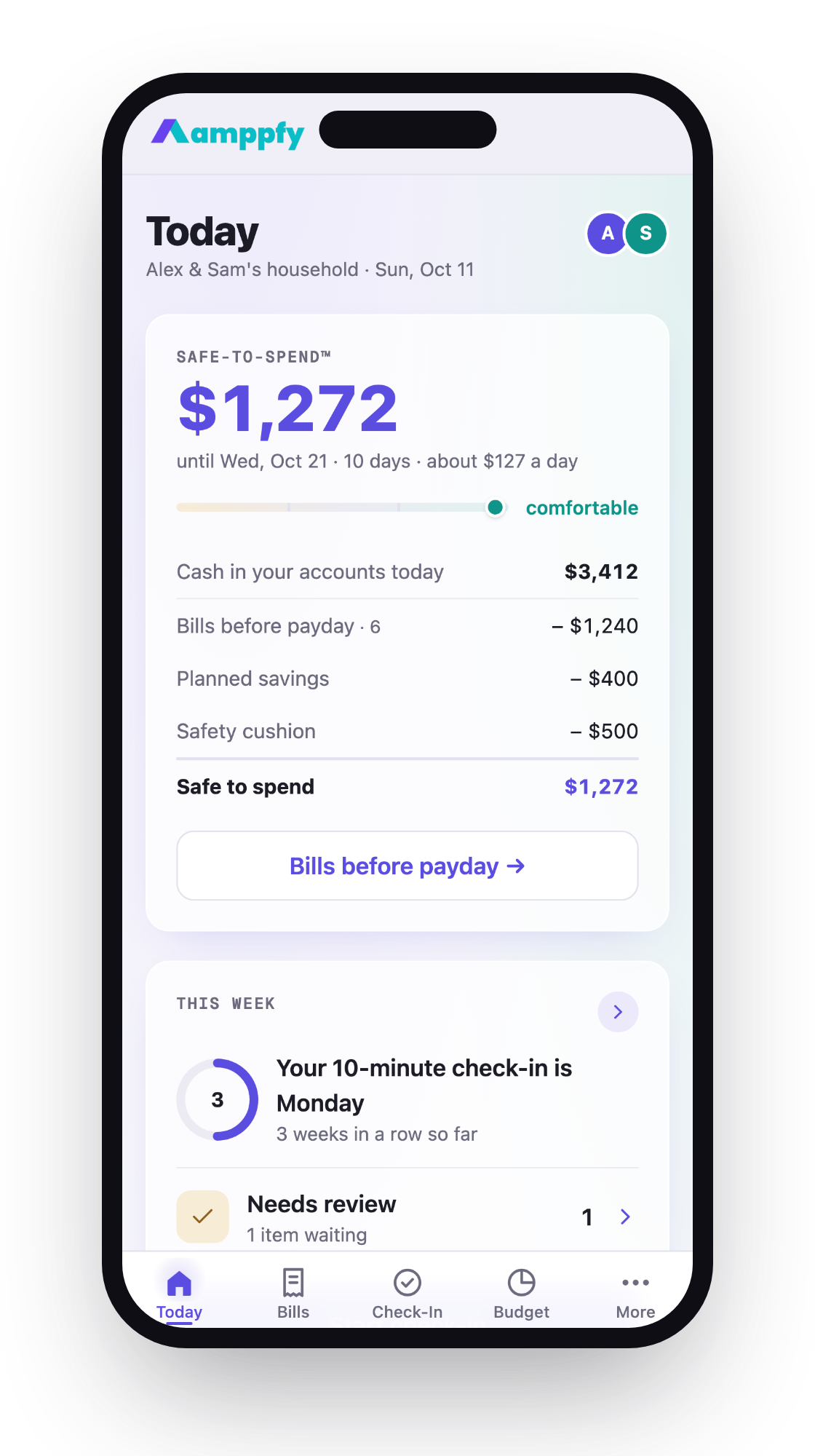
That’s $2,700 − $1,575 − $200 − $150 = $775. The banner shows $2,700. What you can actually spend over the next two weeks is $775. That’s your Safe-to-Spend™ number, and it doesn’t change based on which day the money arrived.
If early timing keeps throwing you off, opting out is a reasonable choice. Same pay, one predictable day.
FAQ
What time does Huntington direct deposit hit?
Huntington doesn’t publish a posting time, as of October 2026. Under NACHA rules effective September 18, 2026, standard ACH credits must be available by 9:00 a.m. local time on the settlement date. Early Pay may make qualifying deposits available up to two days sooner.
How long until Huntington Early Pay starts working?
Huntington says it may take up to 90 days to enroll you and identify qualifying deposits, as of October 2026. You’ll get an email alert once you’re enrolled.
Does Huntington charge for Early Pay?
No. Huntington describes Early Pay as automatic and free for personal checking customers with a qualifying recurring direct deposit, as of October 2026.
Can I turn off Early Pay?
Yes. You can opt out at a Huntington branch or by calling (800) 480-2265, as of October 2026.
Once your Huntington deposit lands, your balance still isn’t what’s safe to spend. Bills due before the next payday come out first, then planned savings, then a cushion you pick. Whatever’s left is yours, whether the money showed up Wednesday or Friday.
If you’d like that math done for you, Amppfy shows one Safe-to-Spend™ number with the four lines printed underneath. It’s free on iPhone and the web. You type in your balances yourself, and a 10-minute check-in each week keeps the number current. Take ten minutes before your next payday to set it up.