Close Menu

    Subscribe to Updates

    Get the latest creative news from FooBar about art, design and business.

    What's Hot

    How to Budget $6,000 a Month on Two Incomes

    October 6, 2026

    How to Budget $4,500 a Month: A Worked Example for a Small Household

    October 6, 2026

    How to Budget $3,000 a Month: A Worked Example

    October 6, 2026
    Facebook X (Twitter) Instagram
    Amppfy
    • AppNew
      • Amppfy on iPhone — one clear number with the math under itYour number, in your pocketFree on iPhone, with the same account on the web.
        • Download on the App Store
        • Prefer the web? Sign up free ›
      • The app
        • OverviewOne clear number for what’s safe to spend before payday
        • Safe-to-Spend™The four-line math, always shown
        • Weekly check-inTen minutes a week keeps it honest
      • Features
        • Bills & paydaysEvery bill and payday on one calendar
        • GoalsSavings that fund themselves first
        • For couplesTwo logins, one number you both trust
        • SubscriptionsWhat you pay monthly, and what cancelling gives back
        • Calendar & heads-upsYour month at a glance, a heads-up before bills land
        • Net worth & payday nudgeThe whole picture, month by month
        • BudgetWhere the month’s money goes, month by month
      • Trust & help
        • Security & privacyJust your balances, optional two-step verification
        • Help centerSetup, the number, check-ins, FAQ
        • Open the web appSame account, any browser
    • Personal Finance
      • Money Basics
        • How to Master Money Management
        • Psychology of Money Habits
        • How to Set Financial Goals
        • Money Management for Every Life Stage
        • Beyond Budgeting: Advanced Money Skills
        • Financial Literacy
        • Money Management
        • Know Your Money
        • Cash Flow
      • Financial Wellness
        • Understand Your Money Relationship
        • Build a Healthy Money Mindset
        • 7 Money Tips for Financial Freedom
        • Take the Money Health Quiz
        • Monthly Financial Reviews
        • Money Habits
        • Money Mindset
        • Financial Goals
        • Financial Independence
      • Side Hustles & Extra Income
        • 8 Realistic Side Hustles
        • How to Make Money Online
        • Passive Income Ideas That Work
        • Passive Income 101: Ideas That Scale
        • Spot a Bad Passive Income Deal
        • Start Freelance Writing: First $1,000
        • Budgeting with Irregular Income
        • Side Hustle Ideas
        • Passive Income
        • Gig Economy
      • Major Money Decisions
        • Plan a Major Purchase Without Debt
        • Car Buying: Save, Finance, or Lease?
        • Used Car Buying & Negotiation Tips
        • What to Save For vs. Finance
        • Life Insurance 101: Coverage Needs
        • Term vs. Whole Life Insurance
        • Buying a Car
        • Major Purchase Planning
        • Home Improvement
        • Life Insurance
      • Money Tools & Calculators
        • Net Worth Calculator
        • Cost of Living Calculator
        • Compound Interest Calculator
        • Monthly Budget Calculator
        • Savings Goal Calculator
        • Emergency Fund Calculator
        • Savings Calculator
        • Do Money Management Tools Work?
        • Spend Tracking
        • Net Worth
    • Savings
      • Budgeting Tips
        • The 50/30/20 Rule Explained
        • How to Make a Monthly Budget
        • How to Budget Money in 5 Steps
        • The Envelope Method Explained
        • Best Budgeting Apps Compared
        • Common Budgeting Mistakes
        • Budgeting for Couples
        • Start a Budget
        • Budget Methods
        • 50/30/20 Budgeting
      • Ways to Save
        • Save $500 This Month
        • 14 Ways to Cut Monthly Expenses
        • How to Save Money on Groceries
        • Lower Your Utility Bills
        • Budget Swaps for Big Purchases
        • Save Money on Car Insurance
        • Cut Expenses
        • Groceries Savings
        • Smart Saving Strategies
      • Emergency Fund
        • How Much Emergency Fund to Save
        • How to Build an Emergency Fund
        • Start a Rainy Day Fund
        • Sinking Funds vs. Emergency Fund
        • Emergency Fund Essentials
        • Where to Keep Your Emergency Fund
        • Best Emergency Fund Tips
        • Emergency Savings
        • Emergency Buffer
      • Savings Goals & Plans
        • How to Create a Savings Plan
        • How to Set Savings Goals
        • Track Spending Without Spreadsheets
        • 529 College Savings on a Budget
        • Saving During a Recession
        • Budget a Debt-Free Vacation
        • Vacation Budgeting
        • Family Budgeting
        • Savings Goals
        • Recession Saving
      • Savings Tools & Planning
        • Budget Calculator
        • Savings Goal Calculator
        • Emergency Fund Calculator
        • Savings Calculator
        • Compound Interest Calculator
        • Savings Buckets
        • Sinking Funds
        • Maximize Your Savings
        • Savings Tips
        • Savvy Saver
    • Debt
      • Get Out of Debt
        • Debt Snowball vs. Avalanche
        • Pay Off Credit Card Debt Fast
        • Beginner’s Credit Card Payoff Plan
        • Build a Debt Payoff Calendar
        • Use Windfalls to Crush Debt
        • Debt Free Journey
        • Debt Payoff
        • Credit Card Debt
      • Student & Auto Loans
        • Student Loans 101
        • Get Out of Student Loan Debt
        • Income-Driven Repayment Plans
        • Best Student Loan Repayment Option
        • Auto Loans: Shop & Save on Interest
        • Pay Off Your Auto Loan Early
        • Student Loans
        • Auto Loans
        • Auto Loan Debt
      • Debt Consolidation
        • Debt Consolidation Pros & Cons
        • Is Consolidating Debt Right for You?
        • Balance Transfers to Pay Off Debt
        • HELOC to Pay Off Credit Cards
        • 401(k) Rollover to Pay Down Debt
        • How to Refinance a Personal Loan
        • Before You Take a Personal Loan
        • Personal Loans
        • Personal Loan Refinance
      • Managing Debt
        • Navigating Medical Debt
        • Budgeting with a High-Interest Loan
        • Build a Debt-Repayment Fund
        • Debt Payoff for Single Parents
        • Save for a Wedding Without Debt
        • Medical Debt
        • Single Parent Debt
        • Personal Loan Debt
      • Debt Relief & Protection
        • When Bankruptcy Is an Option
        • Avoid Predatory Lenders & Scams
        • Negotiate with Creditors: Scripts
        • Budgeting Around Wage Garnishment
        • Debt Relief
        • Bankruptcy
        • Creditor Negotiation
        • Predatory Lenders
        • Wage Garnishment
    • Credit
      • Credit Scores
        • Credit Score 101
        • Check & Improve Your Credit Score
        • Credit Utilization: A Simple Fix
        • Check Your Credit Score Free
        • Rebuild Credit After a Setback
        • How Credit Scores Are Calculated
        • What Credit Scores Mean
        • Credit Health
      • Credit Reports
        • Read & Dispute Your Credit Report
        • Dispute Template That Works
        • How Long Negative Marks Last
        • Remove Negative Items
        • What to Expect as Items Age Off
        • Understanding Credit Utilization
        • Credit Basics
        • Checking Your Credit Score
      • Building Credit
        • Best Starter Credit Cards
        • Secured vs. Unsecured Cards
        • Secured Cards & Credit-Builder Loans
        • Build Credit as a Gig Worker
        • Boost Your Score Before a Mortgage
        • Borrow Now vs. Wait
        • Build Credit
        • Credit Cards for Beginners
        • Credit for Gig Workers
      • Credit Cards
        • Best Rewards Credit Cards
        • Credit Card Hacks: Intro APRs
        • Balance Transfers Explained
        • Earn Rewards Without Debt
        • Responsible Card Use & Rewards Tips
        • Lost or Stolen Card: What to Do
        • Credit Card Rewards
        • Balance Transfer Cards
      • Credit Protection & Safety
        • Identity Theft Checklist
        • Truth About Credit Freezes
        • How to Freeze & Thaw Your Credit
        • Credit Monitoring vs. Freezes
        • Credit Protection
        • Credit Freeze
        • Fraud Awareness
        • Financial Safety
    • Investing
      • Start Investing
        • Investing 101: Beginner’s Guide
        • Start Investing with $100
        • Start with $50/Month
        • Scared of the Market? Start Here
        • Open a Brokerage Account
        • Invest While Paying Down Debt
        • How to Start Investing
        • Start with Little Money
        • Fear of Investing
      • Investing Strategy
        • Roth IRA vs. Traditional IRA
        • Dollar-Cost Averaging Explained
        • DCA vs. Lump-Sum Investing
        • 5 Simple Starter Portfolios
        • Asset Allocation Beyond 60/40
        • How to Rebalance Your Portfolio
        • Diversify Your Portfolio
        • Investing Mistakes to Avoid
        • Investment Strategies
        • Diversification
      • Stocks
        • How the Stock Market Works
        • How to Make Money in Stocks
        • How to Read Stock Charts
        • Analyze Stocks in 5 Steps
        • P/E Ratio for Beginners
        • Bullish vs. Bearish Explained
        • How Stock Trading Works
        • Stock Market Basics
        • Stock Analysis
        • Stock Trading Strategies
      • Funds & Wealth Building
        • Beginner’s Guide to Index Funds
        • Best S&P 500 Index Funds
        • Mutual Funds vs. ETFs
        • How to Invest in ETFs
        • Dividend Investing for Beginners
        • Build a Dividend Income Stream
        • Maximize Your 401(k) Match
        • Build a Retirement Portfolio
        • Index Funds
        • Dividend Investing
      • Brokerages & Platforms
        • Vanguard vs. Fidelity
        • Fidelity vs. Schwab
        • Robinhood vs. E*Trade
        • Robo-Advisors vs. Human Advisors
        • Robo-Advisor or DIY Investing?
        • How Brokerage Fees Affect Returns
        • Manage Multiple Brokerage Accounts
        • Brokerages
        • Investment Platforms
        • Robo Advisors
    • Home
      • Home Buying
        • First-Time Homebuyer Checklist
        • How Much Down Payment You Need
        • How Much Home Can You Afford?
        • Renting vs. Buying
        • True Costs of Homeownership
        • Qualify as a First-Time Buyer
        • Buying a Fixer-Upper
        • First-Time Home Buyer
        • Home Affordability
      • Mortgage
        • First-Time Buyer’s Mortgage Guide
        • Fixed vs. Adjustable Mortgage
        • How to Refinance a Mortgage
        • Mortgage Payoff Strategies
        • Winning in a High-Rate Market
        • Mortgage Amortization Calculator
        • Down Payment Assistance Programs
        • Mastering Refinance Rate Locks
        • Mortgage Rates
        • Mortgage Refinance
        • Debt-to-Income Calculator
      • Real Estate Investing
        • Real Estate Crowdfunding Platforms
        • Rental Property Cash Flow
        • REITs for Passive Income
        • REITs vs. Direct Ownership
        • Fix-and-Flip Opportunities
        • Airbnb & Short-Term Rental ROI
        • Buying a Multi-Family Property
        • 1031 Exchange to Defer Taxes
        • Real Estate Investing
        • Rental Property
      • Home Insurance
        • Homeowners Insurance Guide
        • Compare Home Insurance Quotes
        • Best Home Insurance Companies
        • Choose Your Deductible
        • Renters vs. Homeowners Insurance
        • File a Property Insurance Claim
        • Home Insurance Coverage Basics
        • Home Insurance Rates
        • Home Insurance Claims
      • Home Equity & Ownership
        • Smart Ways to Use Home Equity
        • Save for a Down Payment
        • Down Payment Strategies
        • Estimate Property Appreciation
        • Home Equity
        • HELOC Payoff Strategy
        • Home Down Payment
        • Home Ownership
        • Home Renovation
    • Bank
      • Banking Basics
        • Open Your First Bank Account
        • Online Banks vs. Traditional Banks
        • How to Avoid Bank Fees
        • How to Switch Banks
        • Read Your Bank Statement
        • Second-Chance Checking Accounts
        • Get Better Rates from Your Bank
        • Banking Basics
        • How to Choose a Bank
        • Compare Banks
      • Checking Accounts
        • Best Checking Accounts
        • Choose the Right Checking Account
        • Overdraft Protection Guide
        • Stop Paying Overdraft Fees
        • The True Cost of Checking Fees
        • Mobile Check Deposits
        • How Long Checks Take to Clear
        • Checking Accounts
        • Best Checking Account
      • Savings Accounts & CDs
        • High-Yield Savings Explained
        • Best High-Yield Savings Account
        • Savings Accounts vs. CDs
        • What Is a CD?
        • Money Market vs. Savings Account
        • HYSA vs. Treasury Bills
        • How Savings Interest Is Calculated
        • Savings Account Minimum Balances
        • Savings Account
      • Bank Smarter
        • Top Banks for High-APY Savings
        • How Much Cash in Each Account
        • How Many Savings Accounts to Have
        • Managing Multiple Bank Accounts
        • Where to Put Your Money
        • When to Save vs. When to Invest
        • Savings Account Fees to Avoid
        • Banking Tips
        • Digital Banking
      • Banking Safety & Security
        • Set Up Bank Account Alerts
        • Avoid Check Scams
        • Missing Debit Card: Next Steps
        • When to Stop a Check Payment
        • Bank Fees
        • Debit Cards
        • Joint Bank Accounts
        • Banking How-To Guides
    • Tax
      • Tax Filing
        • Tax Filing for Beginners
        • How to File Freelance Taxes
        • Choose the Right Tax Software
        • Change Withholding Mid-Year
        • Handling Back Taxes
        • Year-End Tax Checklist
        • How to File Taxes
        • Tax Filing Basics
        • Tax Tips
      • Deductions & Credits
        • Tax Deductions 101
        • Tax Credits vs. Deductions
        • Child Tax Credit Explained
        • Child & Dependent Care Credit
        • Claim the Saver’s Credit
        • Moving Expense Deductions
        • Tax Deductions
        • Tax Credits
        • Child Tax Credits
      • Tax Strategy
        • Avoid Audit-Triggering Mistakes
        • Capital Gains Taxes Explained
        • IRA Tax Rules
        • Tax Basics for New Investors
        • Minimize Taxes for Your Heirs
        • Capital Gains Taxes
        • Retirement Taxes
        • Adjusted Gross Income
      • Tax Savings
        • Use an HSA to Lower Your Tax Bill
        • HSA: The Triple Tax Advantage
        • 529 Plans for Education Savings
        • Max the Match, Then What?
        • Tax Savings
        • Tax Refunds
        • Tax Bill
        • HSA
      • Gig & Life Situation Taxes
        • Freelancer & Gig Worker Taxes
        • Side-Gig Income & Your Taxes
        • Tax Strategies for Side Hustles
        • Taxes for Life Situations
        • Freelance Taxes
        • Gig Work Taxes
        • Child Tax
        • Dependent Care Credit
    • Sign In
    • Sign Up
    Amppfy
    Home » Budgeting and Saving » Utilities in a Household Budget: Planning Bills That Change With the Season
    Budgeting and Saving

    Utilities in a Household Budget: Planning Bills That Change With the Season

    Average your utility bills across twelve months so July's electric bill doesn't wreck a single pay period.
    Thomas T.By Thomas T.October 6, 2026Updated:October 6, 20269 Mins Read
    Facebook Twitter LinkedIn Email Copy Link
    Utilities in a Household Budget: Planning Bills That Change With the Season
    Share
    Facebook Twitter LinkedIn Email Copy Link

    Your electricity bill in January looks nothing like your electricity bill in July. That gap can throw off your spending plan for weeks. A solid utilities budget accounts for these swings before they happen, so you’re never scrambling to cover a bill you didn’t expect. The trick isn’t predicting the weather. It’s building a plan that absorbs the highs and lows across twelve months, keeping your cash flow steady from paycheck to paycheck. Below, you’ll find a practical way to map every utility, understand why costs shift, and fold those shifting numbers into a household budget that actually holds up.

    Which utilities to count

    Most people think of electricity and gas first. That’s a good start, but it’s not the full picture. Your utilities budget should include every recurring service tied to keeping your home running.

    Here’s a working list:

    Amppfy app icon

    Amppfy

    Free on iPhone and the web

    Know what’s safe to spend before payday

    Your balances, bills, and payday. Ten minutes to one clear number, with the math shown under it. Learn more ›

    Download on the App Store

    Prefer the web? Sign up free ›

    Free  ·  No credit card  ·  Just your balances

    Amppfy dashboard on an iPhone showing the Safe-to-Spend™ number with the math under it
    • Electricity: Lighting, appliances, AC, heat pumps
    • Natural gas or propane: Furnace, stove, water heater
    • Water and sewer: Municipal or well pump electricity
    • Trash and recycling: Often billed monthly or quarterly
    • Internet: A fixed cost, but still a utility
    • Phone service: Landline or mobile, if you treat it as a household expense

    Some households also pay for storm water fees, HOA-bundled services, or solar lease payments. If it shows up on a regular bill and keeps your home functional, count it.

    A quick way to build your list: pull the last three months of bank or credit card statements. Search for the word “utility” or the name of your local providers. You’ll catch anything you forgot.

    Utility Seasonal? Typical billing
    Electricity Yes Monthly
    Natural gas Yes Monthly
    Water/sewer Mildly Monthly or bimonthly
    Trash No Monthly or quarterly
    Internet No Monthly
    Phone No Monthly

    Fixed-cost utilities like internet and trash are easy. Plug them in once. The seasonal ones need more thought, which is exactly where the next section picks up.

    Why the amounts move

    Electricity and gas bills shift because your home works harder in extreme temperatures. That’s the short answer. The longer answer involves three overlapping forces.

    Weather-driven demand

    Air conditioning in summer and heating in winter are the two biggest energy draws. One Maryland study found a nearly 41% drop in electricity usage[1] between August and October, when homes stopped running AC but hadn’t yet cranked up the heat. That shoulder season is the cheapest stretch of the year for most households.

    Rate changes and surcharges

    Utility companies adjust rates throughout the year. Summer peak-demand surcharges are common. Some providers also pass along fuel-cost adjustments quarterly. Your per-kilowatt-hour price in August might be higher than your price in April, even if you used the same amount of power.

    Hidden winter costs

    Water heaters work harder in cold months because the source water entering your home from underground pipes drops in temperature. Your heater has to close a bigger gap between the cold inlet and your target temperature. That extra effort shows up on your gas or electric bill, but it’s easy to overlook because you didn’t change your behavior.

    These three forces combine to create peaks and valleys. The goal isn’t to eliminate them. It’s to plan for them so your spending stays predictable between paychecks.

    Averaging a year of bills

    The simplest way to flatten seasonal swings is to calculate your twelve-month average for each variable utility. Here’s how.

    1. Gather twelve months of statements for electricity and gas. Your provider’s online portal usually has a usage history chart.
    2. Add up the twelve totals for each utility.
    3. Divide by twelve. That’s your monthly average.

    Suppose your electricity bills over the past year totaled $2,160. Your monthly average is $180. Some months you’ll pay $130, others $240, but $180 is the number you plan around.

    If you don’t have a full year of history (maybe you moved recently), use the highest bill you’ve received and multiply it by 0.75. That gives you a rough average that leans slightly conservative.

    A worked example

    Month Electric Gas
    Jan $155 $120
    Feb $148 $115
    Mar $130 $90
    Apr $110 $60
    May $120 $40
    Jun $180 $30
    Jul $230 $28
    Aug $240 $28
    Sep $185 $30
    Oct $130 $55
    Nov $140 $95
    Dec $152 $110
    Total $1,920 $801
    Monthly avg $160 $67

    Using these averages, you’d budget $227 per month for electricity and gas combined. In cheap months, the surplus sits in your checking account. In expensive months, it absorbs the spike.

    Average U.S. household electricity costs for the summer 2026 cooling season are projected at $792[2], a 10.5% jump from last year. If your summer bills are climbing, update your average with the most recent twelve months rather than relying on older data.

    Budget billing vs. a seasonal cushion

    You have two main strategies for handling seasonal variation. Each has trade-offs.

    Budget billing through your provider

    Most electric and gas companies offer a budget billing or levelized payment plan. They calculate your twelve-month average and charge you that flat amount every month. Once or twice a year, they true up: if you used more than projected, you owe the difference; if less, you get a credit.

    Pros:

    • Predictable monthly amount
    • No math on your end

    Cons:

    • True-up bills can surprise you
    • You lose visibility into actual usage trends
    • Some plans charge a small fee

    A seasonal cushion you control

    The alternative is to budget your own average and hold a small buffer for peak months. Set aside your calculated monthly average into a “utilities” line in your spending plan. In low-cost months, the unspent portion builds a cushion. In high-cost months, you draw it down.

    This approach keeps you aware of what you’re actually using. You spot a broken HVAC system or a rate hike faster because you’re watching real numbers.

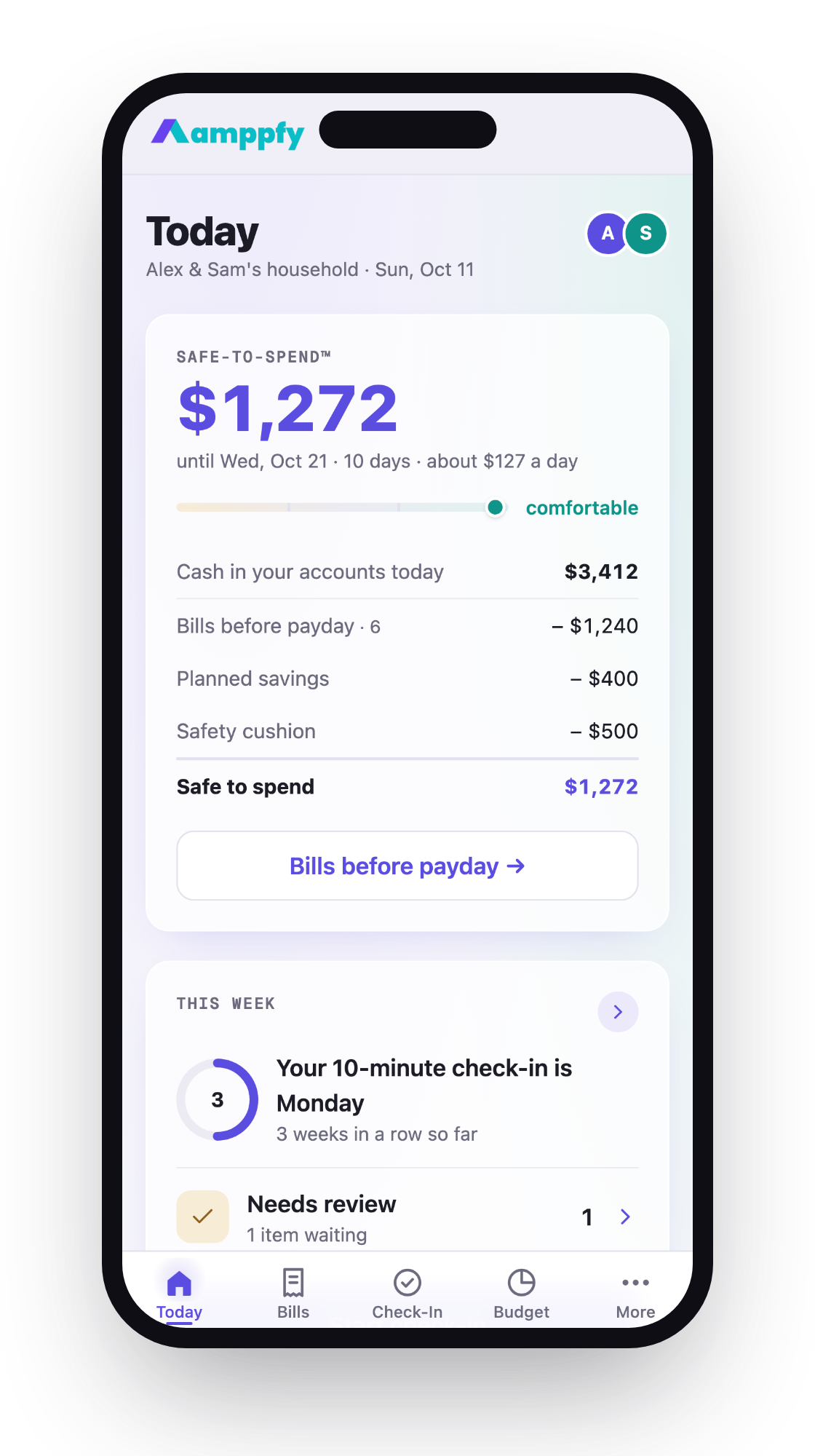
    If you use Amppfy, your Budget page already breaks the month into Bills, Savings, Subscriptions, and Everyday spending. Plug your averaged utility figure into the Bills slice. When a peak month hits, the math adjusts your Safe-to-Spend™ number automatically: $3,412 cash – $1,240 bills – $400 savings – $500 cushion = $1,272. You see the impact before it lands.

    Either strategy works. The worst option is no strategy: just hoping each bill fits.

    Grouping utilities so the month makes sense

    Scattering utility due dates across the month creates confusion. Grouping them gives you a cleaner picture of what’s left after bills.

    Align due dates where possible

    Call your providers and ask to move your due date. Most will shift it for free. Try to cluster utility bills in the first week after your main payday. That way, the money leaves your account early, and everything remaining is available for other spending.

    If you’re paid biweekly, pick the paycheck that’s closest to the start of the month. Assign utilities there.

    Combine with other fixed costs

    Utilities are just one slice of your fixed monthly costs. Group them mentally (or in your app) with rent or mortgage, insurance, and any loan payments. This “fixed cost block” is the first thing that gets funded each pay cycle. What’s left is what you actually have for groceries, gas, and everything else.

    A simple grouping might look like this:

    • Paycheck 1 (1st of the month): Rent, electricity, gas, water, internet
    • Paycheck 2 (15th of the month): Car payment, insurance, phone, subscriptions

    Watch for quarterly and bimonthly bills

    Water and trash are sometimes billed every two or three months. Don’t let a $180 quarterly water bill catch you off guard. Divide it by three and set aside $60 each month. When the bill arrives, the money is already waiting.

    State-level costs vary widely. Hawaii households pay an average monthly electric bill of $237.60[3], while Utah households pay about $101.55. Your grouping strategy should reflect your actual numbers, not national averages.

    Frequently Asked Questions

    How often should I update my utilities budget?
    Revisit your averages every six months or after any major change: a rate increase notice, a new appliance, adding a household member, or moving. Pull your latest twelve months of bills, recalculate the average, and adjust your plan. A ten-minute check twice a year keeps your numbers honest.

    Should I include streaming services and subscriptions as utilities?
    Streaming services aren’t utilities in the traditional sense, but they behave like them: fixed, recurring, and easy to forget. Keep them in a separate “Subscriptions” category so they don’t inflate your utility average. Tracking them separately also makes it easier to cancel one when you realize you haven’t opened it in months.

    What if my partner and I split utility costs?
    Decide on a split method (50/50, proportional to income, or one person covers utilities while the other covers groceries) and lock it in. The key is that both people see the same plan. Amppfy lets partners share one Safe-to-Spend™ number while keeping individual balances private, which removes the “did you pay the electric bill?” conversation.

    Is budget billing worth it if I’m already tracking my own averages?
    Usually not. Budget billing is most helpful for people who don’t want to think about utilities at all. If you’re already averaging your bills and holding a cushion, you have more control and better visibility into your actual usage. Skip the provider’s plan and keep managing it yourself.

    Plan for the Swing, Not Just the Bill

    Utility costs aren’t unpredictable. They follow the same pattern every year: up in summer, up in winter, down in the shoulder months. The only real question is whether your spending plan accounts for that rhythm.

    Start with your list of every utility. Pull twelve months of history. Calculate your averages. Decide whether you want your provider to flatten the bill or you’d rather hold your own cushion. Then group your due dates so they land right after payday.

    If you want one number that tells you what’s safe to spend after every bill, savings goal, and cushion is accounted for, get Amppfy free. Enter your balances, bills, and payday once (about ten minutes), and your Safe-to-Spend™ number stays current from paycheck to paycheck.


    1. pureskyenergy.com

    2. neada.org

    3. saveonenergy.com

    Amppfy app icon

    Amppfy

    Free on iPhone and the web

    Know what’s safe to spend before payday

    Your balances, bills, and payday. Ten minutes to one clear number, with the math shown under it. Learn more ›

    Download on the App Store

    Prefer the web? Sign up free ›

    Free  ·  No credit card  ·  Just your balances

    Amppfy dashboard on an iPhone showing the Safe-to-Spend™ number with the math under it
    Budget Methods Budgeting Basics Cash Flow Cut Expenses Monthly Budget Sinking Funds
    Share. Facebook Twitter LinkedIn Email Copy Link
    Previous ArticleHow Much Should You Spend on Rent? The 30% Guideline and When It Breaks
    Next Article Transportation Budget: Car Payment, Insurance, Gas, and Repairs in One Number
    Thomas T.

    Thomas is a Personal Finance Writer and Financial Content Strategist with over 10 years of experience helping individuals make smarter financial decisions. He specializes in topics such as budgeting, debt management, saving strategies, and financial behavior, translating complex financial concepts into clear, actionable guidance. His work focuses on empowering readers to build sustainable financial habits and confidently navigate their financial lives, combining data-driven insights with practical, real-world advice.

    More Like This

    How to Budget $6,000 a Month on Two Incomes

    By Thomas T.October 6, 2026

    How to Budget $4,500 a Month: A Worked Example for a Small Household

    By Thomas T.October 6, 2026

    How to Budget $3,000 a Month: A Worked Example

    By Thomas T.October 6, 2026
    Amppfy app icon

    Amppfy

    Free on iPhone and the web

    Know what’s safe to spend before payday

    Your balances, bills, and payday. Ten minutes to one clear number.

    Download on the App Store

    Prefer the web? Sign up free ›

    Amppfy dashboard on an iPhone showing the Safe to Spend number with the math under it
    Helpful Resources

    How to Budget $6,000 a Month on Two Incomes

    October 6, 2026

    How to Budget $4,500 a Month: A Worked Example for a Small Household

    October 6, 2026

    How to Budget $3,000 a Month: A Worked Example

    October 6, 2026

    Budgeting Without Tracking Every Purchase

    October 6, 2026

    Financial Clarity. Everyday Confidence.

    Facebook X (Twitter) YouTube LinkedIn
    Calculators

    Emergency Fund Calculator

    Compound Interest Calculator

    Interest Rate Calculator

    Net Worth Calculator

    Mortgage Calculator

    How Much Home Can I Afford

    Debt-to-Income Ratio Calculator

    Cost of Living Calculator

    Savings Calculator

    Savings Goal Calculator

    Monthly Budget Calculator

    Latest Resources

    How to Budget $6,000 a Month on Two Incomes

    October 6, 2026

    How to Budget $4,500 a Month: A Worked Example for a Small Household

    October 6, 2026

    How to Budget $3,000 a Month: A Worked Example

    October 6, 2026

    Budgeting Without Tracking Every Purchase

    October 6, 2026
    About & Legal

    About Amppfy

    Documentation

    Editorial Policy

    EULA

    Terms of Use

    Acceptable Use Policy

    Privacy Policy

    Cookie Policy

    Disclaimer

    Do Not Sell or Share My Personal Information

    Acceptable Use Policy

    Disclaimer: Amppfy is committed to keeping its information transparent, accurate, and up-to-date. The information on Amppfy is provided for educational and informational purposes only and should NOT be considered financial, investment, tax, or legal advice. You should consult a qualified financial professional before making any financial decisions. This information may differ from what you find on the specific product or service provider’s website. All information, content, software, tools, products, or services on Amppfy are presented without warranty or guarantee. Please review the specific provider’s terms and conditions when evaluating products or services. By accessing Amppfy or using our AI generator tools, you acknowledge that you have read, understood, and agreed to our EULA, Terms of Use, Acceptable Use Policy, Privacy Policy, Cookie Policy, and Disclaimer. Amppfy.com uses cookies. For more information, visit Amppfy’s Cookie Policy. Amppfy may be compensated through third-party advertisers and affiliates. For more information, visit Amppfy’s Disclaimer.

    Copyright© 2026 Amppfy | All Rights Reserved

    Type above and press Enter to search. Press Esc to cancel.

    Advertiser Disclosure: Products may include affiliate links related to financial products or services. We may earn a commission at no additional cost to you. Our content remains independent and focused on helping you make informed financial decisions.
    Fact Checked
    Financial Disclaimer

    This content is for informational and educational purposes only and should not be considered financial advice. Personal finance decisions—including budgeting, saving, investing, credit, mortgages, taxes, and debt management—depend on your individual circumstances. Always consult a qualified financial professional before making financial decisions.

    Editorial Standards and Content Integrity

    Our editorial process ensures accuracy, clarity, and trust across all personal finance topics, including budgeting, saving, investing, and debt management. Content is created using credible sources such as government agencies, academic research, and established financial institutions, and may incorporate insights from industry experts when relevant. Each article is reviewed for accuracy, timeliness, and relevance before publication and updated as needed to reflect changes in financial guidelines and best practices, with the goal of providing clear, evidence-based information to help readers make informed financial decisions.

    Learn more about our editorial policy and guideline.
    Amppfy app icon

    Amppfy

    Free on iPhone and the web

    Know what’s safe to spend before payday

    Download the app and enter your balances, bills, and payday. About ten minutes to one clear number: what’s safe to spend before payday.Your balances, bills, and payday. Ten minutes to one clear number. Learn more ›

    Download on the App Store
    Scan with your iPhone to get the app

    Free  ·  No credit card  ·  Just your balances

    Prefer the web? Sign up free ›