Most people budget forward: earn money, pay bills, hope there’s something left. But there’s a quieter approach that flips the whole cycle. You spend this month using money you earned last month. Your current paycheck sits untouched until next month. That one-month income buffer removes the constant mental math of “will this clear before that hits?” It’s not a new idea, but it’s one that changes how your money feels on a Tuesday afternoon.
What It Means to Spend Last Month’s Pay
Living on last month’s income means every dollar you spend in June was earned in May. Your June paychecks? They sit until July. You’re always one full month ahead of your spending.
This is different from an emergency fund. An emergency fund covers the unexpected: a broken furnace, a job loss, a medical bill. A one-month buffer covers the expected. Rent, groceries, gas, subscriptions: all the normal stuff you already know is coming.
Here’s how the math looks in practice. Say you bring home $5,200 per month after taxes. You enter July with $5,200 already sitting in your checking account from June’s paychecks. Your July paychecks land, and you don’t touch them. They become August’s spending money.
| Month | You’re spending | You’re earning (untouched) |
|---|---|---|
| July | June’s income ($5,200) | July’s paychecks |
| August | July’s income | August’s paychecks |
| September | August’s income | September’s paychecks |
The pattern repeats indefinitely. You’re never spending money you haven’t fully received yet. Current financial planning standards suggest building a one-month buffer of bare-bones expenses[1] as a priority even before tackling high-interest debt. That’s how foundational this step is.
Think of it like a conveyor belt. Last month’s earnings roll forward. This month’s earnings load onto the belt behind them. Nothing gets grabbed early.
Why It Removes Payday Timing Stress
The real benefit isn’t financial. It’s mental. When you’re living on a buffer of last month’s income, payday stops being an event. It becomes a quiet deposit you’ll use later.
Without a buffer, your week looks something like this:
- Monday: Check bank balance.
- Tuesday: Car insurance auto-pays. Wince.
- Wednesday: Grocery run. Mental math about what’s left.
- Thursday: Partner asks about dinner out. You check the app again.
- Friday: Payday. Exhale.
That cycle is exhausting. It’s not about being bad with money. It’s about timing. Bills don’t care when you get paid. Your electric company doesn’t sync with your pay schedule. Neither does your kid’s daycare.
A one-month buffer eliminates that mismatch. The money for every bill this month is already there on the first. You’re not juggling due dates against deposit dates. You’re not moving $200 from savings on the 14th because rent cleared on the 12th but payday isn’t until the 15th.
Americans paid $17 billion in credit card late fees during 2024[2]. A big chunk of those weren’t from people who couldn’t afford their bills. They were from people whose cash arrived two days too late. A buffer makes “too late” almost impossible.
For couples, the relief doubles. Two pay schedules, two sets of bills, two people checking the same balance: that’s a recipe for friction. When the money’s already there, the conversation shifts from “can we afford this right now?” to “does this fit our plan this month?”
Building the Buffer a Little Each Paycheck
You don’t need to save an entire month’s income overnight. That’s unrealistic for most households. The goal is to build it gradually, paycheck by paycheck.
Pick Your Target Number
Start with your bare-bones monthly expenses. Not your full income: just what you actually need to cover in a month. Add up rent or mortgage, utilities, groceries, transportation, insurance, minimum debt payments, and childcare. For many households, that number lands between $3,000 and $5,000.
Choose a Per-Paycheck Amount
Divide your target by the number of paychecks you’ll receive over your timeline. If you want a $4,000 buffer in 10 months and you’re paid biweekly (roughly 22 paychecks in 10 months), that’s about $182 per paycheck.
| Buffer target | Timeline | Pay frequency | Amount per check |
|---|---|---|---|
| $3,000 | 8 months | Biweekly (17 checks) | ~$176 |
| $4,000 | 10 months | Biweekly (22 checks) | ~$182 |
| $5,000 | 12 months | Semi-monthly (24 checks) | ~$208 |
Automate the Transfer
Set up an automatic transfer on payday. The money moves before you see it in your spending balance. Treat it like a bill you owe yourself. If your employer allows split direct deposit, send the buffer amount to a separate account automatically.
A few ways to speed this up:
- Put your next tax refund directly into the buffer account.
- Redirect a subscription you cancel.
- Add any side income or bonus pay to the buffer instead of spending it.
The key is consistency, not speed. Missing a contribution one paycheck doesn’t reset anything. You just pick it back up next time.
Amppfy’s payday nudge can help here. It prompts you to fund goals first when a paycheck lands, so the buffer contribution happens before you start spending.
Keeping It Separate from Emergency Savings
This is where people get confused. A buffer and an emergency fund serve different purposes. Mixing them defeats the point of both.
What Each One Does
Your emergency fund handles surprises: a layoff, a hospital visit, a major car repair. You hope you never touch it. Your income buffer handles the ordinary. It’s the money you spend every single month on things you already expect.
| Income buffer | Emergency fund | |
|---|---|---|
| Purpose | Cover normal monthly expenses | Cover unexpected events |
| How often used | Every month | Rarely |
| Ideal size | One month of bare-bones expenses | Three to six months of expenses |
| Where to keep it | Checking or linked savings | Separate savings account |
| Replenishment | Automatic, every pay cycle | After each use |
Why Separation Matters
If your buffer and emergency fund live in the same account, you’ll never know which dollars are doing which job. A $6,000 balance might look healthy. But if $4,000 of that is your buffer for next month’s bills, you really only have $2,000 for emergencies. That’s a different picture.
Keep your buffer in your primary checking account or a savings account linked for instant transfer. Keep your emergency fund somewhere slightly less accessible: a high-yield savings account works well. The small friction of transferring emergency money helps you pause before spending it on something that isn’t actually an emergency.
Some people worry they’re “hoarding” cash by having both. You’re not. You’re separating functions. A spare tire and gas in the tank both keep your car moving, but they solve completely different problems.
If you’re building both from scratch, the recommended sequence is a $1,000 starter emergency fund first, then the one-month buffer, then expanding the emergency fund to three to six months.
What Changes Once You Get There
The first month you spend entirely on last month’s earnings feels oddly anticlimactic. Nothing dramatic happens. That’s the point.
What you’ll notice:
- Bill due dates stop mattering. Your electric bill is due the 7th, your car payment the 22nd, your rent the 1st. Doesn’t matter. The money’s there.
- You stop checking your bank balance out of anxiety. You might still check it, but it’s a glance, not a stress response.
- Irregular paychecks smooth out. If you get paid biweekly and occasionally land three paychecks in a month, that third check just rolls forward calmly.
- Conversations with your partner shift. “Can we afford it?” becomes “Do we want to spend on this?” That’s a fundamentally different question.
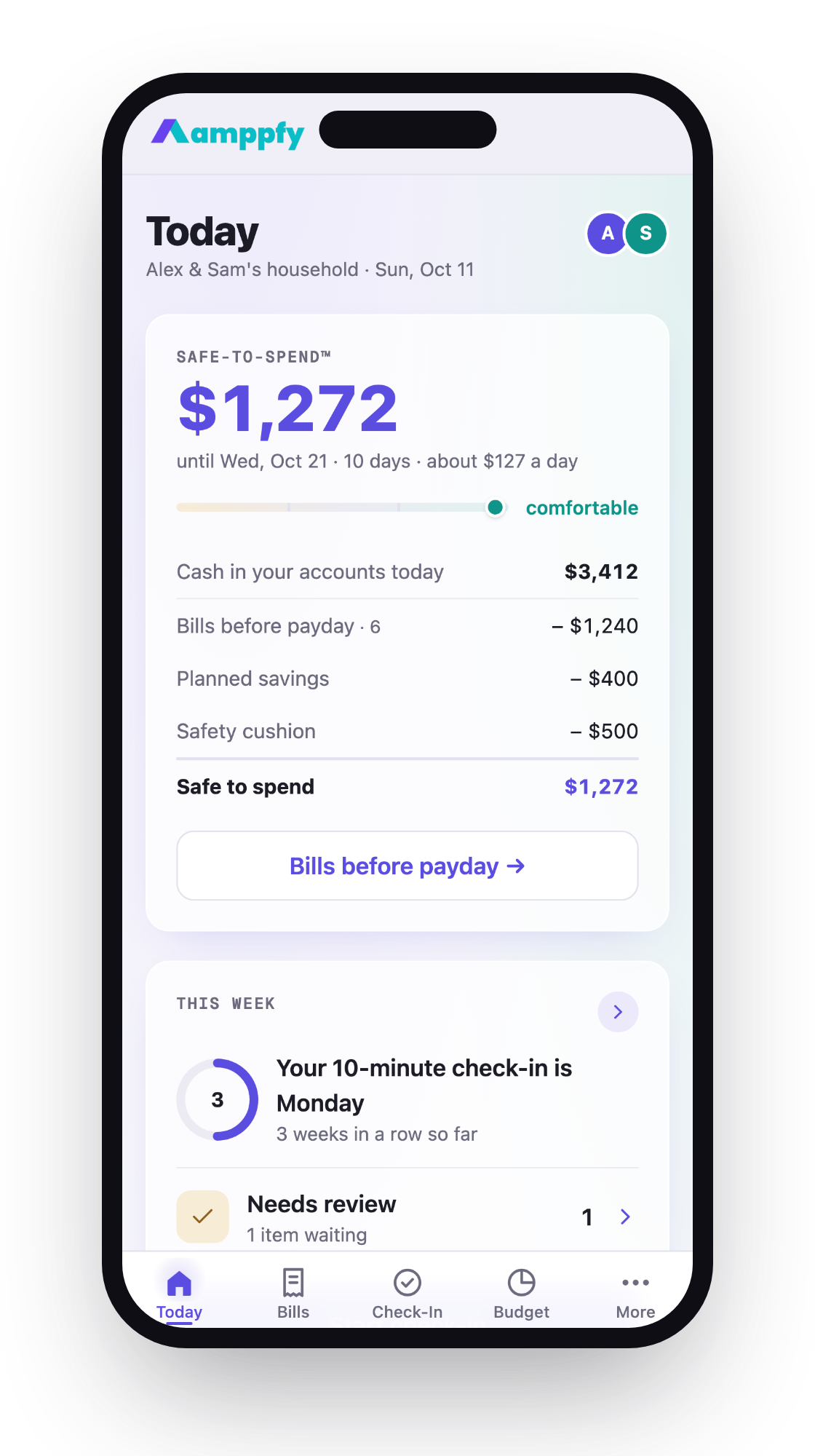
The psychological shift is real. You move from reactive to intentional. Your Safe-to-Spend™ number in Amppfy reflects this too: $4,100 cash minus $1,800 bills minus $300 savings minus $400 cushion = $1,600. That number stays stable all month because the underlying cash doesn’t fluctuate with payday timing.
One thing to watch: don’t let the buffer become a permission slip to inflate your spending. The comfort of having money already there can make $50 purchases feel trivial. They add up. Your buffer exists to remove timing stress, not to expand your lifestyle.
The average FICO score dipped to 714 in 2026[3], partly because more people are carrying balances and missing payment windows. A buffer protects your credit score by making on-time payments automatic rather than aspirational.
Frequently Asked Questions
How much money do I need to start a last-month’s-income buffer?
You don’t need the full amount upfront. Start with whatever you can set aside per paycheck: even $50. Your target is one month of bare-bones expenses, not one month of gross income. For a household spending $4,000 on essentials, that’s your number. Build toward it over 6 to 12 months.
Can I use my buffer if something unexpected comes up?
That’s what your emergency fund is for. If you dip into your buffer for an emergency, you’re back to living paycheck to paycheck until you rebuild it. Protect the buffer by keeping a separate emergency fund, even a small one.
Does this work if I have irregular income?
It works even better. Freelancers and commission earners benefit the most because their income timing is unpredictable. Build the buffer during a strong month, then spend from it the following month regardless of what you earn. It turns variable income into a steady spending pattern.
What if my partner and I have different pay schedules?
That’s exactly the scenario a buffer solves. Instead of coordinating two deposit dates against shared bills, you both contribute to next month’s pool. Amppfy lets partners see the same Safe-to-Spend number while keeping individual balances private, so neither person has to ask “did your check clear yet?”
Your Next Step
A one-month income buffer isn’t flashy. Nobody posts about it on social media. But it quietly solves the most common money problem: not a shortage of dollars, but a shortage of dollars at the right time. Start with your next paycheck. Set aside what you can, even if it’s small. Automate the transfer so you don’t have to decide each time. In a few months, you’ll open your bank app on a random Wednesday and realize you haven’t thought about payday in weeks. That’s the whole point. Take 15 minutes this week to calculate your bare-bones monthly expenses and set up your first automatic transfer. Future-you will barely remember what payday stress felt like.