Most budgeting advice starts with the same instruction: break your spending into categories. Groceries. Gas. Subscriptions. Dining out. Pet supplies. Coffee. The list grows until you’re managing a spreadsheet with thirty lines, and you quit by week three. The truth is, there are budget categories you can skip entirely, and doing so won’t wreck your finances. It’ll probably save them. The real question isn’t how many categories you need. It’s which few actually change your behavior. If you’ve ever abandoned a budgeting app because it felt like a second job, this is your reset.
Why thirty categories make budgets fail
A budget with thirty line items has the same problem as a diet that tracks every micronutrient: it collapses under its own weight. You open the app, see a wall of categories, and close it again. That’s not a willpower issue. It’s a design problem.
The failure pattern looks the same for most people. You start strong, logging every purchase for a week or two. Then a charge doesn’t fit neatly into one category. Is the Target run “household” or “groceries”? You guess. The data gets messy. You stop trusting it, and then you stop checking.
A 2024 Federal Reserve Survey of Household Economics found that 37% of adults who tried budgeting in the prior year stopped within three months. The top reasons weren’t about money knowledge. They were about time and complexity.
Here’s what a thirty-category budget actually costs you:
- Decision fatigue on every purchase: you’re classifying, not learning.
- False precision: knowing you spent $14.22 on “personal care” doesn’t change a single habit.
- Maintenance debt: each category needs a target, a review, and an adjustment cycle.
- Guilt without action: seeing red numbers across twelve categories feels bad but tells you nothing about what to do next.
The categories you can safely skip are the ones that don’t lead to a decision. If knowing how much you spent on gas doesn’t change how much you drive, that category is noise. Most spending categories fall into this bucket. They describe your life without giving you a lever to pull.
The four lines that drive the decision
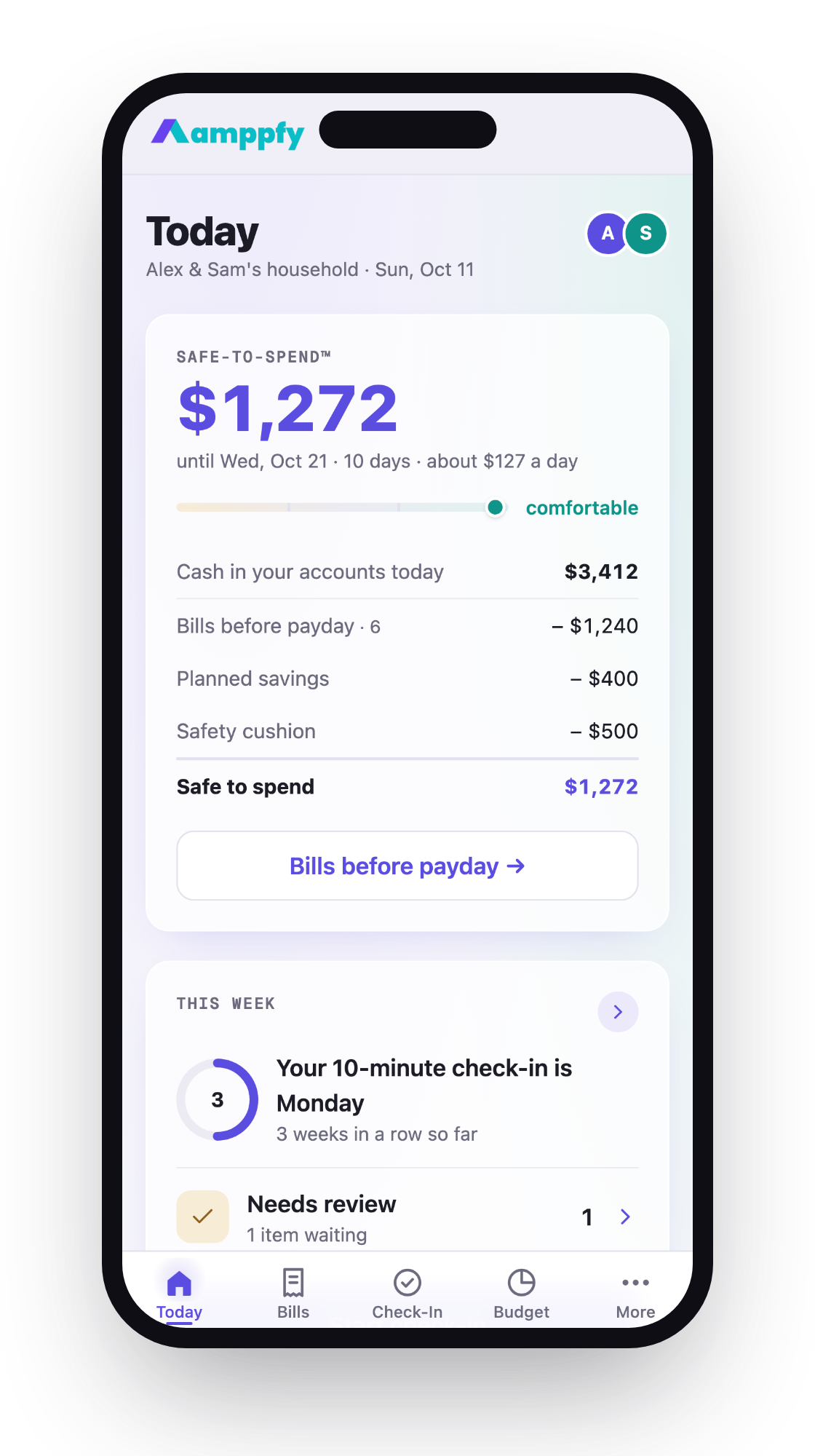
Strip away every category, and your budget comes down to four numbers. These are the only lines that answer the question you actually care about: what’s safe to spend before your next paycheck?
Here’s the math in one line:
$3,412 cash − $1,240 bills − $400 savings − $500 cushion = $1,272
That’s it. Four inputs, one output. You don’t need to know whether $42 went to coffee or lunch. You need to know $1,272 is yours to use freely until payday.
| Line | What it means | How often it changes |
|---|---|---|
| Cash on hand | Your checking and spending account balances right now | Every few days |
| Bills due before payday | Rent, utilities, insurance, subscriptions, anything on autopay | Monthly, with small shifts |
| Planned savings | The amount you’ve committed to move toward a goal this pay period | Each paycheck |
| Safety cushion | A buffer you pick so you don’t hit zero | Set once, revisit quarterly |
The result, your Safe-to-Spend™ number, replaces every granular category. It doesn’t judge how you spend the $1,272. It just makes sure the $1,272 is real, meaning your bills and goals are already covered.
This is the approach Amppfy uses: you enter your balances yourself (about 30 seconds per account), plug in your bills and goals, and the app shows one number with the math printed underneath. No bank login required. A 10-minute weekly check-in keeps everything current.
The shift here is philosophical. Traditional budgets ask you to plan every dollar. This approach plans the committed dollars and frees the rest.
Which categories are worth watching for a month
Not every category deserves permanent tracking. But a few deserve a short, focused audit. Think of it like checking your tire pressure: you don’t do it every drive, but a monthly glance prevents problems.
The “surprise drain” test
Pick one or two categories where you suspect money is leaking. Common culprits:
- Subscriptions you forgot about (streaming, apps, gym memberships with auto-renew)
- Dining out and delivery fees
- Impulse purchases from one specific retailer
Track that category for exactly one month. Write down every purchase or tag it in your bank app’s search. At the end of the month, look at the total. If it shocks you, make one change. Cancel a subscription. Set a weekly delivery budget. Move on.
When to stop tracking a category
The goal isn’t permanent surveillance. Once you’ve made the adjustment, you don’t need to keep counting. A subscription you canceled stays canceled. A delivery habit you trimmed to twice a week doesn’t need a spreadsheet.
Here’s a simple rule: if tracking a category for 30 days didn’t lead to a specific action, that category isn’t worth your attention. Drop it. Your time is better spent on a quick balance check than on sorting receipts into bins.
The few categories that matter most are the ones where a single decision saves you $50 or more per month. Everything else is rounding error dressed up as financial planning.
Tracking less without losing control
The fear behind quitting categories is losing control. If you’re not watching every dollar, won’t spending spiral? This concern makes sense, but the evidence runs the other direction. Simpler systems get used. Complex ones get abandoned. An abandoned budget gives you zero control.
Here’s what “tracking less” actually looks like in practice:
- Check your Safe-to-Spend number twice a week. This takes about 30 seconds.
- Update your account balances once a week during a quick check-in.
- Review your bills list once a month to catch anything new or expired.
- Glance at your net worth once a month to confirm the trend line.
That’s the whole system. No categorizing. No receipt sorting. No reconciliation sessions on Sunday afternoons.
The reason this works is that your Safe-to-Spend number already accounts for bills and savings. If you spend freely within that number, your obligations are met. You don’t need a “groceries” category to tell you groceries are fine. You need to know the total pool is intact.
For couples, this gets even simpler. Instead of negotiating fifteen category limits, you share one number. Both partners see the same Safe-to-Spend figure. Amppfy handles this with separate logins: each person sees the shared number while keeping private balances private. One number to agree on beats fifteen arguments about whether $7 coffee counts as “dining” or “groceries.”
The control doesn’t come from watching more. It comes from watching the right thing.
A simpler setup for the next pay period
Your next paycheck is a clean starting point. Here’s how to set up a budget that skips the categories you don’t need and focuses on the lines that matter.
Step one: gather your numbers
Open your bank app and write down the balance of every account you spend from. Checking, savings, cash apps. This takes about two minutes.
Step two: list your bills
Write down every bill due between now and your next payday. Include the amount and the date. Rent, car payment, phone, insurance, subscriptions. If you’re not sure about a subscription, check your last bank statement for recurring charges.
Step three: set your savings and cushion
Pick a savings amount for this pay period. Even $50 counts. Then choose a cushion, the amount you don’t want to dip below. A good starting point is $200 to $500, depending on your comfort level.
Now run the math:
$4,100 cash − $1,800 bills − $200 savings − $300 cushion = $1,800
That $1,800 is yours. Spend it however you want. No categories. No guilt. Your bills are covered, your savings goal is funded, and your cushion is in place.
If you want the number to update automatically as you spend and as bills clear, Amppfy does exactly this. It’s free, works on iPhone and the web, and takes about 10 minutes a week to maintain.
The whole point of skipping unnecessary budget categories is to build a system you’ll actually use past February. A budget that survives is worth more than a perfect spreadsheet that doesn’t.
Frequently asked questions
Won’t I spend too much on dining out if I don’t have a category for it?
You might, for a month. But your Safe-to-Spend number will reflect that. If you blow through your safe amount by the 20th, that’s feedback without needing a “dining” label. The fix isn’t adding a category. It’s noticing the number dropped faster than expected and adjusting next pay period.
What if my partner wants detailed categories?
Have a conversation about what problem the categories solve. If your partner wants to know where money goes, try a one-month audit of two or three areas instead of permanent tracking. Most couples find that sharing one spending number reduces friction more than debating category limits.
How do I handle irregular expenses like car repairs or medical bills?
Build these into your cushion. If you set a $500 cushion and a $400 repair hits, your Safe-to-Spend drops but stays above zero. For predictable irregular costs (annual insurance, holiday gifts), add a small monthly savings goal. That’s one line, not a new category.
Is this approach the same as the 50/30/20 rule?
It’s related but more practical. The 50/30/20 rule gives you broad targets (50% needs, 30% wants, 20% savings), but it still requires you to classify every purchase. The four-line approach skips classification entirely. Your bills and savings are handled first, and the rest is yours to spend without sorting.
Your next ten minutes
You don’t need thirty categories to manage your money. You need four numbers and a system simple enough to check twice a week. Start with your next paycheck: list your bills, set a savings amount, choose a cushion, and subtract. The number left over is your permission to stop worrying.
If you want that number calculated and updated for you, try Amppfy for free. Enter your balances, add your bills, and see your Safe-to-Spend in about five minutes. No bank login. No category maze. Just one number that tells you what you actually have.