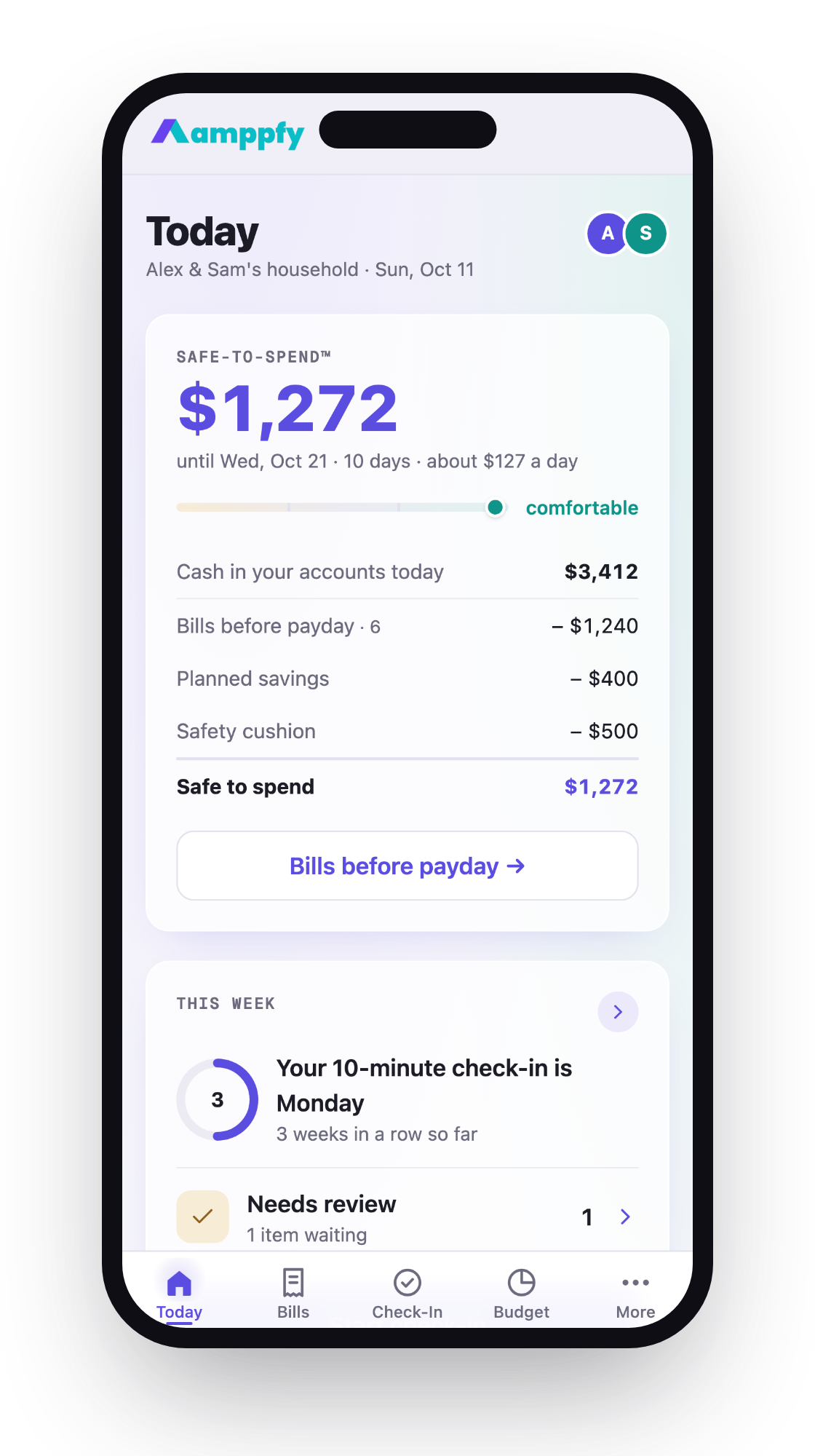
Most people who check their bank app daily still get blindsided by a bill. The balance looks fine on Tuesday, but by Friday three auto-pays hit and suddenly things feel tight. A personal cash flow calendar fixes that by laying every dollar coming in and going out on a timeline, not just a category. You see the shape of your month before it happens. That shift from “How much did I spend?” to “When will my cash dip?” changes how you make every money decision.
What a Cash Flow Calendar Shows That a Budget Does Not
A budget groups your money into categories: groceries, rent, subscriptions, fun. It tells you how much you plan to spend, but it doesn’t tell you when. That missing dimension is the whole problem.
Consider a simple example. You earn $4,200 on the 1st and 15th. Your rent of $1,600 hits on the 1st. Car insurance of $280 hits on the 3rd. Your electric bill of $160 hits on the 5th. By the 6th, more than half your paycheck is gone, and you still have twelve days until the next one. A budget says you can afford all of it. The calendar shows you’re running on fumes for nearly two weeks.
| Tool | What It Answers | What It Misses |
|---|---|---|
| Monthly budget | “Can I afford this category this month?” | Timing gaps between paydays and bills |
| Cash flow calendar | “What’s my balance on any given day?” | Nothing: it includes amounts and dates |
A cash flow calendar for your personal finances maps deposits and withdrawals onto actual dates. You see the peaks right after payday and the valleys right before the next one. That valley is where overdrafts, late fees, and stress live. A budget can’t warn you about it because a budget doesn’t know what day it is.
The calendar also reveals patterns that repeat every month. Maybe the second week is always tight. Maybe the last three days before payday are consistently uncomfortable. Once you see the pattern, you can act on it.
Plotting Paydays, Bills, and Savings on One View
Building your first calendar takes about twenty minutes. After that, it mostly runs on its own. Here’s how to set it up.
Step 1: List Every Inflow
Write down each paycheck date and amount. Include side income, child support, or any recurring deposit. If it hits your account on a predictable schedule, it goes on the calendar.
Step 2: List Every Outflow with Its Due Date
Pull up your bank statement from last month. Note every recurring charge and the date it posted:
- Rent or mortgage: 1st
- Car payment: 10th
- Streaming services: 7th, 12th, 22nd
- Insurance: 3rd
- Phone bill: 18th
- Savings transfer: 1st and 15th
Don’t forget quarterly or annual bills. Car registration, insurance premiums paid every six months, and annual subscriptions all belong here. Spread them across the right months.
Step 3: Plot a Running Balance
Start with your current checking balance. Add each deposit on its date. Subtract each bill on its date. The result is a running total that shows your projected balance for every day of the month.
Here’s a simplified week:
| Date | Transaction | Amount | Running Balance |
|---|---|---|---|
| Mar 1 | Paycheck | +$2,100 | $2,500 |
| Mar 1 | Rent | -$1,600 | $900 |
| Mar 3 | Car insurance | -$280 | $620 |
| Mar 5 | Electric | -$160 | $460 |
| Mar 7 | Streaming | -$16 | $444 |
You don’t need fancy software for this. A spreadsheet works. A paper calendar works. Amppfy’s month calendar marks the lowest-cash day automatically and shows your Safe-to-Spend™ number: available cash minus bills due before payday, minus planned savings, minus a safety cushion you set.
Spotting the Low Point Weeks Ahead
The single most useful thing on your calendar is the lowest balance day. That’s the day you’re most likely to overdraft, skip a savings transfer, or put something on a credit card you’d rather not.
According to a 2023 Federal Reserve survey on household finances, 37% of U.S. adults said they couldn’t cover a $400 emergency expense with cash. The low-point day on your calendar tells you exactly when you’d be in that position, and how far in advance you can see it coming.
Spot the dip early and you have options. Spot it the day it happens and you don’t.
What to Do When You See a Low Point
- Move a non-essential purchase to the week after payday.
- Shift your savings transfer by a few days so it lands after the bills clear.
- Set aside a small buffer in a separate account to cover that specific week.
- Contact a service provider and ask to move your due date (more on that below).
The point isn’t to panic. It’s to make one small adjustment while you still have time. A cash flow calendar gives you personal visibility into the exact week where trouble lives, so you can reroute before you arrive.
Couples benefit here too. If both partners see the same calendar, neither one accidentally spends into the dip. With Amppfy, both partners see the same Safe-to-Spend number while keeping private balances private: one view, no surprises.
Using It to Move Due Dates
Most billers will move your due date if you ask. Credit card companies, utilities, phone carriers, and insurance providers all have processes for it. You usually just call or chat with customer service.
The goal is to spread your bills more evenly across the month, or cluster them right after a payday so the money is there when the charge hits.
Before and After: Rebalancing Due Dates
Say your paydays land on the 1st and 15th. Here’s what a lopsided month looks like versus a rebalanced one:
| Bill | Original Due Date | Adjusted Due Date |
|---|---|---|
| Rent | 1st | 1st (can’t move) |
| Car payment | 3rd | 16th |
| Phone | 5th | 17th |
| Insurance | 4th | 18th |
| Electric | 6th | 20th |
Before the change, five bills hit within six days of the first paycheck. After, only rent comes out of the first check. The rest spread across the second half of the month. Your running balance stays more stable, and the low-point day rises significantly.
How to Request a Due Date Change
- Call the number on your bill or open the provider’s chat.
- Ask to change your payment due date. Most will do it for free.
- Confirm whether the change takes effect this cycle or next.
- Update your calendar immediately.
Credit card issuers are required to let you pick your due date under the CARD Act. Utilities and phone carriers almost always accommodate the request. Mortgage and rent due dates are harder to change, so plan around those as fixed anchors.
One round of calls, maybe thirty minutes total, and your month looks completely different. That’s a high-return use of half an hour.
Keeping It Current in Ten Minutes a Week
A calendar that’s three weeks out of date is just decoration. The key is a short, consistent check-in rather than a long monthly session.
Pick a day. Sunday evening works for a lot of people. Friday afternoon works for others. The day matters less than the habit.
Your Weekly Check-In
- Open your bank app and note your current balance. Update the calendar’s starting number.
- Scan the next two weeks for any new or changed bills.
- Check if any annual or quarterly charges are coming up.
- Adjust your running balance if anything shifted.
That’s it. Ten minutes, maybe less once you’ve done it a few times. Amppfy is built around this same weekly rhythm: you type in your balances (about 30 seconds per account, no bank login needed), and the app recalculates your Safe-to-Spend for the rest of the pay period.
What Triggers a Mid-Week Update
Not everything waits for Sunday. If any of these happen, take two minutes to update:
- Unexpected expense: car repair, medical co-pay, a gift you forgot about
- Income change: a bonus, a missed shift, a freelance payment
- New subscription: that free trial you signed up for is about to convert
The calendar only works if it reflects reality. But “reflecting reality” doesn’t mean logging every coffee. It means keeping the big numbers honest: your balance, your upcoming bills, and your next payday.
A personal cash flow calendar isn’t a budgeting tool. It’s a timing tool. The difference matters because most money stress comes from when, not how much.
Frequently Asked Questions
Is a cash flow calendar the same as a budget?
No. A budget assigns dollars to categories. A cash flow calendar assigns dollars to dates. You might be perfectly within budget for the month but still overdraft on the 12th because three bills clustered together. The calendar catches that. The budget doesn’t. Ideally, you use both: the budget sets your limits, and the calendar makes sure the timing works.
How far ahead should I plan my calendar?
One full month is the minimum. Two months is better, especially if you have quarterly bills like insurance premiums or annual charges like car registration. The further out you look, the more time you have to adjust. Start with the current month and next month, then extend as you get comfortable.
Can couples use one cash flow calendar together?
Yes, and it’s one of the best uses for it. When both partners see the same timeline of bills and paydays, nobody accidentally spends into a gap. You don’t need to merge every account. Just make sure shared bills and shared income appear on the same calendar. Each person can keep a separate view for personal spending.
What if my income is irregular?
Use your lowest recent month as the baseline. Plot your fixed bills against that amount. When a higher-income month happens, the extra goes to savings or to pre-paying a bill that would otherwise hit during a lean stretch. The calendar becomes even more valuable with irregular income because the timing gaps are less predictable.
Start Seeing Your Month Before It Happens
Your bank balance is a snapshot. Your calendar is a forecast. One tells you where you are. The other tells you where you’re headed. That difference is worth twenty minutes of setup and ten minutes a week to maintain.
Pick one tool: a spreadsheet, a paper calendar, or an app like Amppfy. List your paydays. List your bills. Plot the running balance. Find the low day. Move what you can. Then check in once a week to keep it honest. Take fifteen minutes this weekend to build your first month. The number that matters isn’t how much you spent last month. It’s how much is safe to spend before your next paycheck.