Most people make one credit card payment per month and don’t think twice about it. But what if splitting that single payment into two smaller ones could save you money, smooth out your cash flow, and even help your credit score? Making a credit card payment twice a month is a simple habit shift, not a radical overhaul. Whether it actually helps depends on your balance, your billing cycle, and your paycheck timing. Here’s how the math works and when it’s worth the effort.
Splitting One Payment Across Two Paychecks
The idea is straightforward. Instead of sending one lump sum right before your due date, you split the total across two paydays. Each payment is smaller, which means less strain on any single paycheck.
Say you get paid on the 1st and the 15th. Your credit card bill is $800, due on the 25th. Rather than pulling $800 from one check, you pay $400 on the 2nd and $400 on the 16th. Same total, two smaller hits.
Why Paycheck Alignment Matters
Most household budgets run paycheck to paycheck in a practical sense: rent, groceries, and utilities cluster around specific dates. A single large credit card payment can collide with those fixed costs and leave you short for the rest of the cycle.
Splitting the payment lines up with how money actually arrives. You’re not borrowing from next week’s grocery budget to cover last month’s card spending. Each paycheck absorbs half the load, and neither check feels gutted.
Who Benefits Most
This approach works best if you:
- Carry a moderate to high balance each month
- Get paid biweekly or semimonthly
- Feel squeezed in the days right after a big bill hits
- Want to reduce interest charges without changing your spending
If you already pay your full statement balance easily from one paycheck, the cash flow benefit is smaller. But even then, the credit reporting angle (covered next) can still matter.
How It Can Lower the Balance That Gets Reported
Credit card issuers report your balance to the bureaus once per month, usually on your statement closing date. That reported number determines your credit utilization ratio: the percentage of your credit limit you’re currently using.
Here’s the key detail. The balance reported isn’t your average balance or your end-of-month balance. It’s whatever you owe on the exact day the statement closes. One well-timed payment before that date can drop the reported number significantly.
The Utilization Math
According to the Consumer Financial Protection Bureau, credit utilization is one of the most influential factors in your credit score. Most scoring models prefer utilization below 30%, and scores tend to improve further below 10%.
| Scenario | Credit Limit | Reported Balance | Utilization |
|---|---|---|---|
| One payment after statement close | $5,000 | $2,400 | 48% |
| One payment before statement close | $5,000 | $1,200 | 24% |
| Two payments (one mid-cycle, one before close) | $5,000 | $600 | 12% |
The two-payment approach can cut your reported utilization by more than half compared to a single late-cycle payment. You haven’t spent less. You haven’t earned more. You’ve just changed the timing.
Finding Your Statement Closing Date
Check your most recent statement or your issuer’s app. The closing date is different from the due date: it’s usually about 21 to 25 days earlier. Mark it on your calendar. Making one of your two payments a few days before that date gives you the biggest utilization benefit.
When It Helps Cash Flow and When It Does Not
Paying your credit card twice a month isn’t a magic fix. It works well in specific situations and falls flat in others.
When It Helps
- Your card balance is high relative to your limit, and you want a lower utilization ratio without waiting to pay down debt.
- You carry a balance month to month. Two payments reduce your average daily balance, which reduces the interest your issuer charges. Interest accrues daily on most cards, so lowering the balance mid-cycle means fewer dollars in finance charges.
- You’re paid biweekly and your budget feels tight around the due date. Splitting the payment prevents the “feast or famine” cycle between paychecks.
When It Doesn’t Help Much
- You pay your full statement balance every month and never carry interest. The interest savings are zero because there’s no interest to save. You might still get a utilization benefit, but the cash flow gain is minimal.
- Your spending is low relative to your limit. If you charge $200 on a $10,000 limit, your utilization is already 2%. Timing won’t move the needle.
- You’re already stretched thin. Two payments don’t reduce what you owe. If the total is more than you can cover, splitting it into two insufficient payments just creates two moments of stress instead of one.
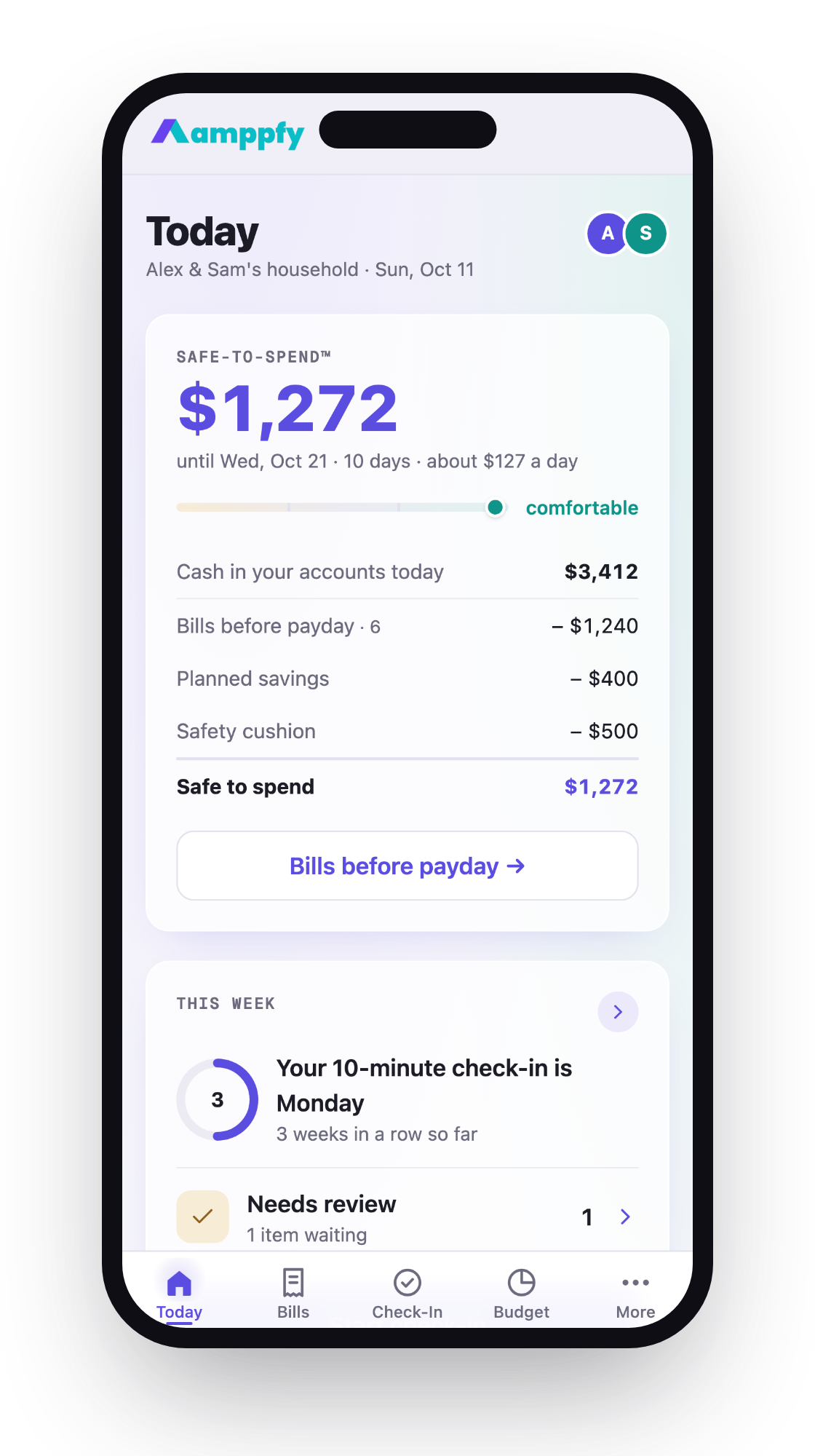
A tool like Amppfy can help here. Its Safe-to-Spend™ number: available cash minus bills due before payday, minus planned savings, minus a safety cushion: tells you whether each half-payment fits comfortably before you commit.
Setting It Up Without Missing the Due Date
The biggest risk of paying twice a month is confusion. You make one payment mid-cycle, feel good about it, and then forget the second one. A missed due date costs you a late fee (often $30 to $41) and can trigger a penalty APR.
Here’s how to set it up cleanly:
- Find three dates: your two paydays and your card’s due date.
- Schedule the first payment for one to two days after your first payday.
- Schedule the second payment for one to two days after your second payday, but at least three business days before the due date.
- Set both as recurring payments through your bank’s bill pay or your card issuer’s autopay system.
- Confirm the minimum payment is covered. If you can’t pay the full balance, make sure at least one of the two payments meets or exceeds the minimum due. Most issuers only require the minimum by the due date, but covering it early removes the late-fee risk entirely.
Autopay as a Safety Net
Consider setting your card’s autopay to the minimum payment on the due date. This acts as a backstop. If both manual payments go through, autopay either won’t trigger or will pull a tiny residual amount. If you forget one payment, autopay catches you before you’re late.
A Quick Calendar Check
| Date | Action |
|---|---|
| 1st (payday) | Pay half the expected bill |
| 12th (statement close) | Confirm balance reported is lower |
| 15th (payday) | Pay remaining balance or second half |
| 25th (due date) | Autopay catches any remainder |
Adjust these dates to match your own cycle. The point is to build a rhythm, not to remember a new task every month.
A Worked Example on a $1,200 Statement
Let’s walk through a real scenario with specific numbers.
You have a credit card with a $4,000 limit. Your statement balance is $1,200. Your APR is 22.99%. You’re paid on the 1st and 15th. Your statement closes on the 12th, and your due date is the 5th of the following month.
One Payment vs. Two Payments
| Single Payment | Two Payments | |
|---|---|---|
| Payment 1 | $1,200 on the 4th (day before due date) | $600 on the 2nd |
| Payment 2 | None | $600 on the 16th |
| Balance on statement close (12th) | $1,200 | $600 (after first payment, before second) |
| Utilization reported | 30% | 15% |
| Average daily balance (approx.) | $1,200 for 30 days | $900 for 15 days, then $600 for 15 days |
Interest Savings
If you carry a balance, interest is calculated on the average daily balance. With one payment on the 4th, your average daily balance stays near $1,200 for most of the cycle. With two payments, the first $600 drops your balance mid-cycle, reducing the average.
Here’s the rough math for one billing period:
- Single payment average daily balance: ~$1,200
- Two-payment average daily balance: ~$750
- Daily periodic rate at 22.99% APR: 0.063% (22.99 ÷ 365)
- Interest saved per cycle: ($1,200 – $750) × 0.00063 × 30 = ~$8.51
That’s about $8.51 saved in one month. Over a year, that’s roughly $102 in interest you keep. Not life-changing, but not nothing either: especially if your balance is higher than $1,200.
The Credit Score Effect
The utilization drop from 30% to 15% can matter. If you’re near a scoring threshold (say, trying to cross from the high 600s into the 700s), that shift alone might move your score by 10 to 20 points. The effect resets each month, so consistency matters.
Frequently Asked Questions
Does paying my credit card twice a month count as two on-time payments?
No. Your issuer reports one payment status per billing cycle: on time or late. Making two payments doesn’t give you double credit for on-time history. It does, however, ensure you’re never late, since the first payment already covers part or all of the minimum.
Will my credit card company charge a fee for extra payments?
No major U.S. issuer charges fees for making additional payments within a billing cycle. You can pay as many times as you want. Some issuers limit the number of online payments per day (usually two or three), but you can space them out across the month without any penalty.
Should I split the payment evenly or weight one payment higher?
Either works. If your goal is lower utilization on the statement close date, put the larger payment before that date. If your goal is smoother cash flow, split evenly across your two paydays. Match the strategy to the problem you’re solving.
Can I do this with autopay, or do I have to pay manually each time?
Most bank bill-pay systems let you schedule two recurring payments to the same payee. Your card issuer’s own autopay usually only allows one scheduled payment, so use your bank’s system for the second. Keep the issuer’s autopay set to the minimum as a safety net.
Making the Two-Payment Habit Stick
Paying your credit card on a bimonthly rhythm works best when it’s automatic and aligned with your paydays. The benefits are real but modest: lower utilization, reduced interest on carried balances, and smoother cash flow between checks. It won’t fix a balance that’s growing faster than your income, but it’s one of the simplest tweaks you can make to how you manage existing debt.
If you want to see whether each half-payment fits your budget before you commit, Amppfy shows your Safe-to-Spend number with the math right underneath: $3,412 cash − $1,240 bills − $400 savings − $500 cushion = $1,272. That one number tells you if the payment is comfortable or if you need to adjust. Take 10 minutes this week to set up your two recurring payments, check that your autopay backstop is in place, and stop thinking about it until next month.