You’ve tried a budget app before. Maybe two. You opened it once, connected your bank, got overwhelmed by pie charts, and quietly deleted it a week later. Or the free trial ended and a $14.99 charge appeared on your statement. Choosing the right budgeting app isn’t about finding the one with the most features: it’s about finding the one you’ll actually keep using. These seven questions will help you pick a budget app that fits your money, your schedule, and your household before you hand over your email address.
Does it fit how you get paid?
A budget app is only useful if it understands your pay cycle. Most apps default to monthly budgets, which works fine if you’re salaried and paid on the 1st and 15th. Plenty of people, from shift workers to freelancers, get paid on a schedule that isn’t neat.
Match the app to your paycheck rhythm
Before you download anything, ask yourself three things:
- Are you paid weekly, biweekly, twice monthly, or on irregular dates? Some apps let you set a custom pay cycle. Others assume monthly and leave you doing mental math.
- Does the app calculate what’s safe to spend between paydays, or just for the whole month? A monthly budget of $2,000 for “spending” doesn’t tell you much on October 9th if your next paycheck lands October 18th.
- Can you adjust when income is uneven? If you freelance or pick up extra shifts, you need an app that lets you update your available cash without rebuilding your whole budget.
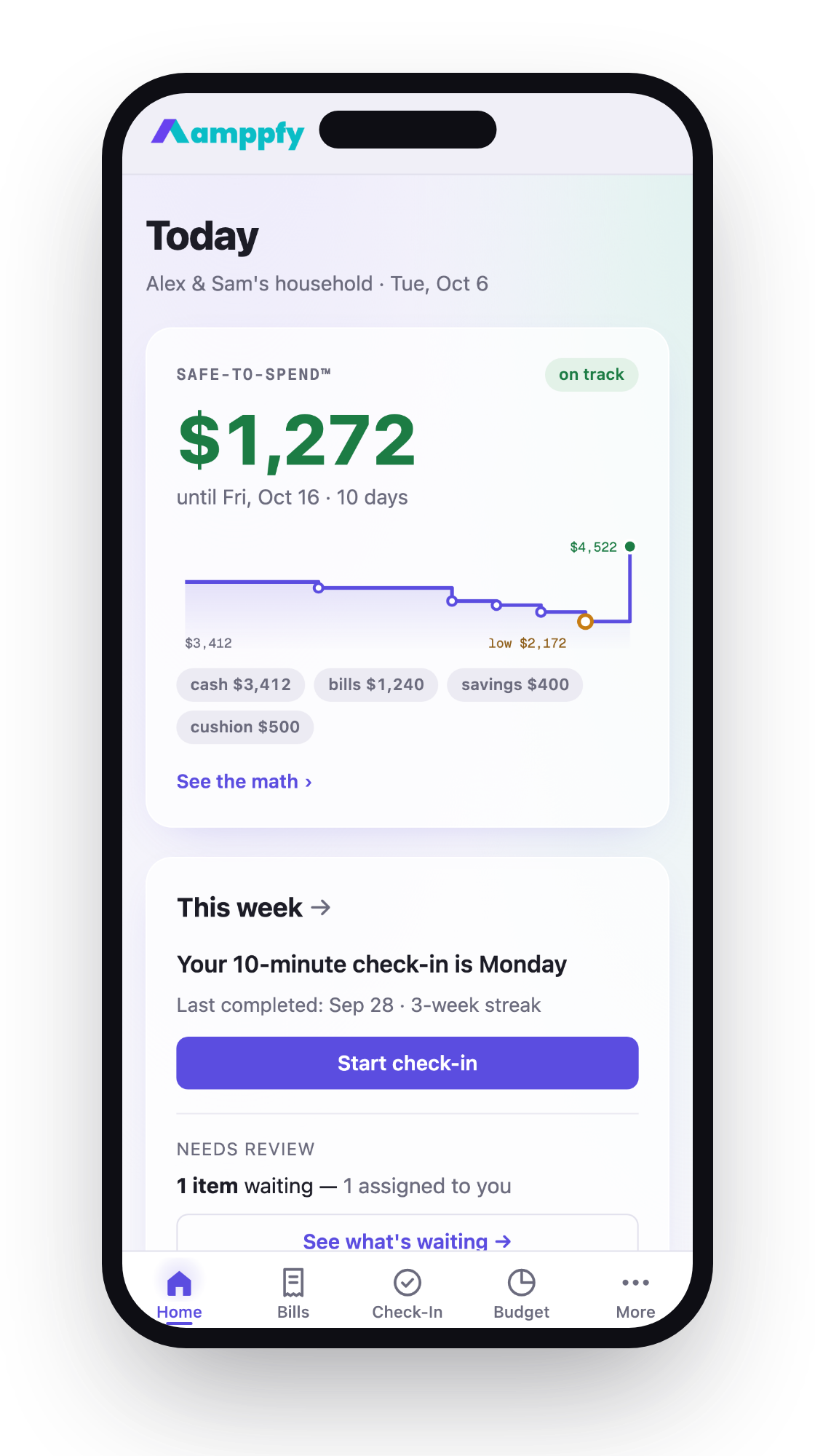
Here’s a quick example of why this matters. Say you bring home $3,412 on the 15th. You have $1,240 in bills before the 30th, $400 going to savings, and a $500 cushion you like to keep. That leaves $1,272 to spend. An app built around pay cycles shows you that number right away. A monthly-only app buries it inside categories you have to add up yourself.
Amppfy calls this your Safe-to-Spend™ number: $3,412 cash − $1,240 bills − $400 savings − $500 cushion = $1,272. It’s one figure, with the math printed underneath. But whatever app you choose, make sure it speaks your paycheck’s language.
Does it need your bank login?
This question splits the entire budgeting app market in two. Some apps connect directly to your bank and pull transactions automatically. Others ask you to type in your balances yourself.
Automatic sync: convenience with caveats
Bank-linked apps save you data entry. You spend $4.50 at a coffee shop and it shows up categorized in your app, usually within a day. The tradeoff is real, though. Bank connections sometimes break and need re-authorization, which means you open the app, see stale data, and have to log back in to your bank to fix it. The CFPB’s Personal Financial Data Rights rule (Section 1033), which sets standards for how apps access your bank data, is being reconsidered by the agency[1]. The rules around bank data sharing are still unsettled.
Manual entry: control with a time cost
Manual-entry apps don’t touch your bank. You type in your checking balance, your savings balance, and your credit card balance yourself. The upside: no broken connections, no sharing credentials, no wondering which third party has access to your transaction history. The downside: you have to do it.
Here’s a fair comparison:
| Factor | Bank sync | Manual entry |
|---|---|---|
| Setup time | 5-15 min (per institution) | 2-5 min total |
| Weekly effort | Near zero when working | 2-3 min to update balances |
| Connection breaks | Can happen; you re-link the account | None |
| Bank credentials shared | Yes | No |
| Transaction detail | Individual purchases | Account-level balances |
Neither approach is wrong. The question is which tradeoff you can live with week after week.
What does it cost after the trial?
Many budgeting apps offer a free tier or a 7- to 30-day trial, then charge monthly. That’s not shady: developers need to eat. But you should know the real price before you start entering your data.
Questions to ask before you tap “Start Free Trial”
- What does the free tier actually include? Some apps gate core features like bill reminders or reports behind the paywall.
- Is the trial auto-renew? Check your App Store subscription settings if you’re unsure.
- What’s the annual cost if you pay monthly vs. yearly? For example, a hypothetical $9.99-a-month app costs $119.88 a year. An annual plan may cost less, but it’s still real money.
- Has the price changed in the last 12 months? Search the app’s subreddit or community forum. Price hikes after you’ve built your budget are frustrating.
Some apps are genuinely free. Amppfy, for example, is free on iPhone and the web with no paid tier, though it doesn’t import transactions. Many bank-linked apps charge a subscription, so check the current price on the app’s own site. The right price depends on what you’re getting and whether you’ll actually use it long enough to justify the cost.
A useful exercise: multiply the monthly price by 12. Then ask yourself if you’d hand that cash to someone at a store for the same service. If the answer is no, look for an alternative.
How much upkeep each week?
This is where most budgeting apps fail people. Not because the app is bad, but because the weekly time commitment doesn’t match the person’s life. A parent juggling two kids and a full-time job isn’t going to spend 45 minutes every Sunday categorizing transactions.
The real weekly time cost
Think about upkeep in three buckets:
- Data entry or review. Bank-synced apps need you to review and re-categorize transactions. Manual apps need you to update balances. Either way, you’re spending time.
- Decision-making. Good budget apps surface a question: “Can I afford this?” Bad ones just show you charts and leave you to figure it out. The less interpreting you have to do, the faster your check-in goes.
- Fixing things that break. Reconnecting bank feeds, adjusting categories the app guessed wrong, updating a bill amount that changed. This invisible maintenance adds up.
A reasonable target for weekly upkeep is 10 minutes or less. If an app demands more than that, you’ll use it for three weeks and then stop. That’s not a character flaw. It’s a design problem.
Before you commit, try this: use the app for two full pay cycles. Time your weekly check-in. If it’s consistently over 15 minutes, the app is too heavy for your routine. Move on.
Can two people use it, and two more questions
If you share finances with a partner, this question matters as much as anything else on the list. Some couples merge everything, some keep money separate, and many do a mix. Your budget app needs to handle whatever arrangement you’ve chosen.
What to look for in a couples-friendly app
- Shared view of bills and spending limits. Both of you should see the same spending number or budget totals without texting screenshots back and forth.
- Private balances. Hybrid finances mean some accounts are shared and some aren’t. The app should respect that boundary.
- Separate logins. One shared login on someone’s phone isn’t a real solution. Each partner needs their own access.
Amppfy handles this with a partner invite by email: each person gets their own login, shared accounts and bills are visible to both, anything you keep private stays private, and both see the same Safe-to-Spend™ number, bills calendar, and goals. Other apps offer family plans or shared accounts with varying levels of privacy. Check the specifics before you sign up.
Two more questions worth asking
- Does it work on your devices? If one partner uses Android and the other uses iPhone, make sure the app covers both, even if through a web version.
- Can you take your data with you? If you ever leave, or the company shuts down, you should be able to take your history with you. A CSV export option is the minimum. Small app companies close. If your entire financial picture lives inside one app with no export, that’s a risk. Keep a simple backup: even a spreadsheet with your account list and balances updated monthly.
Frequently Asked Questions
Should I use more than one budget app at the same time?
Generally, no. Running two apps doubles your upkeep and creates confusion about which numbers to trust. Pick one that handles your most important need: whether that’s a clear spending number, bill tracking, or detailed category breakdowns. Give it two full pay cycles before you judge it.
What if I start with one app and want to switch later?
Export your data first if the app allows it. Then set up the new app from scratch using your current balances and bills. Don’t try to recreate months of history: just start fresh from today. The first pay cycle in a new app is always a little rough, and that’s normal.
Do I need a budget app if my bank already has budgeting tools?
Bank tools are convenient but limited. They only see the accounts at that one bank. If you have a checking account at one bank, a credit card at another, and savings at a third, your bank’s built-in tool gives you a partial picture. A standalone app can pull everything into one view.
Is a free budget app less secure than a paid one?
Price doesn’t determine security. A free app that never touches your bank credentials can be more private than a paid app that stores your login for five financial institutions. Look at what data the app collects, not what it charges.
Choosing the Right Budget App for Your Life
The best way to choose a budget app is to be honest about your habits. How often will you open it? Do you want transaction-level detail or just one clear number? Are you budgeting solo or with a partner? Your answers narrow the field fast.
Skip the app with 200 features if you only need three. Skip the free trial if you know you won’t cancel in time. Pick the app that fits your pay cycle, your patience, and your household, then give it a real chance over two paychecks.
If you want to see your own Safe-to-Spend™ number before your next payday, get Amppfy free. Setup takes a few minutes: enter your balances, bills, and payday, and the number updates each time you update a balance.