Your next budget app asks for your email, your income, maybe your bank login. You hand it over because the app looks helpful. But what happens to that information after you tap “I Agree”? Privacy in budgeting apps is one of those things most people skip right past, and it’s the one thing worth slowing down for. A few pointed questions before you sign up can save you real headaches later.
What Data Budget Apps Collect
Not all budget apps collect the same information, but most ask for more than you’d guess. The gap between what an app needs and what it takes is where privacy risk lives.
Here’s a rough breakdown of common data categories:
| Data Category | Examples | Why It’s Collected |
|---|---|---|
| Identity | Name, email, phone number | Account creation, notifications |
| Financial | Bank balances, transactions, income | Budgeting features |
| Device | Phone model, OS version, IP address | Analytics, crash reports |
| Behavioral | Screen time, feature usage, tap patterns | Product improvement, ad targeting |
| Contacts | Phone contacts, social connections | Referral programs, “find friends” |
Compare popular budgeting apps on what they ask for, not just on features. More data points mean a richer profile of your financial life, and a bigger target if something goes wrong.
Ask yourself two questions before signing up. First: does this app need my contacts to show me what’s safe to spend? Almost certainly not. Second: is there a way to use the app without granting every permission it requests? Some apps work fine with partial access. Others won’t open unless you hand over everything.
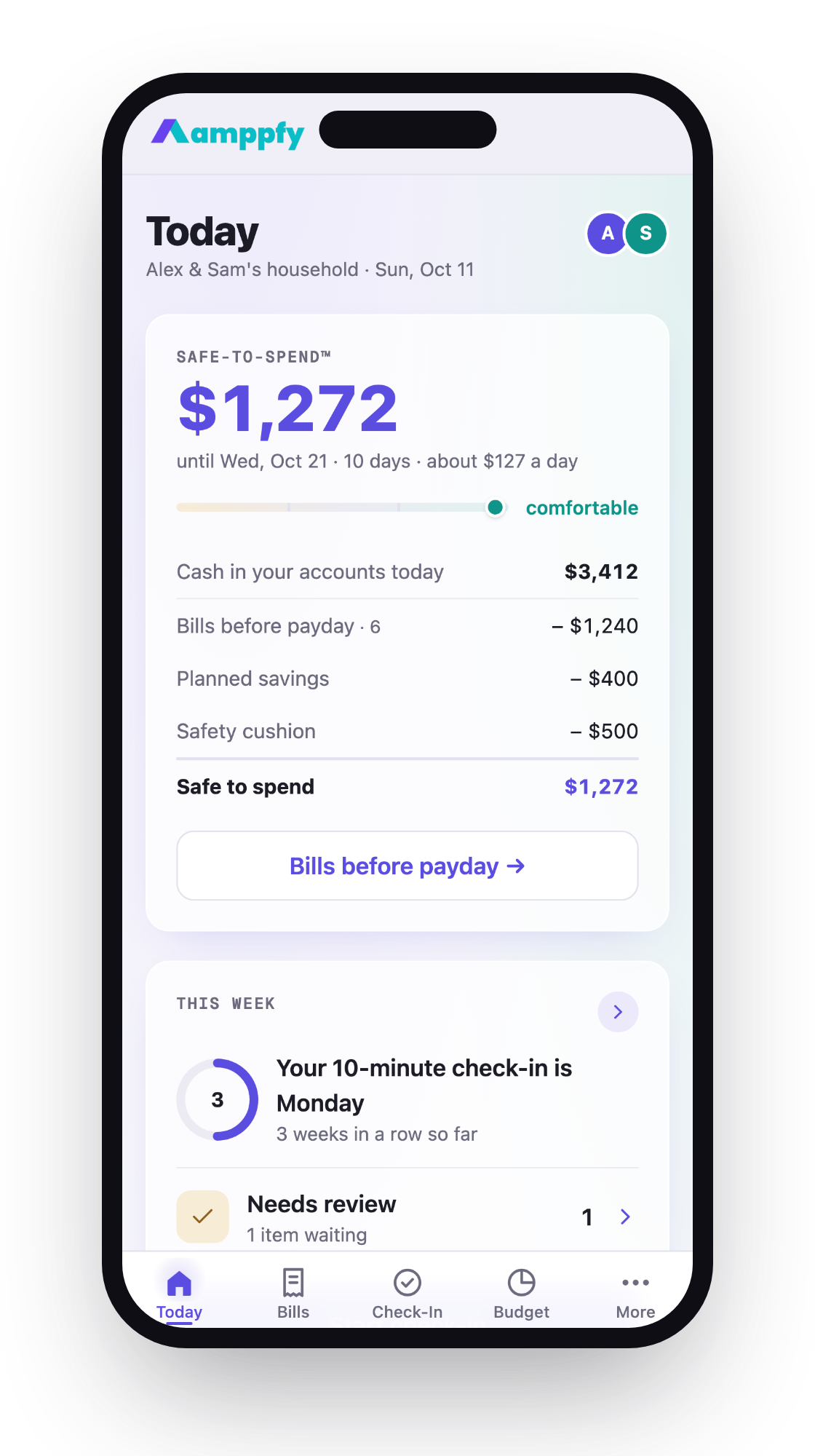
An app like Amppfy, for example, skips bank logins entirely. You type in your own balances, so the app never holds your bank credentials. That’s a design choice that sidesteps an entire category of risk.
Where Your Data Goes
Collecting data is one thing. Sharing it is another. Most budget apps pass some of your information to third parties: analytics providers, advertising networks, cloud hosts, or data aggregators.
The key question: does the app sell your data, or just share it for operations? Those are very different things.
- Selling means a third party pays for access to your information, often for targeted advertising or credit offers.
- Sharing for operations means your data goes to a server host or a payment processor that needs it to keep the app running.
A federal rule from the CFPB, known as the Personal Financial Data Rights rule, was designed to limit how third-party apps handle your financial information. Under its data minimization mandate[1], apps may only collect data reasonably necessary for the specific service you requested. No “bait-and-switch” harvesting. That said, the rule’s path has been uneven: its compliance dates have been pushed back, and the CFPB is reconsidering parts of it[2].
So the regulatory picture is still shifting. That puts more responsibility on you to read the fine print. Here’s what to look for:
- Does the privacy policy name specific third parties?
- Is there an opt-out for data sharing with advertisers?
- Does the app promise not to sell your data, and is that promise in writing?
If you can’t find clear answers, treat that silence as an answer itself.
Linking vs. Manual Entry
The way you connect your financial information to a budget app shapes your privacy exposure more than almost any other choice.
Bank-linked apps
Most popular apps ask you to log in with your bank credentials or connect through a data aggregator. The app then pulls your transactions automatically. That’s convenient. It also means the app, or its aggregator partner, has ongoing access to your account data. The CFPB’s Section 1033 rule aimed to replace password-sharing with secure, API-based access, but with the rule under reconsideration, how apps connect still varies.
Manual-entry apps
A smaller group of apps let you type in your balances yourself. You update them when you check in. The tradeoff is obvious: no automatic transaction import. But the privacy upside is real. The app never stores your bank password. It never has a live pipe into your account. If the app’s servers are breached, attackers get your balance snapshots, not your login credentials.
Here’s how the two approaches compare on privacy:
| Factor | Bank-Linked | Manual Entry |
|---|---|---|
| Credential risk | App or aggregator stores bank login | No bank login stored |
| Data freshness | Real-time or daily | Updated when you enter it |
| Breach exposure | Transaction history, account numbers | Balance snapshots only |
| Convenience | High | Moderate (you type balances in) |
| Third-party access | Aggregator sees your data | No aggregator involved |
Neither approach is wrong. But if budget app privacy is high on your list, manual entry removes an entire layer of risk. You trade some automation for more control.
Reading a Privacy Policy in Five Minutes
Nobody reads privacy policies cover to cover. They’re long, dense, and written by lawyers. But you can extract the most important details in about five minutes if you know where to look.
The five-minute scan
- Search for the word “sell.” If the policy says the company sells personal information, that’s a clear signal. Note any exceptions or opt-out instructions nearby.
- Search for “third party.” Count how many times it appears and skim the surrounding sentences. You want to know who gets your data and why.
- Look for a “data retention” section. How long does the app keep your information after you stop using it? Some apps hold data for years. Others delete it within 90 days.
- Find the “your rights” or “your choices” section. This tells you whether you can download your data, request deletion, or opt out of certain sharing.
- Check the effective date. A policy from 2021 may not reflect the app’s current practices.
Red flags to watch for
- The policy says “we may share” without specifying with whom.
- There’s no mention of data deletion or account closure.
- The app claims broad rights to use your data for “any purpose.”
- Opt-out requires mailing a physical letter or calling a phone number during business hours.
A clean privacy policy won’t guarantee perfect behavior. But a vague or evasive one tells you something useful about how the company thinks about your information.
Deleting Your Data If You Leave
Signing up is easy. Getting your data back, or getting it erased, is where things get complicated.
Start with the app itself. Most budget apps have an account deletion option buried in settings. Look under “Account,” “Privacy,” or “Security.” If you can’t find it, email support and ask for written confirmation that your data will be removed.
Know your state rights
Your rights depend on where you live. California residents have an extra tool right now. The state’s Delete Act created a free tool called DROP[3] that lets California residents send one deletion request to over 600 registered data brokers. Since August 1, 2026, registered data brokers must check DROP at least once every 45 days and process the deletion requests they find, so allow a few months for results.
Other states have their own privacy laws with deletion rights: Colorado, Connecticut, Virginia, and others. Check your state attorney general’s website for specifics.
A practical deletion checklist
- Download or screenshot any data you want to keep before deleting your account.
- Revoke the app’s access to your bank account through your bank’s settings, not just the app.
- Send a deletion request through the app and via email. Keep a copy of both.
- Check back in 30 days to confirm the account and data are actually gone.
- If the app shared your data with third parties, consider using your state’s deletion tools for those companies too.
The goal isn’t paranoia. It’s making sure that when you’re done with an app, the app is done with you.
Frequently Asked Questions
Do budget apps sell my financial data?
Some do, some don’t. The privacy policy is the only reliable place to check. Look for the word “sell” and read the surrounding context. Apps that rely on advertising revenue are more likely to monetize your data. Apps that charge a subscription or are free with no ads may have less incentive to, but the written policy is what counts.
Is it safer to use a budget app that doesn’t connect to my bank?
From a privacy standpoint, yes. Manual-entry apps never store your bank credentials, so there’s no risk of those credentials being exposed in a breach. You lose automatic transaction imports, but you gain meaningful control over what the app knows about you.
Can I request a copy of all the data a budget app has on me?
In most cases, yes. Privacy laws in California, Colorado, Virginia, and several other states give you the right to request a copy of your personal data. Even if you don’t live in one of those states, many apps honor data access requests as a matter of policy. Send an email to the app’s privacy or support team.
What happens to my data if a budget app shuts down or gets acquired?
This is one of the most overlooked risks. If a company is acquired, your data typically transfers to the new owner under the existing privacy policy, unless the policy says otherwise. If the company shuts down, your data may be sold as an asset. Check the privacy policy for language about “business transfers” or “mergers and acquisitions.”
Protect Your Privacy and Your Budget
The questions above aren’t hard to ask. They just require a few minutes of attention before you tap “Sign Up.” Know what data the app collects, where it goes, and how to get it back. Read the privacy policy for five minutes instead of zero. Choose the connection method that matches your comfort level.
If you want a budget app that keeps things simple on the privacy front, Amppfy is free on iPhone and the web. Setup takes about ten minutes: enter your balances, bills, and payday by hand, and your Safe-to-Spend™ number shows the math underneath. No bank login required. Get Amppfy free and see what’s safe to spend before your next paycheck.