Every paycheck arrives with a job to do. Some of it covers rent. Some feeds the family. And some chunk goes straight to debt. The question isn’t whether you have debt: most people do. The real question is how large that chunk should be before it starts squeezing everything else. Understanding what portion of your income should go toward debt payments is one of the most practical things you can figure out for your household budget.
Debt payments as their own group
Most budgets lump debt payments in with other bills. Your car loan sits next to your electric bill, your student loan next to your phone plan. That makes them easy to ignore as just another line item. But debt payments deserve their own category because they behave differently from regular bills.
A utility bill buys you something this month: lights, heat, water. A debt payment covers something you already bought. It’s backward-looking. That distinction matters because debt payments are the one budget category you can actually shrink to zero over time. Your electric bill won’t disappear, but your car payment will, if you keep paying.
Pull every debt payment into one group:
- Mortgage or rent-to-own payments
- Car loans
- Student loans
- Credit card minimums
- Personal loans
- Medical payment plans
- Buy-now-pay-later installments
Add them up. Write that single number down. Now compare it to your gross monthly income (before taxes) and your take-home pay. You need both numbers for what comes next.
Seeing debt as its own slice of your budget changes how you think about it. It’s not just “bills.” It’s a temporary weight you’re carrying, and you can measure exactly how heavy it is. Amppfy’s Budget page breaks your month into four slices: Bills, Savings, Subscriptions, and Everyday spending. Dropping your debt payments into the Bills slice and watching that number shrink over time gives you a clear picture without guesswork.
The debt-to-income ratio, explained
Lenders use a simple formula to judge how much debt you can handle. It’s called the debt-to-income ratio, or DTI. The math looks like this:
Total monthly debt payments ÷ Gross monthly income = DTI
So if you pay $1,800 a month toward all debts and earn $5,000 before taxes, your DTI is 36%. That single percentage tells lenders, and you, how stretched your income really is.
Here’s a quick reference for common thresholds:
| DTI Range | What It Signals |
|---|---|
| Under 20% | Comfortable. Room for savings and goals. |
| 20%-35% | Manageable. Payments fit, with some room left over. |
| 36%-43% | Caution zone. Flexibility shrinks. |
| 44%-50% | Stressed. Daily life feels tight. |
| Over 50% | Red flag. More than half your gross pay is spoken for before you buy groceries. |
The CFPB describes DTI as all your monthly debt payments divided by your gross monthly income, and notes that different loan products and lenders will have different DTI limits[1].
Your debt payments as a percentage of income matter even if you’re not applying for a mortgage. A DTI above 40% means less room for an unexpected car repair or a medical bill. It also means less room for the things that make life worth living: a weekend trip, a birthday dinner, a hobby that costs a little money each month. Calculate your own DTI today. The number itself isn’t a judgment. It’s a starting point.
Minimums as bills, extra payments as a goal
Here’s a mental shift that helps: treat minimum payments as fixed bills and any extra payments as a savings goal. They belong in different mental buckets because they serve different purposes.
Minimum payments keep you current. They prevent late fees and protect your credit score. They’re non-negotiable, like rent or insurance. Put them in your Bills category and forget about them: they’re due, you pay them, done.
Extra payments are different. They’re how you actually get free. Paying $50 above the minimum on a high-interest credit card can save you hundreds in interest and months of payments. But that $50 has to come from somewhere, and it competes with other goals like building an emergency fund or saving for a vacation.
A practical approach:
- List every debt’s minimum payment. That total is your fixed debt bill.
- Decide on a target for extra payments each month: even $25 counts.
- Direct the extra payment to your highest-interest debt first.
- When that debt is gone, roll its minimum into the next one.
The key is treating that extra payment like a goal you fund on payday, not leftovers you scrape together at month’s end. If you wait until the end of the month, there’s rarely anything left. Fund it first. A household budget built from your plan makes this easier because the extra payment is baked into the structure before you spend a dollar on anything else.
When debt crowds out savings
There’s a tipping point where debt payments start eating into your ability to save. You know you’ve hit it when you can describe the feeling: you’re making all your payments on time, but your savings account hasn’t grown in months. Or you’re choosing between paying extra on a loan and putting money into an emergency fund.
This tension is real, and it doesn’t have an easy answer. But here’s a useful framework:
- If you have zero emergency savings, pause extra debt payments and build a small cushion first: $500 to $1,000.
- If you have a small cushion, split your extra money: half to savings, half to debt.
- If you have one month of expenses saved, shift more toward debt payoff.
The reason is simple. Without any savings, one flat tire or one urgent care visit puts you right back on the credit card. You’d be paying off debt with one hand and adding new debt with the other. That’s a treadmill, not progress.
National debt totals make headlines, but your number is the only one that matters. Calculate how much of your take-home pay goes to debt minimums. Then calculate how much goes to savings. If the debt slice is three or four times larger than the savings slice, it’s time to rebalance.
The goal isn’t to stop paying debt. It’s to make sure debt payments don’t consume so much income that you can’t build any financial cushion at all. Even small savings: $50 a paycheck into a separate account: change the math over a few months.
Watching the slice shrink month by month
The most motivating thing about tracking your debt payments as a share of income isn’t the starting number. It’s watching that number drop. Every paid-off balance reduces your DTI. Every raise increases your income without adding debt. Both push the ratio in the right direction.
Here’s a worked example. Say your gross monthly income is $5,500 and your total monthly debt payments are $1,650. Your DTI is 30%. You pay off a $200/month car loan in six months. Now your debt payments are $1,450, and your DTI drops to 26.4%. That freed-up $200 can go toward your next debt, your savings goal, or your everyday life.
Track this quarterly. Write down three numbers every three months:
- Total monthly debt payments
- Gross monthly income
- DTI percentage
You’ll see the trend. And trends matter more than any single snapshot. A DTI that’s dropping by a point or two each quarter means you’re heading somewhere good, even if the current number still feels high.
Amppfy tracks your net worth month by month, which captures the same idea from a different angle. As debt balances fall and savings grow, your net worth line moves up. That’s the slice shrinking, shown as a single trend you can check in about 30 seconds.
Don’t obsess over hitting a specific DTI target by a specific date. Focus on direction. Are your debt payments taking a smaller share of your income this quarter than last quarter? If yes, you’re doing the work. If not, look at what changed and adjust.
Frequently asked questions
What’s a good debt payments percentage of income to aim for?
There’s no single cutoff: the CFPB notes that DTI limits vary by lender and loan product. “Good” depends on your life. A 30% DTI with no savings is worse than a 38% DTI with three months of expenses in the bank. Use the ranges above as a reference point, not a hard rule. The real goal is a ratio that leaves room for savings and daily life.
Should I include my mortgage in my debt-to-income calculation?
Yes. Your mortgage is debt. Lenders include it, and you should too. Some loan programs look at housing debt on its own as well as total debt. If you rent, your rent payment typically isn’t included in DTI calculations by lenders, but you should still account for it in your personal budget.
Is it better to pay off debt or save money first?
Build a small emergency cushion of $500 to $1,000 first. Then split your extra money between debt payoff and savings. High-interest credit card debt deserves aggressive payments because the interest compounds fast. But having zero savings means any surprise expense goes right back on a card, undoing your progress.
How often should I recalculate my DTI?
Once a quarter works well for most people. Any time you pay off a debt, get a raise, or take on new debt, recalculate. The number itself is less important than the direction it’s moving. A quarterly check keeps you honest without turning into a chore.
Watching your number, not just your debt
Your income that goes toward debt is a ratio you can control. Not overnight, but steadily. Group your debts together. Know your DTI. Treat minimums as bills and extra payments as goals. Protect your savings even while paying down balances. And check the trend every few months.
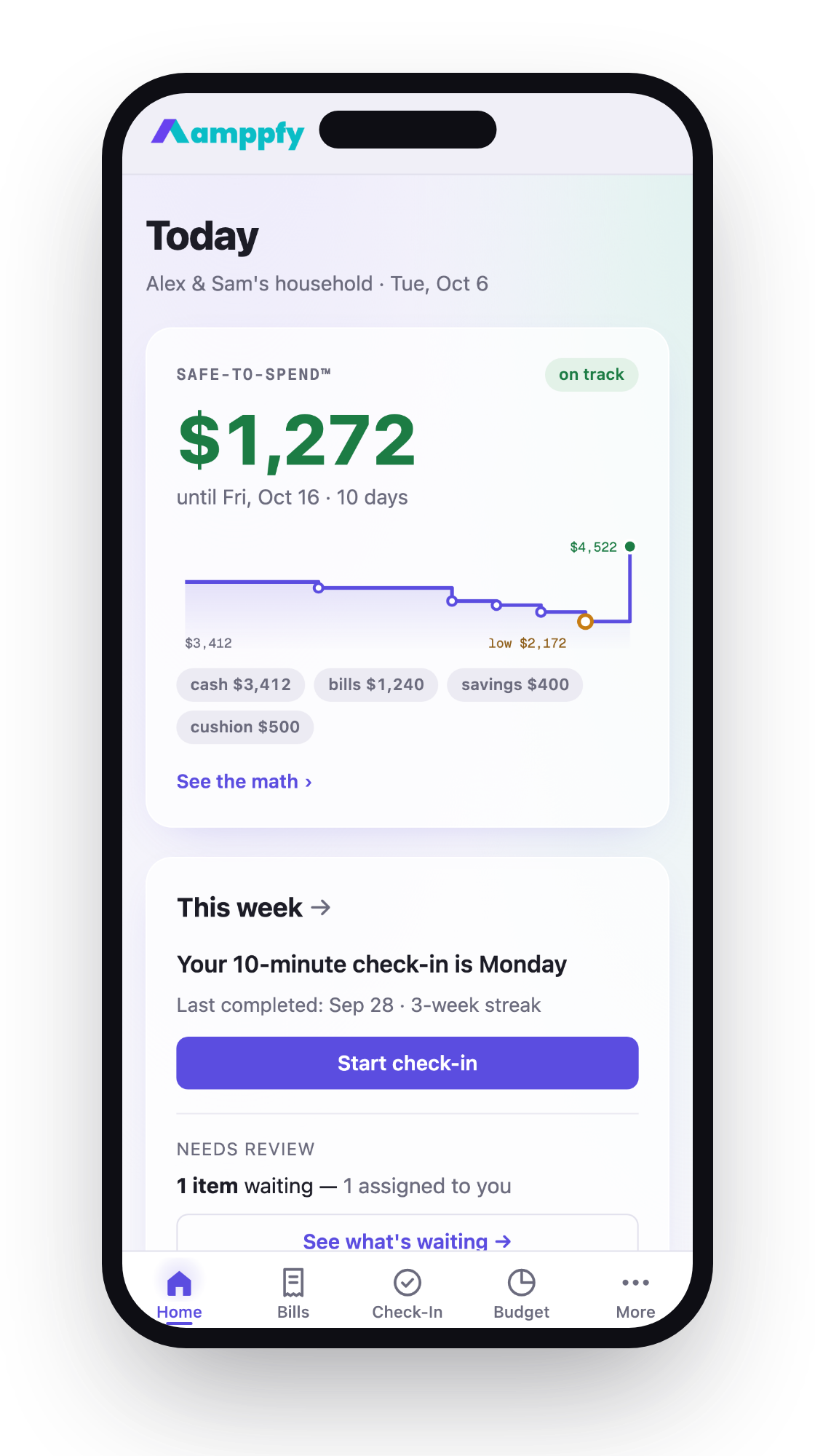
If you want a quick way to see what’s actually safe to spend after your debt payments, bills, and savings goals are covered, get Amppfy free. Enter your balances, bills, and payday once: about ten minutes: and your Safe-to-Spend™ number is always there, showing the math underneath. It’s one number that accounts for everything, so you stop guessing and start deciding.