You’ve had a month where the numbers just worked. Maybe your savings account grew by a surprising amount, or you reached payday with cash still sitting in checking. That feeling is worth holding onto, because it contains a blueprint. The question most people really want answered isn’t whether they can save: it’s how to save more money each month, consistently, without white-knuckling every purchase. Your best savings month already holds the answer. You just need to reverse-engineer it.
Find Your Best Month and Look at Why
Pull up your bank or savings account and scroll back through the last six to twelve months. Find the month where your balance grew the most. Write down the ending balance, the starting balance, and the difference. That difference is your personal best.
Now ask yourself three questions:
- What was different about my income that month?
- What was different about my bills?
- What was different about my daily spending?
Most people skip this step. They remember a good month as a vague feeling rather than a set of facts. But the facts matter. Maybe you got paid three times instead of two. Maybe your car insurance was on a six-month cycle and didn’t hit. Maybe you just happened to stay busy and didn’t eat out much.
Write the answers down, even in your phone’s notes app. You’re building a short case study of your own behavior. The goal isn’t to judge the months that didn’t go well. It’s to identify what made one month click so you can borrow from it.
Here’s a simple way to frame the comparison:
| Category | Best Month | Typical Month |
|---|---|---|
| Take-home pay | $4,800 | $4,400 |
| Bills paid | $1,600 | $1,850 |
| Savings transferred | $600 | $200 |
| Everyday spending | $1,400 | $1,900 |
Even rough numbers help. You’re looking for the gap: the category where your best month pulled ahead. That gap is your starting point.
Was It a Raise, a Smaller Bill, or a Plan?
Once you’ve found the gap, put it in one of three buckets: more income, fewer expenses, or a deliberate plan. Each one tells you something different about how to repeat the result.
More Income
If your best month happened because of overtime, a bonus, or a three-paycheck month, the savings boost was real but not automatic. Three-paycheck months come twice a year for biweekly earners. You can plan for them. Bonuses are less predictable, but you can decide in advance what percentage goes to savings before it hits your checking account.
Fewer Expenses
Sometimes a bill just didn’t show up. An insurance premium paid in full six months ago, a subscription you cancelled the month before, or a utility bill that dropped because of mild weather. Check whether the lower expense was a one-time event or something you can replicate. Cancelling a $45/month subscription is repeatable. A mild-weather electric bill is not.
A Deliberate Plan
This is the most powerful bucket. If your best month happened because you moved money to savings on payday before spending anything else, you found the pattern that works long-term. A 2025 study found that dispositional optimism[1]: the simple expectation that things will turn out okay: predicted savings behavior more strongly than financial literacy, especially in lower-income households. Believing you can save and acting on payday is a stronger combination than knowing every rule in a personal finance textbook.
If your answer is “a plan,” you’re already ahead. If it’s income or expenses, the next section shows you how to convert a lucky month into a default one.
Turning One Good Month Into a Default
A one-time win doesn’t change your finances. A repeated pattern does. The trick is to take whatever made your best month work and build it into your normal routine so it happens without a decision each time.
Start with the math from your best month. Say you saved $600 instead of your usual $200. The extra $400 came from somewhere. If it came from lower everyday spending, ask yourself which habits were different. Did you pack lunch more often? Skip a weekend trip? Cook at home on Fridays? Pick one or two of those habits and commit to them for the next 30 days.
If the extra savings came from timing: a three-paycheck month, for example: redirect the “extra” check before it blends into your regular spending. Set up an automatic transfer for the day after that third payday. The money moves before you mentally assign it to something else.
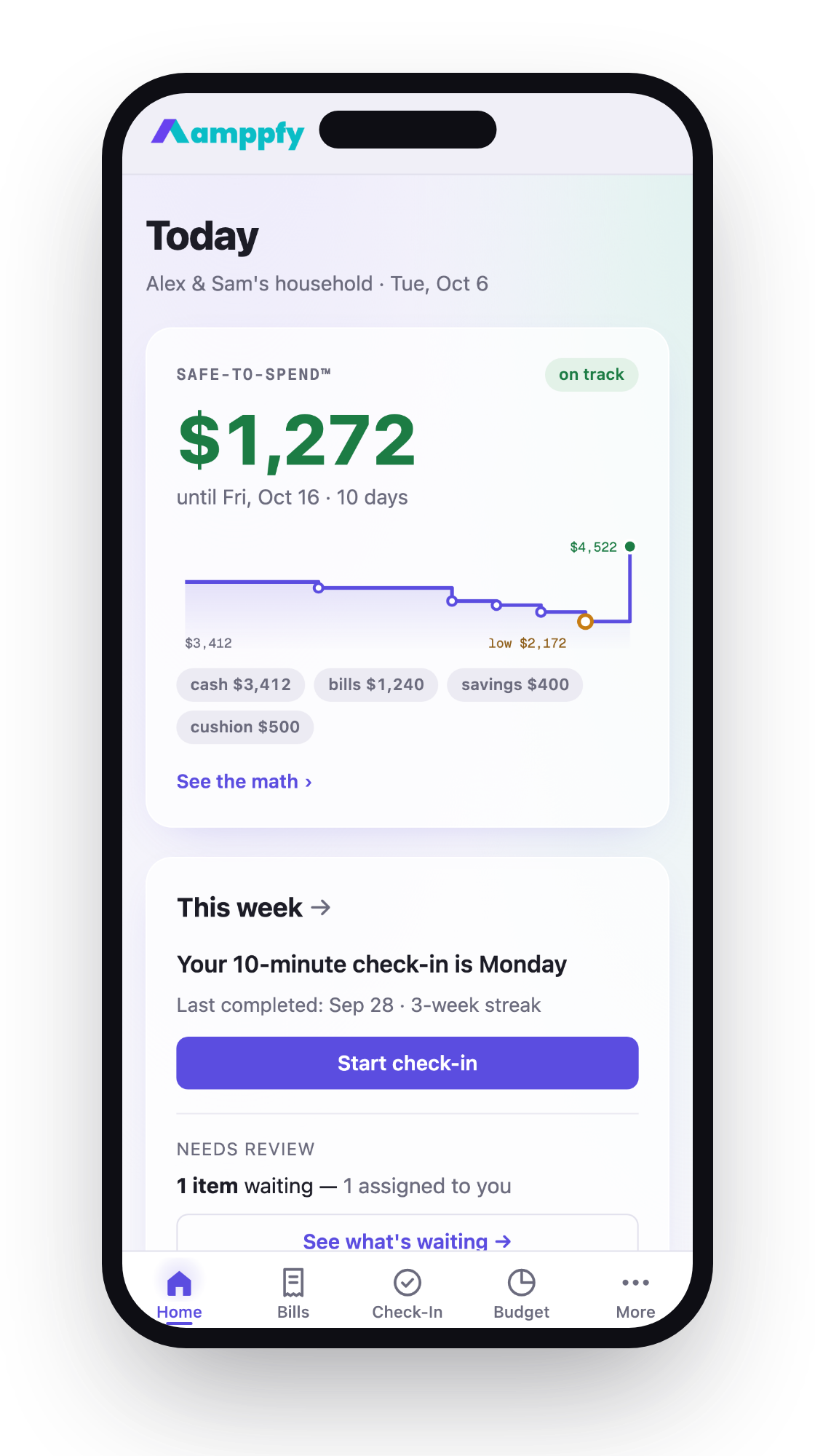
Here’s where a weekly check-in helps. Ten minutes, once a week, to update your balances and see where you stand. Amppfy’s Budget page breaks your month into four slices: Bills, Savings, Subscriptions, and Everyday spending. You can see whether your savings line is tracking toward your best month or drifting back to average. The number you’re watching is Safe-to-Spend™: your available cash minus bills due before payday, minus planned savings, minus a safety cushion. If that number looks healthy, your plan is working.
The household budget built from your plan isn’t a spreadsheet you maintain. It’s a reflection of what you already entered: your bills, your payday, your savings goal. That’s what makes it repeatable. You set it once. The math updates itself.
Automatic features drive most savings increases in workplace retirement plans. In 2025, 73% of all contribution rate increases[2] in 401(k) and 403(b) plans came from auto-escalation, not from participants manually raising their rate. The same principle applies to your checking account. Automate the transfer, and the decision is already made.
Pre-Committing Next Month’s Amount
Pre-commitment means choosing your savings number before the month starts, not after. You’re locking in a decision while you’re clear-headed, rather than negotiating with yourself on a Tuesday night when a sale email hits your inbox.
Here’s a simple process:
- Look at next month’s calendar. Count your paydays.
- List the bills due before each payday.
- Subtract bills and your chosen savings amount from each paycheck.
- The remainder is your Safe-to-Spend™ for that pay period.
Run the math in one line: $4,400 income − $1,800 bills − $500 savings − $400 cushion = $1,700 for everyday spending across the month. If $1,700 feels tight, drop savings to $400. If it feels comfortable, try $550.
The key is writing the number down or entering it into your app before the first paycheck lands. You’re not budgeting every coffee. You’re setting one number: how much moves to savings: and letting the rest take care of itself.
Pre-commitment works because it removes the daily decision. You don’t wake up each morning wondering how much to save this month. You already decided. Research on savings behavior consistently points to the same conclusion: the fewer decisions you have to make, the more likely you are to follow through.
If you share finances with a partner, pre-committing together matters. Agree on the savings number before the month starts. When both of you see the same Safe-to-Spend™ figure, there’s no guessing about what’s available and no awkward end-of-month conversations about where the money went.
When Repeating It Isn’t Realistic
Some months just won’t cooperate. Your car needs new brakes. A medical bill arrives. Holiday gifts stack up. Trying to force your best month’s savings number into a month with genuinely higher costs leads to frustration, not progress.
Here’s how to handle those months without losing momentum:
- Drop to a minimum. Pick the smallest amount you’ll still transfer to savings, even if it’s $25. The habit of moving money on payday matters more than the amount.
- Name the reason. “This month savings is $100 instead of $500 because of a $1,200 car repair.” When you name it, you stop it from becoming a pattern. It’s a specific event, not a trend.
- Set a return date. Decide now which paycheck will go back to your target amount. Put it on your calendar.
Average U.S. household spending reached $78,535 annually in 2024[3], with housing and transportation taking more than half. Some months, those big categories spike. That’s normal. The goal isn’t perfection. It’s a pattern that trends upward over six months, not a streak that never breaks.
A good question to ask yourself after a tough month: “Did I save anything at all?” If yes, you’re still in the game. If no, that’s okay too: just restart on the next payday.
Frequently Asked Questions
How do I figure out how much I should save each month?
Start with your best month as a ceiling and your tightest month as a floor. Your target sits somewhere between those two numbers. If your best month was $600 and your hardest month allowed $50, aim for $300 as a default and adjust up or down based on what’s coming that month.
What if my best savings month was a fluke?
Even flukes contain useful data. If a bonus drove the savings, you learned that windfalls work best when you move them immediately. If low spending drove it, you learned which habits cost you the most in a normal month. Extract one repeatable lesson and build on that.
Should I automate my savings transfer or do it manually?
Automate it. Manual transfers rely on willpower, and willpower is inconsistent. Set the transfer for the day after payday. If your income varies, automate a minimum amount and add a manual top-up on months when you earn more.
How do I save more each month when my bills keep rising?
Review your bills every quarter. Cancel subscriptions you forgot about. Call providers to ask for a lower rate: internet and insurance companies often have retention discounts. Even small reductions, $15 here and $30 there, add up to meaningful savings over a year.
Your Best Month Is a Blueprint, Not a Memory
Your best savings month already proved something: you can do this. The work now is turning that proof into a pattern. Find the gap, pre-commit the number, automate the transfer, and give yourself grace when a month doesn’t cooperate.
If you want one number that tells you what’s safe to spend before your next paycheck, Amppfy does that math for you: enter your balances, bills, and payday once, about ten minutes, and your Safe-to-Spend™ number is always current. It’s free on iPhone and the web. Get Amppfy free and see your number before your next payday.