That promotional 0% rate on your balance transfer card has an expiration date, and it’s getting closer. Maybe you’ve been making minimum payments, maybe you’ve chipped away at it steadily, or maybe you haven’t looked at the statement in months. None of that matters as much as what you do right now. The clock is ticking, and the best move is a paycheck-by-paycheck plan that clears the balance before the rate jumps. Building a budget around your balance transfer ending date turns a stressful deadline into a series of small, manageable steps tied to every payday you have left.
Know the End Date and the Remaining Balance
Start with two numbers. You need the exact date your promotional rate expires and the exact balance still on the card. Both are on your most recent statement, and both are also in your online account under the terms or plan details section.
Don’t guess. Promo periods are usually 12, 15, 18, or 21 months from the date the transfer posted, not from the date you applied or the date the card arrived. A one-month miscalculation can cost you hundreds in surprise interest.
Where to find the promo end date
- Your monthly statement, often in a box labeled “promotional APR details” or “plan summary.”
- Your online card account under “balance transfer plan” or “special offers.”
- The original approval letter or email from the card issuer.
Confirm the remaining balance
Pull up your current balance, then subtract any pending payments that haven’t posted yet. Write this number down. If you’ve been making purchases on the same card (more on that later), your payoff balance may be higher than you expect.
Here’s a quick reference for what you need before moving on:
| Item | Where to find it | Why it matters |
|---|---|---|
| Promo end date | Statement or online account | Sets the deadline for your plan |
| Current balance | Statement or app | Tells you the total to divide |
| Minimum payment | Statement | Confirms the floor you must hit each month |
| Regular APR | Cardmember agreement | Shows what you’ll owe if you miss the deadline |
Once you have these, you have everything you need to build a paycheck plan. No spreadsheet required, just division.
Dividing What Is Left by the Paychecks You Have
Count your remaining paychecks between now and the promo end date. Be precise. If you get paid biweekly and your promo ends August 15, count every payday from your next check through the last one before August 15.
Say your balance is $4,200 and you have seven paychecks left. Your target payment per paycheck: $4,200 / 7 = $600.
That’s the core of this plan. Every payday, $600 goes to the card before you spend on anything else.
What if $600 per paycheck feels impossible?
It might. Here are three honest options:
- Cut a recurring expense temporarily. Cancel a streaming service, pause a subscription box, or cook at home one extra night a week. Even $80 per paycheck freed up makes a difference over seven pay periods.
- Sell something. A used phone, old furniture, or unused gear can knock $200 to $500 off the total in one shot.
- Pick up a short gig. Overtime, freelance work, or a weekend side job for just the remaining months can close the gap.
The goal isn’t perfection. It’s getting as close to zero as possible before the rate changes. Paying off $3,800 of a $4,200 balance is dramatically better than paying off $1,000.
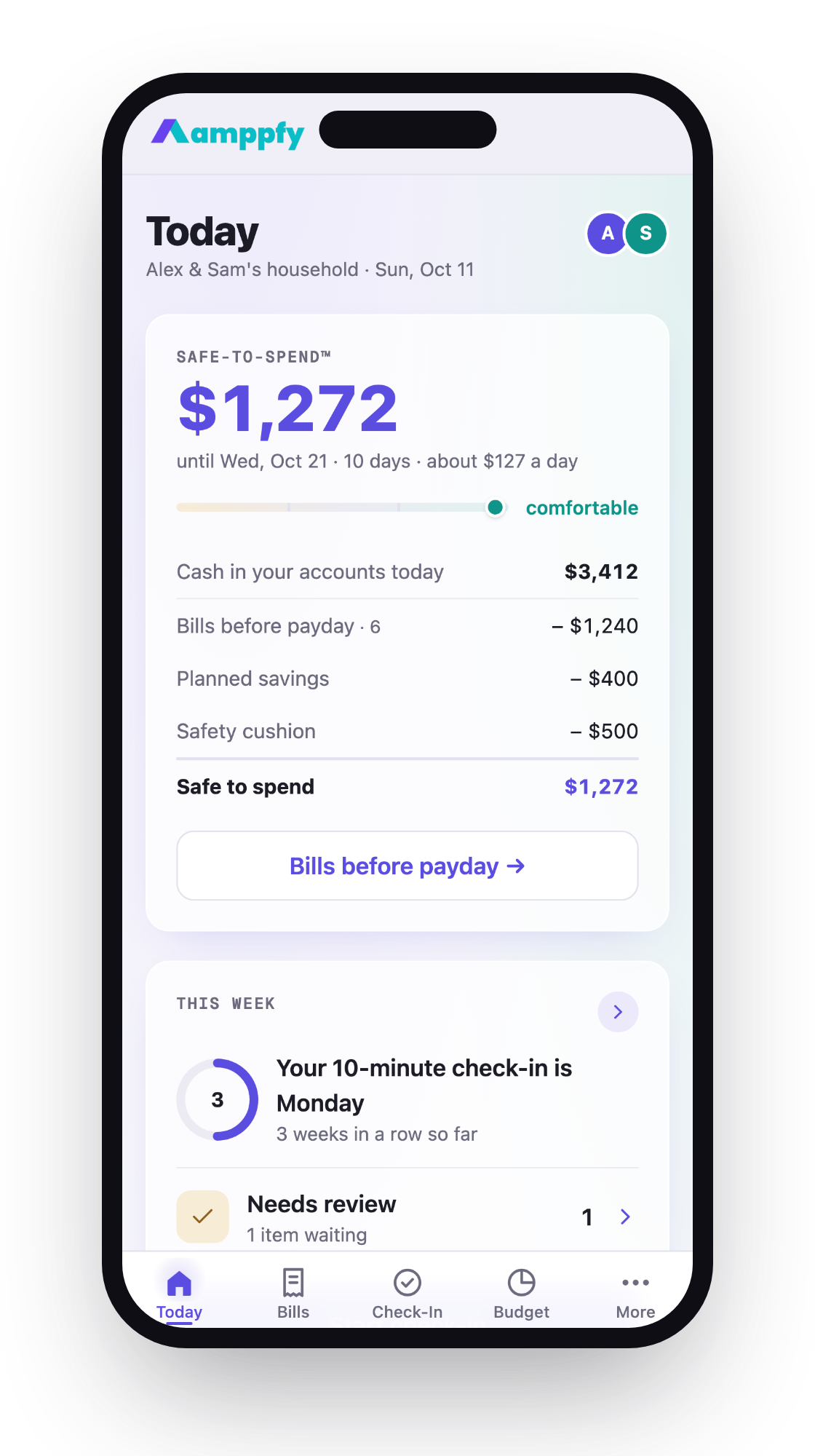
If you use Amppfy, you can set the card payment as a recurring bill tied to each payday. Your Safe-to-Spend™ number (available cash minus bills due before payday, minus planned savings, minus a safety cushion) will automatically reflect the money already spoken for, so you know what’s actually left for groceries and gas.
What Happens to the Rate After the Promo
This is where the math gets uncomfortable. Most balance transfer cards revert to a regular purchase APR between 18% and 29% once the promo window closes. According to the Federal Reserve’s most recent data, the average credit card interest rate was above 22% as of late 2025. That rate applies to whatever balance remains.
How the interest actually hits
Some people assume interest only applies to new purchases after the promo ends. That’s wrong. The remaining balance from day one of the post-promo period starts accruing interest immediately. On a $3,000 leftover balance at 24% APR, you’d owe roughly $60 in interest in the first month alone, and that compounds.
Here’s a quick look at what different leftover balances cost you monthly at two common rates:
| Remaining balance | Monthly interest at 22% APR | Monthly interest at 27% APR |
|---|---|---|
| $1,000 | ~$18 | ~$23 |
| $2,500 | ~$46 | ~$56 |
| $5,000 | ~$92 | ~$113 |
Those are just interest charges. They don’t reduce your balance at all. Every dollar you leave on the card after the promo is a dollar that starts working against you.
Does retroactive interest apply?
Some store cards and a few bank cards charge deferred interest, meaning if you don’t pay the full balance by the promo end date, they charge interest on the original transfer amount from day one. This is different from a standard balance transfer, which typically does not have deferred interest. Check your terms. If you see the phrase “deferred interest” anywhere, paying in full is even more critical.
Keeping New Spending Off the Card
This is the part people skip, and it’s the part that wrecks the plan. If you’re funneling $600 per paycheck toward the card but also putting $200 in new charges on it, you’re running on a treadmill.
Stop using the balance transfer card for purchases. Put it in a drawer. Use a debit card, cash, or a different credit card you pay in full each month. The reason is simple: most card issuers apply your payment to the lowest-rate balance first. Your new purchases might carry 24% interest from day one, while your payment gets applied to the 0% transfer balance. You end up paying interest on new charges even though you thought you were ahead.
A simple rule
One card for payoff. A different card (or debit) for daily spending.
If separating cards feels hard to manage, set a weekly check-in. Ten minutes once a week: update your balances, confirm the next payment amount, and make sure no new charges snuck onto the transfer card. Amppfy’s bill reminders and payday nudges can handle the timing so you don’t have to remember on your own.
Couples sharing expenses should talk about this explicitly. If both partners have access to the balance transfer card, both need to agree it’s off-limits for spending until the balance is gone. One surprise charge from a shared card can throw off a month’s payment plan.
A Worked Example with Six Paychecks to Go
Meet Sam. Sam transferred $5,400 to a 0% card 15 months ago. The promo period is 18 months, so three months remain. Sam gets paid biweekly, which means six paychecks before the deadline.
The setup
- Remaining balance: $3,600 (Sam paid some down already)
- Paychecks left: 6
- Target per paycheck: $3,600 / 6 = $600
The paycheck-by-paycheck plan
| Paycheck | Date | Payment | Balance after payment |
|---|---|---|---|
| 1 | March 14 | $600 | $3,000 |
| 2 | March 28 | $600 | $2,400 |
| 3 | April 11 | $600 | $1,800 |
| 4 | April 25 | $600 | $1,200 |
| 5 | May 9 | $600 | $600 |
| 6 | May 23 | $600 | $0 |
Sam’s promo ends June 1. The balance hits zero a full week before the rate changes.
What if Sam can only do $450 per paycheck?
Six payments of $450 = $2,700 paid. That leaves $900 on the card when the promo expires. At 24% APR, that $900 costs about $18 per month in interest. Not ideal, but far better than owing the full $3,600 at 24%, which would cost roughly $72 per month in interest alone.
The point: partial progress still saves real money. If $600 per paycheck isn’t possible, $450 is still worth doing. Adjust, don’t abandon.
Sam’s Safe-to-Spend math on payday
Here’s what Sam’s budget looks like each payday using the four-line formula:
$2,100 paycheck – $840 bills (including the $600 card payment) – $200 savings – $150 cushion = $910 Safe-to-Spend
That $910 covers groceries, gas, and everything else until the next paycheck. No guessing.
Frequently Asked Questions
Should I do another balance transfer if I can’t pay it off in time?
You can, but it’s not free. Most new balance transfer cards charge a 3% to 5% fee on the transferred amount. On a $3,000 balance, that’s $90 to $150 added to your debt. If the alternative is paying 24% interest for months, a second transfer might still save money. Run the numbers both ways before applying. Also check whether your credit score supports approval for a new card with a competitive offer.
What if I miss a payment during the promo period?
Missing a minimum payment can trigger a penalty APR, sometimes 29.99% or higher, and some issuers will revoke the promotional rate entirely. Set up autopay for at least the minimum amount due. Your paycheck plan payments can go on top of that. Protecting the 0% rate is the single most important thing you can do during this stretch.
Can I pay more than my target amount if I have extra cash?
Absolutely. A tax refund, bonus, or sold item can accelerate the payoff. Any extra payment above your per-paycheck target just moves your zero-balance date closer. There’s no prepayment penalty on credit cards.
Does paying off a balance transfer card help my credit score?
Yes. Paying down the balance reduces your credit utilization ratio, which is one of the largest factors in your score. A card that was at 80% utilization dropping to 0% can produce a noticeable score increase within one to two billing cycles.
Your Next Ten Minutes
You have a deadline, a balance, and a number of paychecks. The entire plan fits on an index card. Divide, commit, and protect the 0% rate by keeping new spending off that card.
The hardest part isn’t the math. It’s making the first payment feel automatic instead of optional. Set the recurring payment now, today, before the next payday arrives. If you want a tool that shows you exactly what’s safe to spend after that payment is accounted for, Amppfy is free and takes about ten minutes to set up at amppfy.com/app/. One number, updated every payday, no bank login required.
Six paychecks from now, you’ll either owe zero or owe interest. Pick zero.