Close Menu

    Subscribe to Updates

    Get the latest creative news from FooBar about art, design and business.

    What's Hot

    Budget Categories You Can Skip (and the Few That Matter)

    October 2, 2026

    Living on Last Month’s Income: How a One-Month Buffer Changes Everything

    October 2, 2026

    Fun Money for Each Partner: How Much, Where It Comes From, and Why It Helps

    October 2, 2026
    Facebook X (Twitter) Instagram
    Amppfy
    • AppNew
      • Amppfy on iPhone — one clear number with the math under itYour number, in your pocketFree on iPhone, with the same account on the web.
        • Download on the App Store
        • Prefer the web? Sign up free ›
      • The app
        • OverviewOne clear number for what’s safe to spend before payday
        • Safe-to-Spend™The four-line math, always shown
        • Weekly check-inTen minutes a week keeps it honest
      • Features
        • Bills & paydaysEvery bill and payday on one calendar
        • GoalsSavings that fund themselves first
        • For couplesTwo logins, one number you both trust
        • SubscriptionsWhat you pay monthly, and what cancelling gives back
        • Calendar & heads-upsYour month at a glance, a heads-up before bills land
        • Net worth & payday nudgeThe whole picture, month by month
      • Trust & help
        • Security & privacyJust your balances, optional two-step verification
        • Help centerSetup, the number, check-ins, FAQ
        • Open the web appSame account, any browser
    • Personal Finance
      • Money Basics
        • How to Master Money Management
        • Psychology of Money Habits
        • How to Set Financial Goals
        • Money Management for Every Life Stage
        • Beyond Budgeting: Advanced Money Skills
        • Financial Literacy
        • Money Management
        • Know Your Money
        • Cash Flow
      • Financial Wellness
        • Understand Your Money Relationship
        • Build a Healthy Money Mindset
        • 7 Money Tips for Financial Freedom
        • Take the Money Health Quiz
        • Monthly Financial Reviews
        • Money Habits
        • Money Mindset
        • Financial Goals
        • Financial Independence
      • Side Hustles & Extra Income
        • 8 Realistic Side Hustles
        • How to Make Money Online
        • Passive Income Ideas That Work
        • Passive Income 101: Ideas That Scale
        • Spot a Bad Passive Income Deal
        • Start Freelance Writing: First $1,000
        • Budgeting with Irregular Income
        • Side Hustle Ideas
        • Passive Income
        • Gig Economy
      • Major Money Decisions
        • Plan a Major Purchase Without Debt
        • Car Buying: Save, Finance, or Lease?
        • Used Car Buying & Negotiation Tips
        • What to Save For vs. Finance
        • Life Insurance 101: Coverage Needs
        • Term vs. Whole Life Insurance
        • Buying a Car
        • Major Purchase Planning
        • Home Improvement
        • Life Insurance
      • Money Tools & Calculators
        • Net Worth Calculator
        • Cost of Living Calculator
        • Compound Interest Calculator
        • Monthly Budget Calculator
        • Savings Goal Calculator
        • Emergency Fund Calculator
        • Savings Calculator
        • Do Money Management Tools Work?
        • Spend Tracking
        • Net Worth
    • Savings
      • Budgeting Tips
        • The 50/30/20 Rule Explained
        • How to Make a Monthly Budget
        • How to Budget Money in 5 Steps
        • The Envelope Method Explained
        • Best Budgeting Apps Compared
        • Common Budgeting Mistakes
        • Budgeting for Couples
        • Start a Budget
        • Budget Methods
        • 50/30/20 Budgeting
      • Ways to Save
        • Save $500 This Month
        • 14 Ways to Cut Monthly Expenses
        • How to Save Money on Groceries
        • Lower Your Utility Bills
        • Budget Swaps for Big Purchases
        • Save Money on Car Insurance
        • Cut Expenses
        • Groceries Savings
        • Smart Saving Strategies
      • Emergency Fund
        • How Much Emergency Fund to Save
        • How to Build an Emergency Fund
        • Start a Rainy Day Fund
        • Sinking Funds vs. Emergency Fund
        • Emergency Fund Essentials
        • Where to Keep Your Emergency Fund
        • Best Emergency Fund Tips
        • Emergency Savings
        • Emergency Buffer
      • Savings Goals & Plans
        • How to Create a Savings Plan
        • How to Set Savings Goals
        • Track Spending Without Spreadsheets
        • 529 College Savings on a Budget
        • Saving During a Recession
        • Budget a Debt-Free Vacation
        • Vacation Budgeting
        • Family Budgeting
        • Savings Goals
        • Recession Saving
      • Savings Tools & Planning
        • Budget Calculator
        • Savings Goal Calculator
        • Emergency Fund Calculator
        • Savings Calculator
        • Compound Interest Calculator
        • Savings Buckets
        • Sinking Funds
        • Maximize Your Savings
        • Savings Tips
        • Savvy Saver
    • Debt
      • Get Out of Debt
        • Debt Snowball vs. Avalanche
        • Pay Off Credit Card Debt Fast
        • Beginner’s Credit Card Payoff Plan
        • Build a Debt Payoff Calendar
        • Use Windfalls to Crush Debt
        • Debt Free Journey
        • Debt Payoff
        • Credit Card Debt
      • Student & Auto Loans
        • Student Loans 101
        • Get Out of Student Loan Debt
        • Income-Driven Repayment Plans
        • Best Student Loan Repayment Option
        • Auto Loans: Shop & Save on Interest
        • Pay Off Your Auto Loan Early
        • Student Loans
        • Auto Loans
        • Auto Loan Debt
      • Debt Consolidation
        • Debt Consolidation Pros & Cons
        • Is Consolidating Debt Right for You?
        • Balance Transfers to Pay Off Debt
        • HELOC to Pay Off Credit Cards
        • 401(k) Rollover to Pay Down Debt
        • How to Refinance a Personal Loan
        • Before You Take a Personal Loan
        • Personal Loans
        • Personal Loan Refinance
      • Managing Debt
        • Navigating Medical Debt
        • Budgeting with a High-Interest Loan
        • Build a Debt-Repayment Fund
        • Debt Payoff for Single Parents
        • Save for a Wedding Without Debt
        • Medical Debt
        • Single Parent Debt
        • Personal Loan Debt
      • Debt Relief & Protection
        • When Bankruptcy Is an Option
        • Avoid Predatory Lenders & Scams
        • Negotiate with Creditors: Scripts
        • Budgeting Around Wage Garnishment
        • Debt Relief
        • Bankruptcy
        • Creditor Negotiation
        • Predatory Lenders
        • Wage Garnishment
    • Credit
      • Credit Scores
        • Credit Score 101
        • Check & Improve Your Credit Score
        • Credit Utilization: A Simple Fix
        • Check Your Credit Score Free
        • Rebuild Credit After a Setback
        • How Credit Scores Are Calculated
        • What Credit Scores Mean
        • Credit Health
      • Credit Reports
        • Read & Dispute Your Credit Report
        • Dispute Template That Works
        • How Long Negative Marks Last
        • Remove Negative Items
        • What to Expect as Items Age Off
        • Understanding Credit Utilization
        • Credit Basics
        • Checking Your Credit Score
      • Building Credit
        • Best Starter Credit Cards
        • Secured vs. Unsecured Cards
        • Secured Cards & Credit-Builder Loans
        • Build Credit as a Gig Worker
        • Boost Your Score Before a Mortgage
        • Borrow Now vs. Wait
        • Build Credit
        • Credit Cards for Beginners
        • Credit for Gig Workers
      • Credit Cards
        • Best Rewards Credit Cards
        • Credit Card Hacks: Intro APRs
        • Balance Transfers Explained
        • Earn Rewards Without Debt
        • Responsible Card Use & Rewards Tips
        • Lost or Stolen Card: What to Do
        • Credit Card Rewards
        • Balance Transfer Cards
      • Credit Protection & Safety
        • Identity Theft Checklist
        • Truth About Credit Freezes
        • How to Freeze & Thaw Your Credit
        • Credit Monitoring vs. Freezes
        • Credit Protection
        • Credit Freeze
        • Fraud Awareness
        • Financial Safety
    • Investing
      • Start Investing
        • Investing 101: Beginner’s Guide
        • Start Investing with $100
        • Start with $50/Month
        • Scared of the Market? Start Here
        • Open a Brokerage Account
        • Invest While Paying Down Debt
        • How to Start Investing
        • Start with Little Money
        • Fear of Investing
      • Investing Strategy
        • Roth IRA vs. Traditional IRA
        • Dollar-Cost Averaging Explained
        • DCA vs. Lump-Sum Investing
        • 5 Simple Starter Portfolios
        • Asset Allocation Beyond 60/40
        • How to Rebalance Your Portfolio
        • Diversify Your Portfolio
        • Investing Mistakes to Avoid
        • Investment Strategies
        • Diversification
      • Stocks
        • How the Stock Market Works
        • How to Make Money in Stocks
        • How to Read Stock Charts
        • Analyze Stocks in 5 Steps
        • P/E Ratio for Beginners
        • Bullish vs. Bearish Explained
        • How Stock Trading Works
        • Stock Market Basics
        • Stock Analysis
        • Stock Trading Strategies
      • Funds & Wealth Building
        • Beginner’s Guide to Index Funds
        • Best S&P 500 Index Funds
        • Mutual Funds vs. ETFs
        • How to Invest in ETFs
        • Dividend Investing for Beginners
        • Build a Dividend Income Stream
        • Maximize Your 401(k) Match
        • Build a Retirement Portfolio
        • Index Funds
        • Dividend Investing
      • Brokerages & Platforms
        • Vanguard vs. Fidelity
        • Fidelity vs. Schwab
        • Robinhood vs. E*Trade
        • Robo-Advisors vs. Human Advisors
        • Robo-Advisor or DIY Investing?
        • How Brokerage Fees Affect Returns
        • Manage Multiple Brokerage Accounts
        • Brokerages
        • Investment Platforms
        • Robo Advisors
    • Home
      • Home Buying
        • First-Time Homebuyer Checklist
        • How Much Down Payment You Need
        • How Much Home Can You Afford?
        • Renting vs. Buying
        • True Costs of Homeownership
        • Qualify as a First-Time Buyer
        • Buying a Fixer-Upper
        • First-Time Home Buyer
        • Home Affordability
      • Mortgage
        • First-Time Buyer’s Mortgage Guide
        • Fixed vs. Adjustable Mortgage
        • How to Refinance a Mortgage
        • Mortgage Payoff Strategies
        • Winning in a High-Rate Market
        • Mortgage Amortization Calculator
        • Down Payment Assistance Programs
        • Mastering Refinance Rate Locks
        • Mortgage Rates
        • Mortgage Refinance
        • Debt-to-Income Calculator
      • Real Estate Investing
        • Real Estate Crowdfunding Platforms
        • Rental Property Cash Flow
        • REITs for Passive Income
        • REITs vs. Direct Ownership
        • Fix-and-Flip Opportunities
        • Airbnb & Short-Term Rental ROI
        • Buying a Multi-Family Property
        • 1031 Exchange to Defer Taxes
        • Real Estate Investing
        • Rental Property
      • Home Insurance
        • Homeowners Insurance Guide
        • Compare Home Insurance Quotes
        • Best Home Insurance Companies
        • Choose Your Deductible
        • Renters vs. Homeowners Insurance
        • File a Property Insurance Claim
        • Home Insurance Coverage Basics
        • Home Insurance Rates
        • Home Insurance Claims
      • Home Equity & Ownership
        • Smart Ways to Use Home Equity
        • Save for a Down Payment
        • Down Payment Strategies
        • Estimate Property Appreciation
        • Home Equity
        • HELOC Payoff Strategy
        • Home Down Payment
        • Home Ownership
        • Home Renovation
    • Bank
      • Banking Basics
        • Open Your First Bank Account
        • Online Banks vs. Traditional Banks
        • How to Avoid Bank Fees
        • How to Switch Banks
        • Read Your Bank Statement
        • Second-Chance Checking Accounts
        • Get Better Rates from Your Bank
        • Banking Basics
        • How to Choose a Bank
        • Compare Banks
      • Checking Accounts
        • Best Checking Accounts
        • Choose the Right Checking Account
        • Overdraft Protection Guide
        • Stop Paying Overdraft Fees
        • The True Cost of Checking Fees
        • Mobile Check Deposits
        • How Long Checks Take to Clear
        • Checking Accounts
        • Best Checking Account
      • Savings Accounts & CDs
        • High-Yield Savings Explained
        • Best High-Yield Savings Account
        • Savings Accounts vs. CDs
        • What Is a CD?
        • Money Market vs. Savings Account
        • HYSA vs. Treasury Bills
        • How Savings Interest Is Calculated
        • Savings Account Minimum Balances
        • Savings Account
      • Bank Smarter
        • Top Banks for High-APY Savings
        • How Much Cash in Each Account
        • How Many Savings Accounts to Have
        • Managing Multiple Bank Accounts
        • Where to Put Your Money
        • When to Save vs. When to Invest
        • Savings Account Fees to Avoid
        • Banking Tips
        • Digital Banking
      • Banking Safety & Security
        • Set Up Bank Account Alerts
        • Avoid Check Scams
        • Missing Debit Card: Next Steps
        • When to Stop a Check Payment
        • Bank Fees
        • Debit Cards
        • Joint Bank Accounts
        • Banking How-To Guides
    • Tax
      • Tax Filing
        • Tax Filing for Beginners
        • How to File Freelance Taxes
        • Choose the Right Tax Software
        • Change Withholding Mid-Year
        • Handling Back Taxes
        • Year-End Tax Checklist
        • How to File Taxes
        • Tax Filing Basics
        • Tax Tips
      • Deductions & Credits
        • Tax Deductions 101
        • Tax Credits vs. Deductions
        • Child Tax Credit Explained
        • Child & Dependent Care Credit
        • Claim the Saver’s Credit
        • Moving Expense Deductions
        • Tax Deductions
        • Tax Credits
        • Child Tax Credits
      • Tax Strategy
        • Avoid Audit-Triggering Mistakes
        • Capital Gains Taxes Explained
        • IRA Tax Rules
        • Tax Basics for New Investors
        • Minimize Taxes for Your Heirs
        • Capital Gains Taxes
        • Retirement Taxes
        • Adjusted Gross Income
      • Tax Savings
        • Use an HSA to Lower Your Tax Bill
        • HSA: The Triple Tax Advantage
        • 529 Plans for Education Savings
        • Max the Match, Then What?
        • Tax Savings
        • Tax Refunds
        • Tax Bill
        • HSA
      • Gig & Life Situation Taxes
        • Freelancer & Gig Worker Taxes
        • Side-Gig Income & Your Taxes
        • Tax Strategies for Side Hustles
        • Taxes for Life Situations
        • Freelance Taxes
        • Gig Work Taxes
        • Child Tax
        • Dependent Care Credit
    • Sign In
    • Sign Up
    Amppfy
    Home » Budgeting and Saving » Kids’ Allowance on Payday: Teaching Money With Your Own Pay Cycle
    Budgeting and Saving

    Kids’ Allowance on Payday: Teaching Money With Your Own Pay Cycle

    Pay your kids on your own payday so allowance stops slipping through the cracks and the money lesson sticks.
    Thomas T.By Thomas T.October 2, 2026Updated:October 2, 202610 Mins Read
    Facebook Twitter LinkedIn Email Copy Link
    Kids' Allowance on Payday: Teaching Money With Your Own Pay Cycle
    Share
    Facebook Twitter LinkedIn Email Copy Link

    Most parents want their kids to understand money, but the timing of allowance always feels random. You pick a day, forget it, scramble to find cash, and the lesson fizzles. A simpler path: pay your kids on the same day you get paid. Tying your children’s allowance to your own payday turns an abstract chore into a household rhythm that sticks. Your money arrives, their money arrives, and the whole family practices the same cycle of earning, planning, and waiting.

    Why Paying Kids on Your Payday Keeps It Simple

    The biggest reason allowance systems fail is inconsistency. You mean to pay on Sunday, but Sunday gets busy. By Tuesday you’ve forgotten. Your kid stops expecting it, and the money lesson evaporates.

    Linking your child’s allowance to your payday removes the guesswork. You already know when your check hits. That date is anchored in your calendar, your bills, and your routine. Adding one small task to an existing habit costs almost no mental effort.

    Amppfy app icon

    Amppfy

    Free on iPhone and the web

    Know what’s safe to spend before payday

    Your balances, bills, and payday. Ten minutes to one clear number, with the math shown under it. Learn more ›

    Download on the App Store

    Prefer the web? Sign up free ›

    Free  ·  No credit card  ·  Just your balances

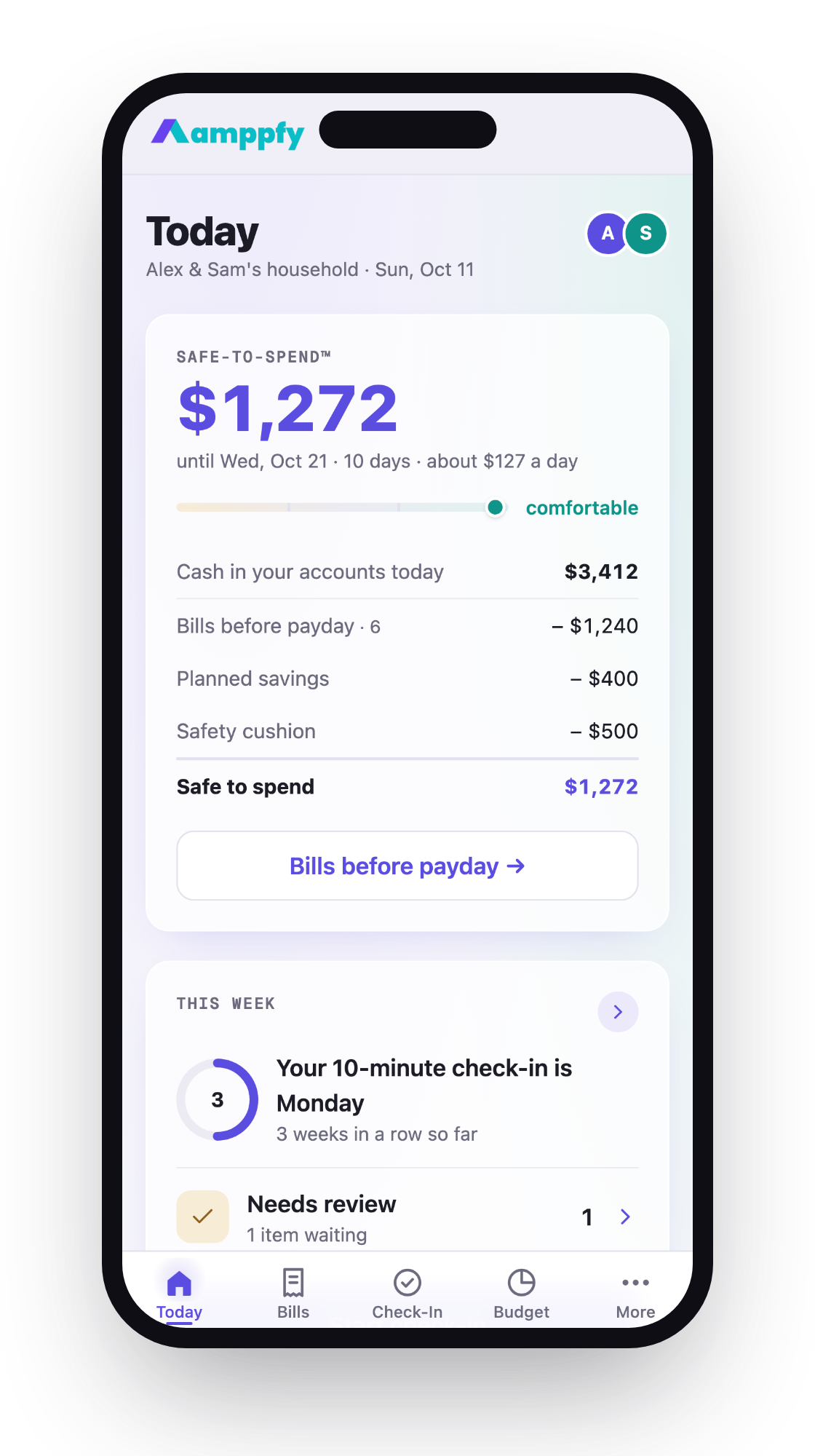
    Amppfy dashboard on an iPhone showing the Safe-to-Spend™ number with the math under it

    There’s a practical benefit for your own budget, too. You know exactly how much cash leaves your account and when. A kids’ allowance tied to payday shows up as a predictable line item, not a surprise withdrawal on a random Wednesday.

    Kids also absorb a real-world pattern. They learn that money arrives on a schedule, not on demand. They see you check your own accounts, pay bills, and set aside savings. That modeling matters more than any lecture.

    Here’s what the rhythm looks like in practice:

    Payday task (you) Payday task (your kid)
    Check account balance Receive allowance
    Pay bills due before next payday Divide money into jars or envelopes
    Fund savings goals Decide what to save vs. spend
    Note your Safe-to-Spend number Count what’s left for the next cycle

    The parallel is powerful. Your child mirrors your behavior without you having to explain abstract concepts. They just live it.

    One more thing: if you get paid biweekly, your kid gets paid biweekly. That longer gap between paydays teaches patience in a way weekly payments can’t. A 10-year-old waiting 14 days for $10 is practicing the same muscle you use waiting for your own check.

    Picking an Amount That Fits Your Spending Number

    The classic rule of thumb is $1 per year of age per week. A 7-year-old gets $7. A 12-year-old gets $12. It’s a starting point, not a law.

    What matters more is whether the amount fits your household cash flow. If you’re already watching your Safe-to-Spend™ number to make sure bills and savings are covered before you spend freely, your kid’s allowance needs to live inside that math. It’s a real expense, and it deserves a line in your plan.

    Try this quick calculation. Take your Safe-to-Spend after bills, savings, and your cushion are subtracted. Your child’s allowance should feel comfortable inside what’s left. If $10 biweekly per kid doesn’t change your breathing, that’s your number. If it does, start at $5 and adjust later.

    A few guidelines to keep the amount honest:

    • Match it to what you expect them to buy. If they’re covering their own snacks at school, the number needs to be high enough to actually do that.
    • Don’t inflate it to avoid guilt. A smaller, consistent amount teaches more than a large, irregular one.
    • Round to bills you have on hand or set up a simple digital transfer if your kid is old enough for a prepaid card.

    By age 10, many families shift to a hybrid system that combines a base allowance with extra “commissions” for additional chores[1]. The base stays tied to payday. The commissions get paid when the task is done. This keeps the rhythm intact while teaching that extra effort produces extra income.

    The number will change over time. That’s fine. Start where your budget breathes easily and revisit every six months.

    Spend, Save, Give: Three Jars That Work

    Handing a kid cash is step one. Showing them how to split it is where the learning starts.

    The spend-save-give model is a widely recommended framework with a suggested split of $2 for savings, $2 for spending, and $1 for sharing out of every $5[2]. Three jars, three envelopes, three sections of a notebook: the container doesn’t matter. The habit does.

    Here’s how a $10 biweekly allowance breaks down:

    Jar Amount Purpose
    Spend $4 Whatever they want, no questions asked
    Save $4 A bigger goal they’re working toward
    Give $2 Donation, gift for a friend, or community cause

    The “spend” jar is freedom. Let them buy something pointless. That $4 gummy bear purchase is a lesson you can’t teach with words. They’ll feel the sting of an empty jar long before the next payday, and that feeling is the entire point.

    The “save” jar builds patience. Kids as young as six or seven can work toward multi-month goals. Data shows that top savings goals among young savers include cars, college, and computers[3]: proof that even small children think long-term when given a structure.

    The “give” jar is optional but valuable. It shifts the conversation from “what can I get” to “what can I do.” Some families let kids choose a cause each quarter. Others use it for birthday gifts for friends. Either way, it rounds out the picture.

    Adapting the Split for Older Kids

    A 13-year-old might prefer a 50/30/20 split: 50% spend, 30% save, 20% give. Let them propose their own ratio and defend it. That conversation alone is worth more than the dollars involved.

    You don’t need a formal system. Three labeled envelopes in a drawer work fine. The key is that splitting happens on payday, every payday, before anything gets spent.

    Letting Them Feel a Short Week

    Here’s where most parents stumble. Your kid blows through their spend jar three days after payday. They ask for more. You want to help.

    Don’t.

    Financial experts warn that paying kids early when they run out of money works like a payday loan and undermines the core lesson of making money last[4]. The discomfort of an empty jar is the teacher. Your job is to stay calm and let the lesson land.

    This doesn’t mean you ignore your child. You acknowledge the feeling and point forward:

    • “That’s tough. Your next payday is Friday. What will you do differently?”
    • “You’ve got $0 in spend and 9 days to go. Want to plan next time’s jar together?”
    • “I’ve had short weeks too. Here’s what I do: I check what’s left before I buy anything extra.”

    Notice the tone. No shame. No “I told you so.” Just a fact and a next step.

    What If They Ask to Borrow Against Next Payday?

    Some parents allow a one-time advance with a clear repayment. If you go this route, subtract it from the next payout in front of them. Write it down. Make the math visible: $10 allowance minus $4 advance equals $6 next payday. They’ll feel the smaller envelope and remember.

    A better default is to simply wait. The waiting builds the skill. If your child can survive a short week at age 8, they’re practicing what most adults still struggle with at 35.

    You’re not being harsh. You’re being honest. Money runs out. The next check comes on a schedule, not on demand. That’s the same reality you face, and sharing it openly makes the lesson stick.

    Raising It as They Take On Costs

    A static allowance stops teaching after a while. As your child gets older, the amount should grow, but so should their responsibilities.

    The simplest approach: when you stop buying something for them, add that cost to their allowance. You used to buy their school supplies. Now that’s their job. You add $5 per pay period and they manage it. You used to pay for movie tickets with friends. Now that comes from their funds.

    This mirrors how adult income works. A raise comes with new expenses. The paycheck gets bigger, but so do the bills.

    Here’s a sample progression:

    Age Biweekly allowance They now cover
    6-8 $5 Small treats, stickers, small toys
    9-11 $10 Snacks, basic entertainment
    12-14 $20 School supplies, outings with friends
    15+ $30-40 Clothing basics, phone costs, gas money

    Each bump is a conversation, not a surprise. Sit down on a payday and walk through the new number together. Show them the math: “Your allowance is going up by $10, but you’re now paying for X and Y. That means your actual spending power didn’t change much. You just have more control.”

    This is also a natural time to revisit the jar split. A 14-year-old covering their own movie tickets might shift to 60% spend, 25% save, 15% give. Let them propose it. Negotiate if needed. The discussion is half the education.

    If you use Amppfy to see your own Safe-to-Spend number each payday, you can show your teen the same concept applied to your household. Your cash minus your bills minus your savings minus your cushion equals what’s actually available. Their version is simpler, but the logic is identical. That connection between their jars and your real budget closes the loop.

    Frequently Asked Questions

    What age should I start giving an allowance tied to my payday?
    Most kids can handle a basic allowance by age 5 or 6. At that age, keep it small: $2-3 per pay period. The goal isn’t the money itself. It’s the rhythm of receiving, splitting, and waiting. If your child can count coins and understands “we have to wait until Friday,” they’re ready.

    Should allowance be tied to chores?
    This is a personal call. A base allowance teaches budgeting regardless of behavior. Tying all of it to chores risks a kid deciding they’d rather skip the money than clean their room. A hybrid approach works well: a guaranteed base that arrives on payday, plus optional commissions for extra tasks like washing the car or organizing the garage. The base builds the budgeting habit. The commissions teach effort-to-income connection.

    What if I get paid monthly instead of biweekly?
    A monthly cycle works, but it’s harder for younger kids. A 7-year-old waiting 30 days between payouts will struggle. Consider splitting their monthly amount into two payments: one on payday and one mid-month. As they get older (around 10-12), switch to the full monthly cycle. That longer gap is excellent practice for managing a real paycheck later.

    How do I handle allowance when money is tight?
    Be honest in age-appropriate terms. “Our budget is tighter right now, so your allowance is going to be $6 instead of $10 for the next few months.” Kids handle honesty better than silence. They also learn that income fluctuates, which is a real and useful lesson. When things improve, raise it back and explain why.

    Building a Payday Habit That Lasts

    The best money lessons don’t come from worksheets or apps. They come from lived repetition. Paying your kids on the same day you get paid creates a shared household rhythm that teaches budgeting, patience, and planning without a single lecture.

    Start small. Pick your next payday. Hand over the first envelope or make the first transfer. Set up three jars. Let them make mistakes. Stay calm when the spend jar runs dry. Raise the amount as they take on real costs.

    Your own payday routine already exists. Your child’s allowance just rides alongside it. Ten minutes on payday, a few jars, and a willingness to let them feel a short week: that’s the whole system.

    If you want your own Safe-to-Spend number ready each payday so the family conversation starts with real math, Amppfy is free to set up and takes about 10 minutes.


    1. pennytime.app

    2. midwest.bank

    3. mastercard.com

    4. aicpa-cima.com

    Amppfy app icon

    Amppfy

    Free on iPhone and the web

    Know what’s safe to spend before payday

    Your balances, bills, and payday. Ten minutes to one clear number, with the math shown under it. Learn more ›

    Download on the App Store

    Prefer the web? Sign up free ›

    Free  ·  No credit card  ·  Just your balances

    Amppfy dashboard on an iPhone showing the Safe-to-Spend™ number with the math under it
    Budgeting Basics Family Budgeting Family Finance Family Financial Education Money Habits Teen Money Skills
    Share. Facebook Twitter LinkedIn Email Copy Link
    Previous ArticleYour 0% Balance Transfer Is Ending: A Paycheck Plan for the Last Months
    Next Article Childcare on a Biweekly Paycheck: Fitting the Biggest Bill Into Your Cycle
    Thomas T.

    Thomas is a Personal Finance Writer and Financial Content Strategist with over 10 years of experience helping individuals make smarter financial decisions. He specializes in topics such as budgeting, debt management, saving strategies, and financial behavior, translating complex financial concepts into clear, actionable guidance. His work focuses on empowering readers to build sustainable financial habits and confidently navigate their financial lives, combining data-driven insights with practical, real-world advice.

    More Like This

    Living on Last Month’s Income: How a One-Month Buffer Changes Everything

    By Thomas T.October 2, 2026

    Budget Categories You Can Skip (and the Few That Matter)

    By Thomas T.October 2, 2026

    Fun Money for Each Partner: How Much, Where It Comes From, and Why It Helps

    By Thomas T.October 2, 2026
    Amppfy app icon

    Amppfy

    Free on iPhone and the web

    Know what’s safe to spend before payday

    Your balances, bills, and payday. Ten minutes to one clear number.

    Download on the App Store

    Prefer the web? Sign up free ›

    Amppfy dashboard on an iPhone showing the Safe to Spend number with the math under it
    Helpful Resources

    Living on Last Month’s Income: How a One-Month Buffer Changes Everything

    October 2, 2026

    Budget Categories You Can Skip (and the Few That Matter)

    October 2, 2026

    Fun Money for Each Partner: How Much, Where It Comes From, and Why It Helps

    October 2, 2026

    How Much Should Be in Checking vs. Savings?

    October 2, 2026

    Financial Clarity. Everyday Confidence.

    Facebook X (Twitter) YouTube LinkedIn
    Calculators

    Emergency Fund Calculator

    Compound Interest Calculator

    Interest Rate Calculator

    Net Worth Calculator

    Mortgage Calculator

    How Much Home Can I Afford

    Debt-to-Income Ratio Calculator

    Cost of Living Calculator

    Savings Calculator

    Savings Goal Calculator

    Monthly Budget Calculator

    Latest Resources

    Budget Categories You Can Skip (and the Few That Matter)

    October 2, 2026

    Living on Last Month’s Income: How a One-Month Buffer Changes Everything

    October 2, 2026

    Fun Money for Each Partner: How Much, Where It Comes From, and Why It Helps

    October 2, 2026

    A Personal Cash Flow Calendar: Seeing Every Dollar In and Out Before It Happens

    October 2, 2026
    About & Legal

    About Amppfy

    Documentation

    Editorial Policy

    EULA

    Terms of Use

    Acceptable Use Policy

    Privacy Policy

    Cookie Policy

    Disclaimer

    Do Not Sell or Share My Personal Information

    Acceptable Use Policy

    Disclaimer: Amppfy is committed to keeping its information transparent, accurate, and up-to-date. The information on Amppfy is provided for educational and informational purposes only and should NOT be considered financial, investment, tax, or legal advice. You should consult a qualified financial professional before making any financial decisions. This information may differ from what you find on the specific product or service provider’s website. All information, content, software, tools, products, or services on Amppfy are presented without warranty or guarantee. Please review the specific provider’s terms and conditions when evaluating products or services. By accessing Amppfy or using our AI generator tools, you acknowledge that you have read, understood, and agreed to our EULA, Terms of Use, Acceptable Use Policy, Privacy Policy, Cookie Policy, and Disclaimer. Amppfy.com uses cookies. For more information, visit Amppfy’s Cookie Policy. Amppfy may be compensated through third-party advertisers and affiliates. For more information, visit Amppfy’s Disclaimer.

    Copyright© 2026 Amppfy | All Rights Reserved

    Type above and press Enter to search. Press Esc to cancel.

    Advertiser Disclosure: Products may include affiliate links related to financial products or services. We may earn a commission at no additional cost to you. Our content remains independent and focused on helping you make informed financial decisions.
    Fact Checked
    Financial Disclaimer

    This content is for informational and educational purposes only and should not be considered financial advice. Personal finance decisions—including budgeting, saving, investing, credit, mortgages, taxes, and debt management—depend on your individual circumstances. Always consult a qualified financial professional before making financial decisions.

    Editorial Standards and Content Integrity

    Our editorial process ensures accuracy, clarity, and trust across all personal finance topics, including budgeting, saving, investing, and debt management. Content is created using credible sources such as government agencies, academic research, and established financial institutions, and may incorporate insights from industry experts when relevant. Each article is reviewed for accuracy, timeliness, and relevance before publication and updated as needed to reflect changes in financial guidelines and best practices, with the goal of providing clear, evidence-based information to help readers make informed financial decisions.

    Learn more about our editorial policy and guideline.
    Amppfy app icon

    Amppfy

    Free on iPhone and the web

    Know what’s safe to spend before payday

    Download the app and enter your balances, bills, and payday. About ten minutes to one clear number: what’s safe to spend before payday.Your balances, bills, and payday. Ten minutes to one clear number. Learn more ›

    Download on the App Store
    Scan with your iPhone to get the app

    Free  ·  No credit card  ·  Just your balances

    Prefer the web? Sign up free ›