Five hundred dollars sitting in a savings account feels different from five hundred dollars that slipped through your checking account last month. You earned both amounts, but only one is still yours. That shift – from earning to keeping – is the real milestone here. If you’ve saved your first $500 and you’re wondering what comes next, the answer isn’t complicated. It’s a short list of clear moves that turn a good start into a real financial cushion.
Why $500 Changes How the Paycheck Feels
Something happens in your brain when you cross the $500 mark. Researchers have found that reaching this initial savings milestone triggers a psychological shift[1], moving your mindset from “money is for spending” to “money is for protection.” That’s not a small thing. It rewires how you look at every dollar that hits your account.
Before $500, a paycheck felt like a countdown. Money arrived, bills ate most of it, and whatever survived was fair game. Now there’s a buffer between you and the next surprise. A flat tire doesn’t mean a credit card charge. A vet bill doesn’t mean borrowing from a friend.
Only 63% of U.S. adults can cover a $400 emergency with cash[2]. You just cleared that bar by a hundred bucks. That puts you ahead of more than a third of the country.
There’s also a satisfaction effect that’s easy to overlook. Research from the University of Bristol found that low-income individuals who save regularly report life satisfaction comparable to non-savers in higher income brackets[3]. The act of saving itself – not the amount – changes how secure you feel. Your first $500 saved is proof you can do it. That proof matters more than the balance.
Keep It as a Cushion or Grow It Into an Emergency Fund?
You’ve got two options with this money, and they aren’t mutually exclusive. You can treat $500 as a standing cushion for small surprises, or you can use it as the foundation of a full emergency fund. The right answer depends on your bills, your income stability, and how much breathing room you need between paychecks.
The Cushion Approach
A cushion sits in your checking or savings account and absorbs shocks. Think of it like the padding in a bike helmet: it’s not the bike, but it keeps you from cracking your skull. A $500 cushion covers things like:
- An urgent prescription your insurance doesn’t fully cover
- A broken appliance part
- A last-minute school expense for your kid
A savings buffer helps families cope with fluctuations in income[4], and $500 is enough to handle most of those small jolts without touching a credit card.
The Emergency Fund Foundation
If your income is steady and your bills are predictable, consider parking the $500 and building on top of it. A common target is one month of essential expenses. For a household spending $3,200 a month on rent, utilities, food, and insurance, that means growing your fund to $3,200.
Here’s a quick comparison:
| Cushion | Emergency Fund | |
|---|---|---|
| Purpose | Absorb small, frequent surprises | Cover a job loss or major crisis |
| Target amount | $500 – $1,000 | 1-3 months of essential expenses |
| Where to keep it | Savings account you can access fast | High-yield savings account |
| When to start | Right now | After your cushion is stable |
You don’t have to choose one forever. Start with the cushion. Once it feels solid, redirect new savings toward a bigger emergency fund.
Setting the Next Goal With a Date
A goal without a deadline is a wish. You need a number and a date. The simplest next target after your first $500? Double it. Get to $1,000.
Pick a realistic timeline. If you can set aside $50 per paycheck and you’re paid biweekly, that’s $100 a month. You’ll hit $1,000 in five months. Write that date down. Put it in your phone. Make it real.
How to Pick the Right Amount
Your next savings goal should connect to something specific. Generic goals (“save more”) don’t stick. Specific ones do:
- $1,000 to cover a car insurance deductible
- $1,500 to handle a month of rent if hours get cut
- $2,000 to replace a dying laptop you need for work
Match the goal to a real scenario you’ve worried about. That worry becomes fuel.
Where to Stash It
A high-yield savings account is the obvious choice for money you won’t need this week. As of late 2026, HYSAs are offering between 4.0% and 4.5% APY. On $1,000, that’s roughly $40-$45 a year in interest. Not life-changing, but it’s free money for doing nothing except not spending.
Keep your cushion in a regular savings account for quick access. Put your growing emergency fund in the HYSA. Two accounts, two jobs.
Protecting It From Becoming Spending Money
This is where most people stumble. You save $500, feel good, and then a sale pops up or a friend suggests a weekend trip. The money is right there. It’s easy to grab.
The fix isn’t willpower. It’s friction. Make the money harder to reach.
- Move it to a separate savings account at a different bank. Out of sight, fewer impulses.
- Remove that savings account from your payment apps. If it takes two days to transfer, you’ll think twice.
- Label the account. Most banks let you rename accounts. Call it “Do Not Touch” or “Flat Tire Fund” or whatever reminds you why it exists.
The Paycheck Redirect
The strongest protection is automation. Set up an automatic transfer on payday. Even $25 per paycheck keeps the fund growing without you making a decision each time. Decisions are where savings plans die.
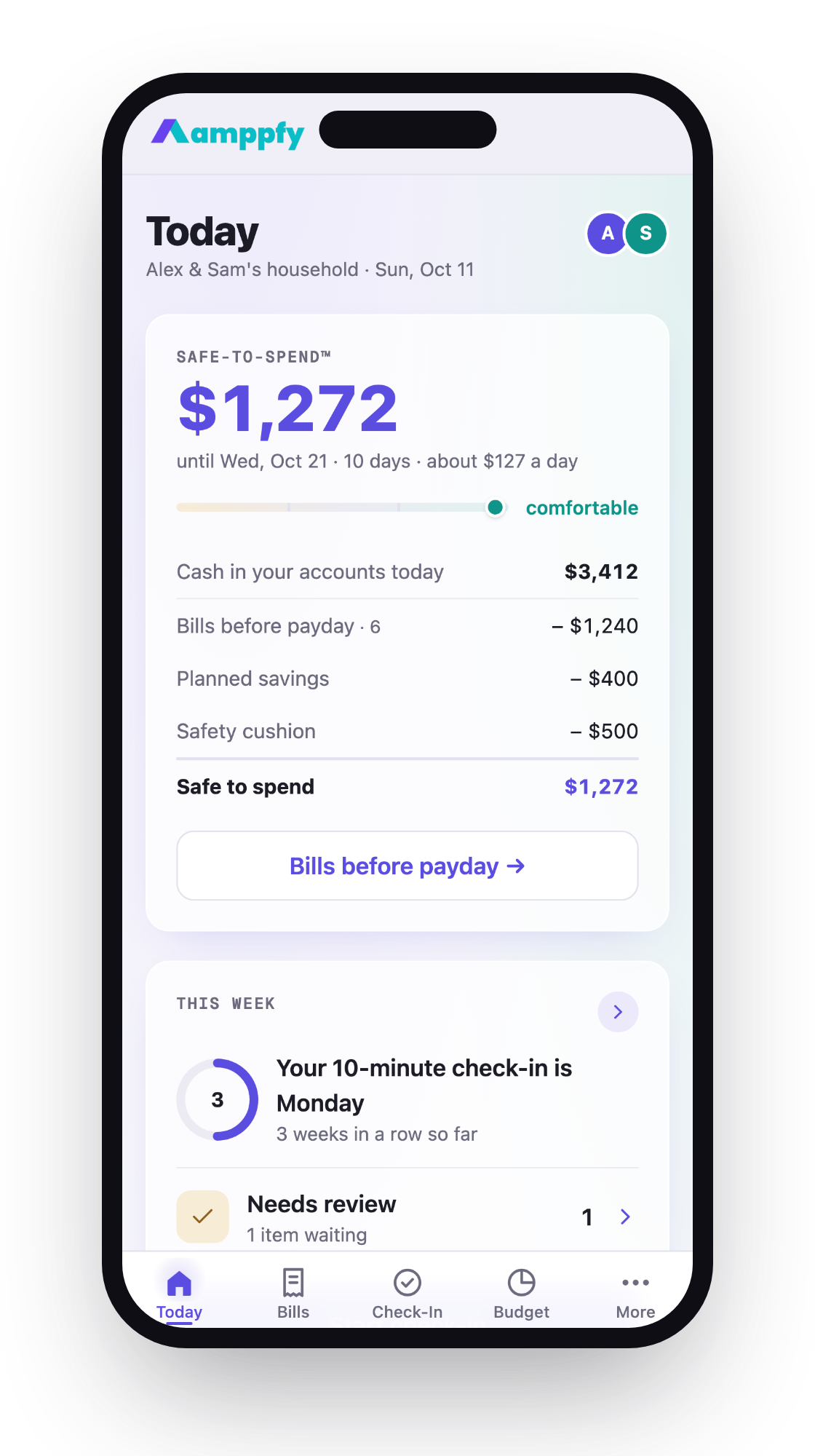
If you use Amppfy, the payday nudge prompts you to fund your goals first, before you spend anything. Your Safe-to-Spend™ number already accounts for that planned savings, so you see what’s actually available after bills and goals. No guessing, no guilt.
The Partner Factor
Couples have an extra challenge. One person saves; the other doesn’t know and spends against the same pool. If you share expenses, you need shared visibility. Both of you should see the same number for what’s safe to spend. That doesn’t mean merging every account. It means agreeing on the savings goal and seeing the same Safe-to-Spend figure so neither person accidentally raids the cushion.
A Worked Plan to $1,500
Here’s a concrete path from $500 to $1,500 in six months. Adjust the numbers to fit your income, but keep the structure.
The Math
Starting balance: $500. Target: $1,500. Gap: $1,000. Timeline: 6 months (26 weeks if paid biweekly, 13 pay periods).
$1,000 ÷ 13 paychecks = $77 per paycheck.
Round it to $75 or $80, whichever feels doable. If $77 sounds tight, start with $50 and increase after month two when you’ve adjusted.
Month-by-Month Breakdown
| Month | Per-Paycheck Transfer | End-of-Month Balance |
|---|---|---|
| Month 1 | $77 x 2 | $654 |
| Month 2 | $77 x 2 | $808 |
| Month 3 | $77 x 2 | $962 |
| Month 4 | $77 x 2 | $1,116 |
| Month 5 | $77 x 3 (extra pay period) | $1,347 |
| Month 6 | $77 x 2 | $1,501 |
That third paycheck in month five is a bonus most biweekly earners get twice a year. Don’t spend it. Redirect it.
What If You Miss a Transfer?
Skip it and move on. Don’t try to double up next paycheck unless you genuinely have room. One missed transfer pushes your target date back two weeks. That’s it. The plan still works.
Check Your Number Weekly
A ten-minute weekly check-in keeps everything honest. Update your balances, confirm upcoming bills, and look at your Safe-to-Spend number. If it’s tight, you know before you swipe. If it’s comfortable, you know you’re on track. Amppfy shows the math right under the number: $3,412 cash − $1,240 bills − $400 savings − $500 cushion = $1,272. Four lines. No mystery.
Frequently Asked Questions
Should I pay off debt before saving $1,000?
If you’re carrying high-interest credit card debt, a split approach works well. Send half your available savings toward the debt and half toward your cushion. Having zero savings while paying off debt leaves you vulnerable to the next surprise, which often goes right back on the card. Keep at least $500 as a floor while you chip away at balances.
Is $500 enough for a real emergency?
It handles the most common ones: a car repair, an urgent copay, a broken phone screen. It won’t cover a job loss or a hospital stay. Think of $500 as your “small emergency” fund. Your next goal – $1,500 to $2,000 – starts covering the bigger stuff.
Where should I keep my emergency savings?
A high-yield savings account at a bank separate from your checking account. The separation adds friction against impulse spending. HYSAs in 2026 are paying around 4.0%-4.5% APY, so your money grows a little while it sits. Avoid CDs or investment accounts for emergency funds since you need access within a day or two.
What if my income is irregular?
Save a percentage instead of a fixed dollar amount. Try 5%-10% of every deposit, regardless of size. Some paychecks will add $30 to your savings. Others might add $150. The habit matters more than the consistency of the amount. Over six months, it averages out.
Your $500 Is a Starting Line, Not a Finish
You’ve already done the hardest part. You proved to yourself that saving is something you can do, not just something other people talk about. Now the job is simple: protect what you have, set a target with a date, and automate the next deposit.
Pick your number. Set the transfer. Check in for ten minutes a week. If you want a single place to see your bills, your savings goal, and what’s actually safe to spend before payday, try Amppfy for free and get that number in about ten minutes.