Every year, the stretch between mid-December and mid-January feels like the longest month on the calendar. Holiday gifts, travel, and end-of-year subscriptions drain your accounts right before a paycheck gap leaves you waiting longer than usual for fresh income. If you’ve ever opened your bank app on January 3rd and wondered how you’d cover rent, you’re not alone. This is the period many people call the January paycheck gap, and a little planning in December can make it feel ordinary instead of stressful.
The good news: you can map out exactly which bills land before your first 2027 deposit, build a short bridge plan, and restart your spending number on solid ground. Here’s how.
Why January Feels Long: Holiday Spending and an Early December Check
December is a two-punch problem. You spend more and get paid earlier. Most employers shift any payday that falls on a holiday or weekend to the last business day before it. That means your late-December check may arrive days sooner than expected, leaving a wider-than-normal window before the next one.
Your spending side doesn’t help either. Gifts, holiday meals, travel, and annual subscription renewals all cluster in the same four weeks.
Here’s a simple way to see the damage. Add up your December non-regular spending: gifts, party supplies, extra groceries, travel costs. Then compare it to a normal month. That extra spending doesn’t vanish. It sits on your credit card or drains your checking account right as your paycheck timing shifts.
The combination of early pay and late spending creates the January gap in your paycheck cycle. You aren’t earning less. You’re just spending more while waiting longer between deposits. Naming the problem is the first step toward fixing it.
Companies are also shifting away from across-the-board raises toward strategic compensation[2], so you can’t count on a January bump to bail you out. Your bridge plan needs to come from cash flow timing, not a raise.
Which Schedules Got Their First 2027 Deposit on Dec 31
January 1, 2027, is a federal holiday. Banks are closed. If your regular payday lands on that date, your employer will almost certainly push the deposit to Thursday, December 31, 2026. That’s good for your wallet on New Year’s Eve, but it means your next check won’t arrive until your normal cycle resets deeper into January.
This shift also has a tax wrinkle. Moving a January 1 payday to December 31 shifts that income into the 2026 tax year[3], which affects your W-2 reporting. You won’t owe more overall, but your 2026 W-2 will show a slightly higher total and your 2027 W-2 will start one check lighter.
The table below shows how common pay schedules handle the holiday shift:
| Pay Schedule | Payday on Jan 1? | Paid On | Next Check After That |
|---|---|---|---|
| Weekly (Fridays) | Yes: Friday, January 1, 2027 | Thursday, Dec 31, 2026 | Friday, Jan 8, 2027 |
| Biweekly (Fridays from Jan 1) | Yes | Thursday, Dec 31, 2026 | Friday, Jan 15, 2027 |
| Biweekly (Fridays from Jan 8) | No | None | Friday, Jan 8, 2027 |
| Semi-monthly (1st and 15th) | Yes, always | Thursday, Dec 31, 2026 | Friday, Jan 15, 2027 |
| Monthly (1st) | Yes, always | Thursday, Dec 31, 2026 | Monday, Feb 1, 2027 |
| SSI (due the 1st) | Yes, always | Thursday, Dec 31, 2026 | Monday, Feb 1, 2027 |
Semi-monthly and monthly schedules feel the gap most. If you’re paid on the 1st and 15th, getting your January 1 check on December 31 means you won’t see another deposit for a full 15 days. Monthly employees wait a full month.
Some biweekly employers ran a 27-pay-period year in 2026. If your employer adjusted check amounts downward to spread pay across 27 periods, your per-check amount may still be slightly lower heading into 2027. Confirm with your payroll department whether your per-check amount resets in January.
Bills Due in Early January
Your paycheck may shift, but your bills don’t care. Rent, mortgage payments, car loans, insurance premiums, and streaming services all hit on their scheduled dates. Here’s a typical early-January bill stack:
| Bill | Common Due Date | Typical Amount |
|---|---|---|
| Rent / Mortgage | Jan 1-5 | Varies |
| Car Payment | Jan 1-10 | Varies |
| Auto / Renters Insurance | Jan 1 | Varies |
| Internet / Phone | Jan 3-7 | Varies |
| Streaming Subscriptions | Various | Varies |
| Credit Card Minimum | Jan 5-15 | Varies |
Add those up. For many households, the first ten days of January carry $2,000 to $3,000 in fixed costs. If your December 31 paycheck is your only income until January 15, you need most of that check reserved for bills alone.
The danger isn’t forgetting a single bill. It’s underestimating how many stack up in the same window.
Pull up your bank and credit card statements from January 2026. List every charge that posted between January 1 and January 14. That’s your real bill number, not a guess. Write it down. You’ll use it in the next section.
A Bridge Plan for the First Two Weeks
A bridge plan isn’t a budget overhaul. It’s a short-term cash-flow map that covers the days between your last December deposit and your first full January payday. Think of it as a two-week spending envelope.
Step 1: Know Your Starting Cash
Check your balances on December 30. Include checking, savings you’re willing to touch, and any cash on hand. Don’t count credit card availability: that’s debt, not cash.
Step 2: Subtract Your Fixed Bills
Take the bill total you gathered from the previous section. Subtract it from your starting cash. What’s left is your actual spending room for groceries, gas, and everything else until the next paycheck.
Here’s a worked example:
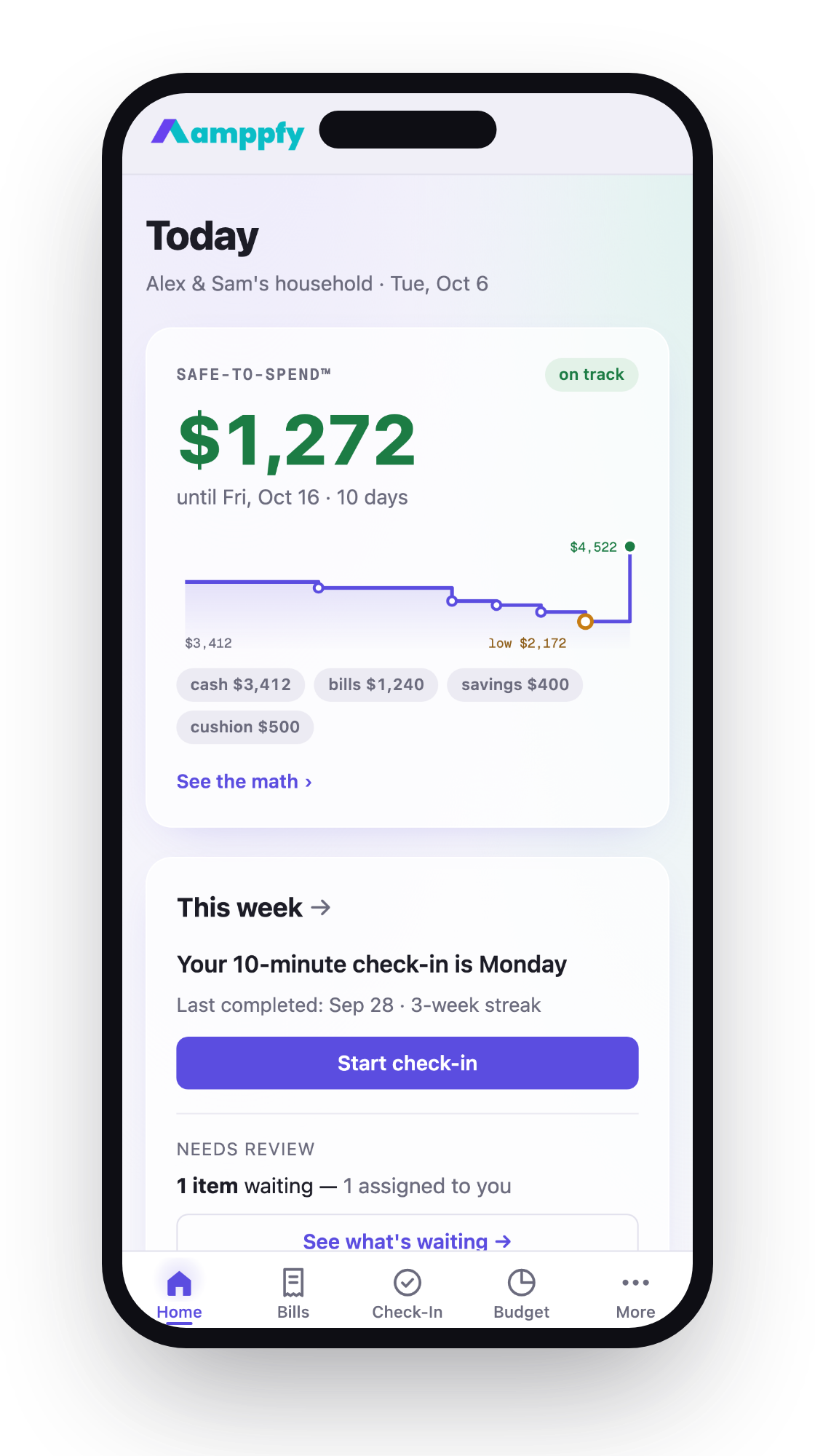
$3,412 cash − $1,240 bills − $400 savings − $500 cushion = $1,272 Safe-to-Spend™
That $1,272 is what you can actually use across two weeks without falling behind. Divide it by 14 and you get about $91 a day. That daily number is your guardrail.
Step 3: Identify What You Can Shift
Some bills offer flexibility. Call your car insurance company and ask if you can move your due date to the 20th. Push any subscription renewal that allows date changes to later in January. Even moving one $150 bill out of the first week eases the pressure.
Step 4: Set a No-Spend Floor
Pick three to five days in the first two weeks where you commit to spending nothing beyond gas to get to work. Not as punishment: as a buffer. If something unexpected comes up on day 8, you’ve got room.
A tool like Amppfy can handle this math for you. Enter your balances, bills, and payday once, and it shows your Safe-to-Spend™ number with the full calculation underneath. The month calendar even marks your lowest-cash day so you know exactly where the pinch point falls.
Restarting Your Weekly Number on the First Payday
Your first real 2027 payday is the reset point. Whatever happened in December is behind you. This is where you set your spending baseline for the year.
On payday, sit down for ten minutes and do three things:
- Update your account balances. Check every account you use for spending or bills. Write down the numbers or enter them into your planning tool.
- List every bill due before your next paycheck. Include the amount and the date. If you’re paid biweekly, that’s 14 days of bills. If semi-monthly, count to the 15th or the 1st.
- Subtract bills, savings contributions, and your cushion from your available cash. The result is your weekly spending number.
This weekly number is the single figure that answers “Can I afford this?” throughout the week. It replaces the vague feeling of checking your bank balance and hoping for the best.
If you and a partner share bills, this reset matters even more. Both of you need to see the same spending number. One person tracking bills in their head while the other swipes a card is how couples end up surprised on January 12th. Amppfy gives each partner their own login with the same Safe-to-Spend™ figure visible to both, while keeping individual account balances private.
Don’t count on a January raise to pad this number. Set your baseline on what you know you’ll earn, not what you hope to earn. If a raise shows up, great: add it to savings goals or your cushion. But your weekly number should work without it.
The habit you build in January carries through the year. Ten minutes on payday, every payday, keeps your number honest. By February, it’s automatic.
Frequently Asked Questions
What if I get paid weekly: does the January paycheck gap still affect me?
It’s smaller, but it’s real. A weekly schedule means you’re never more than seven days from a deposit, so the timing crunch is shorter. But if your January 1 check shifts to December 31, you still have an eight-day gap instead of seven. The bigger risk for weekly earners is that holiday spending ate into your reserves, so even a normal gap feels tighter.
Should I use a credit card to bridge the gap instead of draining savings?
Only if you can pay the full statement balance when it’s due. Carrying a balance into February adds interest costs on top of the holiday spending you’re already recovering from. If you have a small emergency fund, using $200 to $400 from savings and replenishing it over the next two paychecks is usually cheaper than credit card interest.
How do I handle the gap if I’m paid monthly on the 1st?
Monthly pay makes this the most intense version of the problem. Your December 31 deposit has to cover all of January. Build your bridge plan with the full month’s bills, not just two weeks. Set aside rent and fixed costs immediately, then divide the remainder by 30 for a daily spending figure. A monthly calendar showing your lowest-cash day helps you see where to cut back.
Does the December 31 paycheck shift change my tax withholding?
It shifts one paycheck from your 2027 income to your 2026 income for tax purposes. Your total annual earnings don’t change, but your W-2 for 2026 will be slightly higher and your 2027 W-2 slightly lower. If you’re close to a tax bracket boundary, check with your payroll department or a tax preparer to see if it matters for your situation.
Start January on Solid Ground
The gap between your last December check and your first full January payday is predictable. You know the date. You know the bills. The only variable is whether you plan for it or react to it.
Map your bills, calculate your bridge number, and reset your weekly spending figure on your first 2027 payday. Ten minutes of planning in late December saves two weeks of stress in January.
If you want that number ready and waiting, get Amppfy free on iPhone or the web. Enter your balances, bills, and payday once, and your Safe-to-Spend™ number is always current: no guessing, no spreadsheet, about ten minutes to set up.