You borrowed $100 from a cash advance app to cover groceries before payday. Payday arrived, the app pulled back $105, and you were short again by Tuesday. So you borrowed $110. The pattern has a name, and you’re not the only one stuck in it. A 2024 CFPB report found that most earned-wage-access users borrow again within the same pay period, creating a repeating advance cycle that quietly drains each paycheck before it lands. Breaking that loop doesn’t require a windfall or a radical lifestyle change. It takes a few small, deliberate moves spread across a handful of pay periods.
How advances shift a shortfall into next payday
Think of a cash advance as a time machine for a bill. You don’t erase the expense. You move it forward, and it arrives on the same day as rent, utilities, and every other obligation your paycheck already covers. The shortfall doesn’t shrink. It just shows up later, wearing a small fee.
Here’s a simplified example of how one $150 advance snowballs across three pay periods:
| Pay Period | Paycheck | Advance Repaid | Fees | Cash Left for Bills | New Advance Needed |
|---|---|---|---|---|---|
| 1 | $1,800 | $0 | $0 | $1,800 | $150 |
| 2 | $1,800 | $150 | $5 | $1,645 | $155 |
| 3 | $1,800 | $155 | $5 | $1,640 | $160 |
Each cycle, the hole gets a little deeper. The fee might be a flat charge, a “tip,” or a monthly subscription. Whatever the label, it’s money that leaves your account without buying anything you need.
The cash advance app cycle persists because the math always resets against you. Your paycheck covers last cycle’s advance, leaving less for this cycle’s bills. That gap sends you right back to the app. Recognizing this mechanics is the first step toward changing it. The advance didn’t solve the problem. It relocated it.
Mapping every repayment date against your pay schedule
Before you can shrink the loop, you need to see it. Pull up your calendar and mark two things: every upcoming payday and every date an advance app or subscription is set to withdraw money.
List every auto-debit hitting your account
Open your bank’s transaction history for the last 60 days. Write down each recurring charge: advance repayments, subscriptions, insurance, loan payments. Note the date and the amount.
Overlay paydays on the same timeline
Place your paydays on the same list. Now look at the gaps. Most people find a cluster of debits land one to three days after payday, leaving almost nothing for the second half of the cycle.
Spot the pressure point
The day your balance dips lowest is your pressure point. That’s the day you reach for an advance. Amppfy’s month calendar marks this lowest-cash day automatically, so you can see the squeeze coming instead of reacting to it.
A simple table can clarify the picture:
| Date | Event | Amount | Running Balance |
|---|---|---|---|
| Mar 1 | Payday | +$1,800 | $1,800 |
| Mar 2 | Advance repayment | -$155 | $1,645 |
| Mar 3 | Rent | -$950 | $695 |
| Mar 7 | Car insurance | -$140 | $555 |
| Mar 10 | Groceries | -$120 | $435 |
| Mar 14 | Utilities | -$110 | $325 |
Once you see the exact day and dollar amount where the gap opens, you can plan around it rather than borrow through it.
Shrinking the advance a little each cycle
You don’t have to quit cold turkey. That usually fails because the budget can’t absorb the full shortfall in one pay period. Instead, reduce the advance by a fixed amount each time.
Pick a reduction amount you can absorb
Start with $25 or $30 less than your current advance. If you borrowed $200 last cycle, borrow $170 this time. Cover the $30 gap by trimming one discretionary expense: a takeout meal, a streaming service you barely watch, or a single impulse buy you skip.
Track the shrink over four cycles
| Cycle | Previous Advance | This Advance | Reduction | Cumulative Savings |
|---|---|---|---|---|
| 1 | $200 | $170 | $30 | $30 |
| 2 | $170 | $140 | $30 | $60 |
| 3 | $140 | $110 | $30 | $90 |
| 4 | $110 | $80 | $30 | $120 |
By cycle five or six, the advance is small enough to eliminate entirely. The key is consistency, not speed. A $25 reduction each paycheck is $650 over a year. That’s real money reclaimed from fees and borrowed-against future paychecks.
If a particular cycle is rough, hold steady instead of increasing. Don’t punish yourself for not shrinking that round. Just don’t go backward. The goal is a downward trend, not a perfect line.
What to cut first
- Subscriptions with a next-charge date before your next payday (cancel or pause before the charge hits)
- One dining-out meal replaced with a home-cooked version
- Any “buy now, pay later” installment you can pay off early to free up the recurring slot
Each of these frees up $15 to $40 per cycle, which is exactly the margin you need to shrink the advance.
Building a small buffer so the next one is not needed
The advance cycle breaks for good when you have enough cash sitting between paychecks to cover that pressure-point day without borrowing. You don’t need a massive emergency fund to get there. You need a buffer: a small cushion that absorbs the dip.
How much buffer do you actually need?
Look at the table you built earlier. Find the gap between your lowest balance day and zero. If your balance bottoms out at $325 but your next expense before payday is $200, your minimum buffer is $200. Round up to $250 for breathing room.
That number is your target. Not $1,000. Not three months of expenses. Just enough to survive the low point without opening an app.
Fund it $20 at a time
On each payday, move a fixed amount into a separate savings pocket before you spend anything else. Even $20 works. After five pay periods, you have $100. After ten, $200. Pair that with the money you’re saving from shrinking your advances, and the buffer builds faster than you’d expect.
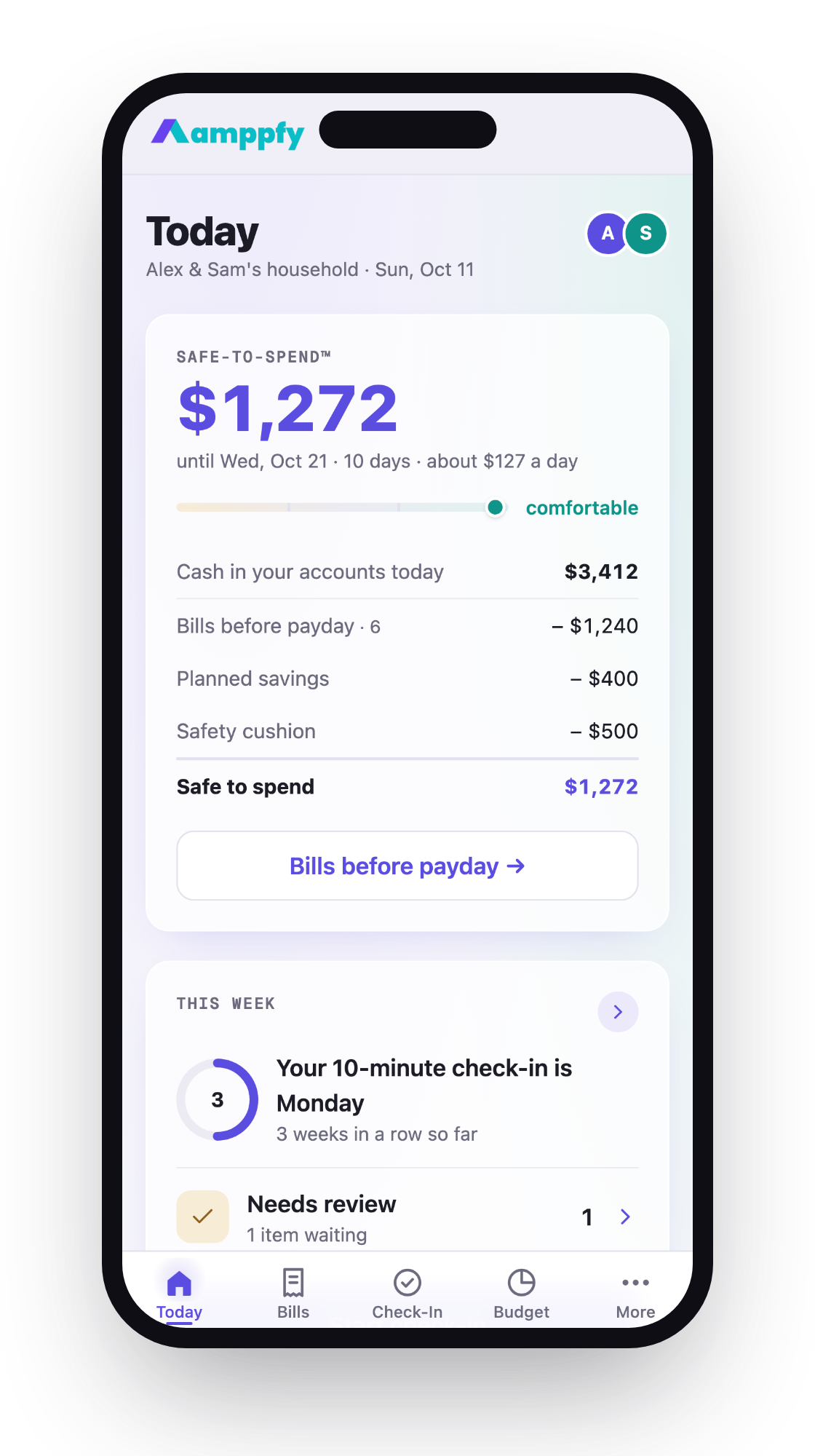
A quick example of the math: $3,412 cash − $1,240 bills − $400 savings − $500 cushion = $1,272 Safe-to-Spend™. That last number is what you can actually use without putting next week at risk. Amppfy shows this calculation on screen every time you check, so the buffer isn’t a vague idea. It’s a visible line in the math.
Protect the buffer
The buffer is not for impulse purchases. It’s not for a sale at your favorite store. It exists for one purpose: to keep you off the advance app on your lowest-cash day. Once it does its job, you refill it on the next payday. Over time, it grows past the minimum, and the idea of borrowing against your own paycheck starts to feel unnecessary.
Talking to billers instead of borrowing ahead
Most people reach for an advance because a bill is due before the money arrives. But many billers will move your due date if you ask. This is one of the most underused tools for breaking the cash advance app cycle.
Which bills can shift?
- Credit card companies: almost all allow a due-date change once per year, sometimes through the app
- Utility providers: many offer flexible billing dates or budget billing that smooths payments across the year
- Insurance: auto and renters policies often let you pick a draft date at renewal
- Phone and internet: carriers typically allow date changes through customer service chat
How to ask
Call or chat with the biller. Say something like: “I’d like to move my due date to the 20th so it lines up better with my pay schedule.” That’s it. No long explanation needed. Most reps handle this in under five minutes.
The payoff of shifting dates
If you move two or three bills from the first week of the month to the third week, you spread the load more evenly across your pay cycle. The pressure-point day shifts later, and the gap shrinks. Sometimes this single change is enough to eliminate the need for an advance entirely.
You can also ask about hardship programs or payment plans if you’re behind. Billers would rather work with you than send your account to collections. A five-minute phone call can save you more than any advance app ever will.
Frequently Asked Questions
How long does it take to break the cycle of borrowing from advance apps?
Most people can stop borrowing entirely within four to six pay periods if they reduce each advance by $25 to $30 per cycle. The timeline depends on the size of your current advance and how much flexibility you find in your spending. Holding steady during a tough cycle is fine. The goal is a downward trend, not perfection.
Will canceling my cash advance app hurt my credit score?
No. Cash advance apps don’t report to credit bureaus, so using or stopping them has no direct effect on your credit score. However, if the app’s repayment causes overdrafts that lead to missed payments on other accounts, stopping the cycle can indirectly protect your credit.
What if I can’t cover my bills without the advance this pay period?
Hold at your current advance amount instead of increasing it. Then call your most flexible biller and ask to move the due date. Even shifting one bill by ten days can free up enough room to start reducing next cycle. The worst move is to borrow more to “catch up,” because that deepens the hole.
Is a $200 buffer really enough to replace an advance app?
It depends on your specific gap. Check your lowest balance day and the next expense after it. If that expense is $150, then $200 covers it with room to spare. The buffer doesn’t need to replace your emergency fund. It just needs to bridge the days between your low point and your next paycheck.
One Paycheck at a Time
Breaking free from repeated cash advances isn’t about willpower or earning more. It’s about rearranging the timing and size of money moving through your account. Map your debits against your paydays. Shrink the advance by a small, fixed amount each cycle. Build a buffer that covers your lowest-cash day. Move bill due dates so they stop clustering right after payday.
Each of these steps takes less than ten minutes. None of them require a bank login or a complicated spreadsheet. If you want a single number that shows what’s actually safe to spend before your next paycheck, with the math printed right underneath, Amppfy is free and takes about ten minutes a week to keep current. You can start at amppfy.com/app/.
One paycheck. One small change. Repeat until the app is the thing you used to need.