Most people who’ve tried budgeting have tried both: a notebook on the kitchen counter and an app on their phone. Each one worked for a while, then didn’t. The debate between a paper budget and an app usually frames one as old-school and the other as modern, but that misses the point. What matters is which one you’ll actually use on a Tuesday night when you’re tired. This comparison breaks down the real strengths and real failures of each method so you can pick the one that fits your life, not someone else’s advice.
What paper gets right: visibility and intent
Writing your budget by hand does something no screen can replicate. It slows you down. That friction is the feature, not the flaw.
A 2024 Federal Reserve Survey of Household Economics and Decision-making found that 54% of adults who said they could cover a $400 emergency expense also reported using some form of written or manual budgeting. The act of writing forces a decision at every line. You can’t autopilot through it. Each number gets a moment of your attention.
Paper budgets also win on visibility. A notebook left open on the counter is a constant, quiet reminder. You don’t need to unlock anything or swipe past notifications to see it. Your partner walks by and glances at it. Your spending plan stays in the room with you.
Where the pen earns its keep
- Intentionality: Writing “$200 groceries” by hand makes you commit to the number.
- Zero learning curve: No account setup, no tutorials, no syncing.
- Privacy: Your data lives in your kitchen, not on a server.
- Flexibility: You can draw columns, use color codes, or sketch a calendar grid however you want.
Paper also works well for people who feel anxious around apps that flash red numbers or send constant alerts. A notebook doesn’t judge. It just holds what you wrote. That calm quality keeps people coming back to it week after week, at least for a while.
The catch is that “a while” has a shelf life. Paper’s strengths are real, but they bump into hard limits the moment your financial life gets even slightly complicated.
Where paper breaks: autopay, couples, and math
Paper budgets tend to fail in predictable ways. Knowing those failure points helps you decide whether they apply to your situation.
The autopay blind spot
Most households run five to fifteen autopay charges per month: streaming, insurance, phone plans, gym memberships. Paper can’t remind you that your car insurance drafts tomorrow. You have to remember to check your notebook, then remember to check your bank app, then do the subtraction yourself. That’s three steps where one missed detail means you’re surprised by a low balance.
The couples problem
If you share expenses with a partner, paper gets awkward fast. You either keep one notebook that both people need physical access to, or you keep two notebooks and hope the numbers match. Neither option scales. One person usually becomes the “budget keeper,” and the other person checks out. That’s not a system; it’s a chore assignment.
The math tax
Here’s a worked example of what paper demands every week:
$4,100 paycheck − $1,350 rent − $280 utilities − $160 subscriptions − $400 groceries − $300 savings = $1,610 remaining.
Now subtract the $87 you spent at Target yesterday and the $42 dinner on Tuesday. Recalculate. Now your partner spent $65 on gas. Recalculate again. Every transaction means erasing or crossing out and rewriting. After two weeks, the page looks like a crime scene. After three weeks, you stop updating.
The comparison between a paper budget and a budgeting app usually comes down to this: paper demands perfect follow-through on tasks that feel tedious. Most people don’t quit because the method is wrong. They quit because the upkeep exceeds their patience.
What a simple app adds without the upkeep
The right app doesn’t replace your judgment. It replaces the arithmetic and the memory work. That’s the distinction worth caring about.
A good budgeting app should answer one question clearly: how much can you safely spend before your next paycheck? Not “how much did you spend on coffee this month.” Not “here’s a pie chart of your categories.” Just the number that matters right now.
What to look for in a budgeting app
| Feature | Why it matters |
|---|---|
| One clear spending number | Replaces the mental math you’d do on paper every few days |
| Bill reminders with dates | Covers the autopay blind spot paper can’t handle |
| Partner access | Both people see the same number without maintaining two systems |
| Low weekly time cost | Ten minutes a week beats an hour of manual recalculation |
| No category guilt | Shows what’s safe, not what you did wrong |
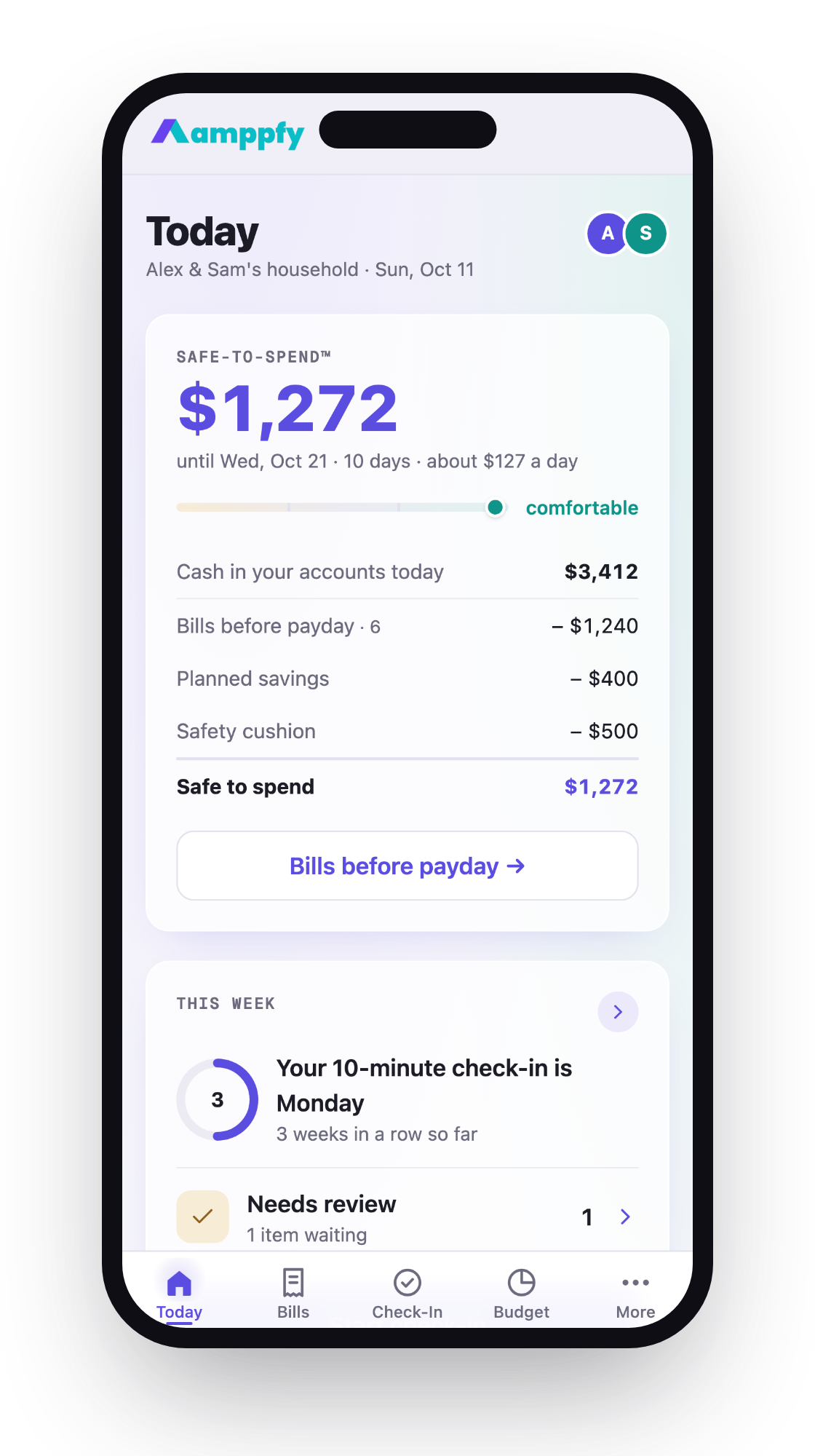
Amppfy takes this approach. You enter your balances yourself (about 30 seconds per account), add your bills and paydays, and it shows one Safe-to-Spend™ number: available cash minus bills due before payday, minus planned savings, minus a cushion you choose. The four-line math prints right under the number so you can see exactly how it’s calculated. Partners get their own login and see the same figure. A 10-minute weekly check-in keeps everything current.
The key difference from paper isn’t automation. It’s that the app holds the structure while you supply the numbers. You still make every decision. You still know where your money goes. You just don’t have to erase and rewrite the same subtraction problem every three days.
A hybrid that keeps the pen
You don’t have to choose one or the other. A hybrid approach keeps the parts of paper that work and offloads the parts that don’t.
How a hybrid system works in practice
Use paper for planning and reflection. Use an app for tracking and reminders. Here’s what that looks like week to week:
- Sunday evening (5 minutes, paper): Write down your top three spending priorities for the week. Maybe it’s “groceries, kid’s soccer registration, date night.” This is the intentional part that paper does best.
- Sunday evening (5 minutes, app): Update your account balances. Confirm your Safe-to-Spend number still covers those three priorities. If it doesn’t, adjust on paper first, then move on.
- Midweek (2 minutes, app): Glance at your app to see if any bills posted or if your number shifted. No recalculation needed.
- End of month (10 minutes, paper): Write a short note about what went well and what surprised you. This is journaling, not accounting. It builds the awareness that paper fans value.
This hybrid method gives you the physical ritual of writing without the fragile math. Your notebook becomes a decision journal. Your app becomes the calculator that never forgets a bill date.
Some people tape their weekly priorities list to the fridge. Others keep a small notebook in their bag. The format doesn’t matter as much as the split: paper for thinking, app for arithmetic.
The hybrid also solves the couples gap. Both partners can keep their own paper notes for personal reflection while sharing one app that shows the same spending number. Nobody has to photocopy a ledger page or text a photo of the budget notebook.
Choosing by how you actually live
The best budgeting method is the one that survives contact with your actual week. Not your ideal week. Not the week where you meal-prep on Sunday and fold laundry on Wednesday. Your real, messy, “I forgot to move money before the electric bill hit” week.
A quick decision guide
| Your situation | Paper works if… | An app works if… |
|---|---|---|
| Single, simple finances | You have fewer than 5 bills and enjoy the ritual | You want bill reminders and a running total |
| Couple, shared expenses | You both sit down together weekly (and actually do it) | You need both partners to see the same number independently |
| Irregular income | You like recalculating by hand each pay period | You want the math updated with each new deposit |
| Quit an app before | The app was too complex or required categorizing everything | The new app asks for less: just balances, bills, and goals |
| Autopay-heavy | You have a photographic memory for due dates | You want a heads-up the day before each charge |
If you’ve bounced between budgeting on paper and using an app before, the pattern probably wasn’t about discipline. It was about fit. A notebook works until your life outgrows it. An over-engineered app works until you stop feeding it data. The sweet spot is a tool that asks just enough of you to stay accurate.
Amppfy was built for exactly this gap: people who want clarity without a part-time accounting job. You type in your balances, tell it when you get paid, and it does the subtraction. That’s it. If you want to keep a paper notebook alongside it for weekly reflections, that actually makes the system stronger.
Frequently asked questions about budgeting on paper versus an app
Is a paper budget more effective than an app for controlling spending?
Paper creates stronger intentionality because writing by hand forces you to slow down and think about each number. But “effective” depends on follow-through. A 2023 CFPB report on financial well-being found that consistency mattered more than method. If you update your paper budget every week without fail, it works. If you stop after two weeks because the math is tedious, it doesn’t. An app that you actually check beats a notebook that collects dust.
Can I use a budgeting app without connecting my bank account?
Yes. Some apps, including Amppfy, let you enter balances manually. You type in what’s in your checking account, and the app does the math from there. This takes about 30 seconds per account and avoids the security concerns that make some people uncomfortable with bank syncing.
What’s the biggest reason people quit paper budgets?
Recalculation fatigue. Every time you spend money, you need to subtract, rewrite, and recheck your remaining balance. With five to ten transactions a week, that’s a lot of erasing. Most people don’t quit because they dislike budgeting. They quit because the maintenance outpaces their patience. An app handles that subtraction automatically each time you update a balance.
Do couples do better with paper or an app?
Couples almost always do better with an app, specifically one that lets both partners see the same spending number without requiring both people to sit at the same table. Paper forces synchronization: you both need to look at the same notebook, at the same time, and agree on what the numbers mean. An app that gives each person their own login but shows one shared Safe-to-Spend number removes that coordination burden.
Pick the method your Tuesday self will use
Your budgeting method needs to survive your worst week, not your best one. Paper brings intention and calm. An app brings memory and math. A hybrid gives you both.
Start with one honest question: did your last budgeting attempt fail because of the method or because of the maintenance? If the method felt right but the upkeep killed it, keep the ritual and hand the arithmetic to an app. If apps felt cold and impersonal, add a paper layer for the human parts.
Take 10 minutes this week to try Amppfy free at amppfy.com/app/ and see your Safe-to-Spend number. Keep your notebook open next to it. You might find that the two tools do better work together than either one did alone.