Most people trying to pay off debt while living paycheck to paycheck don’t need another lecture about lattes. They need a plan that fits inside the cash they already have. The gap between your last dollar out and your next dollar in is real, and pretending it isn’t helps nobody. What does help is a clear system: know your minimums, find the extra, pick a target, and protect yourself from a setback that resets the clock. That’s what we’re covering here.
Minimums are bills; extra payments are goals
Your minimum payments aren’t optional. They’re bills, the same as rent or electricity. Treat them that way. Put every minimum on your bill calendar with its due date and exact amount. If you miss one, a credit card late fee alone runs $30 for the first miss and $41 for the next[1]. That’s money you can’t afford to hand away.
Once minimums are locked in as bills, everything above them becomes a goal. This is a mental shift worth making. You stop seeing “extra toward debt” as something you squeeze out of thin air. You start seeing it as a goal you fund after your bills are covered but before you spend what’s left.
Here’s a quick way to frame it:
| Category | Example | How to treat it |
|---|---|---|
| Rent, utilities, groceries | $2,100 | Fixed bill |
| Minimum debt payments | $340 | Fixed bill |
| Extra debt payment | $75 | Funded goal |
| Everything else | What remains | Safe to spend |
The line between “bill” and “goal” matters. Bills get paid no matter what. Goals get funded from what’s actually available. If you blur the two, you’ll either skip a minimum (expensive) or throw too much at debt and bounce a check (also expensive).
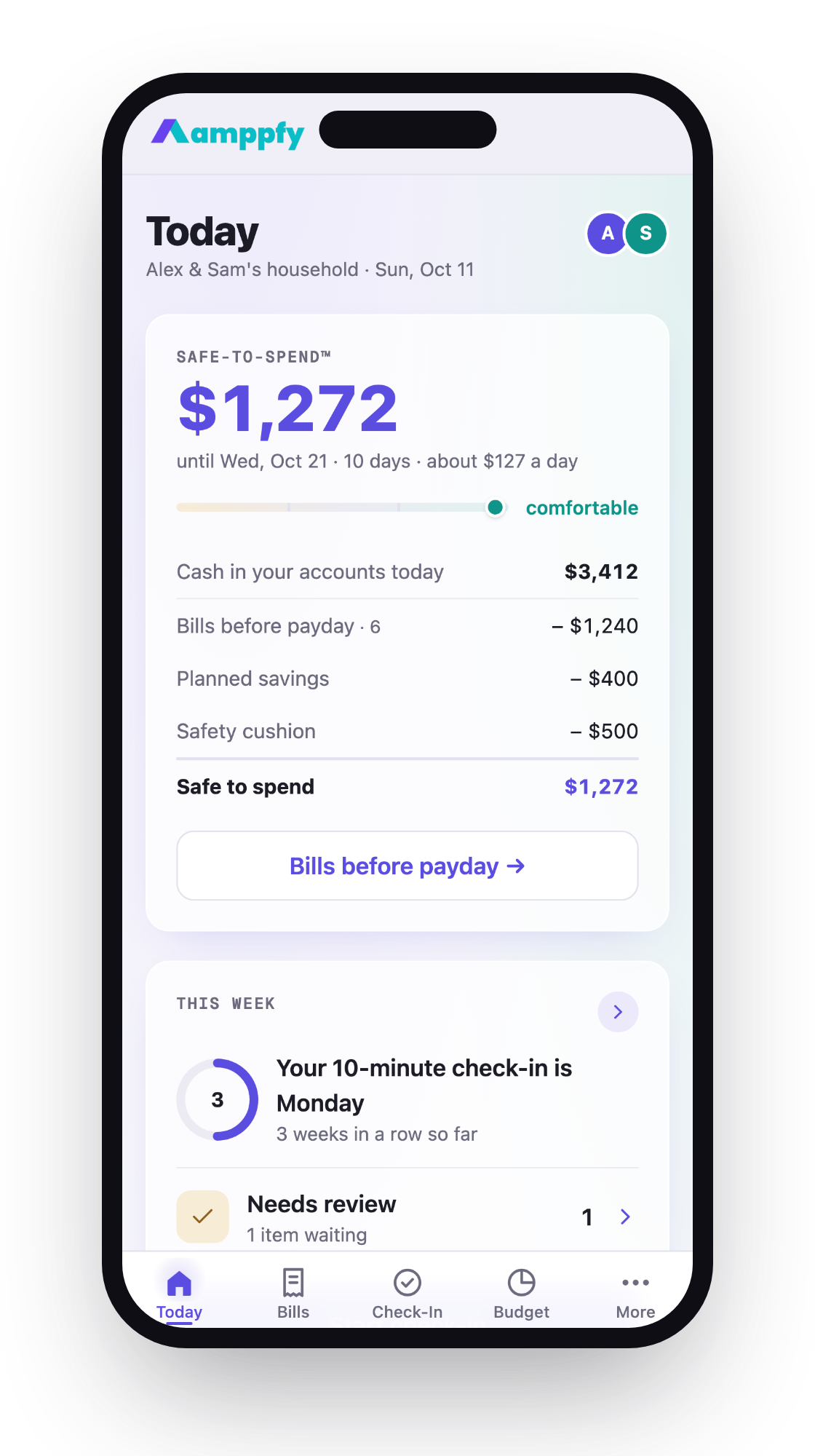
A simple test: after you subtract your bills, your savings contribution, and a small cushion from your cash on hand, what’s left? That leftover is what you can safely spend or redirect. Amppfy calls this your Safe-to-Spend™ number, and it shows the four-line math right under the figure: cash minus bills due minus savings minus cushion. If the number is $80, you know exactly how much “extra” exists this cycle.
Find the extra in the number, not in willpower
Willpower fades. Numbers don’t. If you’re trying to pay down debt on a tight pay cycle, the extra payment has to come from a specific, identifiable source, not from “trying harder.”
Audit your subscriptions first
Pull up your bank statement for the last 30 days. Circle every recurring charge. Most people find two or three subscriptions they forgot about or barely use. Cancel one $14.99 streaming service and one $9.99 app, and you’ve freed $25 a month. That’s $300 a year aimed at a balance instead of a login you haven’t touched since winter.
Shift timing, not just amounts
Sometimes the extra isn’t a new dollar. It’s a dollar that arrived on the wrong day. If you get paid biweekly, two months a year hand you a third paycheck. That third check is real money with no bills already assigned to it. Mark those months on your calendar now. Route that check, or half of it, straight to a balance.
Use round-up math
Rounding your bills up by small amounts creates a quiet surplus. Pay your $67 phone bill as $70. Pay your $128 insurance as $130. Over a month, those extra few dollars add up to $15 or $20 with zero lifestyle change. It’s not dramatic. It doesn’t need to be.
Here’s a realistic example of what “found” money looks like in a single month:
- Cancel one unused subscription: $12
- Round up four bills: $14
- Sell one item sitting in a closet: $35
- Skip one takeout meal, cook instead: $18
That’s $79. Applied to a credit card charging an average APR near 22%[2], $79 extra per month shaves months off your payoff timeline and hundreds off your interest total. The point isn’t perfection. It’s consistency from a known source.
Which debt first on a tight cycle
Two popular methods exist. Both work. The right one depends on your situation.
Avalanche vs. snowball on a tight budget
| Method | How it works | Best for |
|---|---|---|
| Avalanche | Pay minimums on everything, throw extra at the highest-interest balance | Saving the most money over time |
| Snowball | Pay minimums on everything, throw extra at the smallest balance | Getting a quick win to stay motivated |
If you carry credit card debt at 22% and a student loan at 6%, the math screams avalanche. You’ll pay less interest overall. But if your smallest balance is $280 and knocking it out in two months would free up its $35 minimum for the next target, the snowball gives you momentum fast.
For someone living paycheck to paycheck, momentum matters. Watching a balance hit zero is fuel. It proves the system works before the math even matters. Pick the method that keeps you going, then stick with it.
A note on federal student loans
The new Repayment Assistance Plan (RAP) became the primary income-driven option for new federal student loans on July 1, 2026[3], with payments as low as $10 a month for very low earners. If you’re juggling federal loans alongside high-interest cards, it may make sense to drop your student loan to the RAP minimum and redirect the difference to the card. Run the numbers for your own balances. The interest rate gap usually makes this straightforward.
Protecting the cushion while you pay it down
Here’s where people on tight cycles get tripped up. They throw every spare cent at debt, leave zero buffer, and then a $200 car repair goes on the credit card. Net progress: zero, or worse.
You need a cushion. Not a full emergency fund, not yet. Just enough to absorb one small hit without borrowing again. For most people, that’s $300 to $500 sitting untouched.
How to build a cushion and pay debt at the same time
Split your “extra” money. If you found $79 this month, send $50 to debt and $29 to your cushion until the cushion reaches your target. Once it’s funded, redirect the full amount to debt. Yes, this slows your payoff by a few weeks. It also prevents the backslide that costs months.
Think of the cushion as a guardrail. It keeps one bad week from erasing a month of progress. If you dip into it, pause extra debt payments the next cycle and refill it first. The rule is simple: cushion stays funded, always.
U.S. credit card balances have climbed to $1.26 trillion as of Q2 2026[4], with late payments rising alongside them. A big reason balances climb back up is that people pay down debt without a buffer, then re-borrow at the first surprise expense. Don’t be that statistic.
If you use Amppfy, your Safe-to-Spend number already subtracts your chosen cushion from available cash. You see what’s truly left after bills, savings, and buffer. That makes it harder to accidentally raid your own safety net.
Watching net worth move as the balance drops
Paying off debt paycheck to paycheck feels slow. Some months, you’ll wonder if anything is happening. That’s why tracking net worth matters.
Net worth is everything you own minus everything you owe. When you pay $75 toward a credit card, your net worth goes up by $75, even if your bank balance went down. This is the number that tells the real story.
A simple monthly check-in
Once a month, write down:
- Total cash across all accounts
- Total debt balances
- Subtract debt from cash (include any assets like a car’s value if you want, but keep it consistent)
Watch that number. Even if it moves from negative $4,200 to negative $4,125, that’s progress. Plotting it month by month turns an invisible grind into a visible trend line.
Amppfy tracks net worth month by month automatically once you’ve entered your balances. A 10-minute weekly check-in keeps the numbers current. You don’t need a spreadsheet or a Sunday afternoon project.
The psychological payoff of seeing net worth climb is real. It reframes the story. You’re not just “in debt.” You’re someone whose net worth improves every single pay cycle. That framing keeps people going when the balance still looks big.
Frequently asked questions
How much extra should I pay toward debt each paycheck if I’m barely getting by?
Even $10 or $20 per paycheck makes a measurable difference on high-interest debt. Start with whatever your Safe-to-Spend number says you can afford after bills, savings, and cushion. If that’s $15, use $15. Consistency beats size. A $20 biweekly extra payment on a $2,000 card at 22% APR saves you roughly five months and over $200 in interest compared to minimums alone.
Should I stop saving entirely to pay off debt faster?
No. Keep a small cushion of $300 to $500 so you don’t re-borrow at the first surprise. If you already have that buffer, you can pause other savings goals temporarily and redirect to debt. But never go to zero reserves. The risk of a setback outweighs the few weeks you’d save.
Can I really pay off debt living paycheck to paycheck, or is it only possible with extra income?
Extra income helps, but it’s not required. Most people find $50 to $100 a month by canceling unused subscriptions, rounding up bills, and redirecting one or two small expenses. The key is identifying where the money comes from before you need it, not hoping it appears.
What if I miss a month of extra payments?
Nothing breaks. Your minimums (the bills) still get paid. The extra payment is a goal, and goals flex. Skip a month if you need to, refill your cushion if you dipped into it, and resume the next cycle. Progress isn’t linear. It just needs to keep moving forward over time.
The payoff is a direction, not a finish line
Paying off debt on a tight cycle isn’t about one heroic month. It’s about small, repeatable moves: locking in minimums as bills, finding real dollars for extra payments, picking a target debt, and protecting your cushion. Each paycheck that follows this pattern pushes your net worth in the right direction.
You don’t need to overhaul your life. You need a number that tells you what’s actually available and a plan for where it goes. Take 15 minutes this week to list your minimums, cancel one subscription, and set your cushion target. That’s enough to start. If you want the math done for you each cycle, Amppfy shows your Safe-to-Spend after bills, savings, and buffer in one screen, free on iPhone and the web.