The question of how much you should save each month doesn’t have a single right answer. Your rent, your debt, your kids, your income: they all shape the number. What matters is finding an amount that actually sticks, one you can sustain through a slow month or a surprise car repair. This piece breaks that down into a range you can adjust, not a rule you’ll break by February.
Why One Percentage Doesn’t Fit Everyone
You’ve probably heard the 50/30/20 rule. Fifty percent to needs, thirty to wants, twenty to savings. It’s tidy. It’s also built for a paycheck that looks nothing like most people’s.
The US personal saving rate was 4.1% in August 2026[1], well below that 20% target. That gap isn’t laziness. It’s math. When housing and transportation alone eat roughly 50% of household spending[2], the remaining slices get thin fast.
A single parent earning $52,000 a year and paying $1,600 in rent faces a completely different equation than a dual-income couple splitting a $2,200 mortgage. Telling both households to save 20% ignores reality. The parent might start at 4%. The couple might manage 15%. Both are doing the right thing.
Here’s a more honest framework:
| Situation | Realistic Monthly Savings Range |
|---|---|
| High rent or debt payments | 3% – 7% of take-home pay |
| Moderate expenses, no debt | 8% – 15% of take-home pay |
| Dual income, low housing cost | 15% – 25% of take-home pay |
| Rebuilding after a setback | 1% – 5% of take-home pay |
Your number sits somewhere in that table. It’ll shift as your life shifts. The point is to pick a percentage you can actually do this month, not one that sounds impressive on paper.
Start with the Cushion, Then the Goals
Before you funnel money into a vacation fund or a brokerage account, build a short cushion. This is the cash that keeps a flat tire from becoming a credit card balance.
A good starting target is one month of essential bills. Rent, utilities, groceries, insurance, minimum debt payments. Add those up. That’s your first savings goal. Not three months, not six. Just one, to start.
How to Order Your Savings Priorities
Once that cushion exists, stack your goals in this order:
- One month of essential bills (your cushion)
- Employer 401(k) match (if offered): this is part of your compensation, not a bonus
- High-interest debt payoff (anything above 8% APR)
- Extend the cushion to two or three months
- Retirement contributions beyond the match
- Everything else: travel, a down payment, a new couch
The 2026 annual contribution limit for 401(k) plans is $24,500[3]. That’s roughly $940 per biweekly paycheck if you max it out. Most people won’t hit that ceiling, and that’s fine. The average employee deferral rate reached 7.6% in 2025[4], and when employer matches are included, the total hit 12.1%.
Your cushion protects the plan. Your goals give the plan a direction. Without both, savings feels pointless and stops.
A Per-Paycheck Amount You Won’t Miss
Percentages are useful for planning. Dollar amounts are what actually leave your checking account. Convert your target into a per-paycheck number and automate it.
The Math in One Line
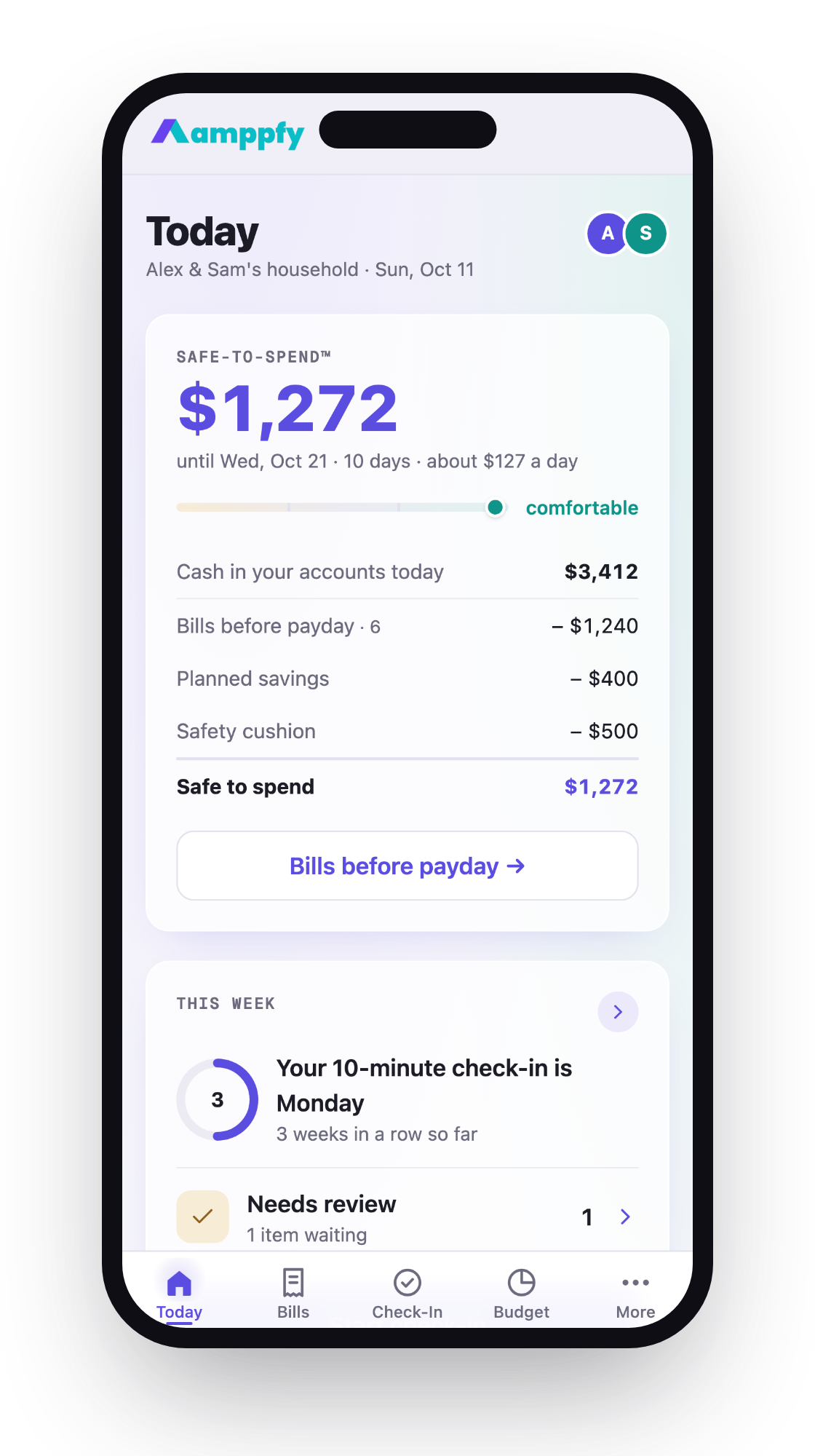
Say you bring home $3,412 every two weeks. You owe $1,240 in bills before the next payday, you want to save $400, and you keep a $500 cushion untouched. That leaves:
$3,412 cash – $1,240 bills – $400 savings – $500 cushion = $1,272
That $1,272 is what’s actually safe to spend on groceries, gas, and everything else until the next check lands. The $400 savings piece is the number you’re setting. If it feels too tight, drop it to $300 and revisit next month.
Finding the Amount That Sticks
- Look at your last three pay periods. How much was left the day before payday?
- If the answer is “almost nothing,” start with $50 per paycheck. That’s $1,300 a year.
- If you had $200 to $400 left over consistently, route half of that surplus to savings.
- Move the money on payday, before you spend anything. Not at the end of the month.
Amppfy’s Budget page breaks your month into four slices: Bills, Savings, Subscriptions, and Everyday spending. Your savings goal is already baked into the Safe-to-Spend™ number, so you’re not guessing what’s left. You see what’s left after savings are funded.
The trick isn’t discipline. It’s removing the decision. When savings move automatically on payday, you spend from what remains. That remaining number is the one that matters day to day.
When to Save Less for a While
Life doesn’t stay steady. A job change, a medical bill, a new baby: these things compress your budget, and the right response is to adjust your savings, not abandon them.
Dropping to a smaller amount during a rough stretch is not failure. It’s a plan. Here’s how to think about temporary reductions:
- Job loss or reduced hours: Pause retirement contributions above the match. Keep putting even $25 per paycheck into your cushion. Protect the floor.
- Medical or emergency expense: Redirect savings toward the bill. Once it’s paid, resume your previous amount. Don’t add guilt to the invoice.
- New baby or dependent: Recalculate your essential bills (they just went up). Set a new savings target that accounts for diapers, childcare, or formula. Even 2% counts.
- Paying down high-interest debt: Minimum savings plus aggressive debt payoff is a valid strategy. Every dollar toward a 22% credit card balance earns you 22% in avoided interest. That’s a return most investments can’t match.
The key is to keep the habit alive. A $25 automatic transfer is more valuable than a $400 transfer you cancel after two months. Consistency builds the muscle. The amount can grow later.
If your household budget changes shape, update your plan. A ten-minute check-in each week is enough to catch shifts before they snowball.
Raising the Amount After a Raise or a Paid-Off Bill
This is where real progress happens. You get a raise, finish a car payment, or cancel a subscription you forgot about. Suddenly there’s slack in the budget. The question is where that slack goes.
The Half-Raise Rule
Take any income increase or eliminated expense and split it down the middle. Half goes to savings. Half goes to your daily life. You still feel the raise. Your savings still grow.
Say you pay off a $380/month car loan. Route $190 to savings and keep $190 for yourself. Your savings just jumped by $2,280 a year without changing how your daily spending feels.
The same logic applies to:
- A $200/month raise after taxes: save $100, spend $100
- A $65 subscription you cancel: save $30, spend $35
- A bonus or tax refund: save half, use half for something you actually want
Ratchet, Don’t Leap
Doubling your savings rate overnight sounds ambitious. It usually lasts about six weeks. Small, permanent increases beat dramatic ones that collapse. If you’re saving $200 per paycheck now, bump it to $225 after your next raise. Then $250 after the next one. In two years, you’ve nearly doubled your rate without a single painful month.
The 2026 super catch-up contribution of $11,250 for employees aged 60 to 63 is a good example of how the system rewards ratcheting up. If you’ve been building the habit for decades, that extra room is there when you need it most.
Frequently Asked Questions
Is $500 a month enough to save?
It depends on your income and expenses, but $500 a month is $6,000 a year. For someone earning $50,000 after taxes, that’s 12%. That’s a strong rate. For someone earning $120,000, it might be a starting point. The right question isn’t whether $500 is “enough” but whether it’s the most you can sustain without stress.
Should I save or pay off debt first?
Both, in most cases. Build a small cushion of $500 to $1,000 first. Then attack high-interest debt (anything above 8% APR) while making minimum savings contributions. Once the expensive debt is gone, redirect those payments into savings. You don’t have to choose one or the other permanently.
How do couples decide how much to save together?
Start with shared goals: an emergency cushion, a vacation, a down payment. Agree on a combined monthly target, then split it proportionally by income or equally, whatever feels fair to both of you. Amppfy lets partners see the same Safe-to-Spend™ number while keeping private balances separate, so you don’t need a spreadsheet summit every Sunday.
What if I can barely save anything right now?
Then save barely anything. Seriously. Even $10 per paycheck builds the habit. The amount matters less than the consistency. When your situation improves, and it will, you’ll already have the pattern in place. Increase the number when you can. Skip the shame entirely.
Your Number, Your Pace
How much you should save each month is a moving target, and that’s the point. Start where you are. Protect a small cushion first. Automate a per-paycheck amount that doesn’t wreck your week. When a bill disappears or a raise shows up, ratchet the number higher.
The goal isn’t to match a statistic or impress anyone. It’s to know, on any given Tuesday, that your bills are covered, your savings are funded, and the money left is yours to spend. If you want to see that number before your next payday, get Amppfy free. Enter your balances, bills, and payday once, about ten minutes, and your Safe-to-Spend™ number stays current from there.