Your bank app shows a checking balance. Your brokerage app shows a portfolio value. Your mortgage portal shows a loan balance. None of them show the whole picture. A good net worth tracker app pulls those numbers into one view so you can see whether you’re actually moving forward, month over month, without logging into six different places. That single number: assets minus debts, is the clearest scoreboard personal finance offers.
Picking the right tool depends on how you want your data handled, what you’re willing to pay, and how much time you’ll spend on upkeep. The differences between apps are real, and some matter more than you’d expect.
What a net worth tracker should show
A useful tracker does more than spit out a single dollar amount. It should break your finances into two clean columns: what you own and what you owe.
Assets to Include
- Checking and savings accounts (every bank, every account)
- Retirement accounts (401(k), IRA, Roth IRA)
- Brokerage and investment accounts
- Real estate (your home’s estimated value, rental properties)
- Other assets (vehicles, crypto, business equity, cash value of life insurance)
Debts to Include
- Mortgage balance
- Student loans
- Auto loans
- Credit card balances
- Personal loans or lines of credit
The math is simple: total assets minus total debts equals net worth. A tracker that only covers bank accounts and investments misses the picture. Your mortgage is likely your largest liability. Your home is likely your largest asset. Skip either one and the number is meaningless.
Look for month-over-month history, too. A single snapshot tells you where you stand today. A trend line tells you whether your habits are working. Many trackers chart this automatically so you can spot stalls or progress without building your own spreadsheet.
One more thing to watch for: how the app handles shared finances. If you and a partner split bills or share a mortgage, you need a tracker that lets both of you see the same data without forcing you to share every private account balance.
Linked vs. manual tracking
This is the biggest fork in the road. Some apps connect directly to your bank, brokerage, and loan accounts. Others ask you to type in balances yourself. Both approaches work, and both have trade-offs.
Linked (Automatic) Tracking
Apps that sync with your financial institutions pull balances automatically. You connect your accounts once, and the numbers update on their own. The upside is obvious: less effort. The downside is less obvious but real.
Bank syncs break. They rely on data-sharing protocols, and the regulatory ground is still shifting. The CFPB’s Personal Financial Data Rights rule (Section 1033), which sets out how banks must share your data with apps you authorize, had its compliance dates stayed by a federal court in October 2025, and the CFPB is reconsidering the rule, including how fees for data access should be handled[1]. Until that settles, how apps connect to banks may keep changing.
Industry groups like the Financial Data Exchange (FDX) publish common API standards for this data sharing[2]. But “standard” doesn’t mean “universal.” Connections still vary by bank, and a broken sync can leave a balance out of date until you reconnect.
Manual Tracking
You type in your balances yourself. The upside: no broken connections, no data-sharing concerns, no third party storing your bank credentials. The downside: you have to do it. If you skip a week, your numbers go stale.
Manual tracking works best if you keep it on a schedule. A regular check-in, weekly or monthly, keeps everything current. That rhythm also forces you to actually look at your accounts, which is a habit that pays for itself.
The apps, compared
Four apps worth considering in 2026, each built for a different type of person. Prices and features reflect what’s published on each company’s own site as of October 2026.
| Feature | Empower Personal Dashboard | Monarch Money | Kubera | Amppfy |
|---|---|---|---|---|
| Price | Free (paid advisory services offered separately) | $14.99/month or $99.99/year | Essentials $250/year; Black $2,500/year (14-day trial) | Free; no paid tier |
| Tracking method | Linked (automatic sync) | Linked (automatic sync) | Linked + manual | Manual only (no bank login) |
| Net worth chart | Yes | Yes | Yes | Yes (net worth page) |
| Couples support | Not stated on Empower’s site | Yes (invite a partner at no extra cost) | Yes (share with family or advisors) | Yes (invite a partner by email) |
| Platforms | Web, iOS, Android | Web, iOS, Android | Web, iPhone, Android | iPhone, web |
| Best for | People whose net worth is mostly in investments | People who want one app for budgeting + net worth | High-net-worth households with diverse assets | People who would rather enter balances by hand than link banks |
Empower Personal Dashboard
A free dashboard with net worth, budgeting and cash flow, real-time investment monitoring, and a retirement planner. Empower says the dashboard and its tools are free; the company also sells paid advisory services, starting at $100,000 invested. Best fit: someone whose net worth is mostly in investment accounts.
Monarch Money
A full budgeting app with net worth tracking built in. It connects to your accounts and categorizes transactions. The household feature lets partners collaborate on a shared budget. The Core plan is $14.99/month or $99.99/year, with a 7-day trial and no free tier. Best fit: someone who wants budgeting and net worth in one place and doesn’t mind paying monthly.
Kubera
Built as a balance sheet for complex asset mixes: stocks, funds, crypto, DeFi, NFTs, and real estate. It supports linked accounts through multiple aggregators as well as manual tracking. Essentials costs $250/year and Black $2,500/year, after a 14-day trial. Best fit: high-net-worth households or anyone with assets spread across unusual account types.
Amppfy
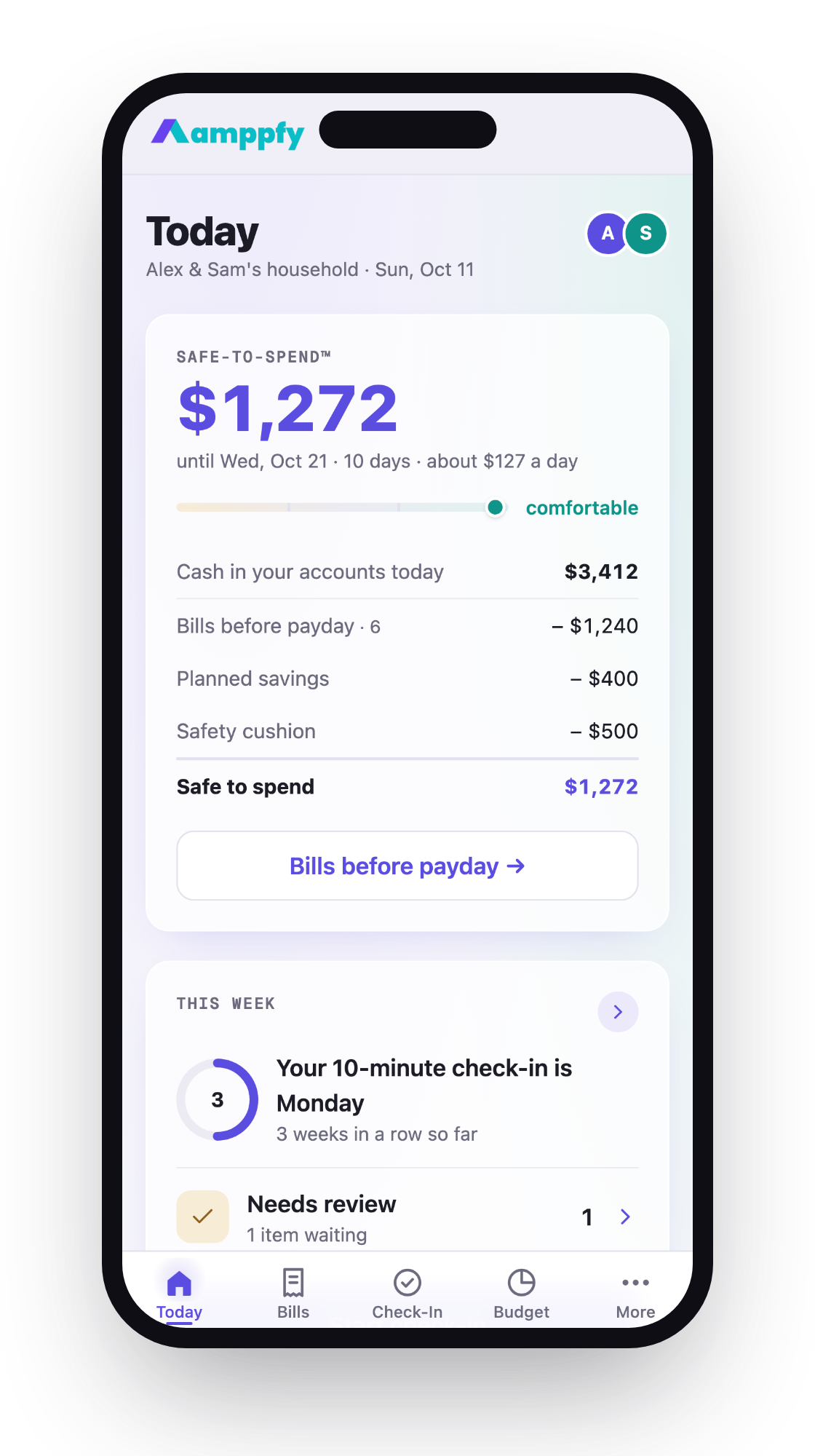
A free app for iPhone and the web that takes a different approach. You enter your balances by hand and get a net worth page plus one Safe-to-Spend™ number, with the math printed under it: cash, minus bills due before payday, minus savings, minus a cushion. No transaction import, no bank login, and no investment syncing, so investment balances are typed in too. You can invite a partner by email; each of you gets your own login, shared accounts show for both, and anything you keep private stays private. Best fit: someone who quit a budgeting app because of broken syncs, or a couple that wants one shared view without sharing bank credentials.
How often to update
Checking your net worth daily is like weighing yourself every hour. The number moves, but the movement is noise, not signal.
A monthly update is the sweet spot for most people. Pick a date: the first of the month works well. Log into each account, note the balance, and update your tracker. The whole process takes ten to fifteen minutes if you have five or six accounts. In a manual app like the one in the table above, typing in each balance takes about 30 seconds per account.
Here’s what a monthly rhythm reveals that a daily check won’t:
- Whether your savings rate is actually growing your net worth or just treading water
- Seasonal patterns (holiday spending dips, tax refund bumps, bonus months)
- The real impact of paying down debt: a $400 extra mortgage payment barely moves your checking balance but shifts your net worth by $400 every single month
If you use a linked app, the numbers update automatically, but you should still review them monthly. Sync errors can silently drop an account or freeze a stale balance. A quick scan catches those problems before they compound.
One practical tip: set a calendar reminder. Don’t rely on motivation. A recurring 15-minute block on the first Saturday of each month turns net worth tracking from a chore into a habit.
Choosing one
The “best” app depends on three things: your comfort with data sharing, your willingness to pay, and how complex your finances are.
Start with these questions:
- Do you want automatic syncing? If yes, Empower, Monarch, and Kubera all link accounts. If sync reliability or data privacy concerns you, manual entry removes that variable entirely.
- Are you tracking just net worth, or budgeting too? Monarch combines both. Empower and Kubera focus on the net worth and investment side. A manual-entry app can pair net worth with a bills calendar but skips transaction categorization.
- Do you share finances with a partner? Monarch lets you invite a partner at no extra cost, and Kubera lets you share with family or an advisor. Check how each app handles access before you invite anyone.
- What’s your budget for a finance app? Empower and Amppfy are free. Monarch Core runs $99.99/year. Kubera Essentials costs $250/year. The paid apps earn their price if you use their extra features. If you just want a net worth number and a trend line, free tools do the job.
Don’t overthink this. Pick one, enter your numbers, and check back in a month. The tracker that gets used is better than the tracker that has the most features. Your net worth isn’t going to change because of which app you chose. It changes because you started paying attention.
Frequently Asked Questions
Is a net worth tracker safe to use?
Safety depends on the app’s data practices. Linked apps usually connect through a data aggregator or a bank API, so check how each one handles your login. Manual-entry apps don’t hold your login information at all, which removes that risk. Read the app’s privacy policy before connecting any account.
Should I include my home’s value in my net worth?
Yes, but be conservative. Use a recent estimate from your county assessor or a home value tool, and update it once or twice a year rather than monthly. Your home is an asset, but it’s not liquid. Including it gives you the full picture; just don’t confuse home equity with spendable cash.
What’s a good net worth for my age?
This varies wildly by income, location, and life stage. A more useful question: is your net worth higher this month than last month? The trend matters more than any benchmark. If you’re 30 with $50,000 in student debt and $20,000 in savings, your net worth is negative $30,000. That’s a starting point, not a verdict. Track the direction.
Can I track net worth with a spreadsheet instead of an app?
Absolutely. A simple spreadsheet with two columns (assets and debts) and a row for each month works fine. The advantage of an app is automation, reminders, and charts you don’t have to build yourself. The advantage of a spreadsheet is total control and zero cost. If you’ve tried a spreadsheet and stopped updating it, an app with reminders might keep you more consistent.
Your Next Step
Your net worth is just a subtraction problem. The hard part isn’t the math: it’s building the habit of checking. Pick one app from this list, enter your balances this weekend, and set a monthly reminder. That first number is your baseline. Every month after, you’ll know whether you’re gaining ground.
If you want a simple starting point, get Amppfy free. Enter your balances, bills, and payday once, and you’ll see both your Safe-to-Spend™ number and your net worth going forward.