You’re probably paying for subscriptions you forgot about. Maybe it’s a meditation app from January, a streaming trial that quietly converted, or a cloud storage upgrade you no longer need. The charges are small enough to miss on a bank statement but large enough to matter over a year. Finding the right app to cancel subscriptions can save you real money, but the options work in very different ways. Some scan your bank transactions automatically. Others just show you a list and let you decide. A few will even contact the company on your behalf. Here’s how to sort through them and pick the one that fits your situation.
How subscription apps find charges
Most subscription-tracking apps use one of two methods to locate recurring charges: bank-linked scanning or manual entry.
Bank-linked scanning
Apps like Rocket Money and PocketGuard usually connect to your bank through a data provider such as Plaid. The provider passes along your transaction history, and the app flags patterns (same merchant, same amount, same interval), and presents them as subscriptions. This approach catches charges you’ve genuinely forgotten. It also means you’re giving a third party access to your account data.
The accuracy depends on how the merchant codes the charge. A subscription billed under a parent company name might not look familiar. A charge that varies slightly each month (usage-based tiers, for example) might not get flagged at all.
Manual tracking
Some tools skip the bank connection entirely. You enter your subscriptions yourself: name, amount, billing date. This takes a few minutes up front but keeps your banking credentials off a third-party server.
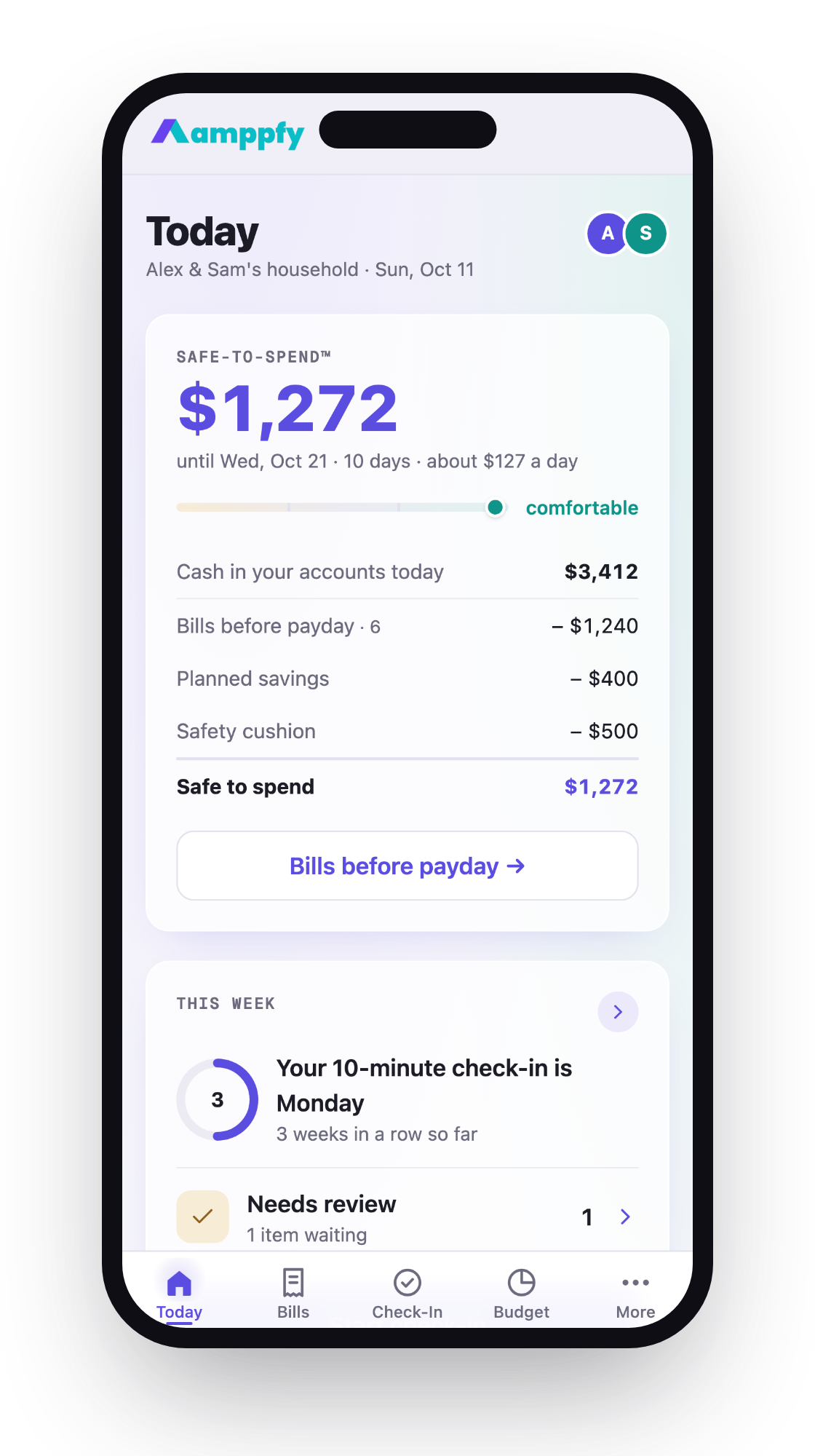
Amppfy takes a manual approach too. It’s free on iPhone and the web, and there’s no bank login: you enter balances by hand and add each subscription yourself (it doesn’t detect them for you). Its Subscriptions card shows the monthly total of everything you’ve added, with each one’s monthly cost and next charge date. For well-known providers there’s a “How to cancel” link; you still do the cancelling. Once you’ve cancelled, tap Mark cancelled and that money goes back into your Safe-to-Spend™ number (cash − bills due before payday − savings − cushion). At the weekly check-in, a “Still using these?” prompt puts the list in front of you again.
What gets missed
Neither method is perfect. Bank-linked apps can miss annual charges that haven’t recurred recently. Manual apps only know what you tell them. The best practice is to check your last three months of bank and credit card statements before you set up any tracker. Look for amounts between $5 and $25. Those are the ones that hide in plain sight.
Cancellation services vs. reminders
There’s a meaningful difference between an app that cancels subscriptions for you and one that just reminds you they exist.
Apps that cancel on your behalf
Rocket Money is a well-known example. Subscription tracking is free, and with Premium you flag a subscription you want gone and Rocket Money contacts the provider for you; its site says this usually takes 2 to 10 days. Premium is pay-what-you-think-is-fair at $7 to $14 a month, and Premium+ is $15 a month. You’re paying for someone else to do the contacting.
The value here is real for services that make cancellation deliberately difficult. Some companies bury the cancel button, require a phone call, or route you through a retention specialist.
Apps that remind and inform
PocketGuard focuses on what’s left: its “Leftover” figure shows what’s safe to spend after bills, debt, savings, and goals, and it flags recurring charges before they renew. Its pricing page also lists “cancel subscriptions” and “lower your bills,” but doesn’t detail how that works. It has no free tier: a seven-day trial, then PocketGuard Plus at $12.99 a month, $74.99 a year, or $149.99 lifetime. Apple’s built-in subscription settings (Settings > your name > Subscriptions on iPhone) show subscriptions billed through Apple and let you cancel them yourself.
Apple’s settings and manual trackers don’t negotiate or contact anyone. They surface the information and leave the action to you.
Why surfacing costs matters more than you’d think
Knowing the annual total can change how a charge feels. Seeing “$14.99/month” reframed as “$180/year” makes it easier to ask whether a service is still worth it.
The apps, compared
Here’s how four options compare. Details are from each company’s own website as of October 2026.
| Feature | Rocket Money | PocketGuard | Apple Settings | Amppfy |
|---|---|---|---|---|
| Finds subscriptions automatically | Yes (bank link) | Yes (bank link) | Apple-billed subscriptions only | No (you add them) |
| Cancels for you | Yes (Premium) | Listed on pricing page; details not stated | You cancel yourself (Apple-billed only) | No; “How to cancel” links for well-known providers |
| Requires bank login | Yes, in practice | Usually; manual tracking possible | No | No |
| Shows spendable cash | Budgets and spending tracking | Yes (“Leftover”) | No | Yes (Safe-to-Spend™; Mark cancelled puts the money back) |
| Free tier available | Yes; Premium $7–$14/mo, Premium+ $15/mo | No: 7-day trial, then $12.99/mo, $74.99/yr, or $149.99 lifetime | Yes (built-in) | Yes, free; no paid tier |
| Partner/shared view | Account sharing (Premium) | Not stated on its site | No | Invite a partner by email |
| Platform | iOS, Android; web on paid tiers | iOS, Android, web | Apple devices | iPhone, web |
A few things stand out. If you want someone else to handle cancellation calls, Rocket Money Premium is built for that. If your subscriptions are all billed through Apple, Apple’s built-in settings let you see and cancel them for free. If you want one figure for what’s safe to spend after subscriptions, bills, and savings, PocketGuard and the manual Safe-to-Spend™ app above both offer one, though PocketGuard usually links your bank and the other doesn’t.
No single subscription management app fits everyone. Your choice depends on how many subscriptions you have, whether they’re billed through the App Store or directly, and how much you value keeping bank credentials private.
What to do without an app
You don’t strictly need an app to find and cancel subscriptions. Here’s a straightforward process.
- Pull up your last 90 days of transactions from every bank account and credit card you use.
- Search for recurring amounts. Sort by merchant name or amount to spot patterns.
- List every subscription you find: name, amount, billing date, and whether you’ve used it in the last 30 days.
- For each unused service, go to the company’s website or app and look for a cancel option in account settings.
- If you can’t find one, check whether your state has an automatic-renewal law. Some states require businesses to offer an easy way to cancel, and your state attorney general’s website explains the rules where you live.
- Screenshot every cancellation confirmation. Companies sometimes “lose” cancellation requests.
This manual approach works. It just requires you to repeat it every few months, because new subscriptions creep in. A bank-linked tracking app automates the detection step; a manual tracker keeps the list and the totals in one place. Either way, you only have to do the deciding and canceling.
If a company makes cancellation unreasonably hard, file a complaint with the FTC or your state attorney general.
Choosing one
The right subscription cancellation tool depends on three questions.
How many subscriptions do you have? If it’s fewer than ten, Apple’s built-in settings plus a quick manual check of your bank statements will handle it. You don’t need a separate app.
Do you want someone else to make the cancellation call? If yes, Rocket Money Premium is a well-known option. Check the current pricing before committing: you’re paying a recurring fee to cancel recurring fees, so the math needs to work.
Do you care about keeping your bank credentials off third-party servers? If so, manual-entry tools fit better. The manual Safe-to-Spend™ app above keeps a Subscriptions card with monthly costs and next charge dates without linking a bank account, and a spreadsheet or Apple’s settings work too. You trade automation for control.
Here’s a simple worked example of why this matters. Say you find four forgotten subscriptions: a music app at $10.99/month, a fitness app at $14.99/month, a news site at $9.99/month, and a VPN at $12.99/month. That’s $48.96/month, or $587.52/year. Cancel all four and you keep almost $49 a month that would otherwise come out of your Safe-to-Spend™ number.
Pick the tool that matches your comfort level. Use it once to clean house. Then check back quarterly. Subscriptions are quiet spenders. The best defense is a short, regular look at where your money goes.
Frequently Asked Questions
Is it safe to give a subscription-cancellation app access to my bank account?
Bank-linked apps typically connect through encrypted data providers rather than storing your bank password themselves. That said, any third-party connection creates some risk. If that concerns you, manual-entry tools or Apple’s built-in subscription settings let you track and cancel without sharing bank login details. Weigh convenience against your personal comfort with data sharing.
Can I cancel subscriptions directly through my iPhone without any app?
Yes. Apple’s support page lists the steps: open Settings, tap your name, then tap Subscriptions. Tap a subscription, then tap Cancel Subscription. If there’s no Cancel button, or you see an expiration message in red, it’s already canceled. This only covers subscriptions billed by Apple, though. If one isn’t listed, another company may be billing you, so contact that company. Subscriptions billed directly through a company’s website (like a gym membership or a news site) won’t appear here.
Do cancellation apps charge a fee?
Some do. Rocket Money’s free tier tracks subscriptions, but its cancellation concierge requires Premium. Its bill negotiation charges a success fee of 35% to 60% of the first year’s savings on Free and Premium, with no fee on Premium+. Apple’s settings are free. Always check an app’s current pricing before signing up: you want to make sure the cost of the tool doesn’t exceed what you’re saving.
How often should I review my subscriptions?
Once a quarter is a good rhythm. New free trials convert to paid plans, annual renewals sneak up, and your needs change. Set a calendar reminder for the first weekend of every quarter. Review your list and cancel anything you haven’t used in 30 days. That small habit adds up over a year.
Your next step
The hardest part of managing subscriptions isn’t canceling them. It’s noticing them. Whether you use a bank-linked scanner, a manual tracker, or just your own bank statements, the goal is the same: see what you’re paying, decide what’s worth it, and cut the rest.
If you want a clear picture of what’s left after subscriptions, bills, and savings goals, get Amppfy free on iPhone and the web. Enter your balances, bills, and paydays by hand, and you’ll see one number: what’s safe to spend before your next paycheck.