Most people who earn on a shifting schedule already know they need a budget. The hard part is finding a budget app for irregular income that doesn’t punish you for not knowing next month’s deposit to the penny. If your pay changes week to week, whether from gig work, commissions, freelance projects, or seasonal tips, the standard “enter your monthly salary” setup screen feels like a trick question. The good news: some apps fit variable income better than others. Below, you’ll find what to look for, how four options compare, and which one fits your household.
Why Most Budget Apps Assume a Steady Paycheck
Traditional budgeting software was designed around a simple loop: paycheck arrives on the 1st and 15th, bills go out, savings get skimmed, the rest is spending money. That loop works when you can predict the deposit. It breaks the moment your income swings.
Many apps ask for a monthly income during setup and divide that number across categories. When you earn $4,800 one month and $2,100 the next, the plan stops matching reality. That doesn’t mean you’re failing. It means the plan assumed a steady number.
The deeper issue is timing. A salaried worker knows cash lands every two weeks. A rideshare driver might get paid Tuesday, Thursday, and Saturday, with amounts that shift by the hour. A real estate agent might close two deals in March and none in April. Budgeting by calendar month hides the real question: what can I safely spend between now and the next deposit?
That question is what separates a useful budgeting tool for variable earners from one that just tracks categories. You need an app that thinks in pay periods, not months, and adjusts when the next check is bigger or smaller than the last.
Features That Matter for Uneven Pay
Not every feature list matters equally when your income moves around. Here’s what to prioritize.
- Flexible pay periods. You should be able to set paydays that aren’t biweekly. Weekly, twice a month, “whenever the client pays”: the app needs to handle all of them.
- Rolling bill tracking. Bills don’t care about your income. An app that shows which bills fall before your next deposit, and subtracts them automatically, saves you from overdraft math in your head.
- Envelope or goal-based allocation. Instead of percentage-based categories, you assign real dollars to real needs each time money arrives. This works because you budget what you have, not what you expect.
- Low-income month buffer. Some apps let you set a safety cushion or reserve fund. That cushion sits between your balance and your spending, protecting you during a slow week.
- Quick check-ins. If the app takes 45 minutes to update, you’ll probably stop using it. A short, regular update is easier to keep.
- Partner access. If two people share bills, both need to see the same spending picture without duplicating work.
Skip apps that rely on automatic transaction categorization as their core feature. Categorizing last week’s spending is useful, but it doesn’t answer “can I afford groceries before Friday?” That forward-looking view is what matters most.
The Apps, Compared
Here’s how four apps handle irregular income. Prices and plan details come from each app’s own website as of October 2026.
| Feature | YNAB | Goodbudget | Monarch Money | Amppfy |
|---|---|---|---|---|
| Core method | Zero-based / envelope | Envelope | Category tracking + goals | Safe-to-Spend™ number |
| Variable paydays | Yes, budget only what you have | Yes, fill envelopes per deposit | Flexible budgets by category or group; forecasting on the Plus plan | Yes, paydays sit on the bills calendar |
| Bank sync | Optional: direct import for select banks, file import, or manual entry | Optional: manual or file import free; bank sync on Premium (US banks) | Yes, 13,000+ institutions | No (you enter balances by hand) |
| Partner access | YNAB Together: up to six people on one subscription | Sync and share a budget across household devices | Invite a partner at no extra cost | Invite a partner by email |
| Bills | Spending targets (bill calendar not stated on its site) | Scheduled transactions | Detects recurring charges | Bills calendar with paydays |
| Safety cushion | Manual via category | Manual via envelope | Not stated on its site | Built in: you choose the amount |
| Price | $14.99/month or $109/year after a 34-day trial | Free (20 envelopes, 1 account) or Premium $10/month or $80/year | Core $14.99/month or $99.99/year; Plus $199.99/year; 7-day trial | Free on iPhone and web; no paid tier |
| Good fit for | Hands-on budgeters who want full control | Envelope budgeters, households sharing one budget | People who want bank sync + planning | People who want one number, minimal upkeep |
YNAB
YNAB’s core rule, “give every dollar a job,” works well for irregular income because you only budget money you already have. You don’t forecast. When a $2,300 freelance payment hits, you assign those dollars to rent, groceries, gas, and savings. When a $900 payment hits the following week, you do the same with less. There’s a learning curve, so give yourself time with it. YNAB costs $14.99 a month or $109 a year after a 34-day free trial, and YNAB Together lets up to six people share one subscription. Bank import is optional: you can connect select banks, import files, or enter transactions by hand.
Goodbudget
Goodbudget uses digital envelopes. Each time money comes in, you fill your envelopes. It’s simple and visual. The free plan gives you 20 envelopes (10 regular plus 10 more) and one account, which may be tight if you track subscriptions separately. On the free plan you enter transactions by hand or upload a bank file. Premium ($10 a month or $80 a year) adds automatic bank sync for US banks and unlimited envelopes and accounts.
Monarch Money
Monarch connects to your accounts (13,000+ institutions) and pulls transactions automatically. It detects recurring charges, tracks net worth and investments, and lets you invite a partner at no extra cost. Budgets are flexible, by category or by group, and the Plus plan adds forecasting, which can help when pay swings. Core costs $14.99 a month or $99.99 a year, Plus is $199.99 a year, and there’s a 7-day trial with no free tier.
Amppfy
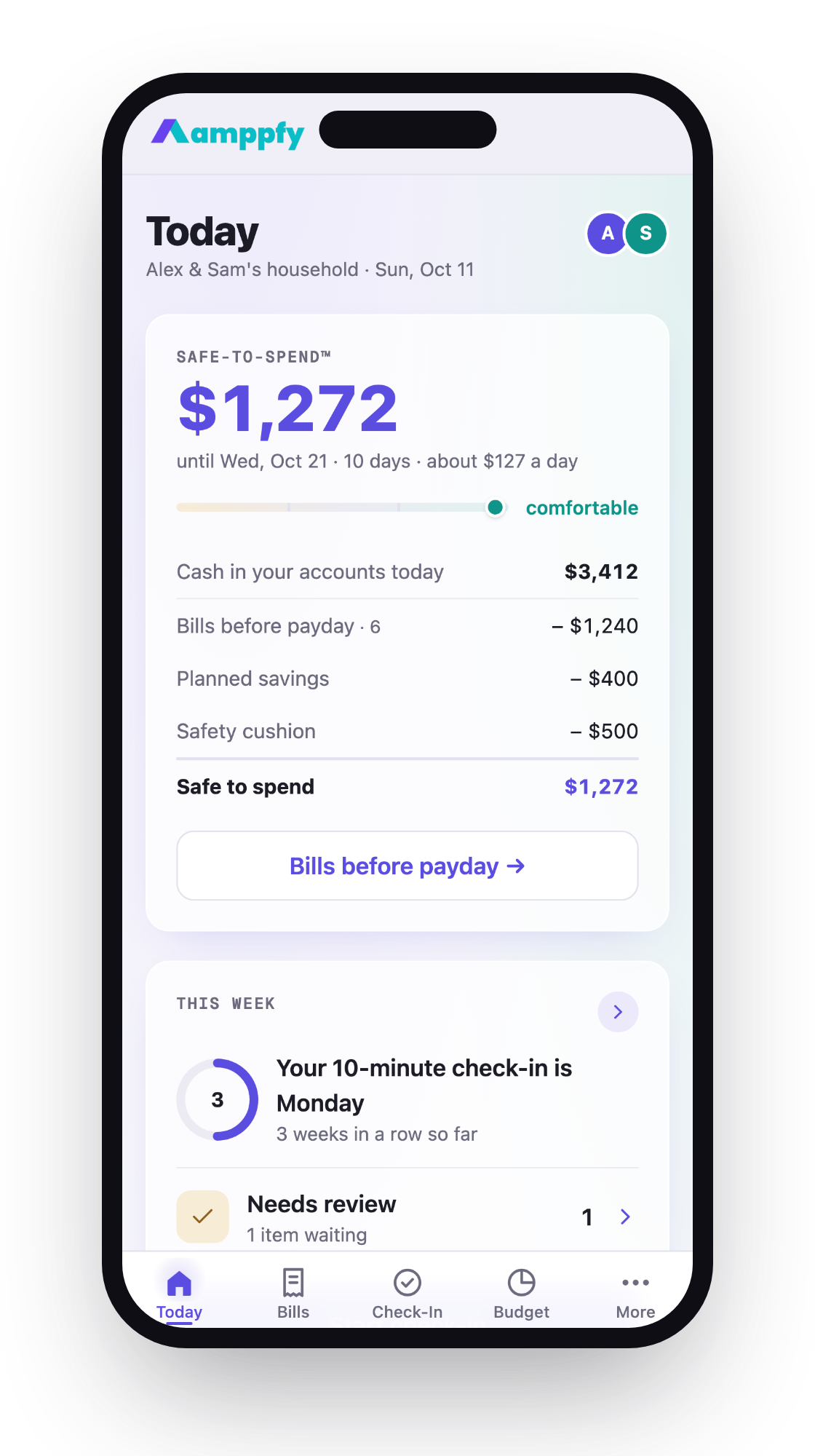
This app is free on iPhone and the web and shows one Safe-to-Spend™ number: your cash minus bills due before payday, minus savings, minus a cushion you pick. The four-line math is printed right under the number. Example: $3,412 cash − $1,240 bills − $400 savings − $500 cushion = $1,272. There’s no transaction import or bank login, so you type in balances yourself. Bills and paydays sit on one calendar, savings goals and a net worth page are included, and you can invite a partner by email. Each of you gets your own login: shared accounts and bills show for both, and anything you keep private stays private.
Gig, Tips, and Commission Households
Variable income is common among gig workers, servers, stylists, salespeople, and freelancers. It isn’t a niche problem.
If you earn tips, commissions, or project-based pay, your budgeting app needs to handle a few specific realities.
- Your deposits land on different days. A server might get cash tips nightly and a paycheck biweekly. A commission salesperson might get a base salary plus quarterly bonuses. The app should let you add income whenever it arrives, not just on preset dates.
- Your “low month” is the real budget. The safest approach: budget based on your lowest recent month, not your average. If you earned $2,100, $3,600, and $4,200 over three months, build your spending plan around $2,100. Extra income goes to savings or debt.
- A buffer matters more than categories. A reserve of a month or more of expenses gives variable earners room for a slow stretch. An app with a built-in cushion makes this easier to maintain. Without it, you’re relying on willpower to not touch the buffer sitting in your checking account.
Couples add another layer. If one partner earns a salary and the other freelances, you’re blending predictable and unpredictable income. The budgeting tool needs to show both people the same spending picture. Otherwise you end up texting “did you pay the electric bill?” every month.
An app that recalculates your safe spending amount each time you update a balance or add a deposit removes the guesswork. You open it, see the number, and know what’s available.
Choosing One for Your Household
Pick the app that matches how you actually manage money, not the one with the longest feature list.
Start with two questions. First: do you want bank sync or manual entry? Bank sync saves time but can break, lag, or miscategorize. Manual entry takes a little typing but puts you in control. If broken bank sync is why you quit your last app, try manual.
Second: how much time will you spend? Apps where you assign or log each transaction (YNAB, Goodbudget’s free plan) ask for more frequent attention. Bank-synced apps like Monarch ask you to review what came in. A balance-based app asks you to type in balances when you check in. With the Safe-to-Spend™ app, that’s about 30 seconds per account, and the weekly check-in takes about ten minutes.
Here’s a simple decision path:
- You want full control and don’t mind a learning curve: YNAB.
- You like the envelope concept and want simplicity: Goodbudget.
- You want automatic transaction pulls and are fine paying for them: Monarch Money.
- You want one number that tells you what’s safe to spend, with no bank login: Amppfy.
Don’t overthink the choice. The best budgeting app for someone with irregular income is the one you’ll actually open next Tuesday. Download one, enter your current balances, set your next payday, and give it two pay cycles. If it fits, keep going. If it doesn’t, try the next one. Each of these has a free plan or a free trial, so a short test costs little more than time. Just note when any trial ends.
Frequently Asked Questions
Can I use a budget app if I don’t know what I’ll earn next month?
Yes. The best approach is to budget only money you already have. YNAB is built around this idea, and envelope apps like Goodbudget work the same way. You assign dollars when they arrive, not before. You never need to forecast. If a bigger check comes later, you allocate those dollars then.
How do I handle months where I earn much less than usual?
Build your baseline budget around your lowest recent month. Cover essentials first: housing, food, utilities, insurance. Everything else waits. A safety cushion, whether built into your app or sitting in a separate savings account, covers the gap. Even $500 set aside makes a slow month less stressful.
Do I need to connect my bank account?
Not always. YNAB and Goodbudget both let you work manually or with file imports, and the Safe-to-Spend™ app above has no bank connection at all. Monarch is built around connected accounts. Typing in your balances yourself avoids the frustration of broken connections.
What if my partner and I have different pay schedules?
Look for an app that supports two users viewing the same budget. All four apps here offer some form of shared access. The key is that both people see the same spending picture. Set each person’s payday separately if the app allows it, and budget from whichever deposit lands first.
Choosing Your Next Step
A budgeting app for variable income should answer one question fast: what can you spend before more money arrives? Everything else, categories, reports, net worth charts, is secondary. Pick the tool that gives you that answer with the least friction, then use it for two pay cycles before judging.
If you want to see your own Safe-to-Spend™ number before your next payday, get Amppfy free on iPhone and the web. Enter your balances, bills, and paydays by hand, and update the balances when you check in.