Most people check their bank app daily and still can’t answer a simple question: am I getting ahead financially, or just treading water? Your balance goes up on payday, drops when rent hits, and the cycle repeats. That pattern tells you almost nothing about direction. There’s a better way to measure progress, and it takes about two minutes once a month. One number, tracked consistently, replaces the guesswork with a clear signal.
Why a bank balance can’t answer this
Your checking account balance is a snapshot of a single moment. It spikes on Friday, craters on Monday, and flatlines by Wednesday. Judging your financial direction from that number is like judging the tide by staring at one wave.
Here’s the core problem: a bank balance ignores everything that isn’t cash. It doesn’t show the $14,000 left on your car loan. It doesn’t reflect the $6,200 sitting in your Roth IRA. It skips your credit card balance entirely. Two people can have the same $3,500 in checking and be in wildly different positions.
A high balance can also create a false sense of comfort. You see $4,800 after payday and feel fine. But $1,600 of that is rent due in three days, $400 goes to auto-pay subscriptions, and $300 is earmarked for a savings goal. Your real spending room is closer to $2,500, maybe less after groceries and gas.
The reverse is also true. A low balance right before payday doesn’t mean you’re failing. If your debts dropped by $800 this month and your 401(k) grew by $500, you made real progress. The bank app just can’t show you that.
What you need is a number that accounts for everything you own minus everything you owe. That number is net worth, and it’s the single metric that answers whether you’re moving forward or standing still.
The monthly net worth snapshot
Net worth is simple math: total assets minus total debts. That’s it. No formulas, no ratios, no spreadsheets with 47 tabs. One subtraction tells you where you stand.
How to calculate it
Pick one day each month. The first works well. Write down every balance you have:
- Checking and savings accounts
- Retirement accounts (401k, IRA, HSA)
- Investment or brokerage accounts
- Cash value of any property (use a conservative estimate)
Then list every debt:
- Credit card balances
- Student loans
- Auto loans
- Mortgage balance
- Any other money you owe
Subtract total debts from total assets. That’s your net worth.
A worked example
| Category | Amount |
|---|---|
| Checking | $3,200 |
| Savings | $8,400 |
| 401(k) | $42,000 |
| Car value | $16,000 |
| Total assets | $69,600 |
| Credit cards | -$2,800 |
| Student loans | -$18,500 |
| Auto loan | -$11,200 |
| Total debts | -$32,500 |
| Net worth | $37,100 |
Next month, you do the same thing. If the number is $37,900, you moved forward by $800. If it’s $36,400, something pulled you backward. Either way, you know.
The estimated inflation-adjusted median household net worth in the U.S. is roughly $210,000[1] for 2026. That’s a useful benchmark, but your own month-over-month trend matters more than any national average. A 32-year-old with $18,000 in net worth who gains $600 a month is in a stronger position than someone sitting at $200,000 with a flat or declining line.
Amppfy tracks net worth month by month alongside your Safe-to-Spend™ number, so you get both the daily spending picture and the long-term direction in one place.
Three signs of progress that aren’t income
A raise feels great. But income alone doesn’t determine whether you’re getting ahead financially. Plenty of households earning $150,000 a year have dramatically different financial health based on their debt-to-asset gaps[2]. What actually moves the needle often has nothing to do with your paycheck.
1. Your debt principal shrinks each month
Minimum payments on a car loan or student loan chip away at principal every single month. You don’t feel richer, but your net worth ticks upward automatically. Check your loan statements: the principal balance line is the one that matters. If it dropped, you made progress.
2. Your savings rate holds steady
You don’t need to save 30% of your income. Even $200 a month, moved consistently into a savings account or retirement fund, compounds over years. The key word is “consistently.” A $200 monthly deposit means $2,400 a year, plus whatever interest or growth it earns. That’s real forward motion.
3. Your recurring costs stay flat while income grows
If your rent, subscriptions, insurance, and loan payments hold steady while your income rises even slightly, the gap between what you earn and what you owe each month widens. That gap is where progress lives. You don’t need to cut expenses to zero. You just need the gap to exist and to direct it somewhere useful: a goal, a debt payment, an emergency fund.
These three signals show up clearly in a monthly net worth snapshot. They’re invisible in a bank balance.
What a flat line usually means
You’ve been tracking for four or five months and the number barely moves. It’s not dropping, which is good. But it’s not climbing either. A flat net worth line usually points to one of three patterns.
The first is a debt treadmill. You’re paying down one balance while another creeps up. Maybe your student loan drops by $400 a month, but your credit card balance rises by $350. Net effect: almost zero. The fix is straightforward. Freeze the balance that’s growing. Even a temporary pause on credit card spending breaks the cycle.
The second pattern is lifestyle creep absorbing raises. You got a $3,000 annual raise last year. But you also upgraded your phone plan, added a streaming service, and started eating out one extra night a week. Those small additions can quietly eat the entire raise. Pull up your subscriptions list and check the next-charge dates. Cancel anything you haven’t used in 30 days.
The third is savings sitting idle without a purpose. You have money in a savings account, but it’s not assigned to anything. So when a surprise expense hits, you pull from savings and refill it later, netting out to zero growth. Giving each dollar a job, even a vague one like “car repair fund” or “vacation,” makes you less likely to raid it for everyday spending.
Only 31% of U.S. households qualify as financially healthy[3], a number that’s held flat for five straight years. A flat net worth line is common. It doesn’t mean you’re doing something wrong. It means there’s a specific friction point worth finding.
One small move that bends the line
You don’t need a dramatic overhaul. One targeted change, applied consistently, can shift a flat net worth line into an upward slope within three to four months.
The payday-first method
On payday, before you spend anything discretionary, move a fixed amount toward your highest-priority goal. It could be $50. It could be $300. The amount matters less than the timing.
Here’s why this works: spending expands to fill available cash. If you move money out first, your spending adjusts to what’s left. If you wait until the end of the pay period to save “whatever’s left over,” there’s rarely anything left.
A quick example using the Safe-to-Spend math:
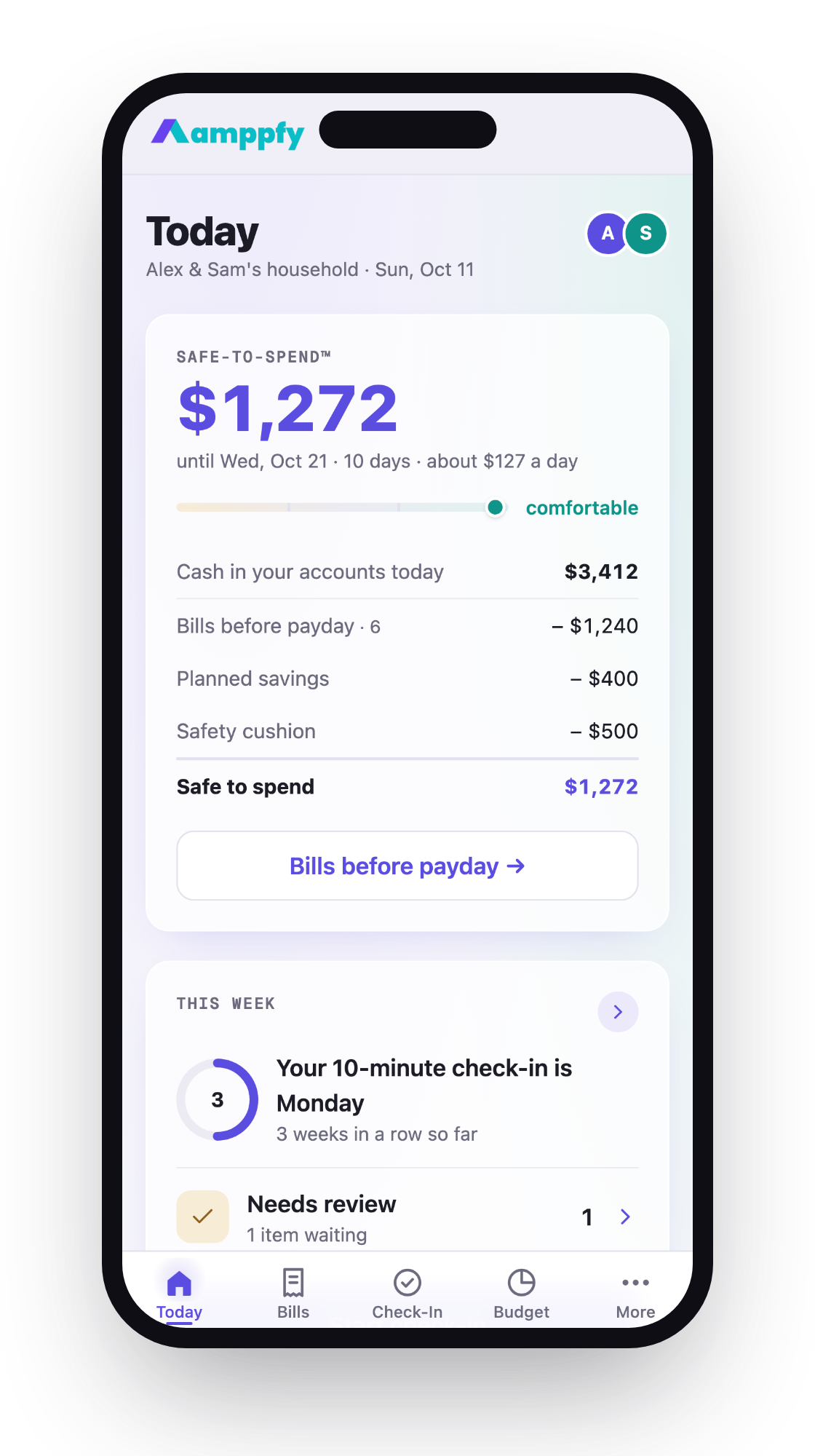
$3,412 cash – $1,240 bills – $400 savings – $500 cushion = $1,272
That $400 savings line is the move that bends the curve. It’s already subtracted before you decide what to spend. You see $1,272 as your real number, and you work within it.
Pick the right target
Where should that payday-first money go? A simple priority order:
- Emergency fund until it covers one month of bills
- High-interest debt
- Employer 401(k) match (if you’re not capturing it, that’s free money left on the table)
- Medium-interest debt or additional savings goals
You don’t need to tackle all four at once. Pick one. Fund it until it’s done. Move to the next.
The compounding effect is real but quiet. A $200 monthly deposit into a debt or savings goal shifts your net worth by $2,400 a year, plus interest saved or earned. Over three years, that’s $7,200 or more in net worth movement from a single, small, repeated action.
Amppfy’s payday nudge prompts you to fund goals first, then shows your updated Safe-to-Spend so you know exactly what’s left for the rest of the cycle.
Frequently Asked Questions
How often should I check my net worth?
Once a month is the sweet spot. Weekly is too noisy because market fluctuations and bill timing create false signals. Quarterly is too slow to catch problems early. Pick the same day each month, spend two minutes updating your balances, and compare to last month. That’s enough to see a clear trend without creating anxiety.
What if my net worth is negative?
A negative net worth means your debts exceed your assets. This is common for people with student loans, a mortgage, or both. It doesn’t mean you’re failing. What matters is the direction. If your net worth was -$22,000 in January and -$19,500 in April, you gained $2,500 in three months. That’s real progress. Focus on the slope of the line, not the position on the chart.
Should I include my home’s value in net worth?
Yes, but use a conservative estimate. Zillow or Redfin can give you a ballpark. Subtract your remaining mortgage balance from that estimate. The difference is your home equity, which is a real asset. Just don’t obsess over monthly fluctuations in home value: update it quarterly or when you have a reason to check.
Does my partner need to share every account for this to work?
No. You can track household net worth by combining shared accounts and each person’s individual totals. You don’t need to see each other’s personal balances. What matters is the combined number moving in the right direction. Amppfy handles this by letting partners see the same household number while keeping private balances private.
Your next two minutes
Knowing whether you’re actually getting ahead financially comes down to one number, tracked once a month. Not your bank balance. Not your income. Your net worth: assets minus debts, written down on the same day each month.
Start this month. Open a note on your phone or a simple spreadsheet. List what you own, list what you owe, subtract. Do it again next month. If the number goes up, you’re moving forward. If it’s flat, you now know exactly where to look.
Take 10 minutes this week to set up your first snapshot in Amppfy. It’s free, it starts with just your balances, and it gives you both your daily Safe-to-Spend and your monthly net worth trend in one place. One number a day, one number a month. That’s all it takes to stop guessing.