Most people can name their biggest monthly bills: rent, car payment, insurance. But ask about subscriptions and the answer gets vague fast. A streaming service here, a cloud storage plan there, a gym app you forgot about: the total is almost always higher than the number in your head. Figuring out your actual subscription spending each month takes about ten minutes, and the payoff is a clearer picture of where your money goes before the next paycheck lands.
Why the monthly subscription total is bigger than it feels
Subscriptions are designed to stay invisible. A $6.99 charge doesn’t trigger the same mental alarm as a $200 grocery run. Each one feels small in isolation, so your brain files it under “no big deal” and moves on. Multiply that by eight or twelve services and the total starts to rival a car payment.
There’s also a timing problem. Subscriptions hit your account on different days throughout the month. Some bill annually, which hides the monthly cost even further. You never see one lump sum, so you never feel the full weight.
According to a 2024 survey published by the Federal Reserve Bank of Philadelphia, U.S. households often underestimate recurring charges by 30% or more compared to what their bank statements actually show. That gap between perception and reality is where money quietly disappears.
The subscription model itself works against awareness. Free trials convert to paid plans. Prices creep up a dollar or two with an email you skim past. A service you used daily six months ago now sits untouched, still charging. None of these moments feel urgent enough to act on, so you don’t.
Your brain treats each subscription as a one-time decision made in the past. You decided once, and now it auto-renews. That’s the core issue: the decision happened, but the spending never stops.
The categories that quietly add up
Subscriptions aren’t just Netflix anymore. They spread across at least six categories in a typical household, and most people can only name three or four off the top of their head.
| Category | Common Examples | Typical Range per Service |
|---|---|---|
| Video streaming | Netflix, Hulu, Max, Disney+, YouTube Premium | $7 – $23 |
| Music and audio | Spotify, Apple Music, Audible | $5 – $17 |
| Cloud storage and productivity | iCloud+, Google One, Microsoft 365 | $3 – $13 |
| Fitness and wellness | Peloton app, Calm, Strava | $5 – $25 |
| News and reading | NYT, WSJ, Substack newsletters | $5 – $20 |
| Software and apps | Password managers, VPNs, photo editors | $3 – $15 |
A household running two video services, one music plan, cloud storage, a fitness app, and one news subscription lands somewhere between $30 and $115 per month, depending on tier choices. Add a second person’s preferences and the number climbs.
The sneaky ones live in the software and apps row. A $3 weather app or a $5 note-taking tool doesn’t register as a “subscription” in most people’s minds. But five of those small charges equal a streaming service you’d think twice about.
Annual subscriptions deserve special attention. A $120 yearly charge is $10 per month, but it never shows up in your monthly review unless you convert it yourself. Write it as a monthly figure so it sits next to everything else.
A worked example: one household’s real list
Meet a two-income household earning about $6,400 per month after taxes. They sat down, pulled up their bank and credit card statements, and listed every recurring charge. Here’s what they found:
| Service | Monthly Cost |
|---|---|
| Netflix (Standard) | $17.99 |
| Hulu (ad-supported) | $9.99 |
| Spotify Family | $16.99 |
| iCloud+ (200 GB) | $2.99 |
| Google One (100 GB) | $2.99 |
| NYT Digital | $4.00 |
| Peloton App | $12.99 |
| Calm | $5.83 (annual converted) |
| 1Password | $4.99 |
| NordVPN | $4.59 (annual converted) |
| Adobe Lightroom | $9.99 |
| YouTube Premium | $13.99 |
| Total | $107.28 |
That’s $107.28 per month, or $1,287.36 per year. Neither partner guessed higher than $60 when asked before the exercise.
Three things stand out. First, they had two cloud storage plans doing the same job. Second, the Calm app hadn’t been opened in four months. Third, YouTube Premium overlapped with Hulu for much of the content they actually watched.
Their monthly subscription spending sat at roughly 1.7% of take-home pay. That percentage feels small until you realize it’s enough to fund a $1,200 annual savings goal with room to spare.
The point isn’t that $107 is too much. Some of those services deliver real value. The point is that the number was invisible until they wrote it down.
How to work out your own total in ten minutes
You don’t need a spreadsheet or a weekend. Ten minutes and your phone will do.
Step 1: Pull your last 60 days of transactions
Open your bank app and credit card app. Search for recurring charges. Most apps let you filter by “recurring” or “subscriptions.” Scan two months instead of one so you catch charges that bill every other month or hit on odd cycles.
Step 2: List every charge with its monthly cost
Write each service name and its cost. For annual subscriptions, divide by 12. A $95 annual charge becomes $7.92 per month. Don’t skip the small ones: $2.99 counts.
Step 3: Sort into three buckets
- Use it weekly: Subscriptions you’d notice tomorrow if they disappeared.
- Use it sometimes: Services you open once or twice a month.
- Forgot about it: Anything that made you say “wait, I still pay for that?”
Step 4: Add up each bucket
Your “forgot about it” bucket is the immediate win. Cancel those today. Your “use it sometimes” bucket is where the harder questions live: is twice a month worth $13?
The total across all three buckets is your real monthly subscription number. Compare it to what you guessed before you started. The gap is almost always $30 to $50.
If you use Amppfy, your subscriptions list with next-charge dates keeps this visible between check-ins, so the number doesn’t drift back into the fog.
What cutting three subscriptions does to a month
Say you cancel three services from the “forgot about it” bucket: Calm ($5.83), the duplicate cloud storage ($2.99), and Adobe Lightroom ($9.99). That’s $18.81 back in your month.
Here’s what $18.81 per month looks like over time:
| Time Frame | Saved |
|---|---|
| 1 month | $18.81 |
| 6 months | $112.86 |
| 1 year | $225.72 |
| 3 years | $677.16 |
That $225 per year can fund a small emergency cushion, cover a car maintenance bill, or go straight into a savings goal. It’s not life-changing on its own, but it’s money that was doing nothing for you.
The real benefit is clarity. When you know your subscription total, you can weigh new services against it honestly. A $14.99 app isn’t just $14.99: it’s pushing your monthly total from $88 to $103. That context changes decisions.
For couples, this exercise works best done together. One partner’s “must-have” might be the other’s “never heard of it.” Seeing the shared number keeps both people honest without turning it into a blame session.
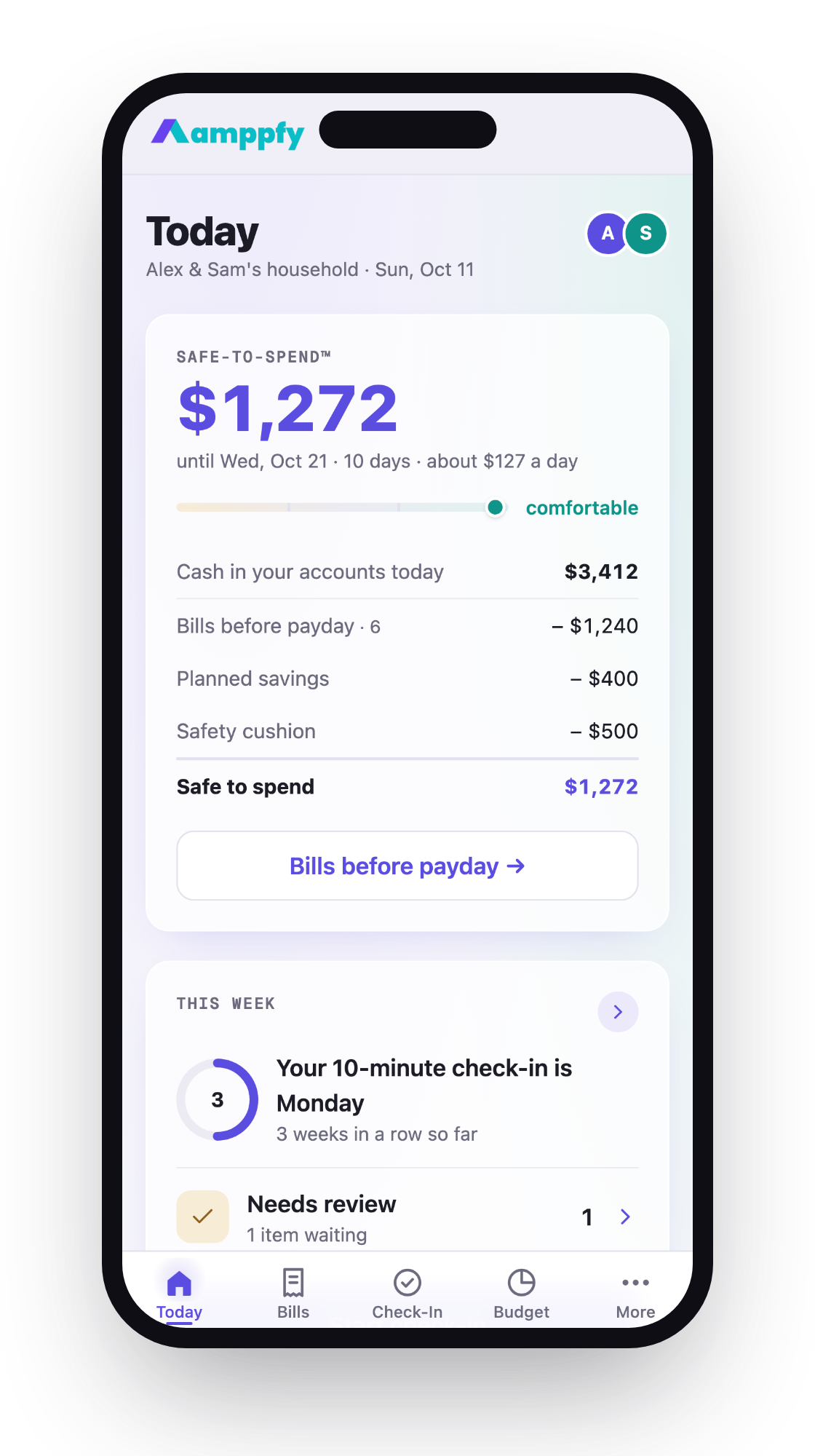
Fold the updated total into your Safe-to-Spend number: $3,200 cash minus $1,400 bills minus $300 savings minus $400 cushion = $1,100. Your subscriptions sit inside that bills figure. When the bills figure drops by $19, your Safe-to-Spend rises by the same amount. Simple math, real result.
Frequently asked questions about monthly subscription costs
What is the average subscription spending per month for a U.S. household?
Estimates vary by source and year, but most published surveys in 2025 and 2026 place the figure between $86 and $130 per month for households that carry four or more active subscriptions. Your own number depends on how many categories you subscribe to and whether you share family plans. The worked example above landed at $107, which sits right in that range. Pull your own statements to get your exact figure rather than relying on an average.
How many subscriptions does a typical household carry?
Research from J.D. Power’s 2025 U.S. Streaming Satisfaction Study found that the median U.S. household subscribes to four video streaming services alone. Add music, cloud storage, fitness, news, and software, and most households carry eight to twelve total subscriptions. The number creeps up because each new sign-up feels minor.
Should I cancel all my subscriptions to save money?
No. The goal isn’t zero subscriptions: it’s zero wasted subscriptions. A service you use daily and enjoy is worth its price. The ones to cut are the ones you forgot you had or barely touch. Focus on the “forgot about it” bucket from the exercise above.
How often should I review my subscriptions?
Once a quarter works well. Prices change, usage patterns shift, and free trials convert without warning. A quarterly review takes five minutes if you keep a running list. Amppfy’s subscriptions list shows next-charge dates, which makes the quarterly scan even faster.
Make the invisible visible
Your monthly subscription total is probably $30 to $50 higher than you think. That gap isn’t a failure: it’s just how recurring charges work when they’re spread across different dates and different cards. The fix takes ten minutes, not ten hours.
Pull your statements, list every charge, sort them into three buckets, and cancel the ones that aren’t earning their keep. Then fold the updated number into your overall spending picture so it stays visible month after month. If you want one place to see that number alongside your bills, savings goals, and Safe-to-Spend, Amppfy is free and takes about ten minutes to set up at amppfy.com/app/.