Mint shut down in early 2024, and millions of people lost the app they’d used for years. Some moved to Credit Karma. Others tried spreadsheets. A lot of people just stopped tracking money altogether. If you’re still looking for a Mint alternative that doesn’t require bank sync, you’re not alone: the appeal of something simpler, something you control, is real. The tools that replaced Mint mostly copied its playbook: connect your bank, auto-categorize, hope nothing breaks. But that model was the source of most complaints in the first place. There’s a different approach worth considering: apps where you type in your own numbers, skip the bank connection entirely, and get a clear answer to the only question that matters: what’s actually safe to spend before your next paycheck?
What Mint users actually miss
People talk about Mint like it was perfect. It wasn’t. What they actually miss is narrower than they think.
The things worth keeping:
- One place for all accounts – checking, savings, credit cards, loans, all visible on a single screen
- Bill reminders – a nudge before something hit, so you could move money in time
- A rough spending picture – not perfect categories, but a general sense of where cash went each month
- Net worth over time – watching the number climb (or at least hold steady) felt motivating
The things nobody misses:
- Broken bank connections that needed re-authentication every few days
- Miscategorized transactions – a gas station lunch tagged as “Auto & Transport” for the hundredth time
- Ads for financial products baked into the dashboard
- The anxiety loop of checking the app, seeing red, and feeling bad without a clear next step
Here’s the honest truth: most Mint users opened the app, glanced at a few numbers, and closed it. They weren’t building detailed budgets. They wanted a quick read on whether things were okay. That’s the real need to solve for, and it doesn’t require a bank login to do it.
Why bank sync is the part that keeps breaking
Bank sync sounds great on paper. Connect once, see everything automatically. In practice, it’s the weakest link in almost every budgeting app.
The technical reality
Most apps don’t connect to your bank directly. They use a middleman: Plaid, MX, Finicity, or a similar data aggregator. Your bank talks to the aggregator. The aggregator talks to the app. When any piece of that chain updates its security, changes an API, or has an outage, your connection drops. According to the CFPB’s 2023 rulemaking on personal financial data rights, the shift toward standardized data-sharing under Section 1033 is still rolling out in phases through 2026, meaning the patchwork of screen-scraping and unstable connections persists for many institutions.
What breaks, and how often
| Problem | How it shows up | How often |
|---|---|---|
| Re-authentication | App asks you to log in again | Every 1-4 weeks per account |
| Missing transactions | Purchases don’t appear for days | Common with smaller banks and credit unions |
| Duplicate entries | Same charge posted twice | Happens after reconnection |
| Dropped accounts | Account disappears from the app entirely | After bank security updates |
If you have three or four accounts, you might spend more time fixing sync errors than you’d spend just typing in balances yourself. That’s the math that makes a Mint alternative without bank sync appealing: less automation, but less frustration too.
The privacy angle
Every bank sync means sharing your credentials or granting token access to a third party. You’re trusting that the aggregator stores your data safely, that the app encrypts it properly, and that neither sells your transaction history. Some people are fine with that tradeoff. Others aren’t. Typing your own balances means your bank credentials stay with your bank. Period.
Manual balances: 30 seconds per account, once a week
The phrase “manual entry” sounds tedious. The reality is surprisingly fast.
Open your bank app. Look at the balance. Type it into your budgeting app. That’s it. No categorizing. No tagging. No receipt photos. Just the number.
The weekly check-in
Here’s what a realistic weekly routine looks like:
- Open your bank app for checking: note the balance
- Open your bank app for savings: note the balance
- Open your credit card app: note the balance (or balances, if you carry more than one)
- Type those numbers into your budgeting tool
- Glance at what’s safe to spend before your next payday
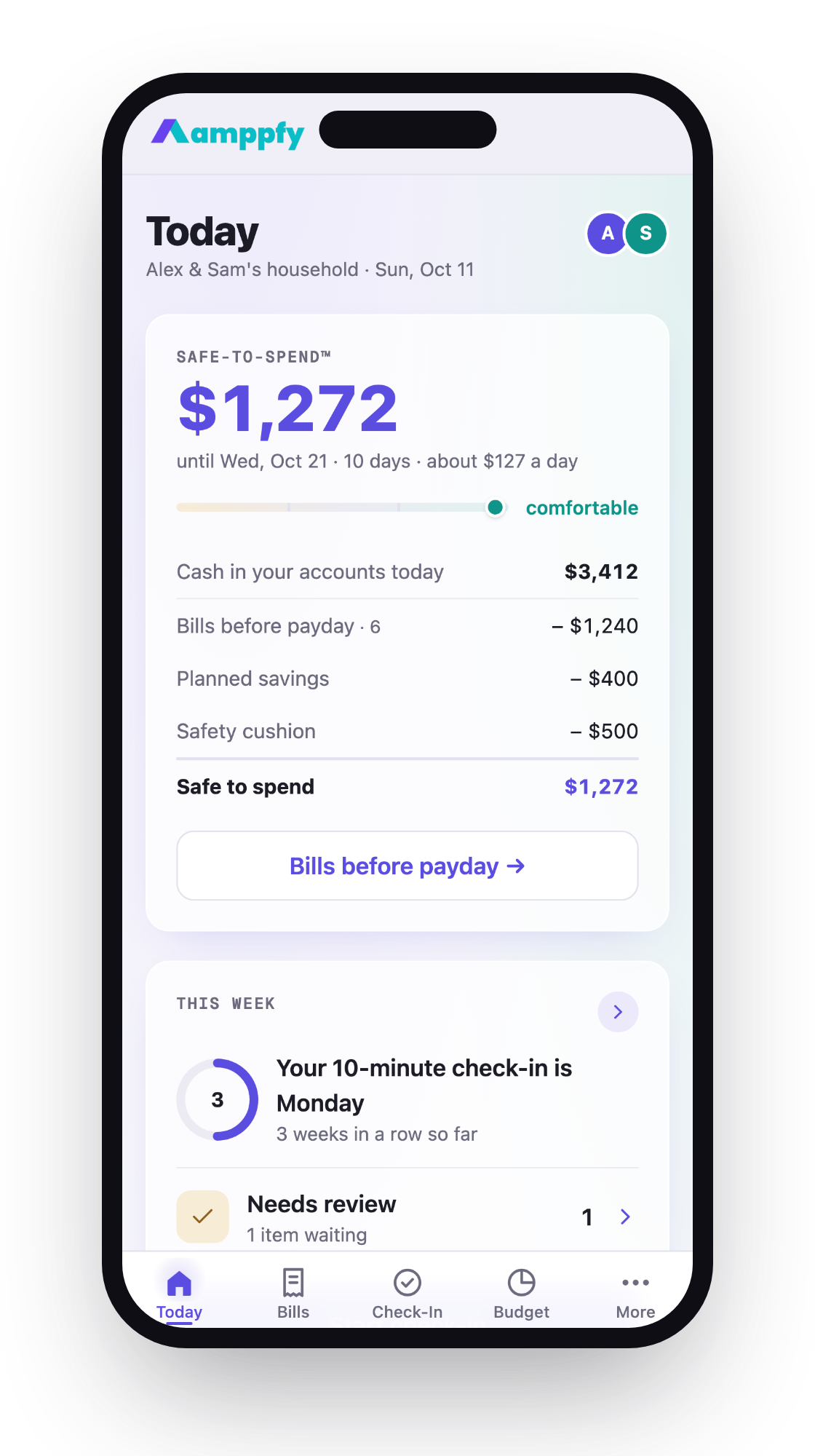
Three to four accounts takes about 90 seconds total. You can do it while waiting for coffee. Amppfy, for example, is built around this exact flow: you enter balances yourself, and the app shows your Safe-to-Spend™ number with the math printed right underneath: $3,200 cash – $1,100 bills – $300 savings – $400 cushion = $1,400. Ten minutes a week keeps everything current.
Why manual entry actually works better for some people
Auto-sync creates a passive relationship with your money. You glance, you scroll, you close the app. Typing your own numbers forces a brief moment of awareness. You notice things. “Wait, checking is lower than I expected.” That tiny pause is where better decisions happen.
A 2024 Federal Reserve survey on household finances found that 37% of U.S. adults said they couldn’t cover an unexpected $400 expense with cash or equivalent. The issue isn’t usually income: it’s visibility. Knowing your real number, even a rough one, changes behavior more than a perfectly categorized transaction log.
What to look for in a simpler replacement
Not every app without bank sync is worth your time. Some are just bare-bones spreadsheets with a logo. Here’s what actually matters when you’re choosing a replacement.
The essentials
| Feature | Why it matters |
|---|---|
| Safe-to-spend calculation | Tells you what’s left after bills, savings, and a buffer: the one number you actually need |
| Bill tracking with reminders | A heads-up the day before a bill hits prevents surprises |
| Payday awareness | The app should know when you get paid and plan around that cycle |
| Works for couples | If you share finances, both partners need access without doubling the work |
| Net worth tracking | Seeing the big picture month over month keeps motivation alive |
Nice-to-haves
- A subscriptions list showing next-charge dates, so you catch that $14.99/month service you forgot about
- A calendar view marking your lowest-cash day of the month
- Goal tracking that nudges you to fund savings on payday, before spending starts
What to skip
You don’t need an app that categorizes every coffee purchase. You don’t need AI-generated spending insights. You don’t need 47 colorful charts. Those features look impressive in screenshots. They rarely change behavior. What changes behavior is one clear number that answers the question: “Can I afford this before payday?”
Amppfy hits most of these marks. It’s free, works on iPhone and web, and it’s built for couples who want to see the same Safe-to-Spend number without sharing every private balance. But whatever you pick, prioritize clarity over features.
Moving over in one evening
Switching apps feels like a chore, but this kind of transition is genuinely quick. You’re not migrating years of transaction history. You’re starting fresh with current numbers.
Step-by-step: your migration evening
- Pick your new app and create an account (5 minutes)
- Open each bank and credit card app on your phone
- Enter your current balances: checking, savings, credit cards (2-3 minutes)
- Add your recurring bills with their due dates and amounts (10-15 minutes)
- Enter your next payday and pay frequency
- Set a savings goal, even a small one: $50 per paycheck is fine to start
- Choose your safety cushion: the amount you never want to dip below
- Look at your Safe-to-Spend number and see where you stand
The whole process takes 20-30 minutes. Most of that time is spent on bills, because you’re pulling amounts and due dates from memory or old statements. A trick: scroll through last month’s bank statement and write down every recurring charge. That catches subscriptions you’ve forgotten about.
What about your Mint history?
If you exported your Mint data before the shutdown, you have a CSV file somewhere. That’s useful for reference, but you don’t need to import it. The point of a simpler tool is starting clean. Your old transaction categories from 2019 won’t help you make better decisions this week.
Set a weekly reminder
Pick a day. Sunday morning. Wednesday lunch. Whenever works. Set a recurring phone reminder: “Update balances.” It takes 90 seconds. After three weeks, it becomes automatic.
Frequently Asked Questions
Is manual balance entry accurate enough for real budgeting?
Yes. You’re pulling numbers directly from your bank, so they’re as accurate as what your bank shows. The difference is timing: you see the number when you check, not in real-time. For most people on a regular pay cycle, checking once a week gives you everything you need. You’re not tracking pennies. You’re answering one question: what’s safe to spend before payday?
Can I use a no-bank-sync app if my partner and I share finances?
Absolutely. Look for an app that gives each partner their own login while showing the same household number. Amppfy does this: both partners see the same Safe-to-Spend number, but private account balances stay private. You each update your own accounts, and the shared view stays current.
What if I have accounts at multiple banks?
That’s actually where manual entry shines. Bank sync tools often struggle with smaller banks, credit unions, and investment accounts. When you type balances yourself, it doesn’t matter where your accounts live. Three banks, five accounts: still under two minutes to update.
Won’t I miss automatic transaction categorization?
You might, for about a week. Then you’ll realize you never actually used those categories to change your spending. The question “Where did my money go?” is less useful than “What’s left before payday?” If you still want category tracking, keep it separate in a simple spreadsheet. Don’t let it block you from having a clear spending number.
Your next 10 minutes
The best replacement for Mint isn’t the app with the most features. It’s the one you’ll actually use every week. A tool that skips bank sync, shows you one honest number, and takes less time than scrolling social media: that’s the whole idea. Grab your phone, open your bank app, and write down your balances. That’s step one. If you want a free app that turns those numbers into a Safe-to-Spend answer with the math shown, try Amppfy and see how it feels. Ten minutes this week is all it takes to know exactly where you stand.