

Payday is Friday, but your friend’s money showed up Wednesday. Yours didn’t. Same employer, same paycheck date, two different landing days. It can feel random. It isn’t.
The difference usually comes down to which bank holds your checking account and when your employer sends payroll. Some banks wait for the official payday. Others release the money the moment they know it’s coming. That second group is what people mean by direct deposit 2 days early.
This guide covers the mechanics, the banks and apps that advertise the feature, and what happens around weekends and holidays. It also covers what to do with the money once it arrives. An earlier deposit is useful. It’s also easy to misread, because a bigger balance on Wednesday can look like more room than you actually have.
The goal is simple: you should know why your pay lands when it does, and what part of it is free to use. No guessing, no surprises at the end of the cycle.
The short answer
Early direct deposit means your bank makes your paycheck available as soon as it receives your employer’s payroll file. It doesn’t wait for the scheduled settlement date. That can put money in your account up to two days before your official payday.
The “up to” matters. The bank can’t release money it hasn’t been told about yet. If your employer submits payroll two days ahead, you may see funds two days early. If your employer submits one day ahead, one day is the most any bank can give you.
A few plain facts to hold onto:
- It’s free at most banks that offer it. You usually just need direct deposit set up to that account.
- It isn’t guaranteed. Banks describe it as “up to” two days because timing depends on your employer.
- It doesn’t change your pay date. Your employer still owes you wages on the normal schedule.
- It can vary paycheck to paycheck. A holiday or a late payroll run can shift the landing day.
So if your deposit came early last month and on time this month, nothing broke. The file simply arrived later.
How ‘two days early’ actually works
Your paycheck travels through the ACH network, the system banks use for direct deposits. Your employer, or its payroll provider, sends a payroll file one to two days before payday. That file lists each employee, each account, and each amount. It also carries a settlement date: the day the money officially moves between banks.
A traditional bank waits for that settlement date, then posts your pay. A bank that offers early pay does something different. It sees the pending file arrive, trusts that the money is coming, and credits your account right away. In effect, the bank fronts the payroll.
Think of it like a package tracking notice. Your employer ships the box on Tuesday, with Friday delivery. One bank keeps the box in the warehouse until Friday. The other hands it to you Wednesday because the label already shows it’s yours.
That’s why the timing depends on your employer’s submission, not the bank. The bank controls whether it releases early. Your employer controls how early there’s anything to release.
The standard date is getting firmer, too. As of October 2026, a Nacha rule that took effect September 18, 2026 requires receiving banks to make non-Same Day ACH credits available by 9:00 a.m. local time on the settlement date[1]. So even without early pay, your money should be there by morning on payday.
Banks can also post a deposit on the normal date instead of early. Wells Fargo, for one, says Early Pay Day is not guaranteed and may vary between pay periods, as of October 2026[2].
Which banks and apps offer early direct deposit
Early pay used to be a fintech perk. Now several large banks and one big credit union offer a version of it too.
Here are the banks and apps that advertise early direct deposit, as of October 2026. Each one publishes its own terms on its own site, and each row links to that page in the sources. Only PNC publishes a clock time, and only for standard deposits; the rest say timing depends on when your employer’s file arrives. Check each bank’s own page for current eligibility before you switch.
| Bank or app | Feature name | What it promises (as of October 2026) | Clock time published? |
|---|---|---|---|
| Chime | Early direct deposit | Up to 2 days early; depends on when the payer sends the file[3] | No |
| Cash App | Direct deposit | Up to 2 days early compared to many banks[4] | No |
| Wells Fargo | Early Pay Day | Up to 2 business days early; not guaranteed[2] | No |
| Chase | Early direct deposit (Secure Banking) | Up to 2 business days early; you may not get funds early[5] | No |
| Capital One 360 | Early Paycheck | Up to 2 days early on 360 Checking; free and automatic[6] | No |
| SoFi | Early paycheck | Up to 2 days early; may vary[7] | No |
| Navy Federal | Early direct deposit (Free Active Duty Checking) | Military direct deposit 1 business day early[8] | No |
| Ally | Early direct deposit | Up to 2 days early; no signup[9] | No |
| Varo | Early direct deposit | Typically up to 2 days early[10] | No |
| USAA | Early direct deposit | Up to 2 days early; not guaranteed[11] | No |
| PNC | Early Pay | Up to 2 business days early; not guaranteed[12] | Standard deposits only: “usually midnight on your payday”[13] |
Two things to check on any bank’s page. First, which accounts qualify. Some banks limit early pay to specific checking products. Second, whether you need to opt in. A few turn it on by default. Others need a tap in the app’s settings.
None of these banks can beat your employer’s file. If two of them both say “up to 2 days,” they’ll usually land your pay on the same day.
What changes on weekends and holidays
Weekends and holidays are where early pay gets confusing. The ACH network settles on banking days: weekdays that aren’t federal holidays. As of October 2026, Nacha has a proposal out for comment that would define a “Banking Day” in its rules as any calendar day other than a Saturday, Sunday, or federal banking holiday[14]. That definition decides which days count when your bank releases funds.
Here’s how it plays out in ordinary weeks:
- Friday payday, normal week. Your employer sends the file Wednesday. An early-pay bank may post Wednesday. You get two extra days.
- Monday payday. The file often arrives the previous Thursday or Friday. You might see pay before the weekend, or Friday, depending on submission.
- Payday after a holiday. If Monday is a federal holiday, nothing settles that day. Your employer may send payroll earlier to compensate, or later. Your early window can shrink or stretch.
- Payday falls on a holiday. Many employers pay the business day before. Check your pay stub or HR portal for the adjusted date.
A simple fix: when a holiday sits near payday, don’t plan on the early date. Plan on the official one. Anything earlier is a bonus.
Longer term, payments are getting faster. The Federal Reserve’s FedNow Service runs 24x7x365[15], so instant payroll on any day of the year is possible in principle. For now, payroll direct deposit runs on ACH, and the banking-day calendar still rules.
For a closer look at why one paycheck lands early and the next lands late, see why your direct deposit lands early or late and how to plan around it.
Planning bills around an earlier landing day
Getting paid early can help with bills, but only if you plan around the right date. The safest rule is to schedule bills from the official payday, not the early one.
Here’s why. Say your rent autopays on the 1st, and your payday is the 1st. Your early-pay bank usually posts on the 30th. One month, your employer sends payroll late, and the money lands on the 1st at 9:00 a.m. instead. If rent pulls at midnight, it may hit before your pay does.
A calm setup takes about ten minutes:
- Find your official payday on your pay stub, not in your bank app.
- List bills due within two days of payday. These are the ones early pay touches.
- Move autopay dates to one or two days after the official payday where your billers allow it.
- Keep a small buffer in checking to cover a late-landing week.
If your employer pays reliably early, you can treat that extra day as slack. You aren’t building your month on it. Bills paid the day after official payday will clear whether pay lands early or on time.
Couples who split bills should agree on the anchor date too. If one partner’s bank pays early and the other’s doesn’t, use the later of the two.
What is safe to spend once it lands
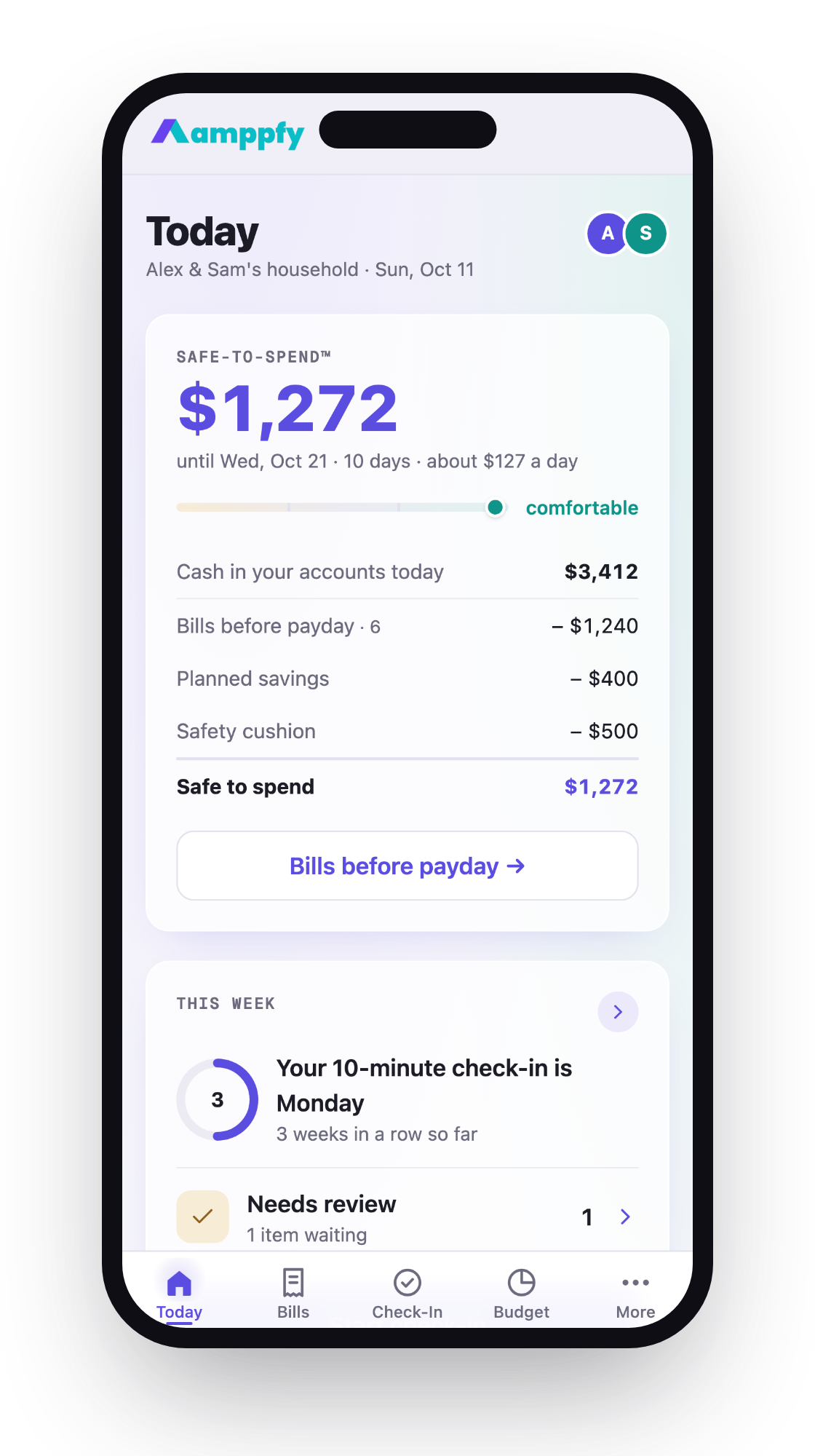
A fresh deposit makes your balance look bigger than your room to spend. That gap is where early pay quietly causes trouble. You see $2,400 on Wednesday, two days before your old payday, and it feels like a lot of space.
Here’s how the math actually works. Start with what’s in the account, then take out what’s already spoken for:
| Line | What it is | Amount |
|---|---|---|
| Available cash | Balance after the deposit | $2,400 |
| Bills before next payday | Rent share, phone, car insurance | −$1,350 |
| Planned savings | Emergency fund transfer | −$200 |
| Safety cushion | Your chosen buffer | −$150 |
| Safe-to-Spend™ | What’s actually free | $700 |
So $2,400 becomes $700. That’s about 29% of the balance, and it has to last the full cycle. Early pay doesn’t add days to your pay period. It starts the period sooner. If you spend from the top-line balance, the next paycheck arrives on the same day it always did, with fewer dollars left to reach it.
One quick habit: when the deposit lands, glance at the bills due before the next payday before you spend anything. It takes a minute, and it keeps the early money honest.
Bank-by-bank guides
Each bank’s posting window and early-pay policy, as published on its own site:
- Chime Early Direct Deposit: How Early It Lands, What Time, and the First-Paycheck Catch
- What Time Does Cash App Direct Deposit Hit? Early Pay, Wednesdays, and Pending Deposits
- What Time Does Wells Fargo Direct Deposit Hit? Posting Times and Early Pay Day
- What Time Does Bank of America Direct Deposit Hit? What Their Posting Schedule Says
- What Time Does Chase Direct Deposit Hit? Posting Times, Early Pay, and Pending Deposits
- What Time Does Navy Federal Direct Deposit Hit? Early Pay for Military Paydays
- What Time Does Capital One Direct Deposit Hit? Early Paycheck and Posting Times
- What Time Does SoFi Direct Deposit Hit? Up to Two Days Early, Explained
- What Time Does USAA Direct Deposit Hit? Military Pay and Early Deposits
- What Time Does PNC Direct Deposit Hit?
- What Time Does Ally Direct Deposit Hit? Early Pay and Posting Times
- What Time Does Varo Direct Deposit Hit? Early Pay at a Fintech Bank
FAQ
Is direct deposit 2 days early guaranteed every payday?
No. Banks advertise “up to” two days because they can only release money after your employer’s payroll file arrives. If your employer submits one day ahead, that’s the most you’ll get. Holidays and late payroll runs can also shift it.
Do I lose my early pay if I switch banks?
You keep it if the new bank also offers early pay. The first deposit or two to a new account may post on the normal date while the bank verifies the employer. After that, early posting usually starts.
Can my bank take back an early deposit?
If the employer’s payroll file is canceled or reversed, the bank can adjust your account. This is rare. It’s one reason not to spend down to zero right after an early deposit.
Does early pay change when my employer legally has to pay me?
No. Early pay is a bank feature, not a change to your pay schedule. Your employer still has to pay you by the normal date under your state’s wage-payment rules, and the official pay date on your pay stub is still the one that counts.
An earlier deposit is a timing perk, not a raise. Your bank fronts the payroll file when it arrives, your employer decides when that is, and weekends and holidays can shift it a day either way.
Once the money lands, the balance still isn’t what’s free to use. Bills due before the next payday come out first, then planned savings, then a cushion. What’s left is your real number. Amppfy does that arithmetic for you on iPhone and the web, with the four lines printed under the number and bills laid out on a calendar up to payday. Take ten minutes this week to add your bills and paydays and see what’s actually yours to spend.