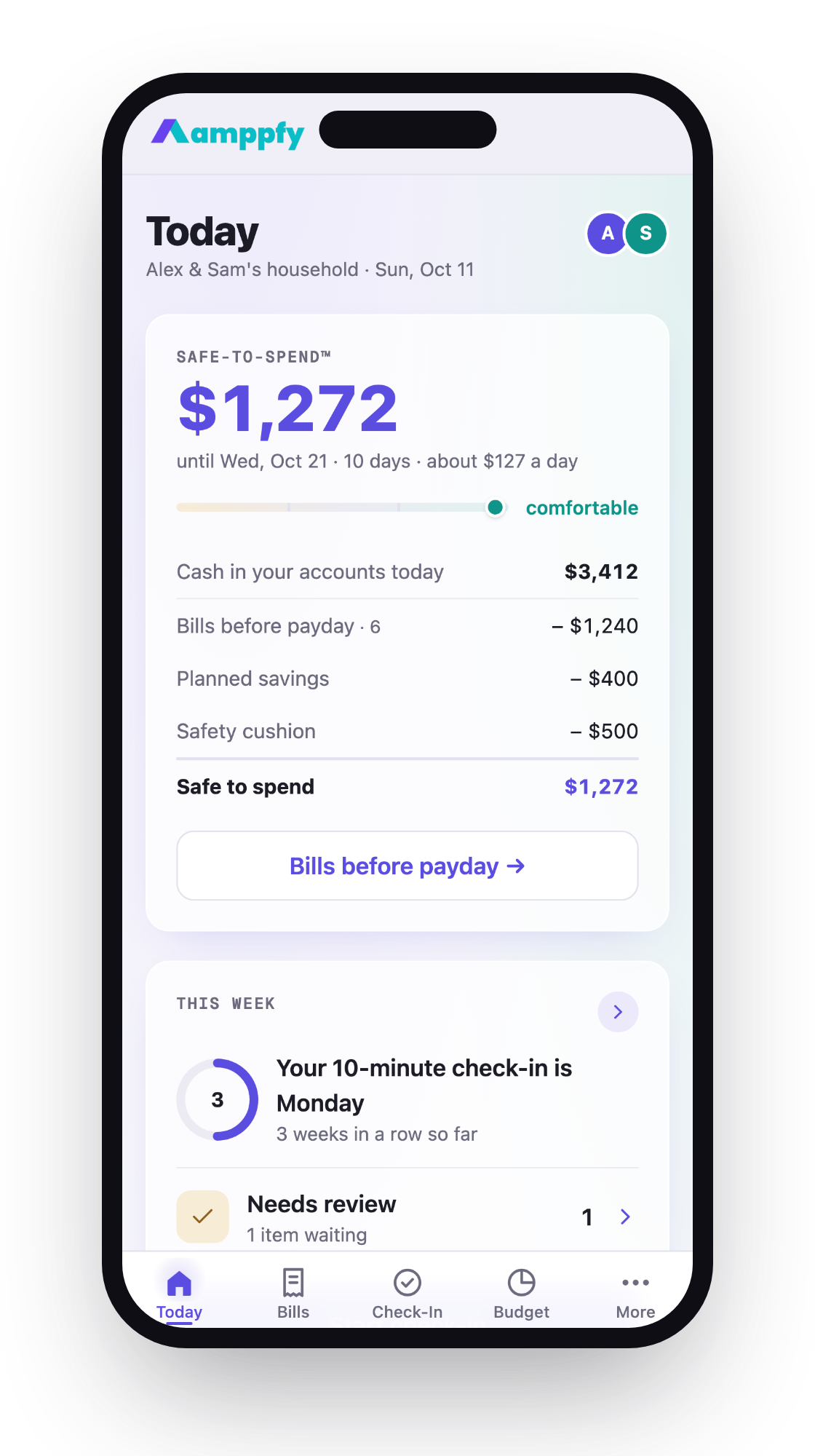


Your bank app shows a balance. It doesn’t show what’s actually yours to use. That gap is why so many people search for national averages, hoping a benchmark will tell them whether they’re doing okay.
A benchmark can be useful context. It can’t tell you whether Thursday’s grocery run is fine or whether you should wait until Friday’s paycheck lands. That question needs a smaller, more personal number, built from your own balances and your own bills.
So the plan here is simple. First, look honestly at what the government’s spending data says, and what it doesn’t. Then set the average aside and work out your own figure, line by line, using arithmetic you can check in a minute.
No guilt, no scare tactics. Just the numbers, and a method you can repeat every payday.
What the numbers say: the BLS Consumer Expenditure Survey, latest release
The most reliable source for household spending in the US is the Bureau of Labor Statistics Consumer Expenditure Survey. The latest release came out on December 19, 2025, and it covers data year 2024.
Two figures matter here. The average “consumer unit” (roughly, a household) had income before taxes of $104,207 and average annual expenditures of $78,535. Spending in that survey covers housing, food, transportation, healthcare, insurance, entertainment and more.
It’s tempting to subtract one from the other and call the result “money left over.” Don’t. The income figure is before taxes. Federal, state and payroll taxes come out before a dollar reaches your checking account. Subtracting spending from pre-tax income gives you a number that never existed in anyone’s bank balance.
BLS did not publish a 2024 income-after-taxes figure in this release. That means the latest survey doesn’t give us an official after-tax “left over” amount at all. Any article quoting a precise average monthly money left over after bills from this data has built it from pre-tax income, and that’s not a fair comparison.
If you want to see how the spending side breaks down by category, there’s a fuller look at how Americans split their spending in the latest BLS data. The full survey tables live on the BLS Consumer Expenditure Survey pages[1].
Why an average is not your number
Even a perfect after-tax average wouldn’t help much on a Tuesday. Averages blend everyone together: a single renter in Ohio, a family of five in San Diego, a retired couple who own their home outright. Your rent, your pay cycle and your kids’ daycare bill aren’t in that blend in any useful way.
Timing matters more than totals. Two people can have the same monthly surplus and feel completely different. One gets paid on the 1st and pays rent on the 3rd. The other gets paid on the 15th and pays rent on the 1st. Same math over a month, very different math over the next ten days.
There’s also the question of what counts as a “bill.” The survey groups spending into categories. Your life groups it into due dates. A car insurance premium that hits every six months won’t show up as a neat monthly slice. It shows up as one big charge in March.
So the honest answer is this: the useful “left over” number is per paycheck, not per year, and it’s yours alone. You find it by looking forward, from today to your next payday, and asking what’s already spoken for.
What Safe-to-Spend™ means
Safe-to-Spend™ is the amount you can use between now and your next payday without shorting a bill, skipping a savings goal or running your account to zero.
It’s built from four lines:
- Cash: what’s in your checking and spending accounts right now.
- Bills due before payday: only the bills that will hit before your next paycheck arrives. Bills due after payday don’t count yet. Next paycheck covers those.
- Planned savings: what you’ve decided to move to savings or goals this pay period.
- Cushion: a buffer you choose, so a surprise charge doesn’t tip you into overdraft.
The result is one number. It’s not a budget category, and it isn’t a forecast for the whole month. It answers one ordinary question: can I spend this, today, and still be fine?
The logic is plain on purpose. If you can see each line, you can trust the result. If a number looks off, you can spot which line is wrong in a glance. That’s very different from an app that shows a figure with no explanation behind it.
You can try it with your own numbers using this Safe-to-Spend™ calculator for the days before payday. It takes a few minutes and needs nothing but your balances and your bill list.
The four-line math, worked
Here’s a real example. Say you’re paid every other Friday, and today is the Monday after a payday.
| Line | What it is | Amount |
|---|---|---|
| Cash | Checking plus spending account balances today | $3,412 |
| Bills due before payday | Rent, phone, car insurance, electric | −$1,240 |
| Planned savings | Transfer to emergency fund and vacation goal | −$400 |
| Cushion | Buffer you chose for surprises | −$500 |
| Safe-to-Spend™ | What’s yours to use until next Friday | $1,272 |
Written as one line: $3,412 cash − $1,240 bills due before payday − $400 planned savings − $500 cushion = $1,272 Safe-to-Spend™.
That $1,272 has to cover groceries, gas, takeout, a birthday gift, whatever comes up in the next eleven days. Divide by eleven and you get about $115 a day. That’s a number you can actually hold in your head at the checkout.
Notice what’s not in the math. Your rent due on the 1st of next month isn’t there if it lands after payday. Your annual car registration isn’t there unless it’s due this week. The math only looks as far as your next paycheck. That’s the whole point. It keeps your attention on the stretch you can control.
Where the number goes wrong
The math is simple. The inputs are where things slip. Three mistakes come up most often.
Counting bills that belong to the next paycheck
If you subtract every bill for the month, your number will look scary and wrong. A bill due the day after payday belongs to the next paycheck. Check the due date against your pay date, not the calendar month. If you’re paid every two weeks, this gets trickier, since some months have three paydays. There’s a full guide to planning bills around 26 paychecks a year if that’s you.
Treating savings as optional
When savings is “whatever’s left,” it’s usually nothing. Put the transfer in the math before you spend. If $400 feels like too much this period, lower it to $150. A smaller amount you actually move beats a bigger one you skip.
Setting the cushion to zero
A zero cushion means one surprise charge, like a forgotten subscription renewal or a pending card hold, can push you into overdraft. Pick a cushion that matches your life. Some people use $200. Others with variable bills use a full week’s spending. You can shrink it as you get comfortable.
One more quiet leak: pending transactions. If your bank shows a pending charge that hasn’t posted yet, treat it as already spent. Subtract it from cash before you start.
Doing it by hand vs letting an app do it daily
Doing this by hand works. A notes app, a spreadsheet or the back of an envelope is enough. List your balances, list bills due before payday, subtract savings and cushion. Ten minutes, maybe less once you’ve done it twice.
The catch is that the number goes stale. You buy groceries on Tuesday. A bill posts early on Wednesday. By Thursday the figure you wrote down on Monday is off, and redoing it every day is a chore most people drop within a month.
An app doesn’t do different math. It only repeats the same math daily, after every change you enter. That’s the honest difference. Here’s how the two compare:
| By hand | With an app | |
|---|---|---|
| Math | Same four lines | Same four lines |
| Updates | When you redo it | Every time something changes |
| Upkeep | About 10 minutes per check | About 10 minutes a week |
| Sharing with a partner | Send a screenshot | Same number on both logins |
If you go the app route, look for one that shows its math under the number. Amppfy does exactly that: free on iPhone and the web as of October 2026, with balances you type in yourself rather than a bank login. It also marks your lowest-cash day before payday on a calendar, so you can see the tight stretch coming. A partner can see the same number while private accounts stay private.
Either way, the method is what matters. Pick the version you’ll actually keep doing.
FAQ
What is the average monthly money left over after bills in the US?
The latest BLS Consumer Expenditure Survey (released December 2025, data year 2024) doesn’t publish an after-tax income figure for 2024. Without it, there’s no official after-tax “left over” number. Figures built by subtracting spending from pre-tax income overstate what households actually have.
How much should I have left over after bills each paycheck?
There’s no universal target. A better question is whether your Safe-to-Spend™ number covers your everyday spending until payday, with savings and a cushion already set aside. If it does, you’re in good shape. If it doesn’t, you’ll see which line to adjust.
Should I include credit card payments as bills?
Yes, if a payment is due before your next payday. Include at least the minimum due, or the full statement balance if you pay in full. Treat new card purchases as spending from your Safe-to-Spend™ number, since they’ll come due later.
How big should my cushion be?
Start with an amount that would cover one surprise charge without stress, often $200 to $500 for many households. If your bills vary a lot, go higher. You can lower it as your numbers become steadier and more predictable.
National figures are a fine starting point for context. They just can’t answer the question you face every week. The latest BLS data shows how much the average household spends, but it doesn’t hand you an after-tax surplus, and it couldn’t tell you about your rent date or your pay schedule anyway.
Your real number is per paycheck. Cash, minus bills due before payday, minus planned savings, minus your cushion. Four lines, one result, and math you can check in a glance.
Take ten minutes this week. Write down your balances and the bills due before your next payday, then run the four lines. If you’d rather have that number stay current on its own, you can see your Safe-to-Spend™ number in the app. Calm money starts with one honest number.