A seasonal gig can drop a few thousand dollars into your account right when you need it most. The trick is knowing what to do with those paychecks before they blend into regular spending. Whether you’re picking up holiday retail shifts, warehouse work, or delivery routes, a plan for your seasonal job income turns short-term hustle into lasting progress. Most people earn the money, spend it on gifts and holiday extras, and enter January with nothing to show for six weeks of work. This article is your counter-plan.
What a Seasonal Paycheck Looks Like After Taxes
Your gross pay and your take-home pay are two different numbers. Seasonal employers withhold federal and state income tax, Social Security (6.2%), and Medicare (1.45%) just like any other job. If you’re earning $16 an hour for 30 hours a week, your gross is $480. After withholdings, expect roughly $390 to $410 depending on your state.
Why Your Withholding Might Feel Off
Seasonal workers often fill out a W-4 for a job they’ll hold for only eight to twelve weeks. The IRS withholding tables assume you’ll earn that wage all year. That can mean too much tax is withheld relative to your actual annual income from the gig. You may get some of it back as a refund, but that doesn’t help your cash flow right now.
Here’s a rough look at what a typical seasonal paycheck yields:
| Line Item | Weekly Amount |
|---|---|
| Gross pay (30 hrs x $16) | $480.00 |
| Federal income tax | -$33.00 |
| State income tax (avg.) | -$15.00 |
| Social Security (6.2%) | -$29.76 |
| Medicare (1.45%) | -$6.96 |
| Net pay (approx.) | $395.28 |
Your actual numbers will vary. The point: plan around net pay, not gross. If you budget based on $480 and only $395 hits your account, you’re already $85 behind every week.
One more thing to watch: if you’re also working a primary job, the combined income could push you into a higher tax bracket for the year. Run your numbers through the IRS Tax Withholding Estimator before your first shift. Adjusting your W-4 at either job now prevents a surprise bill in April.
Deciding Where the Extra Goes Before It Lands
The best time to assign your seasonal holiday income to a purpose is before the first deposit clears. Once money sits in your checking account, it tends to disappear into “stuff.” Pre-deciding removes the guesswork.
A Three-Question Framework
Ask yourself three questions before your first paycheck arrives:
- Do I have any bills that are past due or about to be?
- Do I have less than one month of expenses saved?
- Is there a specific goal I’ve been unable to fund from my regular pay?
Your answers create a priority stack. Past-due bills come first. A thin emergency cushion comes second. Goals, whether that’s paying down a credit card or saving for a security deposit, come third.
Set the Split Before Payday
Write down a percentage or dollar amount for each priority. For example:
- 40% to past-due bills until caught up
- 30% to a savings cushion
- 20% to a specific goal
- 10% to holiday spending money
Stick this split on your fridge, your phone lock screen, wherever you’ll see it on payday. The split can change week to week as priorities shift, but having one at all is what matters.
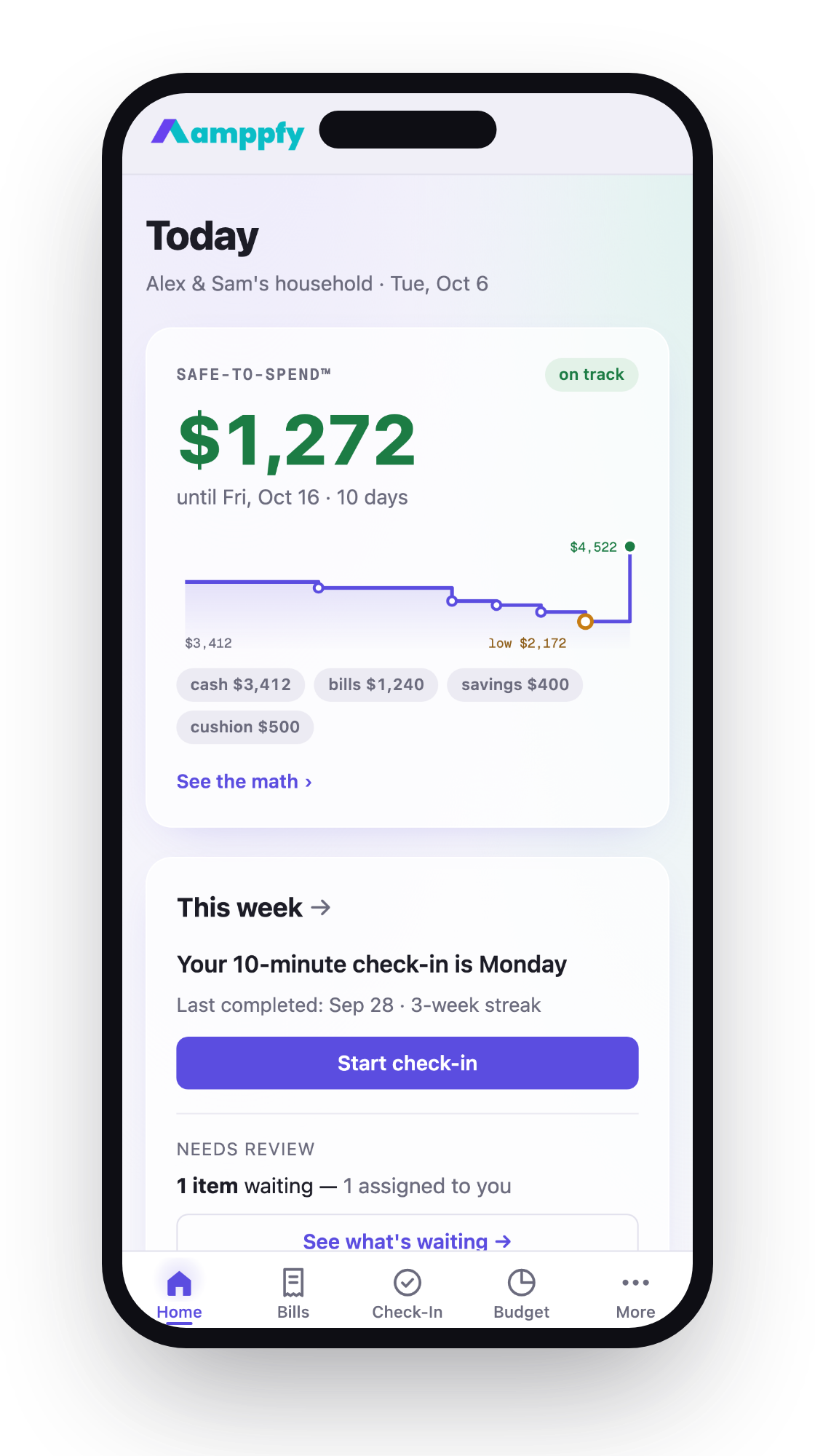
If you use Amppfy, you can set your seasonal payday alongside your regular one. The app recalculates your Safe-to-Spend™ number every time a new paycheck lands, so you see exactly what’s available after bills and savings goals are covered.
Covering January When the Job Ends
January is the hangover month. The seasonal job is gone. Holiday credit card charges start posting. And regular bills don’t pause because your income dropped. Planning for January while you’re still earning is the single most important move you can make.
Build a January Fund
Treat January like a mini emergency. Set aside enough from your seasonal paychecks to cover the gap between your regular income and your January expenses. Here’s a worked example:
- Regular monthly take-home: $2,800
- January bills (rent, utilities, insurance, minimums): $2,400
- Holiday credit card charges due in January: $350
- Total January need: $2,750
- Shortfall after regular pay covers bills: $0 in this case, but the credit card charges eat your margin
If your regular pay barely covers regular bills, even $350 in extra charges creates a real problem. Save at least that amount from your seasonal checks specifically for January.
Avoid the “I’ll Figure It Out” Trap
A 2024 Federal Reserve survey found that 37% of U.S. adults couldn’t cover an unexpected $400 expense with cash or savings. January expenses aren’t unexpected. They’re predictable. The difference between stress and stability is $400 to $600 set aside in a separate savings account you don’t touch until the calendar flips.
Open a no-fee savings account if you don’t already have one. Name it “January Fund” so it has a clear purpose. Transfer money into it on every seasonal payday. Don’t wait until December 23rd to start.
Overtime and Irregular Hours
Seasonal work rarely follows a neat 9-to-5 schedule. You might get 20 hours one week and 45 the next. Overtime kicks in after 40 hours in most states, paying 1.5x your base rate. That’s great for your paycheck but tricky for your budget.
How Overtime Changes Your Math
At $16 an hour, five hours of overtime pays $120 instead of $80. But overtime also bumps your withholdings for that pay period. A $600 gross paycheck and an $840 gross paycheck produce very different net amounts, and the tax bite on the bigger check is proportionally larger.
Don’t count on overtime until you see it on your schedule. Budget your seasonal job earnings around your guaranteed base hours. Treat overtime pay as bonus money that goes straight to your highest priority: the January fund, a debt payment, or your savings cushion.
Handling Week-to-Week Swings
Irregular hours make it hard to predict your income. Here’s a simple approach:
- Estimate your minimum weekly hours (what your employer guarantees or what you’ve consistently received)
- Budget only from that minimum
- Route anything above the minimum into savings or debt payoff
This way, a slow week doesn’t wreck your plan. A busy week accelerates it. You’re never caught off guard.
One practical tip: check your schedule every Sunday evening and update your expected deposit. If you use a tool like Amppfy, adjusting your next payday amount takes about 30 seconds and keeps your Safe-to-Spend™ number honest for the week ahead.
A Simple Split: Bills, Cushion, Goal
You don’t need a complicated spreadsheet to manage seasonal income. You need a split that’s easy to remember and easy to follow. Here’s one that works for most people picking up holiday work.
| Category | % of Net Pay | Purpose |
|---|---|---|
| Bills and catch-up | 50% | Current bills, past-due balances, January charges |
| Cushion | 30% | Emergency savings or January fund |
| Goal | 20% | Debt payoff, down payment, or something you’ve been putting off |
Adjusting the Split to Your Situation
If you have no past-due bills, shift that 50% down and move more into your cushion or goal. If you’re behind on rent, push the bills category to 70% and shrink the others temporarily. The percentages are a starting point, not a rule.
Here’s what this looks like with real numbers. Say your seasonal net pay is $395 per week:
$395 net pay: $197.50 bills, $118.50 cushion, $79 goal.
Over eight weeks, that’s $948 in your cushion and $632 toward a goal. Not life-changing, but real progress that compounds over time.
What About Holiday Gifts?
Gifts come out of the bills category or from a separate, capped amount you decide on before the season starts. Pick a total gift budget, divide it by your number of seasonal paychecks, and set that amount aside each week. If your gift budget is $300 and you’ll get six seasonal paychecks, that’s $50 per check. Carve it from the bills slice and adjust.
The key to making your seasonal job budget work for holiday income is treating every dollar like it has an assignment. Unassigned money gets spent. Assigned money builds something.
Frequently Asked Questions
Do I need to file taxes on seasonal job income?
Yes. Any employer who pays you $600 or more in a calendar year must issue a W-2. That income gets reported on your federal and state tax return. Even if taxes were withheld from every paycheck, you still need to file. If too much was withheld (common with short-term jobs), you’ll likely receive a refund.
Should I put all my seasonal income into savings?
Not necessarily. If you have past-due bills or high-interest debt, directing money there first saves you more than a savings account earns. A good rule: cover obligations first, build a small cushion second, then save or invest with what’s left. The split table above gives you a framework.
How do I avoid spending my seasonal paycheck on holiday extras?
Decide on a fixed “fun money” amount before your first paycheck arrives. Maybe it’s 10% of each check, maybe it’s a flat $50. Put the rest somewhere you won’t casually tap it: a separate savings account, a prepaid card, or a goal inside a budgeting app. The friction of moving money back to checking is often enough to keep it safe.
What if my seasonal hours get cut short?
This happens. Retailers adjust staffing based on foot traffic, and warehouse demand can shift week to week. Protect yourself by budgeting from your minimum guaranteed hours, not your best week. If you’ve already been saving a cushion from earlier paychecks, a short final week won’t derail your plan.
Make the Season Count Beyond December
Seasonal work is temporary. The habits you build around it don’t have to be. The workers who benefit most from holiday income are the ones who treat it like a project: define the goal, split the money, protect January, and let overtime be a bonus rather than a lifeline.
If you want a clear picture of what’s safe to spend while juggling two income sources and holiday bills, get Amppfy free. Enter your balances, bills, and both paydays once, about ten minutes, and you’ll always see one number that accounts for everything due before your next check.
Your seasonal paycheck is a tool. Sharpen it before you swing.