Every January, you promise yourself this year will be different with money. You’ll budget. You’ll save. You’ll finally get a grip on where it all goes. But by mid-February, the spreadsheet is stale, the app notifications are muted, and the whole plan quietly dies. A financial new year resolution doesn’t fail because you lack willpower. It fails because the system you picked demands too much from a life that’s already full.
This piece is about a smaller approach: one number, one weekly habit, and a restart plan that doesn’t punish you. It’s built for people on a regular paycheck who want clarity without a second job managing their money.
Why Big Money Resolutions Stall
The classic January money plan looks something like this: download a budgeting app, connect your bank accounts, create 15 spending categories, and log every purchase. It’s thorough. It’s also exhausting.
The average adult faces roughly 35,000 decisions every day[1], and that mental load builds up. By evening, your brain is running on fumes. Asking it to also categorize a $4.50 coffee doesn’t just feel annoying: it actually competes with decisions that matter more.
Research on budgeting methods supports this. Detailed budgets offer a sense of control, but they often lack the flexibility to address dynamic needs[2]. Your life isn’t static. Kids get sick. Cars break. Grocery prices shift. A rigid 47-line spreadsheet can’t absorb those changes without constant rework.
Here’s the pattern most people recognize:
| Week | What Happens | How It Feels |
|---|---|---|
| 1 | Set up categories, link accounts, log everything | Motivated |
| 2-3 | Miss a few entries, sync breaks, categories blur | Frustrated |
| 4-6 | Stop logging, ignore notifications | Guilty |
| 7+ | Delete the app, avoid thinking about money | Defeated |
That guilt cycle is the real problem. The resolution didn’t fail because you’re bad with money. It failed because the system required perfection, and perfection isn’t a realistic weekly commitment. A better financial new year resolution starts smaller.
One Number Instead of a Full Budget
Strip the whole budget concept down to a single question: what’s actually safe to spend before my next paycheck?
That’s it. Not “how much did I spend on dining out this month.” Not “am I over or under in the entertainment category.” Just: what can I spend right now without wrecking anything?
The math fits on one line:
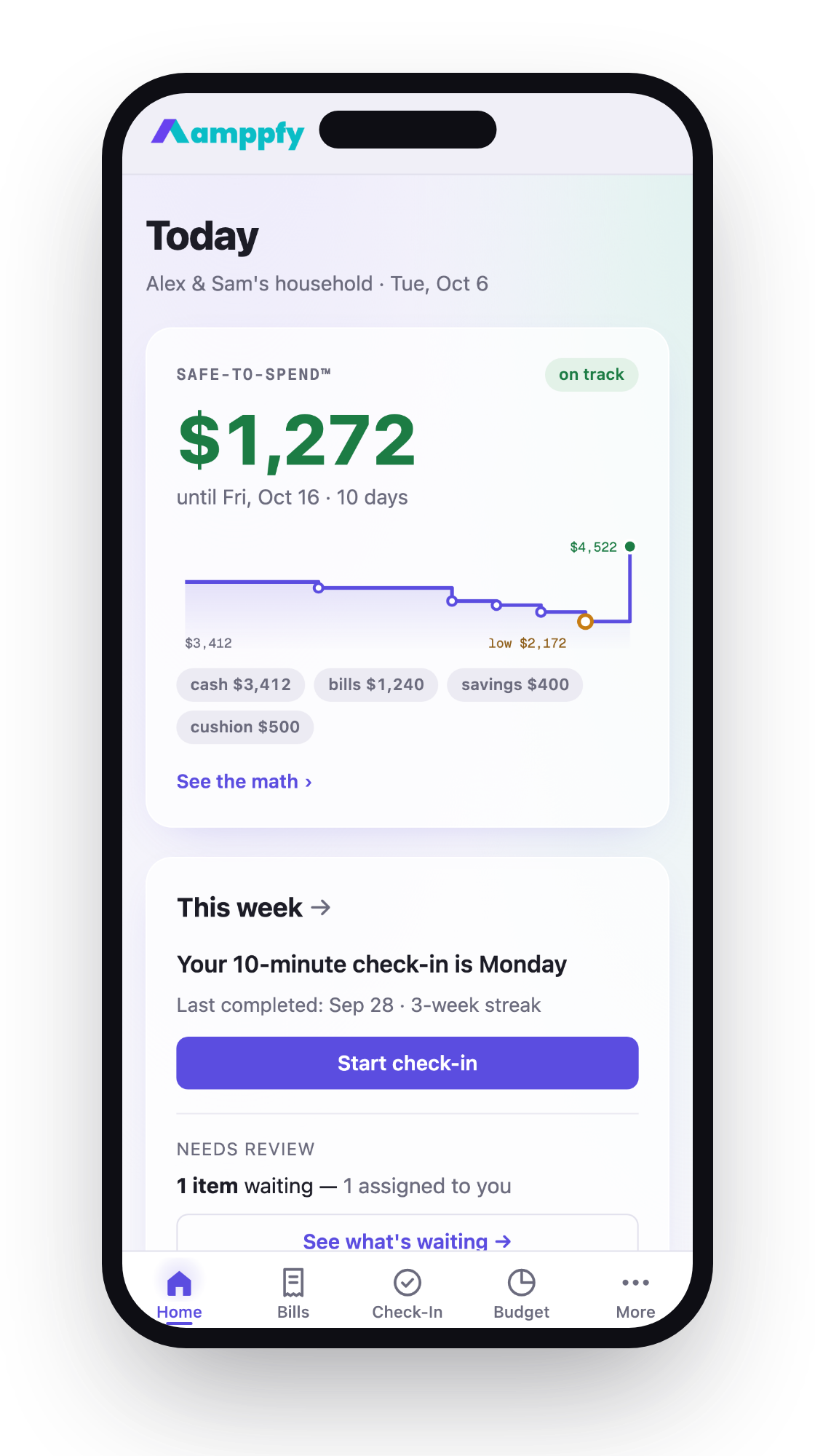
$3,412 cash − $1,240 bills − $400 savings − $500 cushion = $1,272
That $1,272 is your Safe-to-Spend™ number. It accounts for everything that matters: bills coming due, money you want to save, and a buffer so you’re not cutting it close. Whatever’s left is yours to use however you want, no categories required.
This approach aligns with what researchers call “heuristic-based” planning: rule-of-thumb methods that are more scalable and realistic for individuals than detailed line-item budgets. You don’t need to know you spent $38.72 on coffee this month. You need to know you have $1,272 before Friday.
The one-number approach works because it removes decisions. You don’t categorize. You don’t reconcile. You glance at one figure and know where you stand. Amppfy shows this number with the four-line math printed underneath, so you always see how it’s calculated. You enter your balances yourself: about 30 seconds per account, no bank login required.
When your Safe-to-Spend™ is high, you relax. When it’s low, you pull back. No spreadsheet needed.
A Weekly Habit You Can Keep Tired
The reason most money systems collapse isn’t the setup. It’s the upkeep. A system that needs 45 minutes every Sunday won’t survive a bad week. And bad weeks aren’t rare: they’re the norm.
Nearly 25% of U.S. adults serve as caregivers, often putting in over 40 hours a week of care on top of their jobs. That kind of cognitive load makes complex financial planning feel impossible. But even without caregiving duties, most people are running on empty by the time they’d sit down with a budget.
The fix: a 10-minute weekly check-in. That’s the ceiling, not the floor. Here’s what it looks like:
- Open your bank app and note your checking balance. Takes 15 seconds.
- Update your balance in whatever tool you use. Another 30 seconds.
- Glance at upcoming bills. Are any due before your next paycheck?
- Look at your Safe-to-Spend™ number. Adjust your week accordingly.
- Done.
You can do this on the couch after the kids are in bed. You can do it on a lunch break. You can do it half-asleep on a Wednesday, and it still works. That’s the point.
Why 10 Minutes Beats 10 Hours
A monthly deep-dive sounds responsible. But “responsible” doesn’t mean “sustainable.” If you skip one month, you’re now reconciling eight weeks of transactions. That feels like homework, and most people won’t do it.
A weekly check-in catches problems early. You spot a forgotten subscription before it hits. You see a bill coming due before it surprises you. Ten minutes a week adds up to about eight hours a year: a fraction of what a detailed budget demands, with most of the same benefit.
Measuring Progress by Paycheck
Months are an awkward unit for money. You don’t get paid monthly (most of you, anyway). You get paid every two weeks or twice a month. Your money life runs on pay cycles, not calendar months.
So measure your progress the same way. Each paycheck is a fresh cycle with its own Safe-to-Spend™ number. Here’s a simple way to track whether things are getting better:
| Pay Period | Starting Safe-to-Spend™ | Ending Safe-to-Spend™ | Trend |
|---|---|---|---|
| Jan 1-14 | $1,272 | $184 | Baseline |
| Jan 15-28 | $1,340 | $310 | Better |
| Jan 29 – Feb 11 | $1,290 | $275 | Steady |
You’re not aiming for perfection. You’re watching whether the gap between your starting and ending numbers is shrinking. If you start a pay period with $1,300 and end with $300 instead of $50, that’s real progress. You kept a cushion.
Using Payday as a Reset Point
Each payday is a natural moment to fund your goals first. Before you spend anything discretionary, move your savings amount. Even $50. The order matters: save, then spend what’s left, not the reverse.
Amppfy sends a payday nudge that reminds you to fund goals before the rest of the cycle begins. That small prompt turns a vague intention into a concrete action.
Couples and Shared Visibility
If you share expenses with a partner, measuring by paycheck gets tricky when you’re on different cycles. The key is seeing the same number. Both of you need to know what’s safe to spend from shared funds, without requiring both of you to maintain separate spreadsheets. One shared Safe-to-Spend™ figure, visible to both, eliminates the “I thought we had enough” conversations.
Restarting When You Slip
You will slip. Maybe you skip two weeks of check-ins. Maybe an unexpected car repair blows through your cushion. Maybe you just forget. That’s normal. The question isn’t whether you’ll fall off: it’s how fast you climb back on.
Here’s the restart protocol. It takes five minutes:
- Check your current bank balance right now.
- List any bills due before your next paycheck.
- Subtract those bills and your savings target from your balance.
- That’s your new Safe-to-Spend™ number. You’re caught up.
No guilt. No backtracking through six weeks of receipts. No “I’ll start fresh in March.” You restart today with the numbers you have today.
Why Small Resolutions Survive
A new year resolution for your finances doesn’t need to be dramatic. Dramatic resolutions create dramatic failures. The ones that stick are boring. They’re small. They fit inside a tired Tuesday.
The pattern that works:
- Pick one number to watch, not 15 categories.
- Check it weekly, not daily or monthly.
- Measure by paycheck, not by calendar month.
- When you slip, restart in five minutes, not five hours.
That’s it. No overhaul. No lifestyle transformation. Just a small, repeatable system that survives contact with real life.
Frequently Asked Questions
What if my income is irregular: does the one-number approach still work?
Yes, but your starting number changes each cycle. When a paycheck lands, calculate your Safe-to-Spend™ based on what you actually received. Irregular income makes this approach even more useful, because you’re always working from real cash on hand rather than a projected monthly salary that might not show up.
Should I still have a traditional budget alongside this system?
You can, but most people find it redundant. The one-number method already accounts for bills, savings, and a cushion. If you want to set a loose guideline for dining out or entertainment, that’s fine. Just don’t let it become the 47-category spreadsheet that killed your last attempt.
How do I pick the right cushion amount?
Start with whatever makes you feel calm. For most people on a biweekly paycheck, $200 to $500 works. If your Safe-to-Spend™ number dips below zero before payday even with a $200 cushion, the cushion isn’t the problem: your bills or savings target might need adjusting first.
What’s the best way to handle a partner who doesn’t want to budget at all?
Don’t ask them to budget. Ask them to look at one number once a week. That’s a much smaller ask than “let’s sit down and go through our spending.” When both partners can see the same Safe-to-Spend™ figure, money conversations shift from blame to planning.
A Resolution Worth Keeping
The smallest money resolution you can make this year is also the one most likely to survive February. Pick one number. Check it once a week. Restart without guilt when life gets in the way.
If you want to see your own Safe-to-Spend™ number before your next payday, Amppfy is free on iPhone and the web. Enter your balances, bills, and payday once: about ten minutes: and the number stays current from there. Get Amppfy free and give yourself the one financial habit that actually fits your week.