You and your partner have talked about money before. Maybe it went well. Maybe it didn’t. Either way, the conversation probably didn’t happen again the following week. A weekly money date sounds great in theory, but most couples abandon the habit within a month. The fix isn’t more willpower. It’s a shorter, sharper format: ten minutes, four steps, same time each week. That’s the version people actually keep.
Why most money dates fail: too long, too vague
The typical advice is to “sit down and talk about money.” No agenda. No time limit. No clear finish line. That’s a recipe for a 45-minute argument about takeout spending, not a productive check-in.
Here’s what kills the habit:
- No structure. Open-ended money talks drift into blame or anxiety. Without a plan, you’re just staring at bank apps together.
- Too long. Blocking an hour every Sunday sounds reasonable until soccer practice, meal prep, or sheer exhaustion gets in the way. Habit research suggests it takes roughly 66 days for a new behavior to feel automatic[1]. A 60-minute commitment rarely survives that long.
- No shared number. If you’re each looking at different accounts, you’re having two separate conversations. You need one figure you both trust: what’s actually safe to spend before the next paycheck.
The ten-minute version works because it’s specific. You know what you’re checking, you know when you’re done, and neither person dreads it. That last part matters more than any spreadsheet formula.
Consider how you and your partner handle accounts. About 62% of partnered Americans now use a “yours, mine, and ours” setup[2] rather than fully joint finances. That hybrid model makes a short weekly sync even more important. Without it, neither person sees the full picture.
The four steps: balances, bills, flagged items, close the week
Ten minutes. Four steps. Here’s the exact sequence.
Step 1: Update your balances (2 minutes)
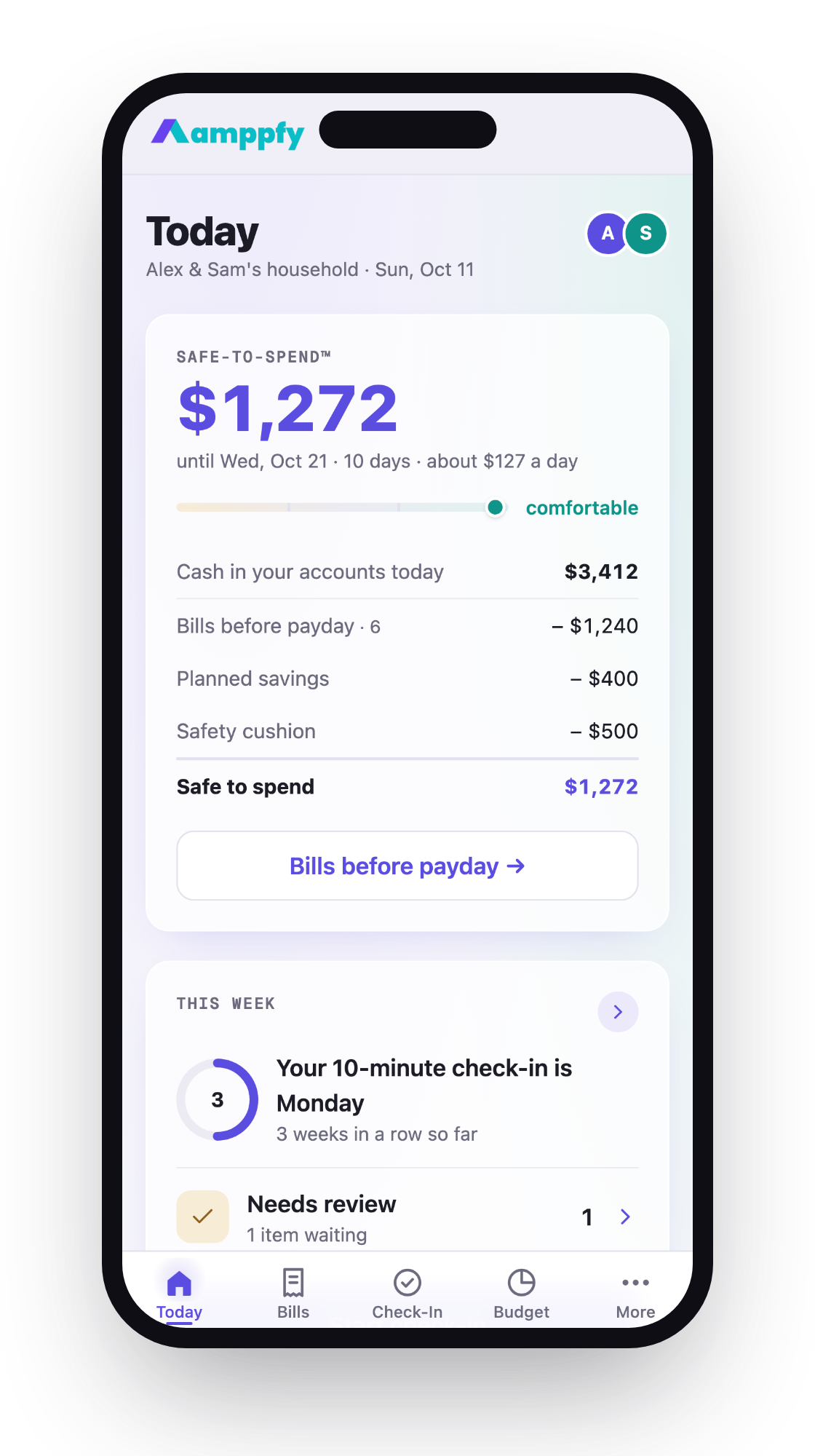
Open each account, checking, savings, credit card, and type in the current balance. This takes about 30 seconds per account. You’re not categorizing transactions. You’re just getting a current snapshot. If you use Amppfy, updating your balances refreshes your Safe-to-Spend™ number: available cash, minus bills due before payday, minus planned savings, minus a safety cushion you set.
Step 2: Confirm upcoming bills (3 minutes)
Look at what’s due between now and your next paycheck. Rent, utilities, subscriptions, loan payments. Check that nothing’s changed and nothing’s been missed.
| What to check | Why it matters |
|---|---|
| Due dates this week | Catch anything that needs manual payment |
| Subscription charges | Spot renewals you forgot about |
| Autopay confirmations | Verify they actually posted |
Step 3: Flag anything unusual (3 minutes)
This is the only part that’s conversational. Either partner raises something that stood out this week:
- An unexpected charge
- A reimbursement that hasn’t arrived
- A goal you want to adjust (vacation fund, emergency savings, a big purchase)
Keep it factual. “I noticed a $140 charge from the vet” is a flag. “You spent too much at Target” is not. More on tone in the final section.
Step 4: Close the week (2 minutes)
State your Safe-to-Spend number out loud. Both of you now know the same figure. Confirm the next check-in time. Done.
That’s it. No spreadsheet review. No receipt sorting. Four steps, ten minutes, and you both walk away knowing exactly where things stand.
Picking a time that survives real life
The best time for your money date is the one you’ll actually keep. That sounds obvious, but most couples pick Sunday evening and then wonder why it falls apart by week three.
What works for most schedules
- Right after payday. Your balances just changed. You’re already thinking about money. The check-in feels natural, not forced.
- A weeknight after kids are in bed. Tuesday or Wednesday tends to stick better than Friday or the weekend, when plans shift constantly.
- During an existing routine. Pair it with something you already do: after dinner cleanup, during the first cup of coffee on Saturday, right before a show you watch together.
What doesn’t work
- “Whenever we both have time.” That means never.
- Right after a stressful event. Don’t stack it on top of a hard workday or a bedtime battle.
- Different times each week. Consistency is the engine. Pick one slot and protect it.
Set a recurring calendar reminder. Put it on both phones. If you skip it, that’s fine. The next section covers exactly what to do. But the reminder keeps the habit from quietly disappearing.
One practical note: if you and your partner are on different pay cycles, pick the earlier payday as your anchor. You can always update balances again when the second check arrives.
What to do when one of you skips
Skipping happens. Travel, illness, a brutal work week. The question isn’t whether you’ll miss a week. It’s whether you’ll come back.
Here’s the rule: one skip is a blip. Two skips in a row is a pattern. If you miss one week, the person who remembers does a solo check-in. Update balances, scan bills, and text your partner the Safe-to-Spend number. That takes five minutes and keeps the data current.
If you miss two weeks, have a brief reset conversation. Not about blame. Just about logistics:
- Is the time slot still working?
- Is the format too long? (It shouldn’t be at ten minutes, but ask.)
- Does one person feel like the “enforcer”? If so, swap who sets the reminder.
Research on couples who merged their finances found higher relationship quality[3] and less score-keeping over time. But that benefit only holds if both people stay engaged. A weekly check-in where one partner does all the work isn’t a shared habit. It’s a chore with an audience.
The real risk of skipping isn’t a missed bill. It’s drift. Small unknowns pile up. A subscription you forgot to cancel. A bill that jumped $30. A savings goal that quietly stalled. Those gaps are where financial secrecy starts to grow[4], even unintentionally. Roughly 40% of adults in committed relationships have kept a money secret from their partner. Regular check-ins make secrets unnecessary because nothing has time to hide.
If your partner resists coming back after a skip, don’t push. Just keep doing your solo update and sharing the number. Most people re-engage on their own once they see the information flowing without pressure.
Keeping it calm: heads-ups, not audits
Tone is everything. A ten-minute money date can strengthen your relationship or wreck your Tuesday night. The difference is whether it feels like a heads-up or an audit.
Ground rules that protect the conversation
- No surprises during the check-in. If you spotted a big charge earlier in the week, mention it then. Don’t save it for the money date like a gotcha.
- Use “I noticed” instead of “you spent.” The first is an observation. The second is an accusation.
- Stick to the four steps. The agenda is your guardrail. If a bigger conversation needs to happen (debt payoff strategy, a career change, helping family), schedule it separately.
What calm actually sounds like
| Instead of this | Try this |
|---|---|
| “Why did you spend $200 at Best Buy?” | “There’s a $200 Best Buy charge. What was that for?” |
| “We can’t afford that.” | “Our Safe-to-Spend is $340 this week. Let’s figure out timing.” |
| “You always forget to update your balance.” | “Can you update your checking balance real quick?” |
The goal is information, not judgment. You’re two people looking at the same number and making sure it’s accurate. That’s it. No grades. No lectures.
If tension creeps in, pause. Say “let’s finish the four steps and talk about this separately.” Protecting the check-in’s simplicity is more important than resolving every issue on the spot.
Apps that use shame, red warnings, or guilt-driven notifications train you to avoid looking at your money. A calm format does the opposite. It makes the habit feel safe enough to repeat. Amppfy was built around this idea: a heads-up the day before a bill, not an alarm after you’ve missed it.
Your ten-minute habit starts this week
You don’t need a perfect system. You need a short one you’ll repeat. Pick your time slot today. Set the reminder on both phones. Run through the four steps once, even if the numbers aren’t perfect yet. The first check-in is always the roughest. By week three, you’ll finish in eight minutes. By week ten, it’ll feel like brushing your teeth.
A weekly money date isn’t about control. It’s about clarity. One shared number. Four quick steps. Ten minutes that keep you and your partner on the same page, without the stress.
Take ten minutes this week and try it. Download Amppfy for free at amppfy.com/app to get your Safe-to-Spend number ready before your first check-in.
Frequently Asked Questions
Do we need to combine bank accounts to make a weekly money check-in work?
Not at all. Most couples in 2026 keep some accounts separate. The check-in works with any setup: joint, split, or hybrid. What matters is that you both see the same Safe-to-Spend number. You each update your own balances privately, and the shared figure reflects your combined reality without exposing every individual transaction.
What if we fight every time we talk about money?
Start with just the first two steps: update balances and confirm bills. Skip the “flagged items” step entirely for the first few weeks. This removes the conversational piece that tends to spark conflict. Once the habit feels routine and neutral, add step three back in. Keep the ground rules tight: observations only, no accusations.
Can this work if we get paid on different schedules?
Yes. Anchor the check-in to whichever payday comes first in the month. When the second paycheck arrives, one of you does a quick solo balance update and shares the new Safe-to-Spend number by text. The formal sit-down still happens at the same time each week regardless of pay dates.
What if one partner handles all the money and the other doesn’t want to be involved?
A ten-minute check-in isn’t asking anyone to become a financial planner. It’s asking both people to look at one number together. The partner who manages the bills still does that work. The check-in just makes sure both people know the result. Over time, this shared awareness tends to reduce the mental load on the “money partner” rather than increase it.