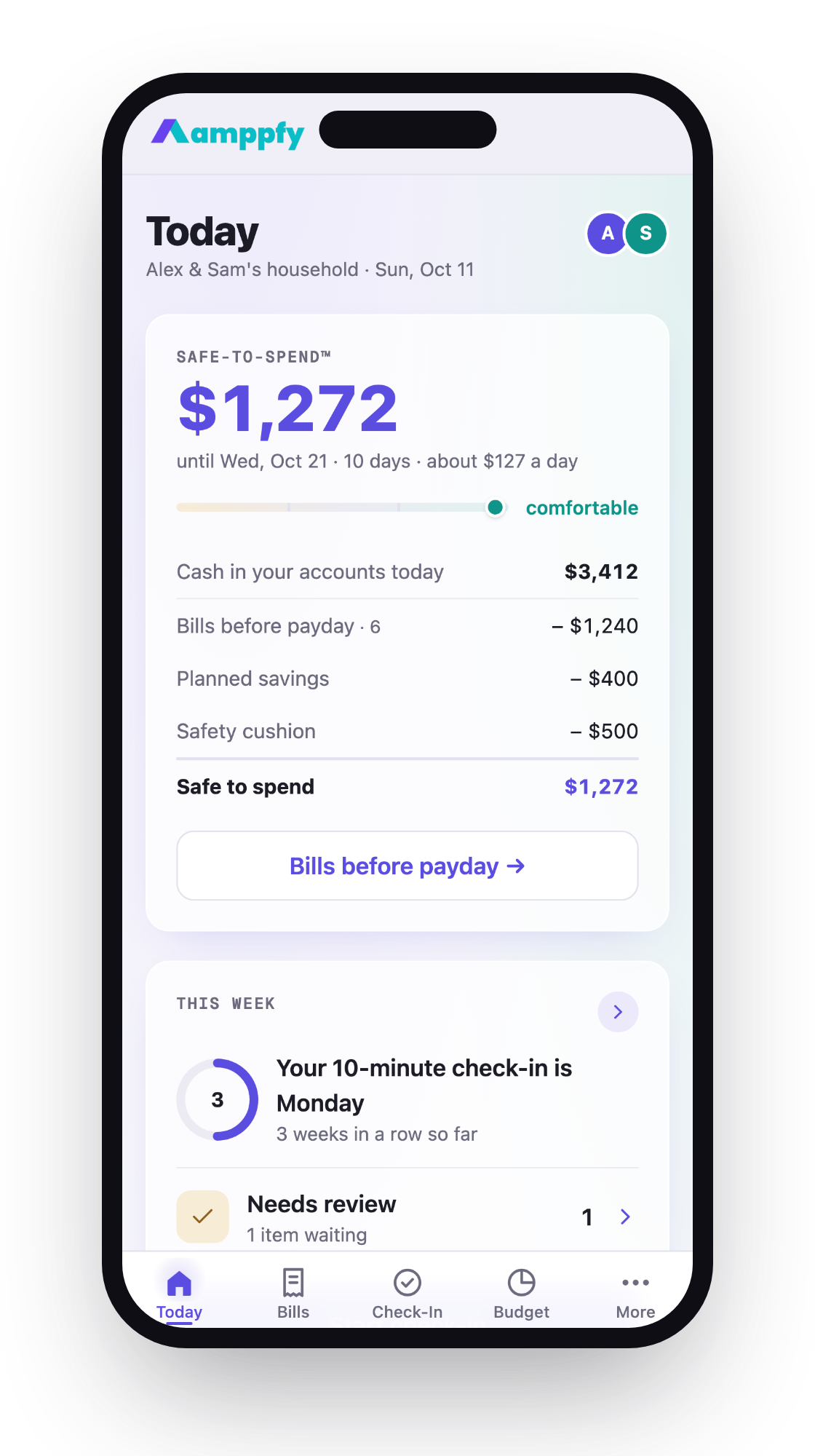
Two paychecks from two different employers hit your account on different days, different weeks, sometimes different halves of the month. Your bills don’t care. Rent is due on the first. The car payment drafts on the twelfth. Your phone bill auto-pays on the twenty-third. The mismatch between when money arrives and when money leaves is the whole problem. One unified bill calendar fixes it, and the setup takes less time than you think.
Why Two Income Streams Need One Calendar
Most people with a single job already struggle with timing. A 2025 survey found that 78% of U.S. workers would face financial difficulty if their paycheck were delayed by just one week[1]. Now double the complexity. You’ve got a Friday paycheck from one employer and a mid-month deposit from the other. Two deposit dates. Two amounts that may not be equal. And a pile of bills that land wherever they land.
Running two mental calendars, one per job, leads to a predictable mistake: you pay a bill from the “wrong” paycheck and leave yourself short for a bill attached to the other one. The fix isn’t two budgets. It’s one calendar that maps every bill to the paycheck best positioned to cover it.
A single calendar also lets you calculate one number: what’s actually safe to spend after every obligation is accounted for. Without that view, you’re guessing. And guessing with two income streams is twice as risky as guessing with one.
The goal here is simple. Line up your paydays, line up your bills, and see the gaps before they become problems.
Assigning Each Bill to the Paycheck That Lands First
The rule is straightforward: each bill belongs to the paycheck that arrives most recently before that bill’s due date. Not the bigger paycheck. Not the paycheck from the job you like more. The one that hits your account first.
Step 1: List Every Recurring Bill
Write down every fixed obligation with its due date. Include rent, utilities, insurance, subscriptions, loan payments, and minimum credit card payments. Don’t skip the $4.99 streaming service. Small charges stack up.
Step 2: Mark Your Two Paydays on a Calendar
Plot both pay schedules for the current month. If Job A pays every other Friday and Job B pays on the 1st and 15th, mark all four to six deposit dates.
Step 3: Match Each Bill to Its Nearest Prior Paycheck
Use this logic:
| Bill | Due Date | Nearest Prior Paycheck | Assigned To |
|---|---|---|---|
| Rent | 1st | Job B (15th of prior month) | Job B |
| Car insurance | 8th | Job A (Friday the 3rd) | Job A |
| Phone | 15th | Job B (1st) | Job B |
| Electric | 22nd | Job A (Friday the 17th) | Job A |
| Student loan | 28th | Job B (15th) | Job B |
Some months the alignment shifts, especially with biweekly pay. Check the calendar at the start of each month and reassign if a paycheck lands later than usual.
When a Bill Falls Right Between Two Paychecks
Pick the earlier one. Paying a bill a few days early never triggers a fee. Paying it a day late often does.
Handling the Week When Neither Check Comes
This is the gap week, and it’s the most dangerous spot in a two-job budget. Biweekly pay creates two or three months a year with a stretch of seven-plus days between deposits. If both jobs pay biweekly on different cycles, you might occasionally hit a window where neither check arrives for ten days.
You have three options for covering gap weeks:
- Build a buffer from a three-paycheck month. Two or three times a year, one of your jobs will produce three paychecks in a single month. Set aside half of that “extra” check specifically for gap-week coverage.
- Shift a bill’s due date. Many creditors let you move your due date once per year with a phone call. If your electric bill falls in the gap week, ask to move it five days later so it lines up with the next paycheck.
- Keep a small float in checking. A fixed cushion of $300 to $500 that you never count as spending money can absorb the timing mismatch. This isn’t an emergency fund. It’s a timing fund.
The worst response to a gap week is using a credit card to “bridge” the shortfall. That turns a timing problem into a debt problem. A buffer you’ve already set aside costs you nothing.
If you use Amppfy’s bill calendar, the app marks the lowest-cash day in each month. That’s your gap-week warning, visible before the month even starts.
A Worked Example with a Friday Job and a 15th Job
Let’s make this concrete. Say you earn $1,800 net from Job A every other Friday and $1,400 net from Job B on the 1st and 15th. Here’s how April 2026 might look:
| Date | Event | Amount | Running Balance |
|---|---|---|---|
| Apr 1 | Job B paycheck | +$1,400 | $1,900 (carried $500 cushion) |
| Apr 1 | Rent | -$1,100 | $800 |
| Apr 4 (Fri) | Job A paycheck | +$1,800 | $2,600 |
| Apr 8 | Car insurance | -$210 | $2,390 |
| Apr 10 | Subscriptions | -$45 | $2,345 |
| Apr 15 | Job B paycheck | +$1,400 | $3,745 |
| Apr 15 | Phone bill | -$85 | $3,660 |
| Apr 18 (Fri) | Job A paycheck | +$1,800 | $5,460 |
| Apr 22 | Electric | -$140 | $5,320 |
| Apr 28 | Student loan | -$350 | $4,970 |
What the Math Tells You
After all bills are paid, you’ve got $4,970 in the account. But that’s not what’s safe to spend. You still need to cover early May bills before the next paycheck. Subtract May rent ($1,100), your savings goal ($400), and your $500 cushion:
$4,970 cash – $1,100 bills – $400 savings – $500 cushion = $2,970 Safe-to-Spend
That $2,970 is your real number. It accounts for money that’s already spoken for. Without this subtraction, you’d look at $4,970 and feel rich, then scramble on May 1st.
The Danger Spot
Notice the dip on April 1st. After rent, you’re at $800 with three days until Job A pays. If an unexpected $400 expense hit on April 2nd, you’d be down to $400: uncomfortably close to zero. That’s why the $500 cushion matters. It exists for exactly this kind of timing squeeze.
Keeping Both Incomes in One Safe-to-Spend™ Number
The whole point of a single bill calendar is to produce one reliable number. Not “how much is in checking” but “how much can I actually spend without putting a future bill at risk.”
A Safe-to-Spend calculation only works when it accounts for every recurring charge[2] between now and your next paycheck. With two jobs and two paydays, “next paycheck” means whichever deposit comes first. Your Safe-to-Spend resets every time a paycheck lands, because new money arrives and a new set of bills becomes the next obligation.
Here’s how to maintain that number week to week:
- Update your checking balance once a week. This takes about 30 seconds per account.
- Confirm which bills are due before the next deposit. Cross off anything already paid.
- Subtract savings contributions and your cushion.
- The remainder is your Safe-to-Spend.
Amppfy runs this math automatically. You enter balances, bills, both paydays, and your savings goals once. The app shows one number with the four-line formula printed underneath, so you always see how it’s calculated. A weekly check-in of about ten minutes keeps everything current. If you share expenses with a partner, they see the same number from their own login.
The key habit is checking one number, not two bank balances. Two balances tell you what’s there. One Safe-to-Spend number tells you what’s available. That distinction is the difference between confidence and anxiety.
Frequently Asked Questions
Should I keep separate checking accounts for each job?
You can, but it adds complexity. Most people do better with one checking account that receives both deposits. A single account makes it easier to see your true balance and calculate one Safe-to-Spend number. If you prefer separation for tracking purposes, consider one checking account for bills and one for spending, rather than splitting by employer.
What if one job pays irregularly or on different dates each month?
Use the earliest likely pay date for planning. If Job B usually pays between the 13th and 17th, assign bills as if it pays on the 17th. You’ll occasionally have money arrive early, which is fine. Planning for the latest possible date protects you from the gap-week problem.
How do I handle months where both jobs have a “bonus” third paycheck?
This happens once or twice a year with biweekly pay. Treat the extra check as found money for your goals: debt payoff, emergency fund, or a specific savings target. Don’t fold it into your regular spending plan. If you absorb it into daily spending, you’ll feel a squeeze the following month when you’re back to the normal rhythm.
Do I need to redo my bill assignments every month?
Only if you’re paid biweekly. Semi-monthly pay (1st and 15th) stays consistent, so your assignments rarely change. Biweekly pay shifts by a day or two each month. Spend five minutes at the start of each month confirming which paycheck covers which bill. That small effort prevents surprises.
One Calendar, One Number, One Weekly Check-In
Managing two jobs and two paydays with a single budget calendar comes down to three moves: assign each bill to the paycheck that arrives first, plan for gap weeks before they arrive, and trust one calculated number instead of two raw bank balances. The worked example above shows exactly how the math flows through a real month.
Take 15 minutes this week to map your May 2026 pay dates and bill due dates onto one calendar. If you want the math done for you, Amppfy is free and built for exactly this kind of multi-paycheck setup. Enter your balances, both paydays, and your bills. You’ll see your Safe-to-Spend number before you finish your coffee.