Every January, your paycheck looks different. You made choices during open enrollment, and now those elections show up as new line items on your pay stub. The shift can be $50 or $500 per check, depending on what you picked. Understanding how open enrollment affects your paycheck deductions is the difference between a smooth start to the year and a scramble to cover bills. This piece walks through the math: premiums, tax-advantaged accounts, and what to do once you see the real numbers. If you share finances with a partner, the stakes double, because two paychecks may have changed at once.
Why your take-home changes in January
Your employer’s benefits year resets on January 1 in most cases. That means any plan changes you made during open enrollment, or any changes your employer made to plan costs, hit your very first paycheck of the new year.
Three things typically shift at once:
- Your health insurance premium share goes up (or down, though up is more common)
- Your HSA or FSA contribution resets to the new annual amount you elected
- Dental, vision, life insurance, or disability premiums adjust to updated rates
Even if you didn’t change a single election, your employer may have raised the employee share of premiums. According to the Bureau of Labor Statistics, employer-sponsored health insurance premiums have risen year over year for more than a decade. Your “same plan” can still cost more in 2026 than it did in 2025.
The compounding effect on biweekly pay
Most salaried workers are paid biweekly (26 checks per year) or semimonthly (24 checks). The per-check hit depends on your pay frequency. A $200/month premium increase splits into $100 per semimonthly check or about $92.31 per biweekly check. Small differences, but they add up across every deduction category.
Here’s a quick example. Say your 2026 per-check deductions totaled $380. For 2027, your premium rose $40/month, you bumped your HSA by $50/month, and your dental went up $8/month. On a semimonthly schedule, that’s $49 more per paycheck. Over the year, that’s $1,176 less take-home pay. Not a crisis, but enough to throw off a spending plan that worked fine last year.
Premiums, deductibles, and paycheck math
Premiums are the most visible deduction. They come out every pay period, pre-tax in most cases. Deductibles don’t show up on your pay stub at all, but they shape how much cash you’ll need throughout the year when you actually use your insurance.
How the math actually works
Your per-check premium depends on three variables: the plan tier you chose (employee-only, employee + spouse, family), the plan level (bronze, silver, gold, or your employer’s equivalent), and your employer’s cost-sharing split.
| Plan Tier | Typical Monthly Employee Share (2026) | Per Biweekly Check |
|---|---|---|
| Employee Only | $150 – $250 | $69 – $115 |
| Employee + Spouse | $350 – $550 | $162 – $254 |
| Family | $500 – $800 | $231 – $369 |
These ranges are approximate and vary widely by employer and region. The point: moving from employee-only to family coverage can reduce your take-home by $300+ per check.
Deductibles: the hidden paycheck pressure
Your deductible doesn’t appear as a payroll deduction, but it creates cash-flow pressure. A $3,000 family deductible means you’re paying full price for most care until you hit that threshold. If your kid needs an ER visit in February, that bill lands while you’re still adjusting to your new, smaller paycheck.
The smart move is to pair your deductible awareness with your HSA or FSA strategy. High-deductible plans cost less per check in premiums but require you to set aside cash for out-of-pocket costs. Low-deductible plans cost more per check but reduce surprise bills. Neither is wrong. The question is whether your paycheck can absorb the premium hit or the out-of-pocket hit more comfortably.
HSA and FSA contributions per paycheck
Health Savings Accounts and Flexible Spending Accounts both reduce your taxable income. They also reduce your take-home pay, because the money comes out before you see it.
HSA contribution limits for 2027
The IRS sets annual HSA limits. For 2027, the self-only limit is $4,500 and the family limit is $9,000. If you elected the family max, that’s $346.15 per biweekly paycheck. That’s real money leaving your check, even though it’s still yours in the HSA.
FSA: use-it-or-lose-it math
FSAs work differently. The 2026 limit is $3,400 for a healthcare FSA; the IRS announces the 2027 limit each fall. Unlike an HSA, most FSA funds expire at year-end (some plans offer a $680 carryover or a 2.5-month grace period). If you elected $3,400, that’s $130.77 per biweekly check.
Here’s a practical breakdown for someone on biweekly pay:
| Deduction | Annual Election | Per Biweekly Check |
|---|---|---|
| Health Premium (Family, Gold) | $14,400 | $553.85 |
| HSA (Family Max) | $9,000 | $346.15 |
| Dental | $720 | $27.69 |
| Vision | $240 | $9.23 |
| Total Pre-Tax Benefit Deductions | $24,360 | $936.92 |
On a $75,000 salary, gross biweekly pay is about $2,884.62. Subtract $936.92 in benefit deductions before taxes even apply. Federal and state taxes, Social Security, and Medicare take another chunk. Your actual deposit could land around $1,500 to $1,700, depending on your tax situation and state.
That gap between gross pay and deposit surprises people every January. It shouldn’t, but it does, because the numbers change and nobody does the math ahead of time.
Couples: two paychecks, one household
If you and your partner both carry benefits, both paychecks shift in January. One of you might carry the family health plan while the other opts for employee-only. Or you might split: one takes dental, the other takes vision. The combination matters for your household cash flow, not just each individual check.
Run the numbers together. Add both new net paychecks. Subtract your shared bills, your individual bills, and your savings goals. That’s your household’s real spending room for the pay period.
Checking your first paycheck of the year
Don’t wait until your bank balance feels wrong. Pull up your first January pay stub the day it posts.
- Compare your new gross pay to your last 2025 stub. Did you get a raise? A cost-of-living adjustment? Note the difference.
- List every pre-tax deduction line by line. Compare each one to your last 2025 stub. Flag anything that changed.
- Check your tax withholding. If you updated your W-4 during open enrollment, your federal withholding may have shifted too.
- Calculate your new net pay. Write it down. This is the number your spending plan needs to work with.
What to look for specifically
- A premium amount that doesn’t match your enrollment confirmation. Payroll errors happen. If your stub shows $400/check for health insurance but your benefits portal says $350, contact HR immediately.
- HSA or FSA contributions that didn’t start. Some employers delay the first deduction to the second or third January check. Confirm the timing so you’re not short-funded later.
- Old deductions that should have stopped. If you dropped a supplemental life insurance policy but it’s still being deducted, that’s money you need to recover.
Catch errors in January. By March, you’ve lost two months of correct pay, and getting retroactive adjustments is harder.
Updating your plan with the new take-home amount
Your spending plan from 2025 doesn’t work in 2026 if your paycheck changed. Treat the first January stub as a trigger to update everything.
Start with the new net deposit amount. Subtract your fixed bills that hit before the next payday. Subtract any savings you want to protect. Subtract a small cushion for timing gaps. What’s left is what you can actually spend.
For example: $1,620 net deposit – $890 bills due before next payday – $200 savings goal – $150 cushion = $380 Safe-to-Spend™.
That $380 is your real number for the pay period. If it’s lower than last year, you have two choices: reduce spending somewhere or revisit your benefit elections during the next open enrollment to pick a plan with lower per-check costs.
If the number is uncomfortably tight
Don’t panic. A tight first paycheck doesn’t mean you made bad choices. It means you need to adjust your spending to match the new reality. Look at subscriptions first: cancel anything you haven’t used in 60 days. Check your grocery and dining spending from December. Most people can find $50 to $100 per pay period without major lifestyle changes.
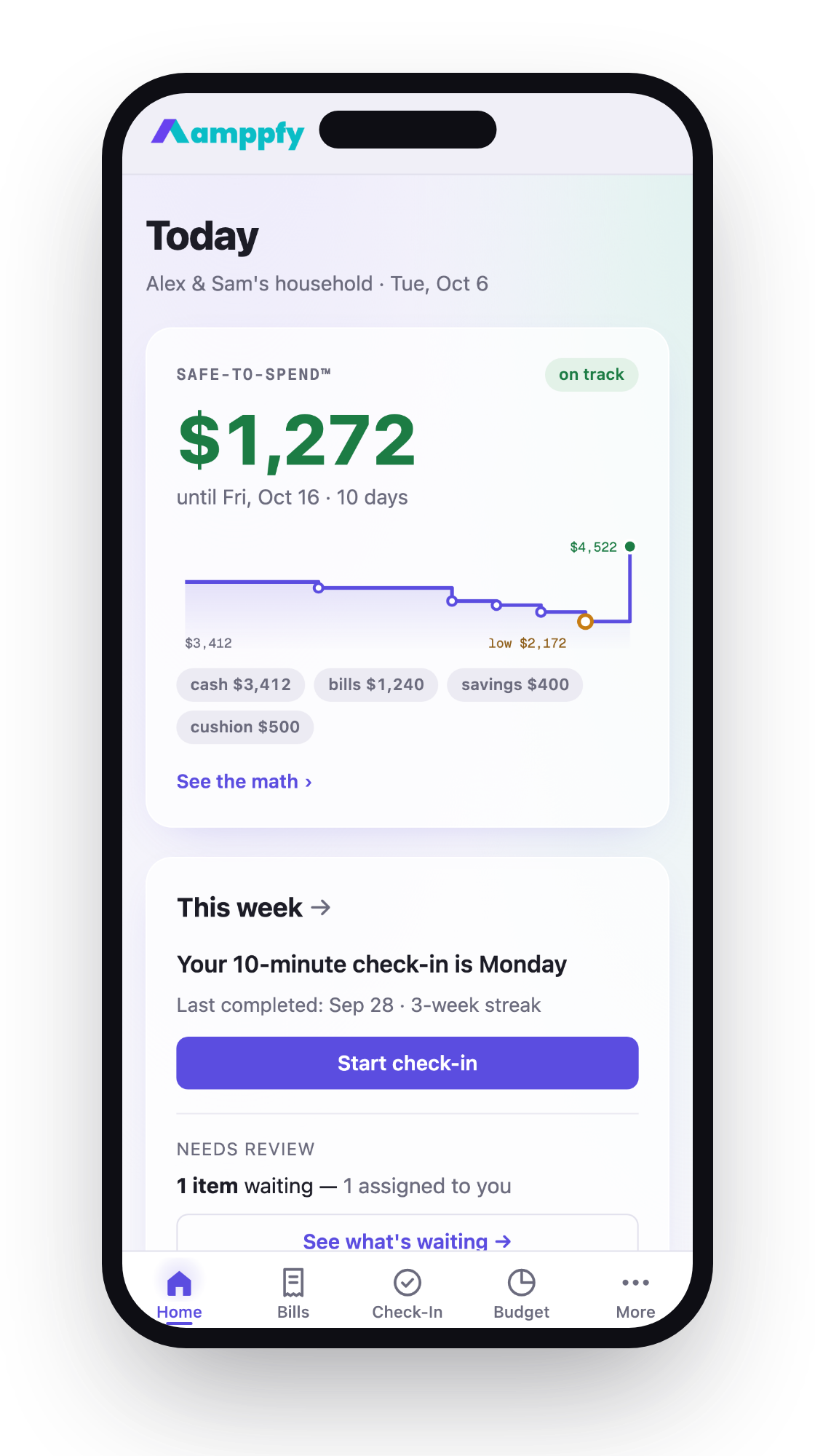
If you share finances with a partner, sit down together with both new stubs. Fifteen minutes of honest math now prevents two months of confusion. Amppfy is built for exactly this: enter your balances, bills, and paydays, and it shows one Safe-to-Spend™ number that accounts for everything due before your next check. Both partners see the same number with their own login.
Revisit mid-year if life changes
A qualifying life event, like marriage, a new baby, or losing other coverage, lets you adjust benefits outside of open enrollment. If your January paycheck math reveals that your elections don’t fit your budget, watch for these qualifying events. They’re your mid-year reset button.
Frequently Asked Questions
Can I change my open enrollment elections after January if my paycheck is too tight?
Generally, no. Open enrollment elections are locked for the plan year unless you experience a qualifying life event such as marriage, divorce, birth of a child, or loss of other coverage. If none of those apply, you’ll need to adjust your spending rather than your benefits. The one exception: some employers allow HSA contribution changes at any time, since HSAs aren’t governed by the same rules as insurance elections.
Why is my first January paycheck smaller than I expected even though I didn’t change plans?
Your employer likely increased the employee premium share. Plan costs rise annually, and employers pass some of that increase to employees. Your benefits confirmation email from open enrollment should list the new per-pay-period amounts. Compare that document to your stub to confirm the numbers match.
Are all benefit deductions pre-tax?
Most health, dental, and vision premiums are pre-tax under a Section 125 cafeteria plan. HSA and traditional FSA contributions are also pre-tax. However, some benefits like supplemental life insurance above $50,000 in coverage, after-tax Roth 401(k) contributions, or certain disability premiums may be post-tax. Check your stub: pre-tax deductions reduce your taxable income, while post-tax deductions do not.
How do I calculate my actual take-home pay after all deductions?
Start with gross pay. Subtract all pre-tax deductions (health premiums, HSA, FSA, traditional 401(k)). The result is your taxable income for that pay period. From that, subtract federal income tax, state income tax, Social Security (6.2%), and Medicare (1.45%). Then subtract any post-tax deductions. The final number is your net deposit. Your pay stub shows each of these lines.
Your paycheck, your plan
Open enrollment decisions live in your paycheck for an entire year. The choices you made in November show up as deduction lines in January, and they stay there until the next enrollment window. Knowing exactly how those deductions change your take-home pay is the first step toward a spending plan that actually holds up.
Check your first January stub line by line. Compare it to your last 2025 stub. Update your spending math with the new net number. If you share bills with a partner, do this together.
If you want one clear number that tells you what’s safe to spend before your next payday, get Amppfy free. Enter your balances, bills, and payday once, about ten minutes, and the number updates every time you do. It’s a simple way to absorb the January paycheck shift without guessing.