Your bank app shows a checking balance. Your retirement account shows a different number. Your car has some value, and your mortgage has a remaining balance. None of these numbers alone tell you whether you’re building wealth or falling behind. That’s where net worth comes in: one figure that combines everything you own and everything you owe. If you’re a beginner wondering how to calculate your net worth, the formula is simple. The hard part is knowing what belongs on the list and what doesn’t.
Net worth in one line: what you own minus what you owe
Here’s the entire formula:
Net Worth = Total Assets – Total Liabilities
That’s it. Assets are things you own that hold value: cash, investments, property, vehicles. Liabilities are debts you still owe: mortgages, student loans, car loans, credit cards. Subtract one from the other, and you get a single snapshot of where you stand financially right now.
Net worth is a “right now” number. It doesn’t include your next bonus, a future inheritance, or the raise you’re expecting. It reflects what you have and what you owe today[1], nothing more.
A negative net worth isn’t unusual, especially if you’re under 35. The median net worth for Americans under 35 is about $39,000[2], and that’s the median: half of that age group sits below it. If you’re carrying student loans or a fresh mortgage, your liabilities may outweigh your assets for a while. That’s normal. What matters is the direction.
The median U.S. household net worth overall is $192,900[3]. That number climbs steadily with age, peaking between 65 and 74. You don’t need to hit any benchmark right now. You just need to know your starting point.
What to count: cash, car, home, retirement
Not everything you own deserves a line on your net worth sheet. Focus on items with clear, verifiable value.
Assets to include
| Asset Type | What to List | Where to Find the Number |
|---|---|---|
| Cash and savings | Checking, savings, money market accounts | Your bank app balances |
| Retirement accounts | 401(k), IRA, Roth IRA, 403(b) | Brokerage or employer portal |
| Investment accounts | Taxable brokerage, HSA investments | Brokerage app or statement |
| Home equity | Current home value minus mortgage balance | Zillow estimate minus loan balance |
| Vehicles | Cars, trucks, motorcycles | Kelley Blue Book or Edmunds |
Your 401(k) deserves attention. The average 401(k) balance hit a record $155,800 in Q2 2026[4] thanks to strong market performance. Even if you’ve only been contributing for a few years, that balance counts.
If you own a home, your equity matters. U.S. homeowners hold an average of $310,500 in home equity as of September 2026[5]. To find yours, take a reasonable estimate of your home’s market value and subtract your remaining mortgage balance.
Liabilities to include
- Mortgage balance
- Auto loan balance
- Student loan balance
- Credit card balances
- Personal loans
- Medical debt
The average U.S. household carries $105,444 in total debt, with credit card balances averaging $6,610 as of Q2 2026. List every debt with its current balance, not the original loan amount.
What to skip or estimate roughly
Some things look like assets but don’t belong on your net worth sheet. Others technically have value but aren’t worth the effort to track precisely.
Skip entirely
- Furniture and clothing. Your couch lost most of its value the day you bought it. Unless you own a genuine antique, leave it off.
- Electronics. Your laptop, phone, and TV depreciate fast. The resale value isn’t worth tracking.
- Future income. A pending bonus, expected inheritance, or stock options that haven’t vested yet aren’t yours today.
- Collectibles without a market. Your vinyl collection or sports memorabilia only counts if you can point to recent comparable sales. If you can’t, skip it.
Estimate roughly
- Vehicles. Don’t obsess over the exact trade-in value. The average used vehicle price has stabilized around $26,000 in 2026, but your car’s value depends on make, model, mileage, and condition. A quick Kelley Blue Book lookup once every three months is plenty.
- Home value. Zillow or Redfin estimates fluctuate monthly. Pick one source, check it quarterly, and use that number. Don’t chase every $2,000 swing.
- Small retirement accounts. If you have an old 401(k) from a previous employer with $3,000 in it, include it. But you don’t need to update it weekly. Quarterly is fine.
The goal is a useful number, not a perfect one. A net worth calculation that’s 95% accurate and gets done every month beats a perfect one you never finish.
One distinction worth knowing
Some financial planners separate “investable net worth” from total net worth. Investable net worth excludes your home equity and focuses only on assets you could actually deploy: cash, stocks, bonds, retirement accounts. This is the number that predicts financial independence, because you can’t pay for groceries with a spare bedroom. Track both if you like, but start with total net worth.
A monthly snapshot that takes five minutes
A net worth number you check once a year isn’t very useful. Monthly tracking reveals patterns. Here’s a five-minute process you can do on the first of every month.
Step 1: Update your balances
Open each account and write down the current balance. You probably have four to eight accounts total. This takes about two minutes.
- Checking account: current balance
- Savings account: current balance
- 401(k) or IRA: current balance
- Brokerage account (if any): current balance
- Credit cards: current balance owed
- Mortgage: remaining balance
- Auto loan: remaining balance
- Student loans: remaining balance
Step 2: Add assets, add liabilities, subtract
Use a simple spreadsheet, a notes app, or a tool that does this for you. The math is basic addition and subtraction.
For example:
| Amount | |
|---|---|
| Checking | $4,200 |
| Savings | $8,500 |
| 401(k) | $47,000 |
| Home value | $320,000 |
| Car value | $18,000 |
| Total Assets | $397,700 |
| Mortgage | -$265,000 |
| Student loans | -$22,000 |
| Credit cards | -$3,100 |
| Total Liabilities | -$290,100 |
| Net Worth | $107,600 |
Step 3: Record and move on
Write the number down with the date. Don’t analyze it yet. After three months, you’ll have a trend. After six months, you’ll see whether your choices are moving the number up or down.
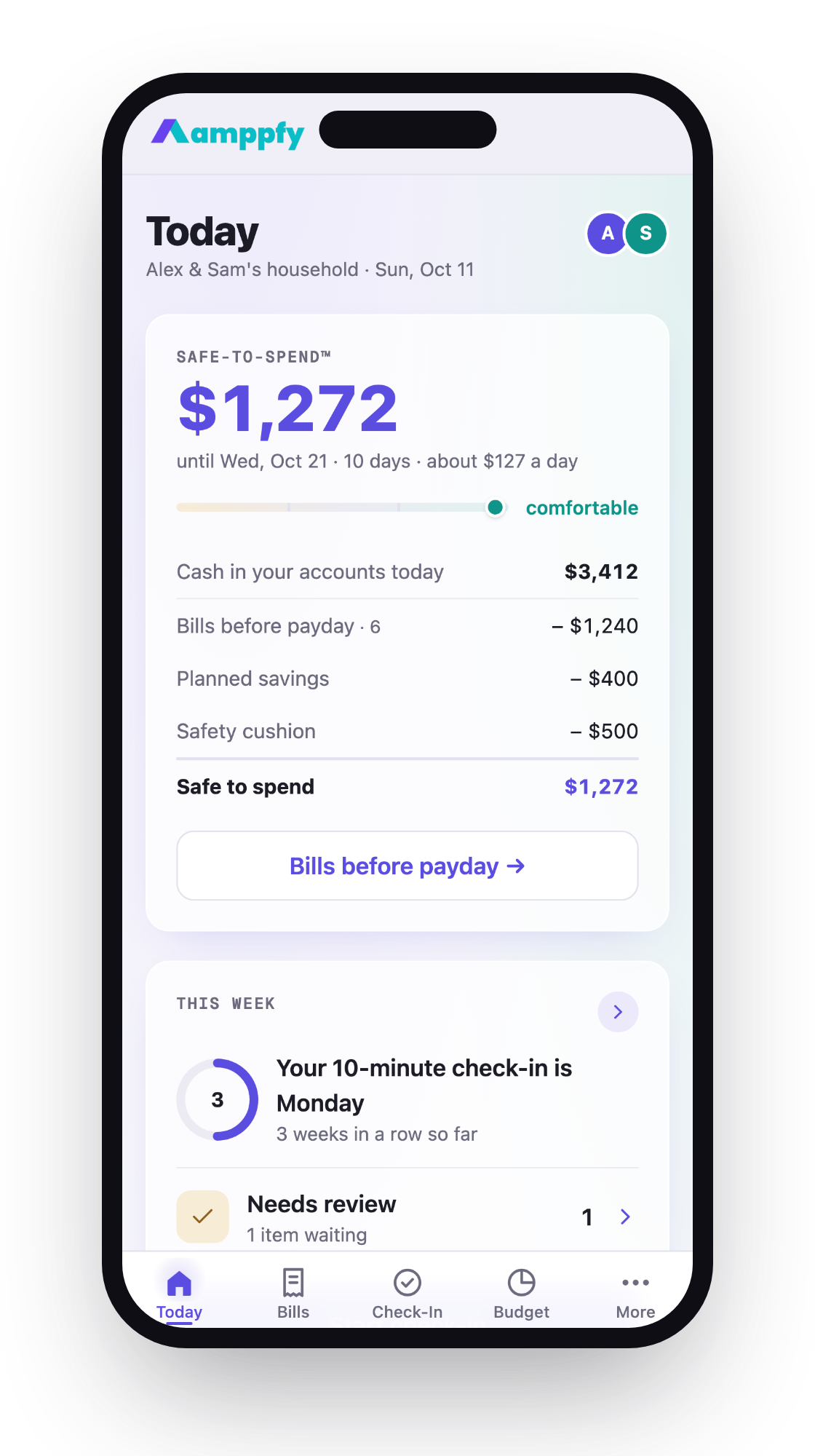
If you already use Amppfy for your Safe-to-Spend™ number, the same balance entries you update each week feed a built-in net worth tracker month by month. No extra work.
Reading the trend, not the number
Your net worth on any single day is just a snapshot. The stock market dropped 3% this week? Your 401(k) dipped. Your home’s Zillow estimate jumped $5,000? Your net worth rose. Neither event reflects a real change in your financial habits.
The trend over three to six months tells the real story. A rising trend means you’re paying down debt, saving consistently, or both. A flat trend means your spending roughly matches your income growth. A declining trend means something needs attention: maybe a new car loan, maybe savings stalled, maybe expenses crept up.
What to look for each quarter
- Is your total debt balance shrinking? Even $500 less per quarter is progress.
- Is your retirement balance growing beyond just market gains? That means your contributions are working.
- Is your cash cushion stable or growing? If it’s shrinking, your spending may be outpacing your paychecks.
Don’t compare your number to anyone else’s. A 30-year-old with $50,000 in net worth and zero credit card debt is in a different position than a 30-year-old with $120,000 in net worth and $15,000 in high-interest debt. Context matters more than the raw figure.
The single most useful thing you can do with your net worth number is pair it with your Safe-to-Spend figure. Net worth tells you the big picture. Safe-to-Spend tells you what you can actually use between now and payday. One is the long game, the other is this week. Together, they replace the vague anxiety of “am I doing okay?” with a concrete answer.
Frequently Asked Questions
Should I include my car in my net worth?
Yes, but use a realistic number. Look up your vehicle on Kelley Blue Book or Edmunds using the “private party” or “trade-in” value, not the dealer retail price. Update it every three months or so. If you still owe money on the car, list the loan balance as a liability. The difference between the car’s value and the loan is what actually counts toward your net worth.
What if my net worth is negative?
A negative net worth means your debts currently exceed your assets. This is common for people in their 20s and early 30s, especially with student loans or a new mortgage. It doesn’t mean you’re failing. Focus on the trend: if your net worth moves from -$30,000 to -$22,000 over six months, you’re heading the right direction. Pay down high-interest debt first and keep contributing to retirement, even small amounts.
How often should I calculate my net worth as a beginner?
Monthly is the sweet spot. Weekly is too noisy because market fluctuations and billing cycles distort the picture. Annually is too infrequent to catch problems or celebrate progress. A monthly check on the first of the month takes five minutes and gives you twelve data points per year to spot trends.
Should I count my home equity or leave it out?
Count it in your total net worth. But also know your investable net worth: the total minus your home equity. Your home equity is real wealth, but it’s not liquid. You can’t easily spend it on retirement or emergencies without selling or borrowing against the house. Tracking both numbers gives you a clearer picture of your actual financial flexibility.
Knowing how to calculate net worth as a beginner comes down to three habits: list what you own, list what you owe, and subtract. Do it monthly. Watch the trend, not any single number. The formula never changes, and the process gets faster each time you do it.
Take 10 minutes this weekend to run your first calculation. If you want one place to keep your balances, track net worth month by month, and see your Safe-to-Spend number before every paycheck, Amppfy is free and starts with just your balances.