You opened YNAB with good intentions. Somewhere between reconciling transactions, reassigning dollars from “Dining Out” to “Groceries,” and fixing a broken bank sync at 10 p.m., the whole thing started to feel like a chore you dread. You’re not alone. A July 2026 survey found that “it’s too time-consuming” is now the top reason Americans quit budgeting[1], beating out lack of income for the first time. If YNAB feels like too much work, the problem probably isn’t you. It might be the method itself.
The signs a budgeting system has become the job
There’s a difference between a helpful routine and a second job. The line is easy to miss because budgeting apps reward consistency, and guilt fills the gap when you fall behind. Here are the warning signs that your system costs more energy than it returns.
- You open the app and immediately feel behind.
- Uncategorized transactions pile up for days or weeks.
- You spend more time moving money between categories than actually deciding what to buy.
- A partner asks “what can we spend?” and you say “let me check” – then never check.
- You’ve rage-quit and restarted more than once.
YNAB’s zero-based method asks you to assign a purpose to every single dollar. That works brilliantly for some people. For others, it creates a maintenance loop: earn, assign, spend, reconcile, reassign, repeat. User surveys in 2026 suggest the app requires 15 to 30 minutes of active management each week[2], plus hours of initial setup. That weekly window assumes nothing breaks: no failed bank sync, no surprise charge, no forgotten subscription.
The real cost isn’t just time. It’s decision fatigue. Every unplanned expense forces a mini-negotiation with your own categories. Buy a birthday gift? Move money from “Clothing.” Vet bill? Pull from “Emergency.” Each move is small, but they stack up. After a few months, the system that was supposed to reduce money stress becomes a source of it.
Categories vs. one number: two different questions
Most budgeting frustration comes down to a mismatch between the question you’re asking and the answer your tool provides.
YNAB answers: “How should I allocate every dollar I have right now?” That’s a powerful question for debt payoff or irregular income. But most people on a regular paycheck are really asking something simpler: “What’s safe to spend before I get paid again?”
Those are two fundamentally different problems.
| Category-based (YNAB) | One-number approach | |
|---|---|---|
| Core question | Where should each dollar go? | What’s left after bills and savings? |
| Weekly upkeep | 15-30 min categorizing and reassigning | ~10 min updating balances |
| Decision per purchase | Check the category, possibly reassign | Glance at one number |
| Best for | Debt snowball, irregular income | Steady paycheck, couples, maintenance mode |
| Failure mode | Abandonment from fatigue | Less granular spending data |
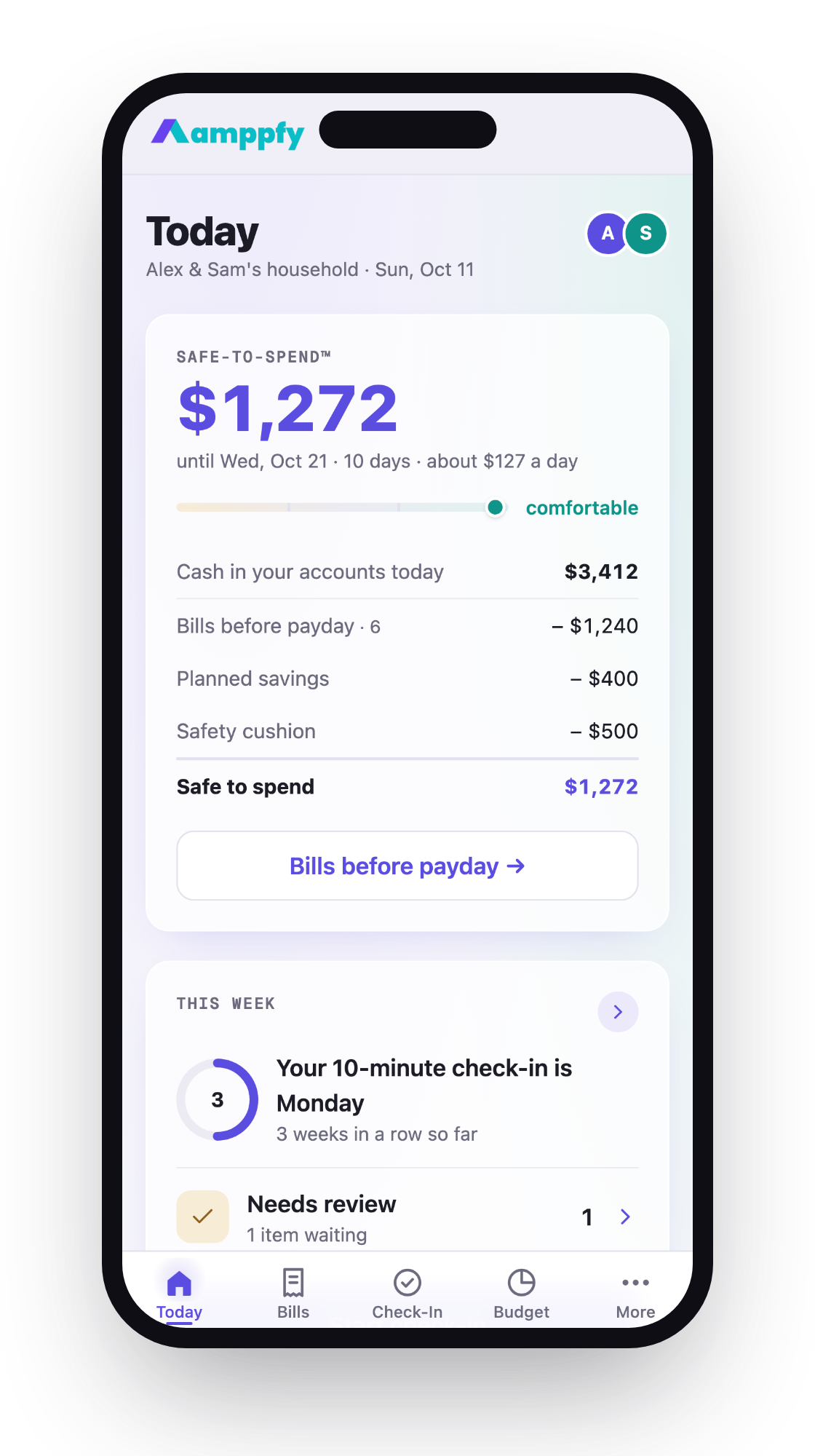
Neither approach is wrong. But if you’re on a regular pay cycle and your main goal is to stop accidentally spending bill money, a single Safe-to-Spend™ number – available cash, minus bills due before payday, minus planned savings, minus a safety cushion – answers your actual question without the overhead.
The category model shines during a financial crisis or a big debt push. Once you’ve stabilized, though, maintaining 30+ categories can feel like filing taxes every week. Recognizing which phase you’re in saves you from forcing a complex tool onto a simple problem.
Keeping the good habit, dropping the upkeep
Quitting YNAB doesn’t mean quitting awareness. The habits you built there are real, and you can keep most of them without the maintenance tax.
Habits worth keeping
- Checking your money at least once a week.
- Knowing your bills and their due dates.
- Saving before you spend, not after.
- Talking about money with your partner on a regular schedule.
Upkeep you can safely drop
- Categorizing every coffee and gas station charge.
- Reconciling bank transactions line by line.
- Reassigning dollars between envelopes after each purchase.
- Maintaining separate sinking funds for 15 different future expenses.
The trick is separating the awareness from the accounting. You don’t need to know you spent $47.83 at Target last Tuesday. You need to know whether spending $50 today leaves enough for the electric bill on Friday.
Some people land on a spreadsheet. Others try a simpler app. Monarch Money, for example, offers a “Flex Budget” feature that sets monthly spending targets[3] without forcing you to reassign every dollar when plans shift. Amppfy takes it further by showing one number tied to your pay cycle: enter your balances, bills, paydays, and savings goals, and the weekly check-in takes about ten minutes. No bank login required. You type in balances yourself.
The point isn’t which tool you pick. It’s that the tool matches your actual question and your actual patience.
A ten-minute weekly alternative
Here’s what a low-effort weekly money check-in looks like, step by step.
Sunday evening routine (pick any day that works)
- Open your bank app. Write down your checking balance. Takes 30 seconds.
- Open your credit card app. Write down what you owe right now. Another 30 seconds.
- Subtract upcoming bills between now and your next payday.
- Subtract whatever you’ve committed to savings this pay period.
- Subtract a cushion: $50, $100, whatever lets you sleep.
- The remaining number is what you can actually spend.
That’s it. Six steps, roughly ten minutes if you’re slow about it.
| Step | Action | Time |
|---|---|---|
| 1 | Check checking balance | 30 sec |
| 2 | Check credit card balance | 30 sec |
| 3 | Subtract bills due before payday | 2 min |
| 4 | Subtract savings commitments | 1 min |
| 5 | Subtract your chosen cushion | 30 sec |
| 6 | Note your Safe-to-Spend number | 30 sec |
Compare that to the roughly two hours per month[4] that even a streamlined category-based workflow demands. You’re trading granular spending data for simplicity, and for most people past the debt-payoff phase, that trade is worth it.
If you share finances with a partner, this routine works best when both of you see the same number. One person updating balances, both people trusting the result. No separate spreadsheets, no “did you log that charge?” conversations.
When to do more than ten minutes
Some weeks need extra attention. A big expense is coming. You changed jobs. You’re planning a vacation. Those weeks, spend 20 minutes instead. But the baseline stays low, and that’s what keeps you showing up.
How to switch without losing your history
The biggest fear about leaving YNAB is losing years of data. Good news: you don’t have to.
Exporting your YNAB data
YNAB’s built-in web export gives you CSV files for transactions and budgets[5]. Those CSVs won’t include targets, category notes, or attached photos, but they capture the financial history you care about most: what came in, what went out, and when.
Steps to preserve your records
- Log into YNAB on the web (not the mobile app).
- Go to your budget, then File > Export Budget.
- Download the ZIP file. Save it somewhere permanent: cloud drive, external hard drive, both.
- Open the CSVs in a spreadsheet to confirm everything looks right.
If you’re moving to another app, open-source migration tools can map your YNAB accounts to a new platform in a single pass. You don’t need to re-enter years of history manually.
What to do with the subscription
YNAB costs $14.99 per month or $109 per year as of late 2026. Once you’ve exported your data, cancel before the next billing cycle. Set a calendar reminder so you don’t forget. That’s $109 back in your pocket each year, or close to it depending on your billing date.
Keep your exported files for at least a full tax year. If you ever need to look up a transaction for a return, a warranty claim, or tax prep, the CSVs have you covered.
Frequently Asked Questions
Is YNAB worth the effort if I’m not in debt?
For active debt payoff, YNAB’s zero-based approach is genuinely useful. Once you’re past that phase and living on a regular paycheck, the maintenance often outweighs the benefit. A simpler system that answers “what’s safe to spend before payday” usually does the job with far less friction.
Can I use YNAB with less effort instead of quitting?
You can. Some people reduce their categories to five or six broad buckets and stop reconciling daily. That helps, but you’re still working within a system designed around assigning every dollar. If the core method feels like a burden, simplifying the categories only delays the frustration.
What’s the biggest risk of switching away from YNAB?
Losing visibility into your spending patterns. The fix is simple: export your data before you cancel, and pick a replacement that gives you at least a weekly snapshot of where you stand. The goal is awareness, not accounting.
Do couples need a category-based budget to manage shared money?
No. Couples need to agree on one number they both trust. Whether that number comes from categories, a spreadsheet, or an app like Amppfy that shows both partners the same Safe-to-Spend figure, the format matters less than the shared visibility.
Moving forward without the guilt
Feeling like YNAB is too much work doesn’t mean you failed at money. It means you outgrew a tool, or it never fit your actual routine in the first place. The best budget is one you actually maintain week after week, not one that looks impressive on a screenshot.
Export your data. Cancel the subscription if it’s draining your time and your wallet. Pick a method that answers your real question in ten minutes or less. Then spend your Sunday evenings doing literally anything else.
Take ten minutes this week to try a simpler check-in. Your future self – the one not dreading Sunday night – will thank you.