Your bank balance looked fine at breakfast. By dinner, three transactions posted in an order you didn’t expect, and a fee showed up. The sequence your bank uses to process charges and deposits can shift your balance by hundreds of dollars in a single day. Understanding how your bank’s transaction posting order works gives you a real edge in avoiding surprise fees and knowing what’s actually safe to spend before your next paycheck.
Most people assume transactions clear in the order they swipe or tap. They don’t. Banks follow internal rules that decide which items post first, which wait, and what happens when several hit at once. The result can mean the difference between a clean day and a $35 overdraft charge. This guide walks through the mechanics, the timing traps, and the habits that keep your balance honest.
Credits first, debits second: the usual posting order
Banks don’t just dump every transaction into your account at random. They batch-process items, typically overnight, in a specific sequence. The general pattern looks like this:
- Credits post first: direct deposits, incoming transfers, refunds.
- Fees and bank-initiated items post next.
- Debits post last: debit card purchases, checks, ACH payments, ATM withdrawals.
This credit-first approach exists partly because of regulations that followed the 2010 overdraft rule changes. Posting your deposits before your charges gives your balance the best chance of covering everything. But the order within each category is where things get interesting, and where fees can sneak in.
A simple example of posting order at work
Say your account starts the day at $200. Overnight, three items arrive for processing:
- A $500 direct deposit (credit)
- A $180 electric bill (debit, ACH)
- A $90 subscription charge (debit)
Because credits post first, your balance jumps to $700 before either debit hits. Both debits clear with room to spare. If debits posted first, your $200 balance would cover the $180 bill, drop to $20, and then the $90 charge would overdraft you.
What counts as a credit vs. a debit
| Type | Examples | Posting priority |
|---|---|---|
| Credits | Direct deposit, mobile check deposit, P2P transfer in, refund | Usually first |
| Bank items | Monthly fees, interest charges, loan payments from same bank | Second |
| Debits | Debit card swipes, ACH bills, checks, ATM withdrawals | Last |
Not every bank follows this exact sequence. Your account agreement spells out the specific order. It’s usually buried in the section titled “Order of Payments and Transactions” or something similar. Read it once. It takes five minutes.
Largest-first vs. chronological, and why it changes your fees
Within the debit category, banks choose how to sort multiple charges. Two main methods dominate: largest-first and chronological (time-stamp) order. The difference matters most when your balance is tight.
Largest-first posting
Some banks post your biggest debit first, then the next biggest, and so on. The original argument was that your largest payment is probably your most important one: rent, a car payment, a utility bill. Clearing it first protects you from missing a major obligation.
The downside is real. If your balance can only cover part of your debits, the large transaction eats most of your cash. Every smaller transaction behind it bounces or triggers an overdraft fee. A 2014 CFPB report found that high-to-low reordering was a primary driver of multiple overdraft fees in a single day.
Chronological posting
Chronological posting processes debits in the order they were authorized. A $4 coffee at 8 a.m. posts before a $300 insurance payment at 2 p.m. This approach tends to produce fewer overdraft fees because smaller items clear while you still have funds.
| Method | How it sorts debits | Fee risk when balance is low |
|---|---|---|
| Largest-first | Biggest dollar amount posts first | Higher: small transactions pile up behind the big one |
| Chronological | Time-stamp order | Lower: more items clear before balance runs out |
Many large banks shifted to chronological posting after regulatory pressure and class-action settlements. But not all have. Check your bank’s current policy. It may differ for checks vs. debit card purchases vs. ACH payments, with each category sorted by its own rule.
What you can do about it
You can’t change your bank’s posting method. You can pick a bank that uses chronological posting if fees have been a recurring problem. You can also keep a buffer in your checking account so the sorting method rarely matters. A cushion of $200 to $500 makes most posting-order risks disappear.
The cutoff time that moves a Friday into Monday
Every bank sets a daily cutoff time. Deposits or transactions received after that cutoff roll into the next business day’s batch. This single detail causes more confusion than almost anything else in personal banking.
Most banks set their cutoff between 2 p.m. and 5 p.m. local time, though some push it to 8 p.m. or later for mobile deposits. If you deposit a check at 6 p.m. and your bank’s cutoff is 5 p.m., that deposit belongs to tomorrow. If tomorrow is Saturday, “tomorrow” actually means Monday, because weekends and federal holidays aren’t business days.
The Friday trap
Here’s a scenario that catches people regularly. You get paid every other Friday. Your rent auto-pays on Friday. Your paycheck hits via direct deposit at 3 p.m., but the bank’s cutoff for ACH processing was 2 p.m. Your deposit doesn’t post until Monday. Meanwhile, your rent payment was already in Friday’s batch. If your balance can’t cover it, you’re looking at a returned payment or an overdraft fee, plus a possible late fee from your landlord.
The fix: know your bank’s cutoff time and your employer’s deposit timing. Many employers send payroll files a day or two early. Some banks offer early direct deposit, crediting your pay up to two days before the official payday. Ask your HR department when the payroll file is transmitted, not just when payday falls on the calendar.
Holiday weekends stretch the gap
A three-day weekend means a deposit made after Friday’s cutoff won’t post until Tuesday. That’s a four-day gap where your balance stays lower than you expect. Plan bill due dates around these windows.
Reading your available balance the right way
Your bank app shows two numbers: your current balance (also called ledger balance) and your available balance. They’re almost never the same, and using the wrong one leads to trouble.
Your current balance reflects posted transactions only. It doesn’t account for pending charges, holds, or deposits that haven’t cleared. Your available balance subtracts pending debits and holds, then adds pending credits. It’s the closer-to-real number, but it still isn’t perfect.
Why available balance can mislead you
- Gas station holds: a $1 pre-authorization can balloon to a $100 hold until the final amount posts, sometimes 2 to 3 days later.
- Hotel and rental car holds: these can freeze $200 to $500 of your available balance for days after checkout.
- Pending transactions that drop off: some merchants don’t finalize a charge for several days. The pending amount disappears from your available balance, making it look like you have more cash. Then the charge reappears when it posts.
Your available balance is a better starting point than your current balance, but it doesn’t tell you what’s truly safe to spend. It ignores upcoming bills that haven’t been charged yet, savings you’ve committed to, and the cushion you need to avoid fees.
A better formula
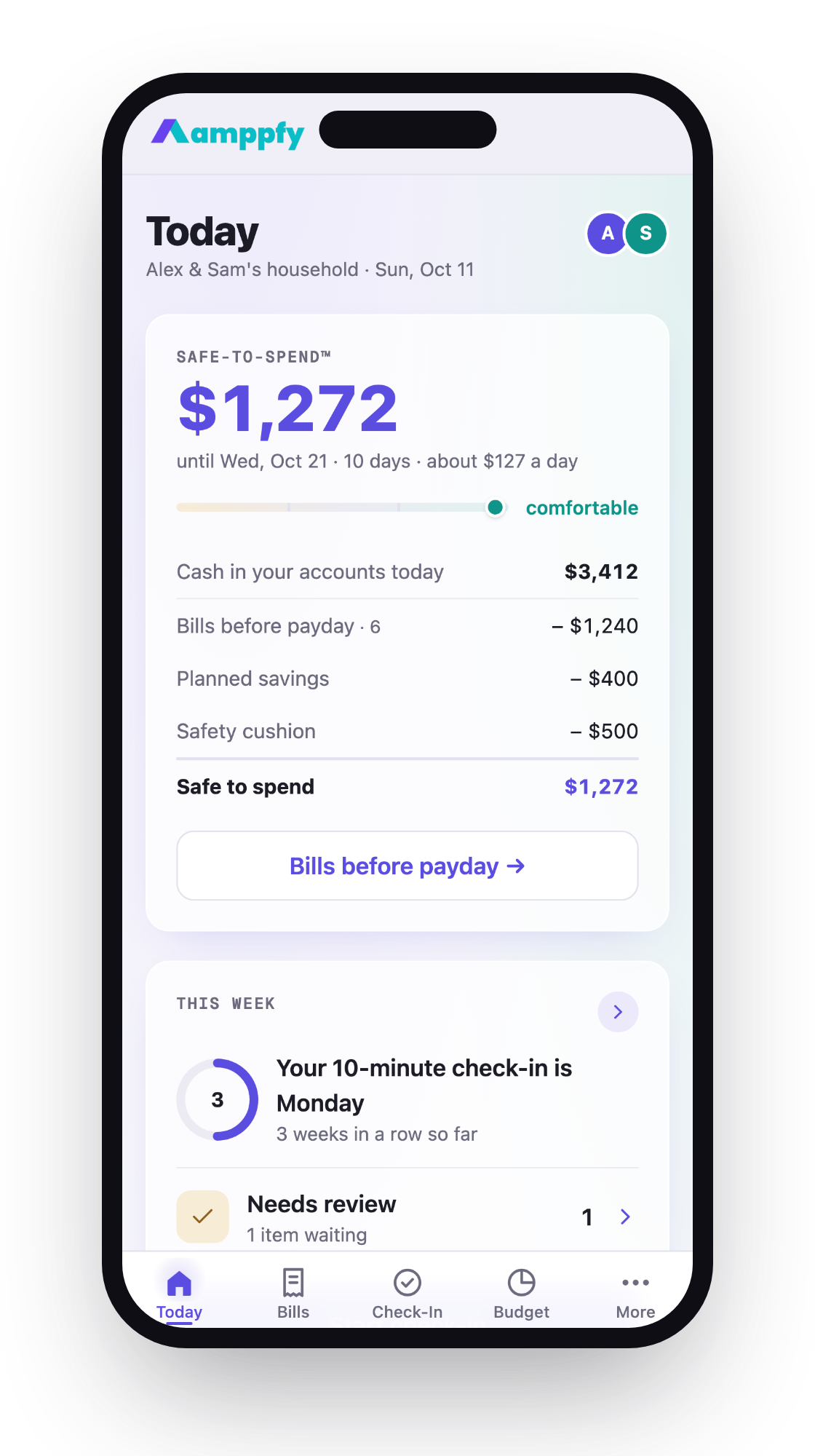
Think of it this way: $3,200 available balance – $1,100 bills due before payday – $300 savings goal – $400 cushion = $1,400 safe to spend. That’s the math Amppfy’s Safe-to-Spend™ number does for you automatically. You enter your balances, bills, and goals once, and the app keeps that number current with about 30 seconds of updates per account each week.
Keeping bills a day away from payday, on purpose
The smartest move you can make with transaction posting is to stop relying on same-day timing. Give yourself a one-day buffer between when you get paid and when your biggest bills hit.
If payday is the 1st and the 15th, set your rent or mortgage auto-pay for the 2nd and your car payment for the 16th. This one-day gap absorbs cutoff-time surprises, posting delays, and holiday weekends. It costs you nothing.
How to set up a bill buffer
- List every recurring bill with its current due date.
- Move each due date to at least one day after your nearest payday. Most billers let you change your due date online or by phone.
- For bills you can’t move (like a fixed mortgage due date), schedule the payment from your bank’s bill pay a day after payday instead.
- Set a calendar reminder or use an app like Amppfy that shows your bills on a month calendar with the lowest-cash day marked, so you can spot conflicts before they cause problems.
Couples and shared bills
When two people share expenses, posting-order problems double. One partner’s paycheck might land on Thursday; the other’s on Friday. A joint bill set for Thursday could overdraft if only one deposit has posted. Coordinate your bill dates around the earlier paycheck, or keep a standing buffer in the joint account. Amppfy lets partners see the same Safe-to-Spend number while keeping private balances separate, which helps both people plan around the same timeline.
Frequently asked questions
Can I ask my bank to change the order it posts my transactions?
No. The posting sequence is set by the bank’s internal policy, not by individual account holders. You can, however, choose a bank whose posting policy works better for you. Look for banks that use chronological posting for debit card transactions and that post credits before debits. Your account agreement or a quick call to customer service will confirm the method.
Does the bank transaction posting order affect overdraft fees even if I have overdraft protection?
Yes, it can. Overdraft protection links a savings account or credit line to cover shortfalls, but transfers from that backup source may carry their own fees, typically $10 to $12 per transfer. If your bank posts debits largest-first and triggers three separate overdraft protection transfers in one day, you could pay $30 to $36 in transfer fees. Chronological posting would likely trigger fewer transfers.
Why did a transaction I made on Monday not show up until Wednesday?
Merchants don’t always submit charges immediately. A restaurant might batch its card transactions at the end of the day. An online retailer might not charge your card until the item ships. The gap between authorization (when the hold appears) and settlement (when the charge posts) can range from one to five business days. During that window, the pending charge may appear, disappear, and reappear in your available balance.
Is there a federal law that requires a specific posting order?
There’s no federal law mandating a single posting sequence. The Federal Reserve’s Regulation E and the 2010 overdraft opt-in rules govern how banks must disclose fees and get your consent for overdraft coverage on debit card and ATM transactions. But the actual order of posting is left to each bank’s discretion, disclosed in your account agreement.
One number that stays ahead of posting surprises
The order your bank posts transactions is one of those behind-the-scenes mechanics that only hurts you when your balance is close to the edge. The best defense isn’t memorizing batch-processing rules. It’s keeping enough distance between your cash and your obligations that the posting sequence stops mattering.
Know your bank’s cutoff time. Space your bills one day past payday. Keep a cushion in checking. And instead of refreshing your bank app and guessing what’s safe to spend, try Amppfy for free at amppfy.com/app/ to see one number that accounts for your bills, savings, and buffer before you spend a dollar. Ten minutes a week keeps it current. That’s less time than you spend worrying about which transaction posts first.