Your bank probably offers overdraft protection. You’ve seen the pitch: “We’ll cover you if your balance dips below zero.” It sounds reassuring, like a financial safety net you can forget about. But a growing number of people are asking whether overdraft protection is worth it, or whether a self-managed safety cushion does the job better and cheaper. The answer depends on how each option actually works, what it costs over a year, and how much control you want over your own money. Most people who compare the two side by side end up surprised by the math.
What overdraft protection does, and what it costs
Overdraft protection is a bank service that covers transactions when your checking account hits zero. Instead of declining your debit card or bouncing a check, the bank pulls money from a linked source: a savings account, a credit card, or a line of credit. Some banks simply let the transaction go through and charge you a fee for the privilege.
The fee structure
The cost depends on which type of overdraft protection your bank offers:
| Type | Typical Cost | How It Works |
|---|---|---|
| Linked savings account | $0 to $12 per transfer | Bank moves money from your savings to cover the shortfall |
| Overdraft line of credit | Interest (often 18% to 24% APR) | Bank extends a small loan; you repay with interest |
| Standard overdraft coverage | $26 to $35 per occurrence | Bank covers the transaction and charges a flat fee each time |
The Consumer Financial Protection Bureau reported that Americans paid roughly $9.1 billion in overdraft and NSF fees in 2022. That number has dropped since some major banks reduced or eliminated fees, but millions of account holders still pay them.
The hidden multiplier
One overdraft fee is annoying. Three in a week is a crisis. Standard overdraft coverage often charges per transaction, so a $4 coffee and a $12 lunch can each trigger a separate fee. You might overdraw by $16 total and owe $70 in fees. That’s the part the brochure skips.
Linked savings transfers are cheaper, but they still carry a cost: your savings balance drops, and some banks charge a transfer fee each time. The line-of-credit option adds interest that compounds if you don’t pay quickly.
What a safety cushion does instead
A safety cushion is money you set aside inside your own accounts and refuse to touch unless something truly unexpected happens. It’s not an emergency fund (that’s for job loss or medical bills). It’s a smaller buffer, typically $200 to $1,000, that sits between your spending and zero.
How it works in practice
You decide on a cushion amount. Then you subtract it from your available cash before you spend anything. If your checking account shows $2,800 and your cushion is $500, you treat $2,300 as your real balance.
Here’s the math for a typical paycheck cycle:
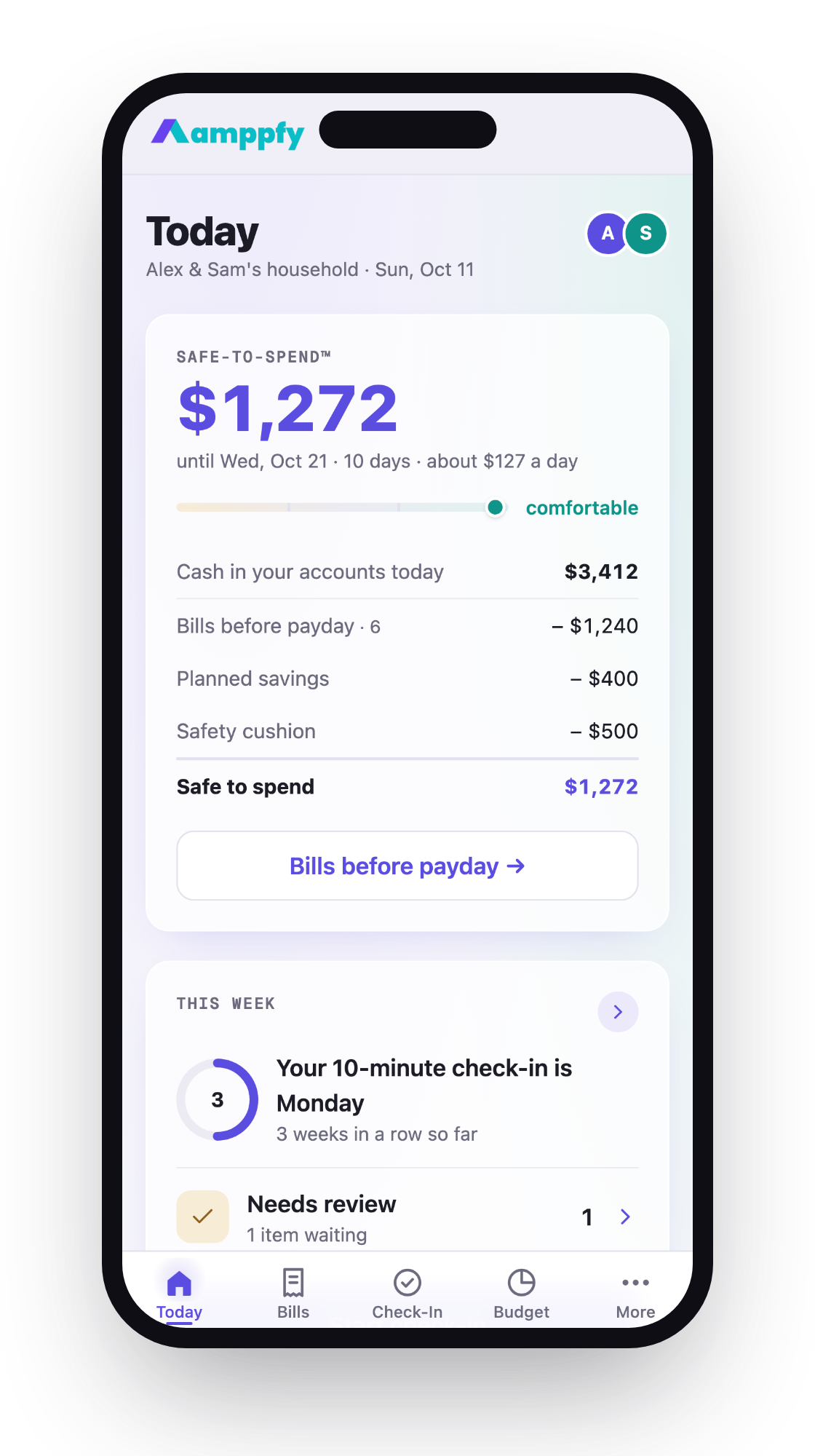
$3,412 cash − $1,240 bills − $400 savings − $500 cushion = $1,272 Safe-to-Spend™
That $1,272 is what you can actually spend before payday without dipping into your cushion. The cushion stays untouched. It earns no fees. It costs you nothing beyond the discipline of pretending it isn’t there.
Why this works better than it sounds
The cushion eliminates the scenario that triggers overdraft fees in the first place. You never hit zero because you’ve already accounted for the buffer. Your bank still sees $500 in the account. No negative balance, no fee, no transfer, no interest.
The tricky part is remembering the cushion exists and not spending it. A budgeting app that bakes the cushion into your Safe-to-Spend number handles this automatically. Amppfy, for example, lets you set a cushion amount once, and it subtracts that number every time it calculates what’s safe to spend. You see one number. The cushion is already factored in.
Side by side: cost, control, and stress
Comparing these two approaches on paper makes the differences hard to ignore.
| Factor | Overdraft Protection | Safety Cushion |
|---|---|---|
| Annual cost (3 incidents/year) | $78 to $105 in fees (standard); $0 to $36 (linked savings) | $0 |
| Who controls the money | Your bank | You |
| Triggers stress? | Yes: fee notifications, negative balances | No: balance stays positive |
| Requires setup | Yes: opt-in or linking accounts | Yes: deciding on an amount and sticking to it |
| Covers large shortfalls | Sometimes, up to a limit | Only up to the cushion amount |
| Builds a habit | No | Yes: reinforces awareness of real spending capacity |
The cost column tells most of the story. If you trigger standard overdraft coverage three times a year at $35 each, that’s $105 gone. A cushion costs nothing because the money is still yours.
Where overdraft protection has an edge
A cushion can’t help you if an unexpected $800 car repair hits the same week as rent. If your cushion is $500, you’re still short. Overdraft protection, especially a linked line of credit, can bridge that gap. It’s a backstop for genuinely unusual situations, not a daily spending tool.
The honest answer about whether overdraft protection is worth the cost: it depends on the size of your cushion and the predictability of your expenses. For most people on a regular pay cycle, a cushion handles 90% of the situations that would otherwise trigger an overdraft.
When linking a savings account makes sense
Not everyone should cancel overdraft protection entirely. Linking a savings account to your checking account is the cheapest form of overdraft coverage, and it can work alongside a cushion.
Three scenarios where it’s a smart backup
- Irregular income months. If you freelance on the side or get quarterly bonuses, your cash flow isn’t perfectly predictable. A linked savings account catches the occasional timing mismatch.
- Joint accounts with variable spending. Couples sharing a checking account sometimes surprise each other. One partner fills the gas tank while the other buys groceries, and the timing overlaps. A linked savings transfer is cheaper than a fight about who spent what.
- Autopay stacking. If several bills hit on the same day and you miscounted, a linked savings transfer prevents a cascade of declined payments or late fees.
What to watch for
Check whether your bank charges a transfer fee. Some charge $10 to $12 per transfer from savings to checking. If your bank charges nothing for linked transfers, keeping the connection active costs you zero and adds a second layer of protection behind your cushion.
Also confirm how many transfers per month your bank allows. Federal rules previously limited savings withdrawals to six per month, but many banks relaxed that restriction after 2020. Your bank’s current policy may differ, so check your account terms.
The ideal setup looks like this: a $500 cushion baked into your spending number, plus a linked savings account with no transfer fee as a silent backup. You get two layers of protection for $0 in fees.
Setting a cushion you won’t touch
The hardest part of a safety cushion isn’t the math. It’s the follow-through. Here’s how to set one that actually sticks.
Pick a number that matches your risk
Your cushion should cover your largest single recurring expense. For most people, that’s rent or a mortgage payment. But a full rent-sized cushion isn’t realistic for everyone. Start here:
- Minimum: $200 (covers a utility bill or a grocery run)
- Comfortable: $500 (covers most unexpected charges within a pay cycle)
- Conservative: $1,000 (covers a car repair or a medical copay)
Pick the number you can set aside right now without feeling squeezed. You can increase it later.
Make it invisible
The cushion works best when your spending tool subtracts it automatically. If you’re doing mental math every time you check your bank app, you’ll eventually round in your own favor. That’s human nature, not a character flaw.
Amppfy’s Safe-to-Spend number subtracts your cushion, your upcoming bills, and your savings goals before showing you what’s left. The four-line math is printed right under the number, so you always see where the money went. You set the cushion once, and it stays subtracted until you change it.
Build it gradually
If $500 feels like too much to set aside at once, build it over four or five paychecks. Move $100 per paycheck into your cushion until you hit your target. The key is treating it like a bill: it gets funded before discretionary spending.
Once the cushion is in place, your weekly check-in takes about 10 minutes. Update your balances, confirm upcoming bills, and glance at your Safe-to-Spend number. That’s it.
Frequently asked questions
Is overdraft protection worth it if my bank doesn’t charge a transfer fee?
Yes, keeping a linked savings transfer active makes sense when it’s free. It acts as a backup behind your cushion. You’re not paying for it, and it catches the rare situation where your cushion isn’t enough. Just don’t rely on it as your primary strategy: a cushion prevents the overdraft from happening in the first place.
How much should my safety cushion be?
Start with $500 if you can. That covers most unexpected charges within a single pay cycle. If $500 feels tight, begin with $200 and add $50 to $100 per paycheck until you reach a comfortable level. Your cushion should match your largest single bill or your most unpredictable expense category.
Can I use both overdraft protection and a cushion at the same time?
Absolutely. They serve different purposes. The cushion prevents you from getting close to zero. Overdraft protection catches you if something slips through anyway. Think of the cushion as your first line of defense and linked-account protection as the backup. Together, they cost little or nothing and cover a wide range of scenarios.
What if I keep dipping into my cushion?
That’s a signal your Safe-to-Spend number needs recalculating, not that you lack willpower. Review your bills and subscriptions. You might have a recurring charge you forgot to account for, or your spending estimate might be too optimistic. Adjust the inputs, not the cushion. If you consistently need the cushion money, your real issue is a gap between income and expenses that a cushion alone can’t fix.
The smarter safety net is the one you build yourself
Overdraft protection isn’t a scam, but it’s designed to profit your bank, not protect your peace of mind. A self-managed cushion flips the equation: you keep the money, you avoid the fees, and you build a habit of knowing exactly what’s safe to spend.
The best version of this setup is a cushion baked into your spending number, with a free linked savings transfer as a quiet backup. No fees. No surprises. No shame-inducing notifications.
If you want to see your Safe-to-Spend number with the cushion already subtracted, try Amppfy for free. Set your balances, your bills, and your cushion. Ten minutes gets you a number you can trust through your next payday.