Most people who search for a household budget template picture a spreadsheet with dozens of columns. They download one, fill it in for January, maybe February, and then stop. The template didn’t fail because of bad math. It failed because it asked for too much detail and gave back too little clarity. What you actually need is a structure: five groups that capture every dollar flowing through your household without turning your evening into a data-entry shift. This article lays out those five groups, explains why they work, and shows you how to keep the whole thing current in about ten minutes a month.
Why most budget templates get abandoned by March
The typical template you find online lists 30 to 50 categories. Groceries, gas, pet food, dry cleaning, haircuts, parking meters. Each one needs its own row, its own number, its own reconciliation at month’s end. That’s a part-time job, not a budget.
The real problem is granularity without payoff. Knowing you spent $14.50 on parking last month doesn’t change your behavior. It just makes you tired of the process. Researchers have started calling this “budgeting fatigue,” and it’s driven partly by the perception gap in recurring costs[1] that people don’t even realize they’re paying.
A better household budget template skips the 40-line spreadsheet entirely. It groups your money into a handful of buckets that match how you actually think about spending. Fixed stuff you can’t skip. Savings you want to protect. Subscriptions you forget about. And everything else.
When each group has a clear purpose, you don’t need to categorize every coffee. You need to know: are the big groups in balance? If yes, you’re fine. If one group is swelling, you can spot it fast and adjust. That’s the whole point. A budget should answer one question: is what I’m doing sustainable until next payday?
The five groups every household bill fits into
Here’s the framework. Every dollar your household spends or sets aside falls into one of five groups.
| Group | What goes here | Examples |
|---|---|---|
| Bills | Fixed or semi-fixed obligations with a due date | Rent/mortgage, utilities, car payment, insurance, minimum debt payments |
| Savings | Money moved out of spending before you touch it | Emergency fund, vacation goal, car repair fund, retirement top-up |
| Subscriptions | Recurring charges that auto-renew | Streaming, gym, cloud storage, meal kits, app fees |
| Everyday spending | Variable costs with no due date | Groceries, gas, dining out, household supplies, transit |
| Irregular expenses | Predictable but not monthly | Annual car registration, holiday gifts, back-to-school supplies |
Why five and not three or ten
Three groups (needs, wants, savings) sound clean but blur important lines. Your Netflix bill and your electric bill are both “needs” to most people, yet one you can cancel in two taps and the other you can’t. Ten groups create the same fatigue that kills spreadsheets. Five hits the sweet spot: specific enough to act on, broad enough to stay simple.
Where couples benefit most
If you share finances with a partner, five groups remove the “whose category is this?” argument. Bills are bills. Savings goals are shared or individual but sit in the same bucket. Everyday spending is whatever’s left. Amppfy’s Budget page shows the month in four of these slices (Bills, Savings, Subscriptions, Everyday spending), read directly from the plan you’ve already entered, so both partners see the same picture without building a second spreadsheet.
Savings and subscriptions as their own lines
Most templates lump subscriptions into “bills” and savings into “what’s left over.” Both choices cost you money.
Why subscriptions deserve their own group
Subscriptions are easy to underestimate. They’re small, they renew quietly, and they land on different cards and dates. The full total usually only shows up when you list every charge in one place.
Giving subscriptions their own line forces you to see them. List every recurring charge, its amount, and its next billing date. You’ll likely find at least one service you forgot about. The FTC even tried to implement a “click-to-cancel” rule to help consumers exit unwanted subscriptions more easily, which tells you how widespread the problem is.
Why savings should come before spending
If savings is “what’s left,” there’s never anything left. Treat it like a bill with a due date: payday. Move it first. Even a modest amount, say $200 per paycheck, adds up to $5,200 a year. The U.S. personal saving rate sat at 4.1% as of August 2026[2], which for a household earning $80,000 means roughly $3,280 saved annually. You can do better by making savings a line item, not an afterthought.
Here’s what the math looks like on payday:
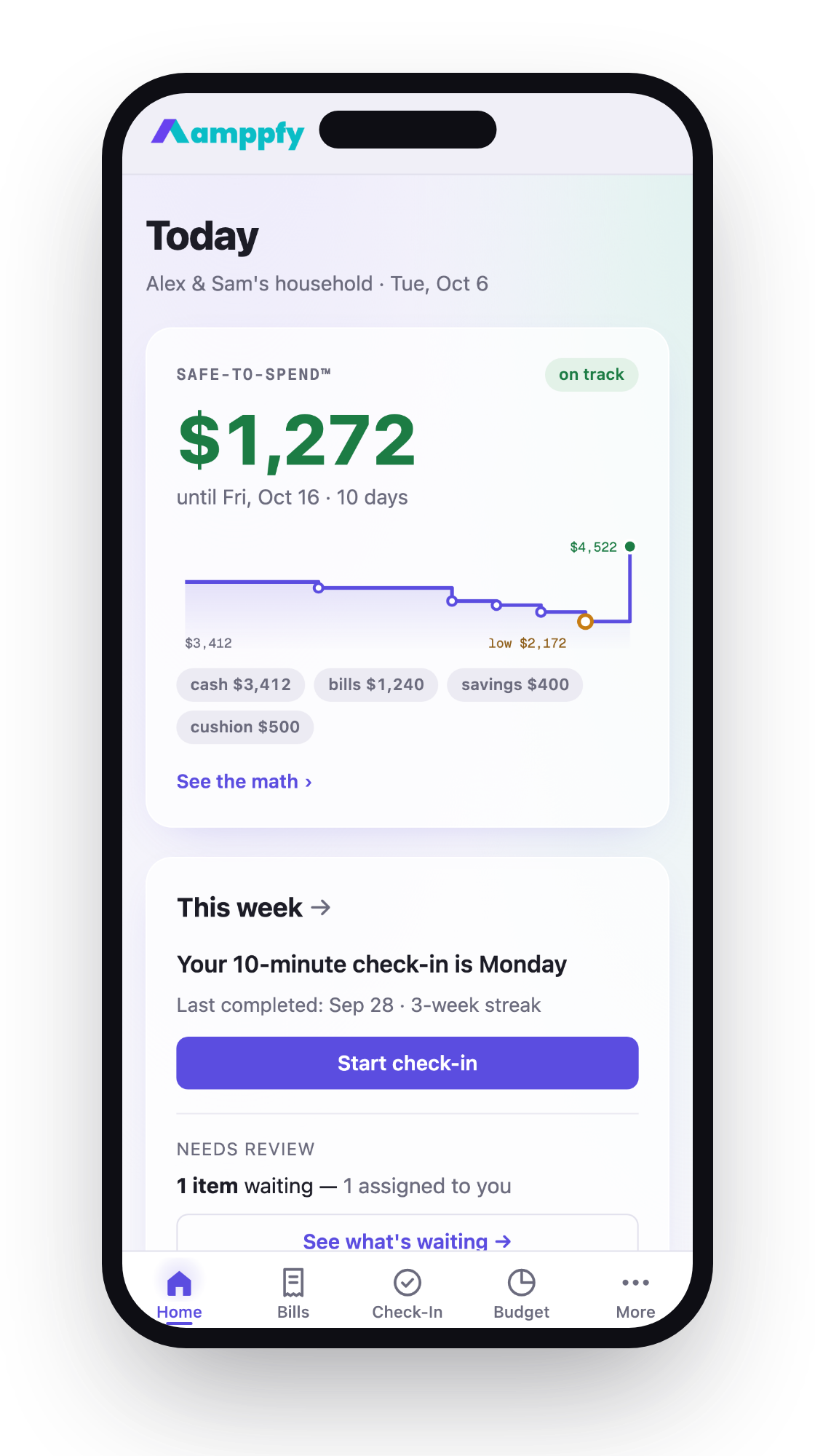
$3,412 cash − $1,240 bills − $400 savings − $500 cushion = $1,272
That $1,272 is what’s actually available for everyday spending and subscriptions before your next check. Amppfy calls this your Safe-to-Spend™ number, and it updates every time you enter a new balance.
What is left: everyday spending
Once bills, savings, and subscriptions are spoken for, you’re looking at your everyday spending group. This is groceries, gas, household supplies, dining, transit, and the random Target run.
You don’t need to track every receipt here. You need to know the total. If your Safe-to-Spend™ number says $1,272 and you have 14 days until payday, that’s about $90 a day. Some days you’ll spend $12. Some days you’ll spend $180 on a grocery haul. The daily average just gives you a gut check.
Handling irregular expenses
Annual costs like car registration, holiday spending, or a yearly insurance premium can wreck a month if you don’t plan for them. The fix: divide the annual cost by 12 and move that amount into savings each month. A $600 car registration becomes $50 a month. When the bill arrives, the money is already sitting there.
A household budget built from your existing plan handles these naturally. You set the goal once, fund it monthly, and forget about it until the bill shows up.
A quick example for a two-income household
Say your combined take-home is $6,800 per month. Here’s how the five groups might break down:
| Group | Amount | % of take-home |
|---|---|---|
| Bills | $2,800 | 41% |
| Savings | $680 | 10% |
| Subscriptions | $180 | 3% |
| Irregular (monthly set-aside) | $200 | 3% |
| Everyday spending | $2,940 | 43% |
That everyday number looks big, but it covers groceries, gas, dining, kids’ activities, and everything else without a due date. If it feels tight, the first place to look is subscriptions: $180 a month is $2,160 a year, and at least a few of those charges are probably unused.
Keeping the template current in ten minutes a month
A budget template is only useful if it reflects reality. Here’s a simple monthly check-in that takes about ten minutes.
- Open your bank app. Write down each account balance.
- Confirm your next payday and any upcoming bills between now and then.
- Scan your subscriptions list. Cancel anything you haven’t used in 30 days.
- Check your savings goals. Are they on track, ahead, or behind?
- Update your Safe-to-Spend™ number with the fresh balances.
That’s it. No categorizing 47 transactions. No color-coding. Five steps, ten minutes, done until next month. If you prefer a weekly rhythm, the same steps take even less time because less has changed.
When to revisit the groups themselves
Twice a year, look at the group totals and ask: did anything shift? A raise means more room in savings. A new car payment changes the bills group. A baby changes everyday spending. Adjust the targets, not the structure. The five groups stay the same; only the numbers inside them move.
What about windfalls or one-time income?
Bonuses, tax refunds, or side-gig payouts don’t fit neatly into a monthly template. The simplest approach: split them using the same ratios. If you normally save 10%, put 10% of the bonus into savings and let the rest flow into everyday spending or an irregular expense you’ve been underfunding.
Frequently asked questions
Do I need a spreadsheet to use a five-group budget?
No. A notebook, a notes app on your phone, or a purpose-built tool like Amppfy all work. The point is the structure, not the software. Five groups. Five numbers. That’s your whole template.
How do I handle expenses that fit two groups?
Pick one and be consistent. A gym membership could be a subscription or a bill. It doesn’t matter which group you choose, as long as it lands in the same spot every month. Consistency beats precision.
What if my income is irregular?
Use your lowest recent month as the baseline. Build your five groups around that number. In months where you earn more, the extra goes to savings or irregular expenses. This keeps you from spending a good month’s income at a bad month’s pace.
Should couples combine everything into one template?
Not necessarily. Some couples share bills and savings but keep everyday spending separate. The five groups work either way. What matters is that both people can see the shared numbers, especially bills and savings, without needing to merge every account.
Your budget template in five minutes, not five hours
You don’t need 40 categories or a color-coded spreadsheet to run your household’s money. You need five groups: Bills, Savings, Subscriptions, Irregular expenses, and Everyday spending. Set them up once. Check them monthly. Adjust twice a year.
If you want to see your own Safe-to-Spend™ number before your next payday, Amppfy is free on iPhone and the web. Enter your balances, bills, and payday once, about ten minutes, and the number stays current from there. Get Amppfy free and put the five-group template to work this week.