Most people lump all their savings into one pile and call it “the emergency fund.” That works until a surprise car repair drains the account and rent is due in four days. The real question isn’t just how much to save: it’s how to split your cash between two jobs. Understanding the difference between an emergency fund and a buffer in your checking account changes how you handle money stress. One absorbs life’s big shocks. The other keeps your weekly spending from going sideways.
Two Different Jobs: Surprises vs. Shocks
Your checking account buffer and your emergency fund look similar on paper. Both are cash you don’t plan to spend. But they serve completely different purposes, and treating them the same creates problems.
| Checking Buffer | Emergency Fund | |
|---|---|---|
| Purpose | Absorb timing gaps between bills and payday | Cover major, unplanned expenses |
| Location | Checking account | Separate savings account |
| Size | 1-3 weeks of expenses | 1-6 months of expenses |
| Access speed | Instant | 1-2 business days |
| Refill cycle | Every paycheck | Monthly or as needed |
| Examples | Grocery run lands before payday; subscription charges early | Job loss; ER visit; major car repair |
Think of the buffer as a shock absorber on a city road. It handles the bumps you hit every week: a bill posting a day early, a grocery trip that runs $40 over, or a forgotten annual subscription hitting your account. Without it, your balance dips to $12 and you start doing mental math in the checkout line.
The emergency fund is the airbag. You hope you never need it. It’s there for the events that would wreck your finances without a safety net: a layoff, an unexpected surgery, or a furnace dying in January.
When you compare an emergency fund vs. a buffer account, the key difference is frequency. The buffer works every single pay cycle. The emergency fund might sit untouched for years. Both matter. Skipping either one leaves a gap.
How Big a Cushion in Checking
Your checking buffer doesn’t need to be huge. It needs to be big enough to cover the timing mismatches that happen between paychecks.
A Simple Formula
Start with your largest single bill that hits between paydays. Add 20% for the random stuff you forget. That’s your minimum buffer.
Here’s a worked example for someone paid biweekly:
- Rent autopay: $1,400 (hits the 1st)
- Car insurance: $180 (hits the 5th)
- Utilities: $160 (hits mid-month)
- Groceries and gas between checks: roughly $500
If your paycheck lands on the 15th and the 30th, the first half of the month has $1,740 in fixed costs plus $500 in variable spending. A buffer of $400-$500 on top of that keeps you from bouncing anything if a charge posts a day early or you need an extra grocery run.
What Counts as “Too Much”
Keeping $3,000 as a buffer when your expenses only need $500 means $2,500 is sitting idle. That money could be earning interest in a high-yield savings account or filling your emergency fund faster. A good rule: if your checking balance regularly sits more than double your buffer target, move the excess somewhere it works harder.
What Counts as “Too Little”
If you’ve seen your checking dip below $50 more than once in the last three months, your buffer is too thin. Bump it by $200 and watch for a full pay cycle. Adjust from there.
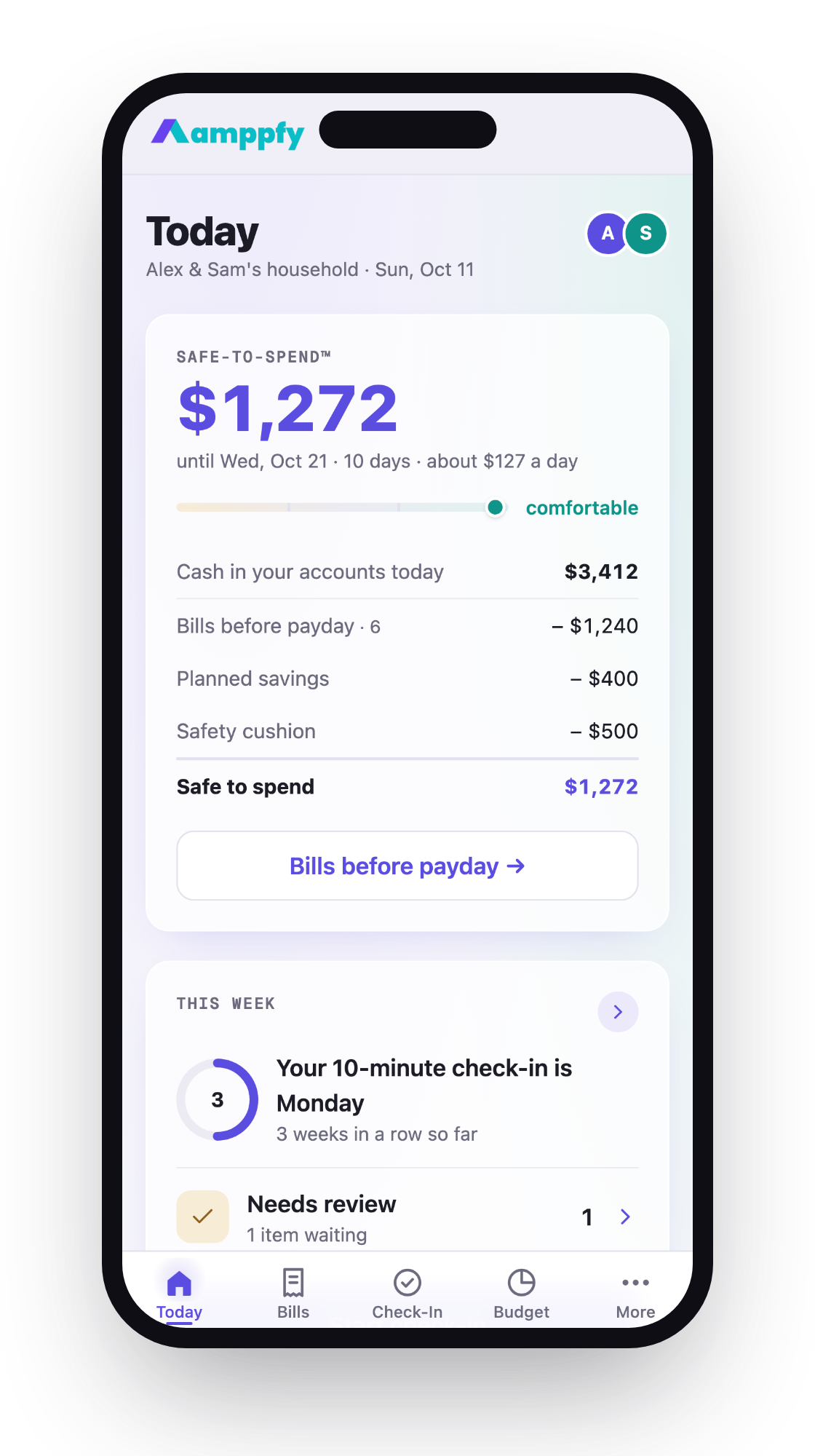
Amppfy’s Safe-to-Spend™ number already subtracts a safety cushion you choose from your available cash. So instead of guessing what’s safe, you see one number: $3,412 cash − $1,240 bills − $400 savings − $500 cushion = $1,272. That $1,272 is what you can actually spend without touching your buffer.
How Big an Emergency Fund, on a Tight Cycle
The standard advice is three to six months of expenses. That’s fine as a destination. But if you’re living paycheck to paycheck, hearing “save $12,000” feels like being told to climb Everest before breakfast.
Right-Size It for Your Situation
Your target depends on a few concrete factors:
- Income stability: A salaried W-2 employee with consistent hours can lean toward three months. A freelancer or gig worker should aim for six.
- Household size: Single parents or single-income couples need a larger cushion than dual-income households where both earners have stable jobs.
- Insurance gaps: High-deductible health plan? Add that deductible to your target. No disability insurance? Push toward the higher end.
According to the Federal Reserve’s 2024 Survey of Household Economics and Decisionmaking, 37% of U.S. adults said they couldn’t cover a $400 emergency with cash or its equivalent. That number has improved slightly since 2019, but it still means more than a third of adults are one flat tire away from debt.
A Realistic Starting Target
If three months feels impossible, aim for one month first. Calculate your essential expenses only: rent, utilities, insurance, groceries, minimum debt payments, transportation. Skip dining out and subscriptions for this number.
For a household spending $4,200 a month on essentials, one month is $4,200. That single month of coverage handles most common emergencies: a car repair, a brief gap between jobs, or an insurance deductible.
Once you hit one month, push to two. Then three. Each month you add buys more breathing room.
Where to Keep It
A high-yield savings account is the standard choice. You want the money accessible within one to two business days but not so accessible that you dip into it for pizza. Keeping it at a different bank than your checking account adds a small friction barrier that helps.
Building the Cushion First
Here’s where most advice gets the order wrong. People try to build a three-month emergency fund while their checking account balance regularly hits $30. That’s building the roof before the foundation.
Build your checking buffer first. It’s smaller, faster to fill, and solves the problem you feel every week.
Step-by-Step Approach
- Pick your buffer target. Use the formula above. For most people paid biweekly, $400-$700 works.
- Fund it over two to four paychecks. Set aside $100-$200 per check until you hit the target.
- Stop and hold. Let the buffer sit through a full pay cycle. Watch how your balance moves. Adjust the target if needed.
- Redirect to the emergency fund. Once your buffer is stable, take that same $100-$200 per paycheck and route it to your savings account.
This order works because the buffer stops the bleeding first. No more overdraft fees. No more anxious balance-checking at 11 p.m. on a Wednesday. Once your day-to-day cash flow is stable, you can focus on the bigger goal without constantly raiding it.
The Paycheck Funnel
A simple way to think about each payday:
- Bills due before next payday get funded first
- Savings goal contribution goes next
- Buffer stays untouched at the bottom of checking
- What’s left is yours to spend
This is exactly the math Amppfy runs every time you update your balances. Bills, savings, and cushion come off the top. The remainder is your Safe-to-Spend number. A 10-minute weekly check-in keeps it current.
Keeping Them Apart on Purpose
The biggest risk to both your buffer and your emergency fund is mixing them. The moment they live in the same account, they become one pool. And one pool gets spent like one pool.
Why Separation Works
Behavioral research backs this up. People who label money for specific purposes spend it more carefully. A buffer labeled “don’t touch” in your checking account is weaker than a buffer that’s structurally separate from your emergency savings. The savings account at a different bank creates real distance.
Here’s what separation looks like in practice:
- Checking account: Paychecks deposit here. Bills pay from here. Buffer lives at the bottom.
- Savings account (same bank): Short-term goals like a vacation or holiday gifts.
- Savings account (different bank): Emergency fund. Harder to reach. That’s the point.
What Happens When You Tap the Emergency Fund
You’ll use it eventually. That’s what it’s for. The key is refilling it with the same urgency you used to build it. After an emergency withdrawal, pause your other savings goals temporarily and redirect that money back to the emergency fund until it’s whole again.
Don’t beat yourself up about it. Using the fund for a real emergency is exactly the right move. The only mistake is not refilling it afterward.
Couples and Shared Money
If you share finances with a partner, decide together on both numbers: the buffer target and the emergency fund target. One person might feel safe with $400 in the buffer while the other needs $800 to sleep at night. Split the difference or go with the higher number. Financial peace of mind isn’t worth arguing over an extra $200.
Amppfy handles this by letting partners see the same Safe-to-Spend number while keeping private balances private. Both people know what’s safe to spend without a spreadsheet negotiation every Sunday.
Frequently Asked Questions
Is a buffer the same as an emergency fund?
No. A buffer is a small cash cushion in your checking account that prevents overdrafts and covers timing gaps between bills and paychecks. An emergency fund is a larger reserve, typically one to six months of expenses, stored in a separate savings account for major unexpected events like job loss or medical bills. They serve different purposes and should be kept apart.
How much should I keep as a checking account buffer?
Most people on a biweekly pay cycle do well with $400-$700. Start with your largest single bill between paychecks, add 20% for surprises, and use that as your target. If your balance regularly drops below $50, your buffer is too small. If it stays well above your target, move the excess to savings.
Should I build my emergency fund or my buffer first?
Build the buffer first. It’s smaller, typically achievable in two to four paychecks, and it stops the cycle of overdrafts and last-minute scrambling. Once your checking account is stable, redirect that same savings amount to your emergency fund. Trying to save $5,000 while your checking hits zero every two weeks rarely works.
Can my emergency fund be in a regular savings account?
Yes, but a high-yield savings account is better. As of early 2026, many online banks offer rates above 4% APY. Keep the emergency fund at a different bank than your checking account. The one-to-two-day transfer time adds just enough friction to prevent casual withdrawals while still giving you access when you truly need it.
Your Next Step
Two pools of cash, two different jobs. Your buffer keeps the lights on between paychecks. Your emergency fund catches you when something big goes wrong. Build the buffer first, then grow the emergency fund month by month.
Take 15 minutes this week to figure out your buffer target. Check your last two months of bank statements, find the tightest moment between paychecks, and set a number. Once that’s funded, you’ll feel the difference on every single payday. If you want one number that shows what’s actually safe to spend after your buffer, bills, and savings are accounted for, Amppfy is free and takes about 10 minutes to set up at amppfy.com.