

Some months just hit different. The car needs new brakes, a medical copay lands on the same week as your water bill, or your hours get cut without warning. Your savings goal suddenly feels like a luxury you can’t afford. Here’s the thing: you don’t have to abandon it. You can pause your savings goal, protect what you’ve already built, and pick right back up when the pressure eases. The difference between people who reach their targets and those who don’t isn’t perfection: it’s knowing how to bend without breaking.
Why Pausing Beats Skipping
Skipping a savings deposit and pausing one sound identical. They’re not. Skipping is passive. You just don’t transfer the money, feel a little guilty, and hope next month goes better. There’s no plan attached, no date circled on the calendar, no acknowledgment that something changed. Pausing is a decision you make on purpose, with a restart date baked in.
The psychological difference matters more than the math. A 2024 Federal Reserve Survey of Household Economics found that 37% of U.S. adults said they couldn’t cover a $400 emergency expense with cash or savings-account equivalent. Tight months aren’t rare. They’re a normal part of earning a paycheck. Treating them as failures makes you more likely to scrap the goal entirely.
Here’s what a deliberate pause looks like versus a skip:
| Skip | Pause | |
|---|---|---|
| Decision | Happens by default | Made on purpose |
| Resume date | None set | Chosen in advance |
| Emotional effect | Guilt, avoidance | Control, clarity |
| Risk to goal | High: one skip invites another | Low: the plan stays alive |
| Visibility | Hidden from your budget math | Reflected in your spending number |
When you pause a savings goal deliberately, you’re telling yourself the goal still matters. You’re just rerouting cash for a few weeks. That mental framing keeps the goal on your radar instead of letting it drift into the “I’ll get to it someday” pile.
A skip often snowballs. You miss one month, then two, then the goal balance sits untouched for a quarter. A pause has edges: a start, a reason, and an end. Those edges keep you honest.
What Happens to Your Number When a Goal Pauses
Your savings contribution is baked into your available cash calculation every pay cycle. When you pause it, that money doesn’t vanish: it shifts back into your spendable pool. Understanding exactly how that shift works keeps you from accidentally burning through the freed-up cash.
The Math Before and After
Say your paycheck lands and you normally run this calculation:
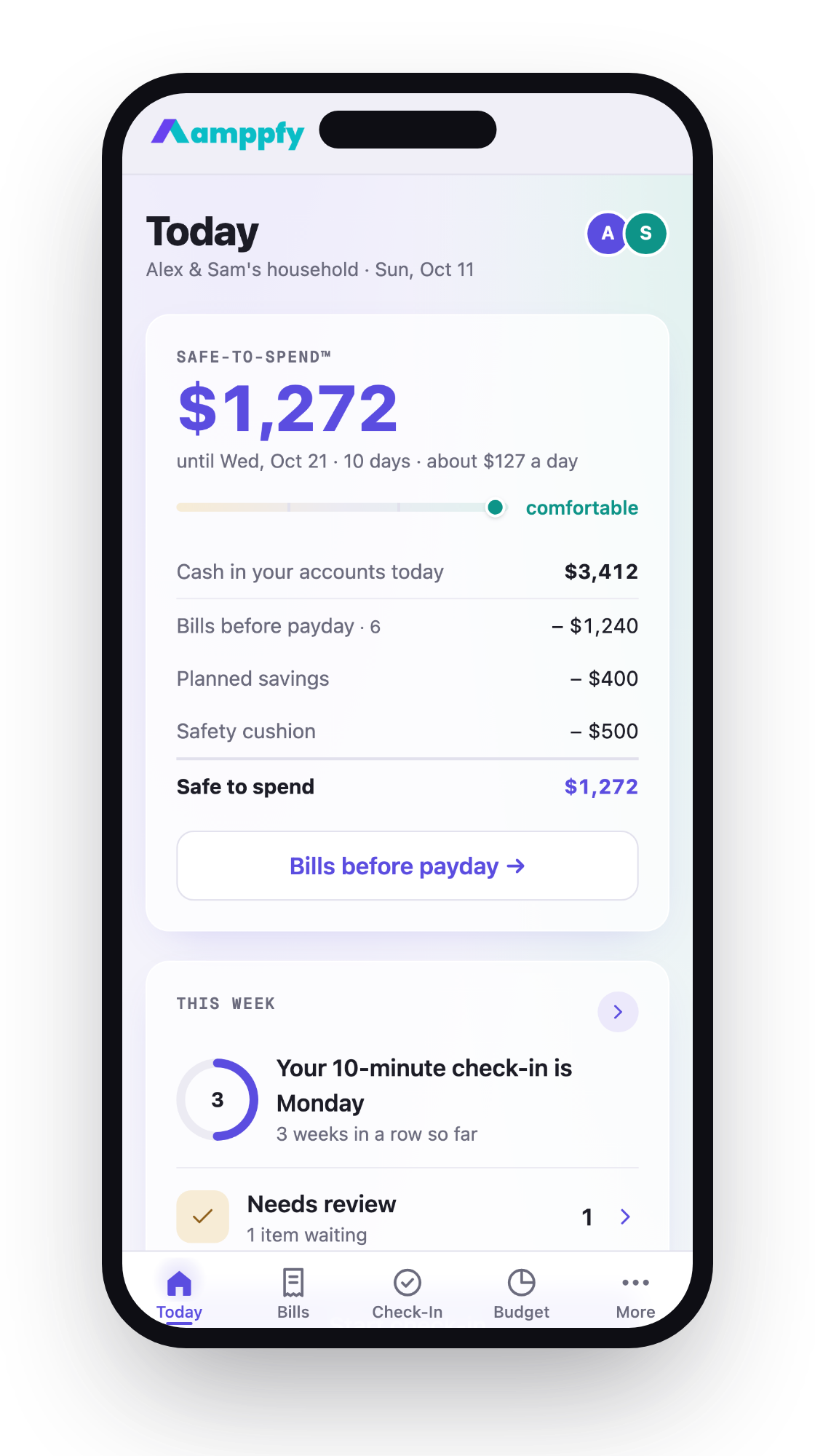
$3,200 cash − $1,400 bills − $300 savings goal − $400 cushion = $1,100 Safe-to-Spend™
Now you pause the $300 savings deposit. Your new number looks like this:
$3,200 cash − $1,400 bills − $0 savings goal − $400 cushion = $1,400 Safe-to-Spend
That extra $300 is real. It’s yours to use. But it didn’t appear from nowhere: it came from your future self’s savings balance. Seeing the math written out makes that trade-off concrete. You’re borrowing from your goal timeline, not finding free money.
Why Visibility Prevents Drift
The danger of a pause isn’t the pause itself. It’s losing sight of where the freed cash goes. If your Safe-to-Spend jumps by $300 and you don’t consciously assign that money to the tight-month expense, it dissolves into coffees, impulse buys, and forgotten subscriptions.
Amppfy shows this math right under your Safe-to-Spend number every time you open the app. When you adjust a savings goal to $0 for a cycle, the line item stays visible at zero. That zero is a reminder, not an absence. You see it, you remember why, and you move on.
Keep a one-line note somewhere: “Paused $300/month goal for March: car repair.” A note turns an invisible decision into a documented one.
Set a Resume Date Before You Pause
A pause without a deadline is just quitting with extra steps. The single most important thing you can do when you temporarily stop saving is pick the exact date you’ll start again.
Pick the Payday, Not the Month
Don’t say “I’ll restart in April.” Say “I’ll restart on my April 11 paycheck.” Tying the resume to a specific payday removes ambiguity. Your paycheck is a trigger event: money arrives, decisions happen. A vague month gives you 30 days of wiggle room to delay.
Build a Simple Restart Checklist
Before you pause, write down three things:
- The amount you’re pausing (e.g., $300/month or $150/paycheck)
- The payday you’ll resume (e.g., April 11, 2026)
- Whether you’ll add a catch-up deposit or just continue at the normal rate
That third item matters. If you paused $300 for one month, you might want to split the missed amount across two future paychecks: $150 extra each. Or you might decide the timeline just extends by one month. Either choice is fine. The wrong choice is no choice.
What If the Tight Month Stretches?
Sometimes one tough month becomes two. If your resume date arrives and things are still tight, don’t panic. Reset the resume date forward by one more pay cycle. Write it down again. The rule stays the same: every pause has an end date, even if that date moves once.
This is where apps that show your savings goals alongside your bills earn their keep. If your goal sits at $0 contribution with a note saying “resumes April 25,” you’ll see it every time you check your balance. That gentle nudge beats willpower alone.
Protecting the Emergency Fund From the Pause
Your savings goal and your emergency fund might live in the same account, but they serve different jobs. A pause on your goal should never mean raiding the emergency stash. Here’s how to keep them separate even when cash is short.
Know Which Pot You’re Touching
Think of your money in three buckets:
- Bills money: spoken for, don’t touch
- Emergency fund: exists for true surprises (job loss, medical crisis, major home repair)
- Goal savings: the vacation, the down payment, the new laptop
When you pause a savings goal, you’re stopping new deposits into bucket three. You’re not pulling from bucket two. If the tight month is caused by something that qualifies as a genuine emergency, that’s a separate decision with separate rules.
Set a Floor for Your Emergency Fund
Pick a number below which you will not let your emergency balance drop. For many households, one month of essential expenses is a reasonable floor. If your essentials run $2,800/month, your emergency fund stays above $2,800 no matter what.
| Situation | Action |
|---|---|
| Tight month, emergency fund above floor | Pause savings goal, cover the gap from freed cash |
| Tight month, emergency fund at floor | Pause savings goal AND cut discretionary spending |
| True emergency, fund above floor | Use the emergency fund for its intended purpose |
| True emergency, fund at floor | Use the fund, then rebuild it before restarting the goal |
This table gives you a decision tree instead of a feeling. Feelings are unreliable at 11 p.m. when you’re staring at your bank balance. A rule you wrote down in advance is not.
Don’t Combine the Pause With a Cushion Cut
If your budget includes a safety cushion (that buffer between your bills and your actual zero), resist the urge to shrink it during the same month you pause your goal. Cutting both at once leaves you exposed. One change per cycle keeps your margin intact.
Getting Back on Track the Next Payday
The pause is over. Your resume date arrived. Now what? Restarting is simpler than you think, but it helps to have a short playbook.
The First Paycheck Back
On your restart payday, fund the savings goal before you spend on anything discretionary. Treat the deposit like a bill. If you wait until the end of the pay cycle to “see what’s left,” there won’t be anything left. Pay your goal first, then check your Safe-to-Spend for the rest.
In Amppfy, your payday nudge can prompt you to fund goals before you do anything else. That 30-second step resets the habit loop.
Decide on a Catch-Up Strategy
You have three options after a one-month pause:
- Resume at the normal amount and accept a slightly longer timeline
- Add a small catch-up amount for two to three cycles (e.g., $50 extra per paycheck)
- Make one lump-sum catch-up deposit if you have the cash
Option one is the gentlest. Option two is a good middle ground. Option three works if you got a tax refund or a bonus. None of them is wrong. The only wrong move is stalling at the starting line.
Celebrate the Restart, Not the Amount
You paused, you protected your emergency fund, and you came back. That’s the whole point. The dollar amount of your next deposit matters less than the fact that you made it. Consistency over time builds the balance. One rough month doesn’t undo that.
Frequently Asked Questions
How long is too long to pause a savings goal?
There’s no universal limit, but a good guideline is two pay cycles. Beyond that, revisit the goal amount itself. If you can’t afford $300/month right now, maybe $150 is realistic for a few months. A smaller deposit beats a permanent pause. Adjust the amount before you extend the pause indefinitely.
Should I pause all my savings goals at once or just one?
Pause the least urgent goal first. If you’re saving for both an emergency fund and a vacation, the vacation pauses. If all your goals are roughly equal priority, pause the one with the longest timeline: it has the most room to absorb a delay. Keep at least one goal active if you can, even at a reduced amount.
Will pausing my savings goal hurt my credit score?
No. Savings goals are internal targets you set for yourself. They don’t appear on your credit report and have no connection to your credit score. The only risk is indirect: if pausing leads you to rely on credit cards for the shortfall, that added debt could affect your utilization ratio.
What if my partner and I disagree about pausing?
Talk numbers, not feelings. Show the math: here’s our cash, here are our bills, here’s what’s left. When both partners see the same Safe-to-Spend number and the same goal balance, the conversation shifts from “I think we should” to “the numbers say we need to.” Agree on the resume date together so both of you own the restart.
Your Next Tight Month Doesn’t Have to Derail Anything
A single rough pay cycle is not a reason to abandon a goal you’ve been building toward for months. Pausing your savings target on purpose, with a resume date and a clear reason, keeps the goal alive while you handle real life. Protect your emergency fund, keep the freed-up cash visible in your budget math, and restart on the exact payday you chose.
Take 10 minutes this week to check your numbers in Amppfy. If a tight month is coming, set the pause now, pick your restart date, and move forward knowing the plan is still intact.