

Two paychecks, one rent payment, and a shared grocery habit. At some point you both open your banking app and wonder: should this money live in one place? If you already bank with SoFi, adding your partner is mostly a few taps. The bigger questions are the ones nobody asks until later.
Who gets the direct deposit perks? Can one of you close the account? Does your partner see your personal savings too? And once the money is shared, how do you both know what’s actually safe to spend before payday?
This guide covers the SoFi steps as the bank publishes them, the fees and APY conditions as of October 2026, and the quieter part: how two people agree on a number without a weekly argument. Most of the setup takes about ten minutes. Your partner then accepts an invite on their own phone.
A note on sources: every SoFi detail below comes from SoFi’s own pages. Where SoFi doesn’t publish a detail, you’ll see that said plainly. Rates and policies change, so check the linked page before you move money.
Joint accounts at SoFi: what they are and who can be on one
A SoFi joint account is a Checking and Savings account owned by two people. SoFi confirms it offers joint Checking and Savings accounts (as of October 2026). The bank behind it is SoFi Bank, N.A., Member FDIC.
Joint ownership has a plain legal meaning. Each person on a joint account has a right to withdraw, deposit, and otherwise manage the funds[1]. That’s the whole point, and also the whole risk. Either of you can move every dollar.
Who can be the second owner? SoFi says the secondary person must meet SoFi’s eligibility requirements (as of October 2026). The support page doesn’t list those requirements in full. Expect the usual identity checks any bank runs when opening an account.
The relationship field is part of the invite. You’ll enter it when you add someone. It can be a spouse, a partner, a roommate, or a family member.
Think of it like a shared house key. You can’t cut half a key. Once your partner has one, they can open every door.
Add a partner to an existing account vs open a new joint account
You have two routes. They lead to different places, so pick on purpose.
| Route | What happens | Good fit if |
|---|---|---|
| Add a joint owner | Your current individual account becomes joint | You want your existing balance and history shared |
| Open a new joint account | A fresh joint account sits beside your individual one | You want shared money separate from personal money |
The add-a-partner route is simple. Your existing balance, direct deposit, and history stay put. Your partner simply becomes a co-owner of all of it. If your personal savings sit in that account, they’re now shared savings.
The new-account route keeps a clean line. Your individual account stays yours. The joint account holds only what you both agree to put in.
One limit matters here. SoFi states that “the option to merge accounts does not exist at this time” (as of October 2026). If you each already have a SoFi account, you can’t combine them into one joint account. You’d open a new joint account and move money in by transfer.
For more on structuring this, see this guide to bank accounts for couples: joint, separate, or both.
Step by step
These steps come from SoFi’s joint account support page, as of October 2026.
To add someone to your existing account
- Open your Checking account in the SoFi app.
- Tap the gear icon.
- Choose “Add a joint account owner.”
- Enter their first name, email, and relationship to you.
- Send the invitation.
To open a new joint account
- Go to the Checking and Savings homepage.
- Tap the gear icon.
- Select “Open a new account.”
- Choose “Joint account.”
- Enter your partner’s details and send the invite.
What your partner does
Your partner gets an email invitation. They accept it and complete SoFi’s eligibility steps. The invitation expires after 30 days (as of October 2026).
Thirty days sounds like plenty. It goes fast when the email lands in a promotions folder. Send the invite when you’re both home, and let them finish it that evening.
What each of you can see, move, and close
Once your partner accepts, you’re equal owners. That’s the legal structure the CFPB describes: both of you can deposit, withdraw, and manage the funds.
In practice, plan for this:
- Seeing: Both owners can view the joint account’s balance and activity.
- Moving: Either owner can transfer or spend from the joint balance.
- Closing: SoFi doesn’t publish owner-by-owner closing rules on the pages cited here (as of October 2026). Ask SoFi support before you assume one person can’t close it alone.
What about your individual account? If you opened a new joint account, your individual account stays separate. Your partner has no ownership of it. If you added your partner to your existing account, there’s no separate personal account left. Everything in it is joint.
That’s the honest trade-off. Joint money is transparent by design. If you want private money too, keep a second, individual account for it. Couples who go this way often budget together with separate accounts and share only the bills.
Fees, minimums, and waivers
SoFi lists no account, service, or maintenance fees on its joint bank account page (as of October 2026). That’s the easy part.
The APY has conditions:
- Savings APY: 3.30% with Eligible Direct Deposit. That rate is as of 9/23/26 and variable, as published as of October 2026.
- SoFi Plus: Joint APY depends on whether one or both holders have SoFi Plus (as of October 2026). Check that page for the exact tiers.
- Direct deposit bonus: In a joint account, bonus activity counts only toward the primary holder (as of October 2026).
- Minimums: SoFi’s joint account page doesn’t publish a minimum balance in the details cited here.
SoFi, like every US bank, must also give you uniform disclosures on APY, rates, and fees before you open. That’s required under Truth in Savings (Regulation DD). Read that disclosure once. It’s the final word.
How the math works
Interest is roughly balance times rate. Say you keep $10,000 in joint savings at 3.30%.
$10,000 × 0.033 = $330 over a year, before compounding and if the rate held steady.
At $25,000, it’s about $825. The rate is variable, so treat these as a snapshot, not a promise.
The bonus rule matters for couples. If your partner’s paycheck lands in the joint account but you’re primary, their deposit may not earn a bonus in their name. Decide who’s primary based on that.
Timing questions? Here’s when SoFi direct deposit typically arrives.
Joint, separate, or both: how couples actually use it
There’s no right setup. There’s the one you’ll both keep running.
Fully joint works when you share goals and trust each other’s spending. Both paychecks land in one place. One balance, one set of bills. The upside is simplicity. The downside is that a surprise purchase shows up for both of you.
Fully separate works when you have different incomes, debts, or habits. You split bills by transfer. It’s clean, but someone always has to do the splitting math.
Hybrid is what many couples settle on. Each of you keeps an individual account. A new joint account covers rent, utilities, groceries, and shared savings. You each send a set amount on payday.
Here’s a hybrid example. Rent is $1,800 and shared bills are $600, so $2,400 a month. You earn 60% of the household income, your partner 40%. You send $1,440. They send $960. Everyone can check the arithmetic.
Since SoFi doesn’t merge accounts, hybrid is also the easiest route if you both already bank there.
One number for two people
A joint account answers where the money sits. It doesn’t answer the question you both ask on a Thursday: can we afford this before payday?
Your SoFi balance shows what’s there right now. It doesn’t subtract the electric bill due Tuesday. It doesn’t hold back the savings you promised. So two people glance at the same balance and reach two different conclusions.
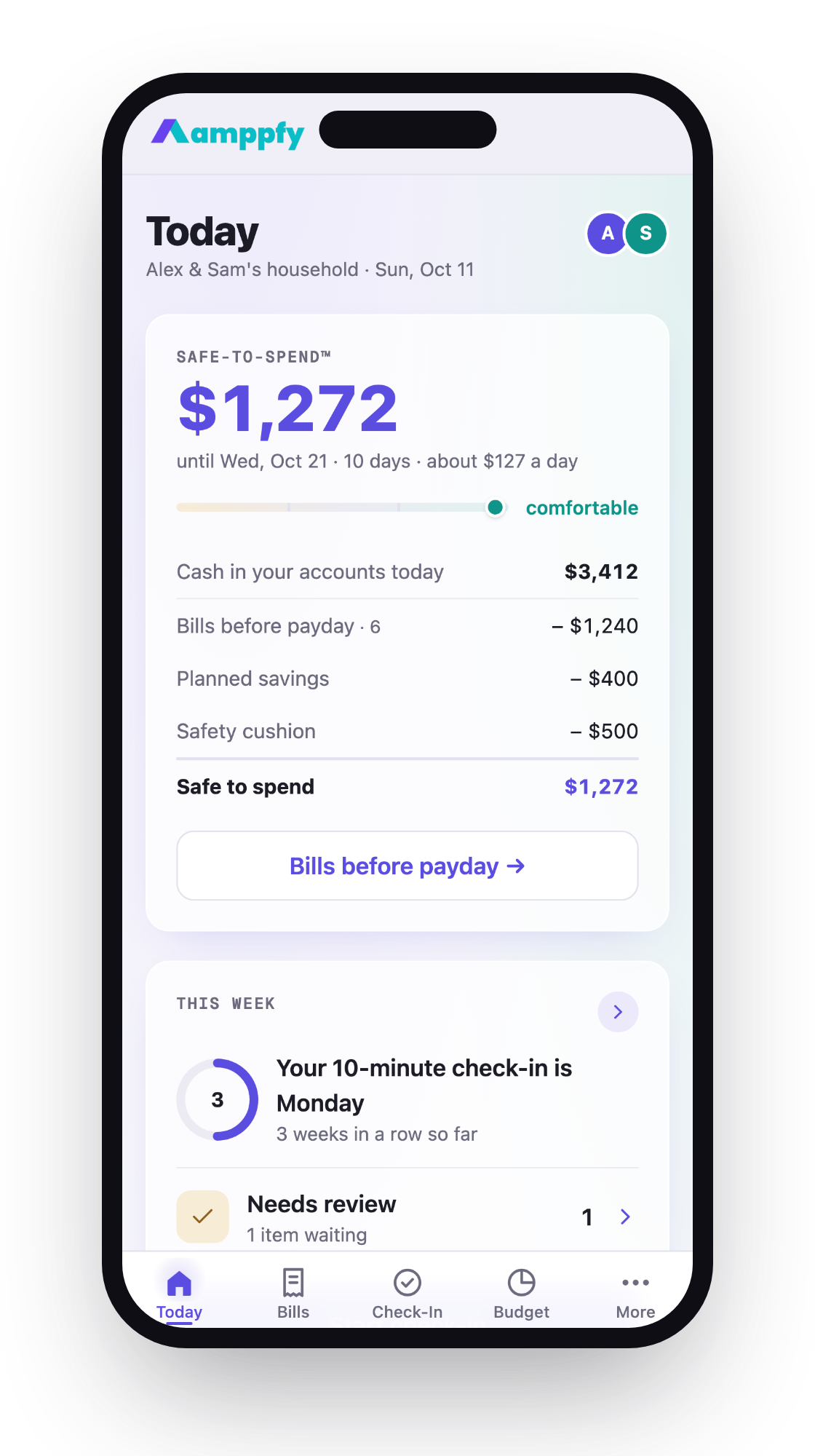
A Safe-to-Spend™ number fixes that with plain arithmetic:
- Available cash: $3,200 in joint checking
- Minus bills due before payday: $1,450
- Minus planned savings: $300
- Minus your cushion: $250
- Safe-to-Spend™: $1,200
Amppfy is built around that number. It’s free on iPhone and the web. You type in balances yourself, with no bank login. A ten-minute weekly check-in keeps it current, and the bills calendar marks your lowest point before payday.
For couples, each partner gets their own login and sees the same number. Your private accounts stay private. Your partner sees the shared total, not your personal balances. You can set it up for two here.
Take ten minutes this week. Send the SoFi invite, agree on the bills, and check one shared number together.
Comparing banks? Here is the list of online banks that offer joint accounts, with each bank’s own steps.
FAQ
Can I merge my SoFi account with my partner’s?
No. SoFi states the option to merge accounts does not exist at this time (as of October 2026). Open a new joint account and transfer money in.
How long does my partner have to accept the invite?
Thirty days (as of October 2026). After that, the invitation expires and you’ll need to send a new one.
Do we both get the direct deposit bonus?
No. In a joint account, direct deposit bonus activity counts only toward the primary holder (as of October 2026).
Does a SoFi joint account charge monthly fees?
SoFi lists no account, service, or maintenance fees (as of October 2026). APY depends on Eligible Direct Deposit and on whether one or both of you have SoFi Plus.