

Two paychecks, one rent payment, and a grocery bill nobody wants to argue about. That’s usually when couples start looking at a shared bank account. If you already bank with PNC, the question gets more specific: do you open something new together, or add your partner to the account you already have?
The answer changes how much time it takes, where you have to be, and what each of you can do with the money afterward. None of it is complicated. It just helps to know the rules before you sit down at a branch or start an online form.
This guide walks through what PNC publishes about joint ownership, the steps, the Virtual Wallet fees and waivers, and how couples split bills in practice. We’ll also cover the part most guides skip: once the account is open, how do two people know what’s actually safe to spend from it?
Grab your photo ID and about ten minutes. That’s enough to make the decision.
Joint accounts at PNC: what they are and who can be on one
A joint account is one account with two or more owners. Each owner has full access. PNC’s own guide to opening a joint bank account says any owner can deposit and withdraw without the other owners’ consent.
That’s the core rule. It’s simple, and it cuts both ways.
Who can be on one? PNC doesn’t limit joint ownership to married couples. Partners, roommates, a parent and an adult child: all can co-own an account. What matters is that each person provides the same information PNC asks of every owner:
- Full legal name
- Social Security number
- Home address
- Phone number
- Date of birth
Each owner also needs government-issued photo ID. As of October 2026, those are PNC’s published requirements.
One legal point sits outside PNC’s paperwork. Joint money is treated as belonging to each owner. If one of you has a debt that goes to a court judgment, a creditor may be able to reach the joint balance. If that’s a live concern in your household, talk to a lawyer before you merge funds.
Add a partner to an existing account vs open a new joint account
You have two paths. Each has a clear tradeoff.
Adding your partner to the account you already have
Your account history stays put. Autopays, direct deposits, and your debit card details don’t need updating. The catch is logistics. As of October 2026, PNC says both the current account holder and the person being added must visit a branch in person, each with government-issued photo ID. There’s no online option for this one.
Opening a new joint account together
You can do this online. As of October 2026, PNC’s online application asks for uploaded photo IDs of all holders. You get a clean slate: a new account that starts at $0 and holds only shared money.
Here’s how they compare:
| Add to existing | Open new joint | |
|---|---|---|
| Where | Branch, both of you present | Online or branch |
| ID | Photo ID, in person | Photo IDs uploaded for all holders |
| Existing autopays | Stay as they are | Need to be moved |
| History in the account | Your partner sees it | Starts fresh |
A new account is often the calmer choice. Your partner doesn’t inherit your old transactions, and the shared account holds only shared bills.
Step by step
These steps follow PNC’s published process as of October 2026. Where PNC doesn’t publish a detail, we don’t guess at it.
Opening a new joint account online
- Pick the account. Most couples look at Virtual Wallet. More on its fees below.
- Gather details for both of you. Name, SSN, address, phone, and date of birth for each owner.
- Upload photo IDs. PNC requires them for all holders.
- Fund it. As of October 2026, Virtual Wallet has a $0 minimum to open online.
- Set up direct deposit. If you’re timing bills around payday, see when PNC direct deposits post.
Adding a partner at a branch
- Pick a time you’re both free. You both need to be there.
- Bring government-issued photo ID. One each.
- Bring your partner’s details. SSN, address, phone, date of birth.
- Ask about a debit card for them. PNC’s article doesn’t cover cards, so ask the banker before you leave.
PNC doesn’t publish how long either process takes from start to finish. Plan for a short visit and confirm timing with your branch.
What each of you can see, move, and close
Joint means equal. As of October 2026, PNC says any owner can deposit and withdraw without the others’ consent. Think of it like a shared house key. Either of you can open the door, and neither needs to ask first.
In practice, each owner can:
- See the full balance and every transaction in the joint account
- Move money in and out, including transfers and withdrawals
- Use a debit card tied to the account
What your partner can’t see is anything you don’t share. Your separate PNC accounts stay yours unless you add them as an owner there too. A joint account opens one door, not the whole house.
Two protections apply to both of you. If a card or login is misused, federal Regulation E caps your liability for unauthorized electronic transfers at $50 if you report within two business days[1], rising to $500 if reported later, within 60 days. The fix is simple: whoever spots something odd reports it that day.
PNC doesn’t publish a specific closing policy for joint accounts on the pages cited here. Ask a banker before you assume one owner can close it alone.
Fees, minimums, and waivers
Here’s the arithmetic for Virtual Wallet (Spend, Reserve, Growth), taken from PNC’s Virtual Wallet features and fees page, effective May 31, 2026:
- Monthly service charge: $7.00, as of October 2026
- Waived to $0: with any one waiver, including $500 in qualifying monthly direct deposits to Spend, as of October 2026
- Minimum to open online: $0, as of October 2026
- Linking: accounts with at least one common owner can be linked for pricing benefits, as of October 2026
The math for couples is friendly. Say each of you sends $1,400 per paycheck into the joint Spend account. That’s well past the $500 direct deposit waiver in a single deposit. The fee drops to $0.
Without a waiver, it’s $7 a month, or $84 a year. That’s not a crisis. It’s just money you don’t need to spend.
On overdrafts, PNC’s Low Cash Mode gives you at least 24 hours of “Extra Time”[2] to bring a negative balance back to $0 before an overdraft fee is charged, as of October 2026. Two people spending from one account is exactly when that buffer helps.
Joint, separate, or both: how couples actually use it
There’s no correct setup. There’s the one that matches how you already live.
Fully joint works when both paychecks land in one place and you see money as shared. It’s simple. It also means every coffee is visible, which some couples like and some don’t.
Fully separate keeps independence, but someone ends up fronting rent and asking to be paid back. That small IOU can get old fast.
Hybrid is what most couples land on: a joint account for shared bills, plus a personal account each. Rent, utilities, groceries, and insurance come from the joint account. Everything else stays private. If you want to compare the three in detail, here’s how to set up joint, separate, or both.
The hybrid question is always “how much goes in?” Add up shared monthly bills, say $3,200. Split by paychecks per month: two paychecks each means four deposits of $800. Adjust for income if you split proportionally. Here’s a full walkthrough on how much to put in each payday.
One number for two people
A PNC joint account solves where the money lives. It doesn’t answer the question you’ll ask most often: can we spend this right now?
The balance in your banking app isn’t that answer. It doesn’t know the internet bill hits Thursday or that you planned $200 for savings. So two people glance at the same balance and reach two different conclusions.
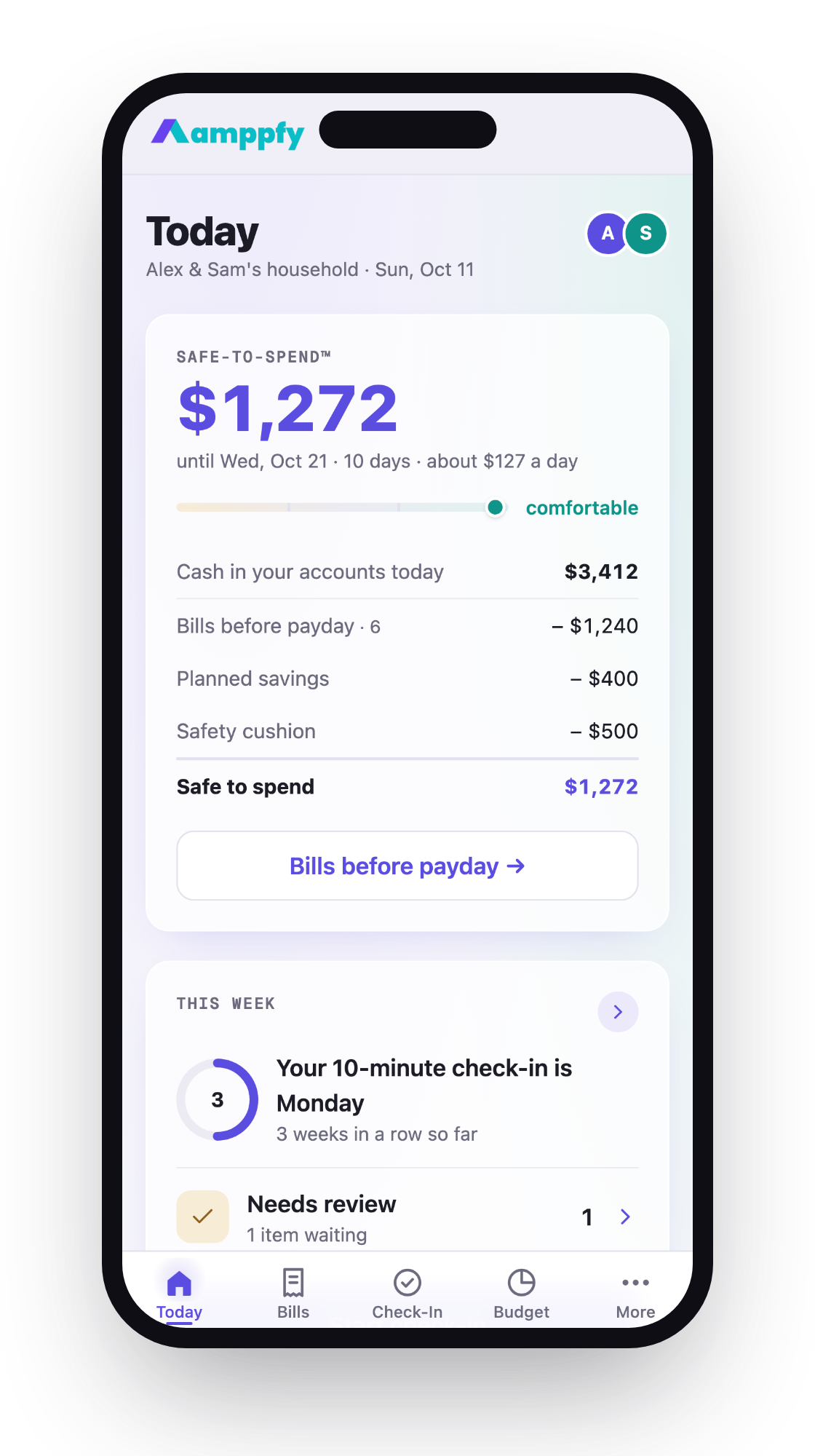
The fix is arithmetic. Start with available cash. Subtract bills due before the next payday. Subtract planned savings. Subtract a cushion. What’s left is your Safe-to-Spend™ number.
Example: $2,400 in the joint account, minus $1,150 in bills before payday, minus $200 to savings, minus a $250 cushion. That’s $800 you can actually use.
Amppfy shows that number with the four lines of math printed underneath. You type balances in yourself, about 30 seconds per account, with no bank login. Each partner gets their own login and sees the same number, while private accounts stay private. It’s free on iPhone and the web, so a partner on Android uses the browser. Take ten minutes this week and set it up together.
Comparing banks? Here is the list of online banks that offer joint accounts, with each bank’s own steps.
FAQ
Can I add my partner to my PNC account online?
No. As of October 2026, PNC says both the current holder and the person being added must visit a branch in person with government-issued photo ID. Opening a brand-new joint account can be done online.
Does my partner need to agree before I withdraw from our joint account?
No. Any owner can deposit and withdraw without the others’ consent, as of October 2026. Agree on your own rules, like a dollar amount that gets a quick text first.
How do we avoid the $7 Virtual Wallet fee?
Meet any one waiver. One is $500 in qualifying monthly direct deposits to Spend, as of October 2026. Most couples routing even one paycheck there clear it.
Will my partner see my other PNC accounts?
Only if you add them as an owner on those accounts. The joint account is shared. Your personal accounts stay yours.
A joint account is a tool, not a commitment to share everything. Pick the path that fits: a branch visit to add your partner, or an online form to start fresh. Route a paycheck in to drop the fee to $0. Then agree on one number you both trust, and check it together once a week. That’s the whole system.