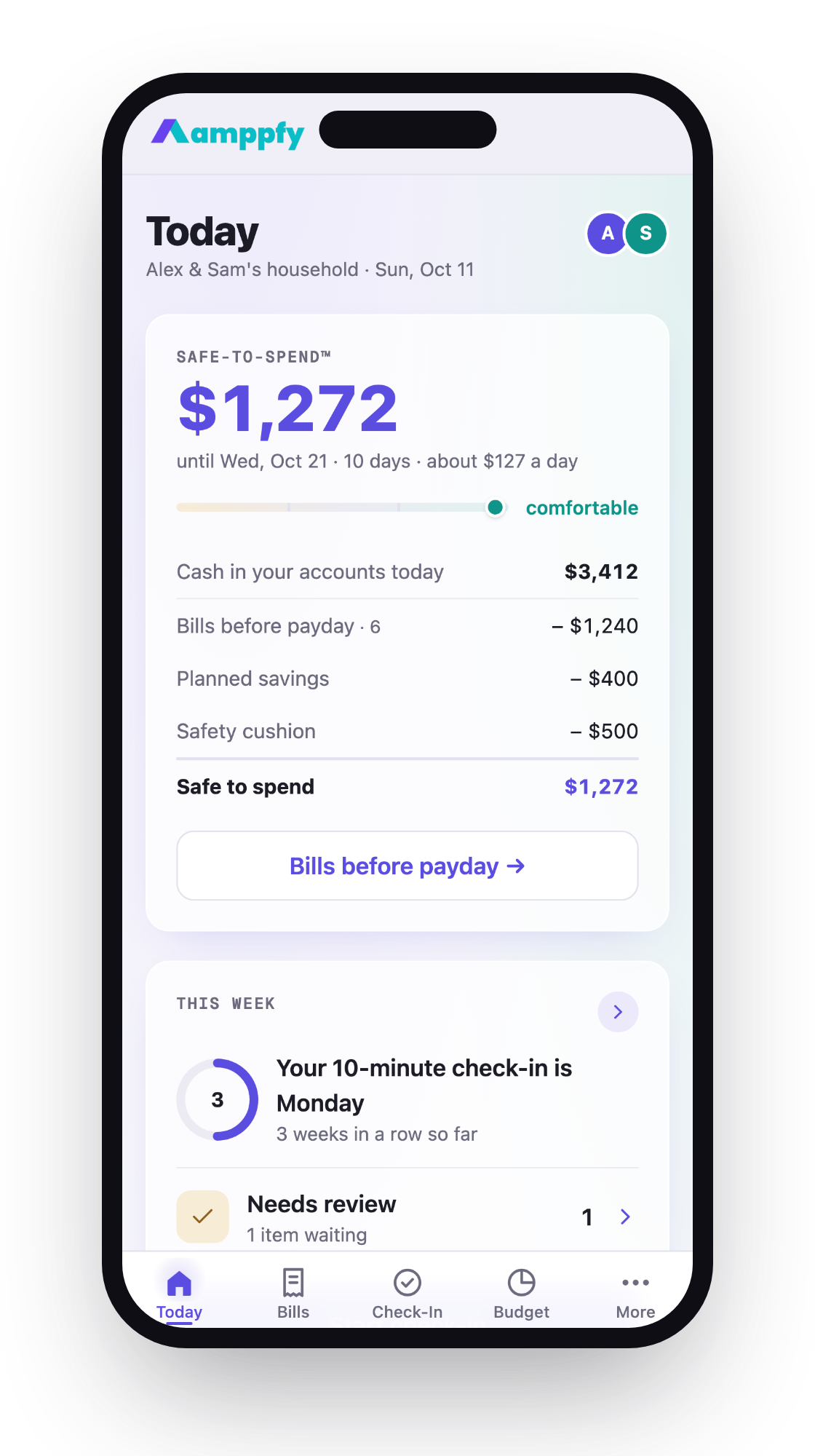
You checked your bank app this morning and felt fine about the number. By Friday, three autopays and a gas hold will have eaten through it. A recent survey found that 57% of US consumers routinely end the month with less money[1] than their bank app led them to expect. Your bank balance looks higher than it is because it shows money that’s already spoken for. The gap between that number and what you can actually spend is where overdrafts, stress, and late-night math live. Here’s how to close it.
Available balance vs. what’s really yours to spend
Your bank shows two numbers: the current balance and the available balance. Neither one tells you what’s safe to spend before your next paycheck.
- The current balance is every dollar deposited minus every transaction that has fully posted.
- The available balance subtracts pending holds and adds any pending deposits, but it still ignores every bill that hasn’t been triggered yet.
Think of it this way: your available balance is a snapshot of right now. It doesn’t know your car insurance drafts on Tuesday. It doesn’t know your electric bill autopays on the 15th. It has no idea you owe $140 for that streaming-and-gym combo before month’s end.
The number you actually need is Safe-to-Spend™: available cash, minus bills due before payday, minus planned savings, minus a safety cushion. That’s the figure that keeps you from borrowing from next week’s groceries to cover this week’s gas.
Here’s a quick comparison:
| What your bank shows | What it misses |
|---|---|
| Posted transactions | Bills scheduled but not yet triggered |
| Pending holds | Autopay drafts coming before payday |
| Deposited funds | Savings you promised yourself |
| Nothing else | A buffer for surprises |
Your bank balance appearing higher than reality isn’t a glitch. It’s a design limitation. Banks report what has happened, not what’s about to happen.
The bills that haven’t hit yet
The biggest reason your balance misleads you is timing. Bills don’t all land on the same day, and your brain doesn’t naturally subtract them in advance.
Picture a common pay cycle. You get paid on the 1st and the 15th. Between those dates, these obligations might be lurking:
- Rent or mortgage (the 1st)
- Car payment (the 5th)
- Phone bill (the 8th)
- Streaming services (the 10th and 12th)
- Insurance (the 14th)
On the 2nd, your balance looks great because only rent has cleared. But five more draws are coming. If you spend based on that inflated number, you’re spending money that belongs to your phone carrier and your insurance company.
This is especially tricky for couples splitting bills across accounts. One partner sees a healthy balance while the other’s account is about to get hit. Neither person has a full picture unless they compare notes. That’s why a shared view of upcoming bills, like the bills calendar in Amppfy, can close the information gap without requiring a joint bank account.
The fix isn’t complicated. Write down every recurring charge between now and your next payday. Subtract that total from your available balance. The remaining number is closer to truth, though it’s still not the whole story.
Pending charges, holds, and autopay timing
Even after you subtract upcoming bills, your balance can still fool you. Pending charges, merchant holds, and autopay quirks create a shadow layer of money that’s gone but doesn’t look gone yet.
Merchant holds that freeze your cash
Gas stations are the classic example. Under updated 2026 Visa and Mastercard rules, a gas pump can place a temporary hold of up to $175[2] on your debit card, even if you only pumped $40. That hold can last one to seven business days. Hotels are worse: incidental deposits can take up to 30 days to clear[3] if the merchant doesn’t finalize the batch promptly.
How long pending transactions really take
Most debit card transactions post within one to three business days[4], but complex merchant batching can stretch that to five. During that window, your balance is in limbo: the money isn’t officially gone, but it’s not yours to spend.
The autopay rejection problem
Here’s one most people miss. Banks now use AI-driven fraud monitoring that can block unusually high autopayments, like a seasonal utility spike. Your balance might look “safe” only because a major bill was secretly rejected. You won’t know until you get a late notice or check your email.
A quick reference for common hold durations:
| Transaction type | Typical hold duration |
|---|---|
| Gas station (debit) | 1-7 business days |
| Hotel incidental deposit | Up to 30 days |
| Standard debit purchase | 1-3 business days |
| Disputed charge | 7-45 days |
| Restaurant (tip adjustment) | 1-3 business days |
The pattern is clear. Your bank balance is a moving target, and the movement is almost always downward.
A one-minute way to translate a balance into a spendable number
You don’t need a spreadsheet. You need four lines of subtraction and about sixty seconds.
The Safe-to-Spend formula
- Start with your available balance (the one your bank app shows right now).
- Subtract every bill due between now and your next payday.
- Subtract the amount you want to save this pay period.
- Subtract a safety cushion (even $25 helps).
The result is your Safe-to-Spend number. That’s it.
A worked example
Say your available balance is $2,400 and you get paid again in 12 days.
| Line | Amount |
|---|---|
| Available balance | $2,400 |
| Bills due before payday | -$1,100 |
| Savings goal contribution | -$200 |
| Safety cushion | -$50 |
| Safe-to-Spend | $1,050 |
That $2,400 balance felt comfortable. The $1,050 reality is tighter but honest. You now know you have roughly $87 per day for groceries, gas, and everything else.
This math takes a minute by hand. If you’d rather not redo it every time a bill posts, Amppfy runs this formula automatically: you enter your balances, bills, paydays, and savings goals once, and it shows the updated Safe-to-Spend number with the four-line math printed underneath. A ten-minute weekly check-in keeps it current.
The point isn’t the tool. The point is the habit. Any method that subtracts future obligations from your current balance puts you ahead of the 57% who end the month surprised.
Habits that stop the morning balance check from misleading you
Knowing the formula is step one. Building a rhythm around it is what actually prevents the “where did my money go” moment on day eleven of a pay cycle.
- Check your Safe-to-Spend number, not your bank balance, before any purchase over $50. Your bank balance is raw data. Your spendable number is the answer.
- Review pending transactions every few days. A hold you forgot about or an autopay that bounced won’t show up in your balance the way you’d expect.
- Set bill due dates to cluster near payday. Most billers let you pick your due date. Grouping them right after payday means the money leaves before you can accidentally spend it.
- Keep a two-day buffer before payday. Don’t plan to spend down to zero the day before you get paid. Transactions post on their own schedule, not yours.
- Do a quick weekly check-in. Ten minutes on the same day each week: update balances, confirm upcoming bills, adjust your cushion if needed. That’s less time than scrolling your bank app daily and wondering.
For couples, one extra step matters: make sure both partners see the same number. Separate bank accounts are fine. Separate realities about what’s left to spend are not. A shared Safe-to-Spend view solves this without merging finances.
The real shift here is mental. Stop treating your bank balance as a green light. Treat it as a starting point for a quick subtraction problem. Once you do that, the gap between what your app says and what’s actually yours disappears.
Frequently Asked Questions
Why does my bank balance look higher than it actually is?
Your bank reports what has posted, not what’s coming. Bills scheduled for later this week, pending holds from gas stations or hotels, and savings you’ve mentally committed are all invisible to your balance. The number is accurate for what it tracks. It just doesn’t track enough.
How do I figure out what I can actually spend before payday?
Take your available balance. Subtract every bill due before your next paycheck. Subtract whatever you want to put toward savings. Subtract a small cushion for surprises. The remainder is your real spending money. You can do this on paper, in a notes app, or with a tool like Amppfy that runs the math for you.
Can pending charges make me overdraft even if my balance looks fine?
Yes. A pending hold reduces your available balance but can drop off temporarily before the final charge posts. If you spend based on the inflated number during that window, the final charge can push you negative. With no federal limit on the amount banks can charge for overdrafts[5] as of late 2026, that mistake can cost you $35 or more per transaction.
How often should I recalculate my Safe-to-Spend number?
Once a week is enough for most people. Pick a consistent day, spend ten minutes updating your balances and confirming upcoming bills, and you’ll have a reliable number for the week ahead. If you have a large unexpected expense, recalculate right then.
Your Balance Is a Starting Line, Not a Finish Line
Your bank app is doing its job. It just isn’t doing your job. The number on screen tells you what’s cleared, not what’s claimed. The difference between those two things is where financial stress hides.
The fix is small: four lines of subtraction, once a week. Subtract your bills. Subtract your savings. Subtract a cushion. What’s left is yours.
Take ten minutes this week to calculate your real Safe-to-Spend number. If you want it done automatically, download Amppfy free on iPhone or the web and enter your balances, bills, and paydays. You’ll see one honest number instead of a balance that tells a half-truth.