You married someone who handles money differently than you do. One of you checks the savings balance like a hobby. The other treats a bonus like a starting pistol for a shopping trip. Neither approach is wrong on its own, but the collision can feel personal. If you’re a saver married to a spender, the real problem isn’t character: it’s that you’re both flying blind. A shared system, not a shared personality, is what keeps the peace.
The fix doesn’t require anyone to change who they are. It requires one visible number, a few ground rules, and about ten minutes a week. Here’s a system that works for both sides.
Why the fight is about visibility, not values
Most money arguments between couples sound like they’re about values. “You don’t care about our future.” “You never let us enjoy anything.” These feel like deep character conflicts. They’re usually not.
A 2023 Federal Reserve Survey of Household Economics found that roughly 35% of adults in partnerships disagreed with their partner about spending priorities. But disagreement isn’t the same as incompatibility. The real trigger is surprise: one partner discovers a charge they didn’t expect, or one partner feels controlled by rules they didn’t agree to.
When a saver and spender share a household, the friction almost always traces back to a visibility gap. The saver doesn’t know what’s already been spent. The spender doesn’t know what’s already committed to bills. Both are guessing, and both feel justified in being upset.
The blame cycle and how to break it
Here’s how the cycle usually runs:
- A purchase appears that one partner didn’t expect.
- The saver feels anxious because they can’t tell if the account is still safe.
- The spender feels judged because they didn’t think the purchase was a big deal.
- Both dig in. The conversation turns personal.
The fix is structural, not emotional. If both partners can see the same number that answers “what’s actually safe to spend right now,” the surprise disappears. No one needs to confess. No one needs to ask permission for a coffee. The number does the talking.
That shift, from “you spent too much” to “here’s what we have left,” changes the entire tone. It moves the conversation from blame to math.
One shared number both of you can see
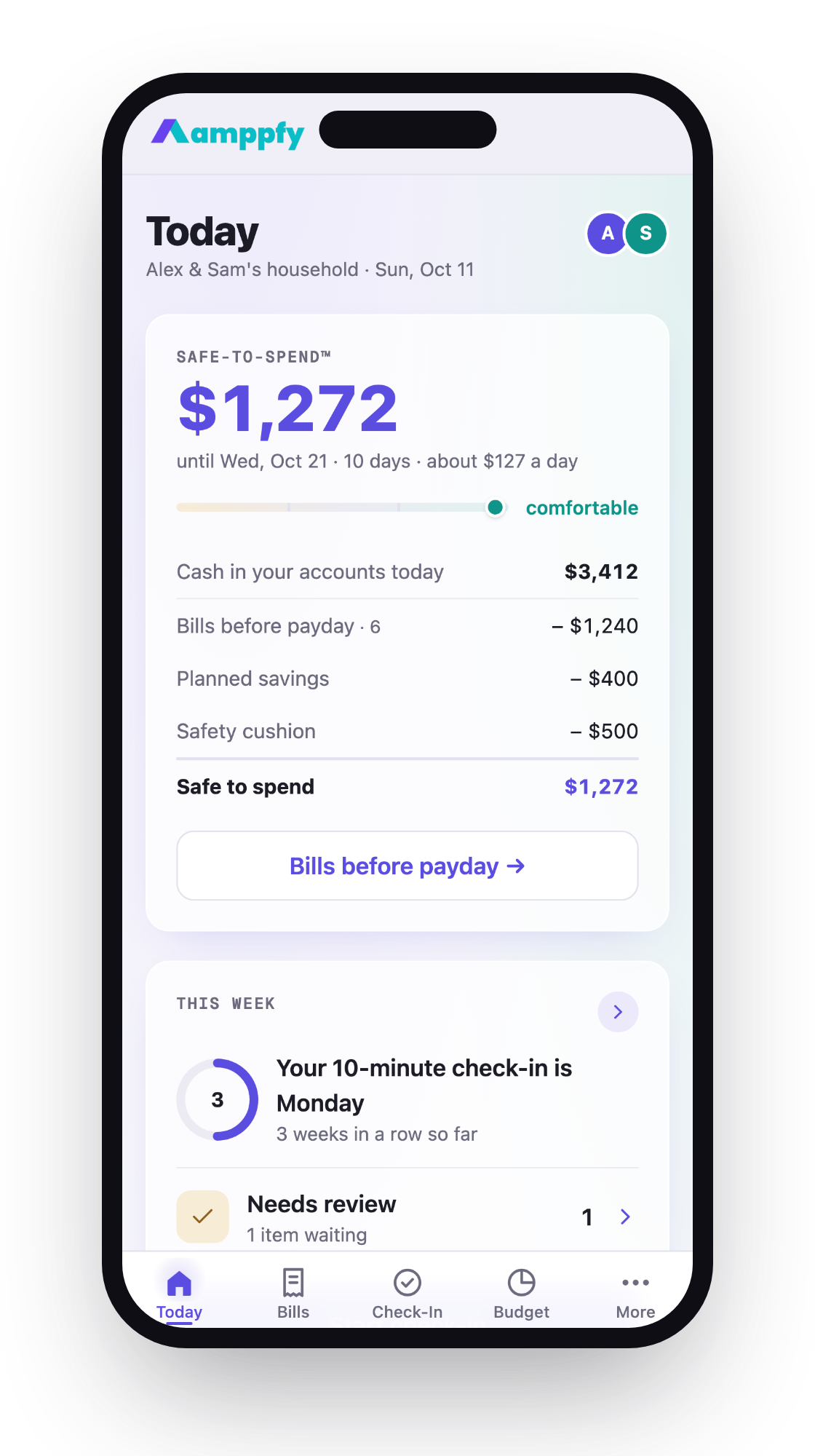
Every money system for couples needs a single answer to one question: how much can we spend before payday without missing a bill or draining savings? That answer is your Safe-to-Spend™ number.
How the math works
The formula is simple:
$4,800 cash − $2,100 bills due before payday − $500 savings goal − $400 cushion = $1,800 Safe-to-Spend
That $1,800 is what’s actually available. Not the bank balance. Not the checking account total. The real number after every obligation is subtracted.
Both partners need to see this same figure. Not a separate app each. Not a spreadsheet one person updates. The same live number, visible to both, updated whenever either person refreshes a balance.
Why one number beats a full budget
Traditional budgets assign a limit to every category: groceries, gas, entertainment, clothing. That works for some people. For a saver-spender couple, it usually creates more conflict, not less. The spender feels micromanaged. The saver becomes the budget police.
One number sidesteps the category wars entirely. You don’t need to argue about whether $60 at Target counts as “household” or “personal.” You just need to know the total that’s safe. Here’s how the two approaches compare:
| Feature | Category Budget | Single Safe-to-Spend Number |
|---|---|---|
| Setup time | Hours of negotiation | One sitting, about 15 minutes |
| Maintenance | Constant re-sorting of purchases | Update balances once or twice a week |
| Conflict trigger | “That doesn’t count as groceries” | Rare: the number speaks for itself |
| Flexibility | Low: every dollar has a lane | High: spend on anything within the number |
Amppfy is built around this idea. Both partners get their own login and see the same Safe-to-Spend number. You enter balances yourself, about 30 seconds per account. Private balances stay private. The four-line math prints right under the number so neither partner has to wonder where it came from.
A personal allowance that needs no permission
Even with a shared number, both partners need money that’s truly theirs. No questions. No justification. This is the pressure valve that keeps the whole system from blowing up.
Setting the right amount
Pick a dollar amount each partner gets per pay period. It doesn’t have to be equal if incomes aren’t equal, but it does have to feel fair to both. A common starting point: 5-10% of take-home pay per person.
- The spender uses theirs on whatever they want: clothes, gadgets, lunches out.
- The saver can stash theirs in a separate account, invest it, or let it pile up.
- Neither partner comments on what the other does with this money. That’s the deal.
This solves one of the deepest tensions in a saver-spender marriage. The spender stops feeling policed. The saver stops feeling like every dollar is at risk. Both get autonomy inside a shared structure.
What counts as “personal”
Draw a clear line. Personal allowance covers anything that benefits only one person. Shared expenses, like groceries, kids’ activities, and household repairs, come from the shared Safe-to-Spend number. If you’re unsure, default to shared and adjust later during your weekly check-in.
One rule that helps: if either partner has to think about whether a purchase is “personal” or “shared,” it probably needs a quick text. Not permission. Just a heads-up. That small habit prevents 90% of the surprises that start arguments.
Rules for purchases above a set amount
Every couple needs a threshold: a dollar amount above which you talk before you buy. This isn’t about control. It’s about keeping the shared number accurate and avoiding shock.
How to pick your threshold
There’s no universal right number. It depends on your income, your Safe-to-Spend, and your comfort level. Here’s a rough guide:
| Combined Take-Home Pay | Suggested Threshold |
|---|---|
| Under $5,000/month | $75-$100 |
| $5,000-$8,000/month | $100-$200 |
| Over $8,000/month | $200-$300 |
The threshold applies to both partners equally. If the saver wants to move $250 into a new investment account, that’s a conversation too. Equality here matters: it keeps the rule from feeling like surveillance aimed at one person.
What the conversation sounds like
This doesn’t need to be a negotiation. A quick text works:
“Hey, the kids need new cleats and a bag. It’s about $140. Cool?”
That’s it. The other partner checks the shared number, confirms there’s room, and replies. If there isn’t room this pay period, you talk about timing. Maybe it waits five days until after payday. Maybe you pull from a different line. The point is that both people know before the number changes.
If you find yourselves arguing about every threshold purchase, your threshold might be too low. Raise it by $50 and see if the tension drops. The goal is to catch the big surprises, not to create a permission slip for every trip to the store.
A ten-minute weekly check-in that stays calm
The weekly check-in is where the whole system stays honest. Skip it, and balances drift. Numbers stop matching reality. Trust erodes. Ten minutes a week prevents all of that.
A simple check-in structure
Pick a consistent time: Sunday morning coffee, Wednesday after the kids are in bed, whatever fits. Then follow this order:
- Both partners update their account balances. This takes about 30 seconds per account.
- Review the Safe-to-Spend number together. Does it match what you expected?
- Glance at upcoming bills for the next two weeks. Any surprises?
- Check progress on savings goals. Celebrate small wins here: even $50 toward a goal counts.
- Mention any big purchases coming up in the next pay period.
That’s the whole meeting. No blame. No deep audit. No scrolling through transactions line by line.
Keeping the tone right
The check-in works only if it stays calm. A few ground rules help:
- No “you always” or “you never” statements. Stick to numbers.
- If the Safe-to-Spend number is lower than expected, ask “what happened” instead of “what did you buy.”
- End with something positive: a goal you’re close to hitting, a bill you just paid off, or simply “we’re on track.”
Amppfy’s weekly check-in is designed around this rhythm. You update balances, the number recalculates, and you both see where things stand. The app sends a gentle payday nudge that funds goals first, so savings happen before spending starts. No alarms. No red warnings. Just a clear picture.
If ten minutes feels like too much at first, start with five. The habit matters more than the duration. Once you’ve done it three or four times, it becomes automatic, like checking the weather before you leave the house.
Building a system that fits both of you
The saver-spender divide doesn’t have to be a source of stress. It can actually be a strength: one partner watches the horizon while the other makes sure you enjoy the journey. The key is a system that respects both instincts.
Start with one shared number you both trust. Add personal allowances that give each person freedom. Set a purchase threshold that catches surprises without creating friction. Then protect the whole thing with a short weekly check-in.
You don’t need to become the same person. You need the same information. Take 15 minutes this week to set up Amppfy, enter your balances, and see your first Safe-to-Spend number together. That single step replaces the guesswork with a fact both of you can point to.
Frequently Asked Questions
What if one partner refuses to participate in the system?
Start small. Ask your partner to simply look at the shared number once a week. Don’t require them to update balances or attend a formal sit-down. When someone sees a clear, non-judgmental number that answers “what’s safe to spend,” curiosity usually replaces resistance. If they’re worried about being monitored, emphasize that personal allowances are truly no-questions-asked. Most reluctance comes from fear of control, not laziness.
Should we combine all our accounts or keep them separate?
Either works. The system doesn’t depend on account structure. Plenty of couples keep separate checking accounts and one joint account for shared bills. Others pool everything. What matters is that the Safe-to-Spend number reflects all shared obligations, regardless of which account holds the cash. Your personal allowance can sit in whatever account you prefer.
How do we handle an unexpected expense that blows past the threshold?
Emergency car repair, medical bill, broken appliance: these don’t wait for a text. Handle it, then bring it to the next check-in. Adjust the Safe-to-Spend number together and decide whether to pull from savings or tighten spending for the rest of the pay period. The rule exists for planned purchases, not genuine emergencies.
What if our incomes are very different: should allowances still be equal?
They don’t have to be. Some couples split allowances proportionally based on income. Others keep them equal because it feels more like a partnership. There’s no single right answer. The test is simple: does each person feel the amount is fair? If one partner resents their allowance, revisit the number at your next check-in and adjust until both sides can live with it comfortably.