Most people who’ve tried a budgeting app already know the cycle. You download it, connect your bank, categorize a few transactions, and then stop opening it two weeks later. The problem isn’t laziness. It’s that the tool asked for more attention than the habit could sustain. The good news: you can track your spending without an app and still know exactly what’s safe to spend before your next paycheck. All you need is one line of math, a method that fits your life, and about ten minutes a week.
What tracking is actually for
Tracking isn’t about guilt. It’s not about knowing you spent $4.75 on coffee last Tuesday. The real purpose is answering one question: how much money can I actually spend right now without messing up a bill, a goal, or next week?
That’s it. One number.
Think of it like checking the gas gauge before a road trip. You don’t need a detailed log of every mile you’ve driven. You need to know if you’ll make it to the next stop. Spending tracking works the same way. You need a forward-looking number, not a backward-looking report.
The reason most systems fail is they focus on categorization. They want you to sort every purchase into buckets, review pie charts, and feel something about the data. But research on the Payment Transparency Index suggests that what actually changes behavior is cognitive friction: the moment you pause and think before spending[1]. You get that friction from doing the math yourself, not from watching an algorithm do it for you.
So before you pick a method, get clear on the goal. You’re not building a historical record. You’re building a habit of knowing your number. Everything else is optional.
The one-line method: balance, bills, savings, cushion
Here’s the simplest way to know what’s safe to spend. Write down four numbers and subtract:
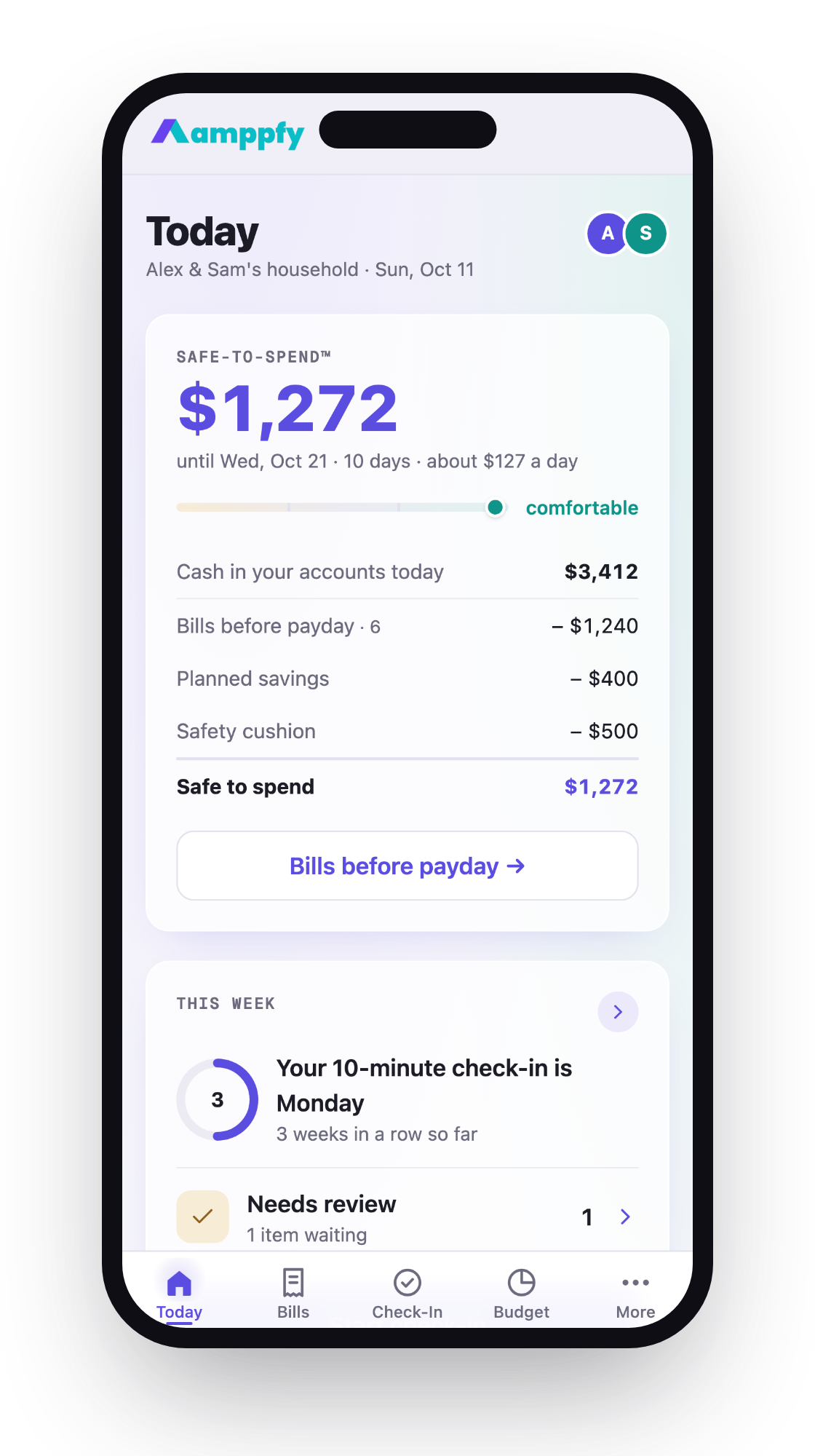
$3,412 cash − $1,240 bills − $400 savings − $500 cushion = $1,272
That’s your Safe-to-Spend™ number. It tells you what’s left after everything that matters is accounted for.
Here’s how to get each number:
- Cash: Open your bank app. Add up checking and any account you spend from. That’s your starting point.
- Bills: List every bill due between now and your next payday. Rent, utilities, subscriptions, minimum payments. Total them.
- Savings: Pick a number you want to set aside this pay period. Even $50 counts. This goes toward a goal, an emergency fund, or both.
- Cushion: This is your buffer for the stuff you forgot. Car registration. A birthday gift. Start with $200 to $500 and adjust over time.
The result is what you can spend freely. No categories. No tracking receipts. Just one number you check against before a purchase.
You can run this math on a napkin. You can run it in your head if the numbers are round enough. The format doesn’t matter. The habit does. Do it once on payday, glance at it midweek, and you’ll know where you stand without logging a single transaction.
If you share finances with a partner, run the same line together. Same bills, same cushion, same number. You both know the answer without a second conversation.
Paper, notes app, or spreadsheet: pros and cons
Once you’ve got the one-line formula, you need somewhere to keep it. Three options work well, and each has tradeoffs.
| Method | Setup Time | Weekly Effort | Best For |
|---|---|---|---|
| Paper notebook | 2 minutes | 5-10 minutes | People who think better by hand |
| Phone notes app | 2 minutes | 5 minutes | People who always have their phone |
| Spreadsheet | 15-30 minutes | 5-10 minutes | People who want history over time |
A paper notebook is the most distraction-free option. You open it, write four numbers, do the subtraction, and close it. No notifications. No temptation to scroll. The downside: you can’t share it easily with a partner, and it won’t do the math for you.
Your phone’s built-in notes app splits the difference. It’s always in your pocket. You can share a note with someone. You can update it anywhere. The risk is that you open your phone to check your number and end up on Instagram instead. Manual entry in a notes app still gives you that hands-on review of your cash flow that builds better habits than passive syncing[2].
A spreadsheet gives you the most power. You can build formulas, track your number over multiple pay periods, and spot trends. Google Sheets works on any device. The downside is setup: you’ll spend 15 to 30 minutes building it the first time. If you enjoy that kind of thing, great. If not, a notes app does 90% of the job.
Pick the method you’ll actually use on a Wednesday night when you’re tired. That’s the right one.
Why weekly beats daily
Daily tracking sounds disciplined. It also burns people out fast. A weekly check-in is enough for most people, and here’s why.
Your bills don’t change daily. Your paycheck doesn’t change daily. The only thing that changes daily is your checking balance, and you can see that in your bank app in five seconds. What you actually need is a regular moment to recalculate your number, catch anything you missed, and adjust.
Pick a day. Sunday morning with coffee works. So does Friday after work. The specific day matters less than the consistency. Set a reminder on your phone if you need to. Ten minutes is plenty.
Here’s what a weekly check-in looks like:
- Open your bank app. Note your current balance.
- Check which bills are still coming before payday.
- Subtract bills, savings, and cushion from your balance.
- Write down the new number.
- Compare it to last week. If it dropped more than expected, ask yourself one question: was it planned or a surprise?
That last step is where the learning happens. You’re not judging yourself. You’re calibrating. Maybe you forgot about a subscription renewal. Maybe you spent more on groceries because prices went up. The Federal Reserve’s 2026 report found that 58% of US adults say price increases have worsened their financial situation[3], so your number dropping isn’t a personal failure. It’s the economy. Adjust your cushion and move on.
Weekly tracking also works better for couples. You check in together once, agree on the number, and go about your week. Nobody’s policing individual purchases. You’re just confirming you’re both looking at the same reality.
When an app is worth it after all
Pen-and-paper tracking works. So does a spreadsheet. But there are moments when an app genuinely earns its place.
You might want an app if:
- You share bills with a partner and need both people to see the same number without texting back and forth.
- You have irregular income or multiple pay dates and the math gets complicated.
- You want automatic reminders the day before a bill hits.
- You’ve tried the manual method and keep forgetting to do the weekly check-in.
The key is choosing an app that matches the method you already trust. If you like the one-line formula, look for something that mirrors it: your balance, minus bills, minus savings, minus a cushion, equals one number. That’s exactly what Amppfy does. You type in your balances yourself (about 30 seconds per account), and it shows your Safe-to-Spend number with the math printed right underneath. No bank login required. A ten-minute weekly check-in keeps everything current.
One thing to watch: apps that rely on automatic bank connections have had a rocky road. The CFPB’s data-sharing rule was blocked by a federal court in late 2025, leaving many apps dependent on screen scraping[4] as of 2026. That means broken connections, missing transactions, and hours spent re-linking accounts. Manual entry sidesteps all of that.
The question isn’t “app or no app.” It’s whether the tool respects your time and gives you the one number you need. If a notebook does that, use a notebook. If an app does it in less time, use the app.
Frequently Asked Questions
Do I need to save every receipt to track spending without an app?
No. Receipt-saving is a holdover from old-school budgeting. The one-line method doesn’t care what you bought. It cares about your current balance and what’s still owed before payday. Your bank app already has the transaction history if you ever need to look something up. Skip the shoe box of receipts.
How do I handle cash spending when I’m tracking manually?
Round it. If you pulled $100 from the ATM, subtract $100 from your balance. Don’t try to track where every dollar of that cash went. The goal is knowing your number, not auditing yourself. If cash spending is a big part of your life, consider pulling a set amount each week and treating it as already spent.
Can this method work for couples with separate accounts?
Yes. Each person runs the one-line formula on their own accounts. Then you share the numbers for joint bills. If rent is $2,000 and you split it evenly, each person subtracts $1,000 from their own line. You don’t need to merge accounts or share passwords. You just need to agree on which bills are shared and how they’re split.
What if my income changes every pay period?
Use your lowest recent paycheck as your baseline. If you earned $2,800, $3,100, and $2,600 over the last three pay periods, plan around $2,600. Anything above that becomes extra cushion or goes straight to savings. This keeps your number conservative and prevents you from spending money you haven’t earned yet.
Your next ten minutes
You don’t need a perfect system. You need a number you trust and a weekly habit that takes less time than making dinner. Start with the one-line formula on whatever’s in front of you right now: a notebook, your phone’s notes app, or a scrap of paper. Run the math once. See how it feels to know exactly what’s available.
If you want that number calculated for you and shared with a partner automatically, Amppfy does it free on iPhone and the web. But the method matters more than the tool. Pick one, spend ten minutes this week, and you’ll already know more about your money than most people figure out in a month.