You’ve downloaded a budgeting app, spent a Saturday afternoon setting it up, used it for three weeks, and then quietly deleted it. Six months later, you did the same thing with a different app. If you keep quitting budgeting apps and can’t figure out why, the problem probably isn’t willpower. It’s the design of the tool itself. Most budgeting apps ask for a daily habit you never signed up for, and they punish you with guilt when you fall behind. This piece breaks down what’s actually going wrong and offers a simpler path that sticks.
The three reasons budgeting apps get abandoned
The cycle of downloading, trying, and quitting a budget app usually traces back to three friction points. Recognizing yours can save you another round of the same loop.
Too many categories, too little payoff
Traditional apps want you to sort every coffee, gas fill-up, and grocery run into a category. That’s fine for a week. By week three, you’ve got 40 uncategorized transactions and a sinking feeling. The app starts showing red bars and warning icons. You close it and don’t come back.
Broken bank connections
Bank sync sounds great until your connection drops for the third time this month. You re-enter credentials, wait for transactions to reload, and find duplicates everywhere. The time you saved by syncing gets eaten by cleanup. A tool that creates chores defeats its own purpose.
Subscription cost creep
U.S. households aggressively cut their paid subscriptions from 4.1 to 2.8 services in 2025[1], a 32% drop. Budget apps charging between $8 and $15 a month[2] are often the first to go when you’re trimming recurring costs. Paying a monthly fee to feel bad about your spending is a hard sell.
These three forces work together. The app demands daily attention, breaks when you rely on it, and charges you for the privilege. No wonder the cycle repeats.
Upkeep is the hidden cost
Every budgeting app has a sticker price and a time price. The sticker price is on the App Store listing. The time price only shows up after you’ve committed.
The real time tax
Think about what a typical category-based app asks of you each week:
| Task | Estimated weekly time |
|---|---|
| Reviewing and categorizing transactions | 15-25 min |
| Fixing sync errors or duplicates | 5-10 min |
| Adjusting budget categories mid-month | 5-10 min |
| Reconciling with partner’s spending | 10-15 min |
| Total | 35-60 min |
That’s the equivalent of a part-time chore. For many people, especially parents or anyone working irregular hours, that time simply doesn’t exist.
Why high-friction tools fail faster for tight budgets
Research on financial behavior shows that people with lower incomes find budgeting less pleasant and are less likely to stick with it[3] because the process becomes about making ends meet rather than building toward something better. A tool that demands more time from the people with the least time to give has a built-in failure rate.
The fix isn’t “try harder.” The fix is a system with a lower time cost. You need a method where ten minutes replaces an hour, and where skipping a day doesn’t break anything.
A ten-minute weekly routine instead of daily categorizing
Daily transaction sorting is the treadmill most people fall off. A weekly check-in replaces that treadmill with a short walk.
Here’s what a ten-minute weekly routine looks like:
- Open your bank app. Write down each account balance. This takes about 30 seconds per account.
- Confirm your upcoming bills for the next pay period haven’t changed.
- Check whether your savings goal got funded after your last paycheck.
- Glance at your one spending number (more on this below) and see if it still looks reasonable.
That’s it. No categorizing. No chasing down a $4.50 charge at a gas station. No color-coded pie charts.
Why weekly works better than daily
The leftover method[4] is a low-friction alternative to traditional budgeting: you move whatever’s left at the end of the month into savings, skipping daily tracking entirely. A weekly check-in borrows that same principle but adds a guardrail so you don’t arrive at month’s end with nothing left.
If you want one area to watch more closely, pick the single category where your spending tends to drift. For most people, that’s dining out or impulse online orders. Setting a spending guardrail on just one or two categories gives you 80% of the benefit with 10% of the effort.
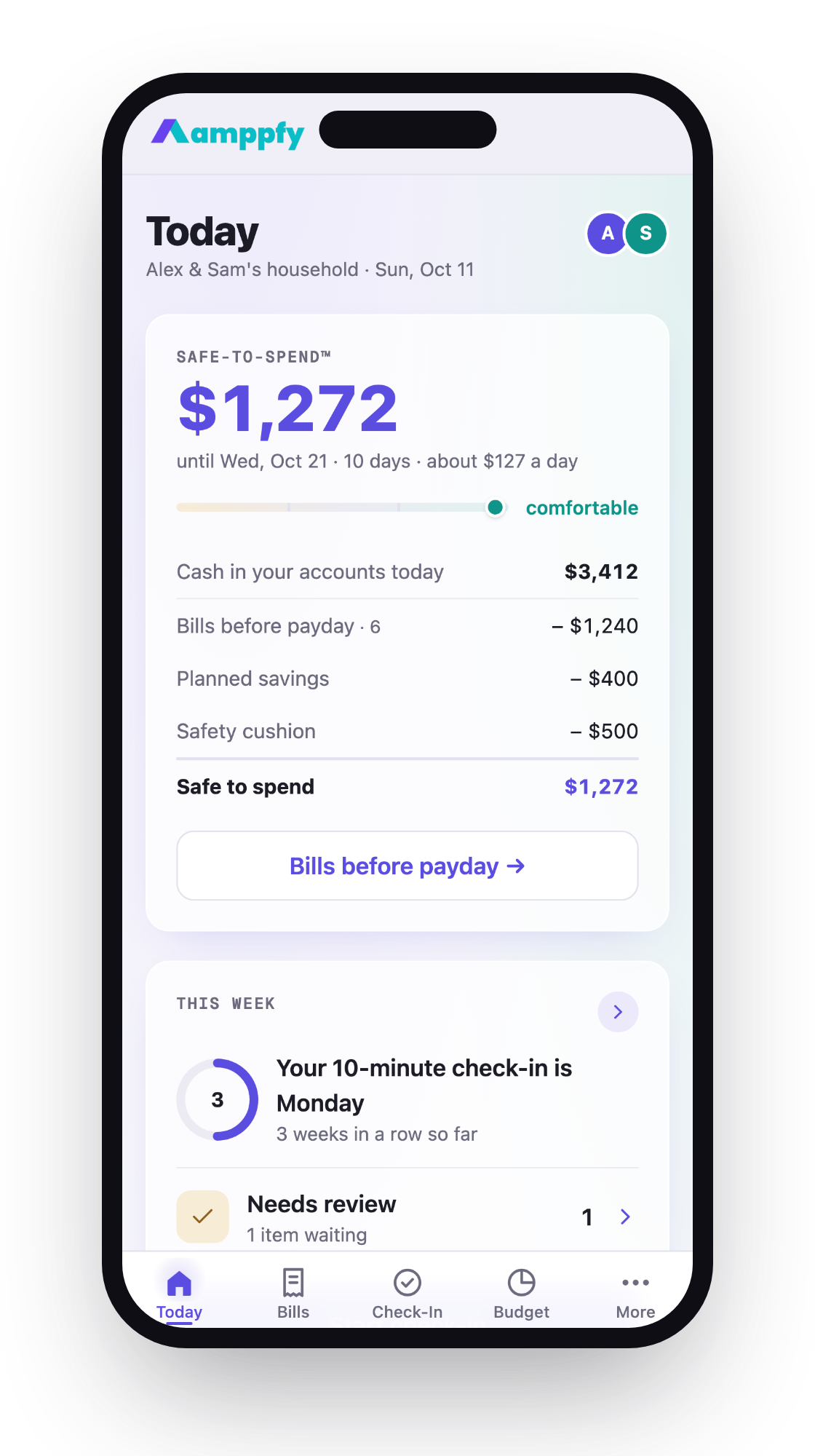
Amppfy is built around this weekly rhythm. You type in your balances yourself, confirm your bills, and the app does the subtraction for you. Ten minutes, once a week, and you’re done.
One number you can trust all week
Category budgets give you dozens of numbers. Most of them don’t answer the question you actually have: “Can I spend this right now without messing up my bills or goals?”
How the math actually works
Safe-to-Spend™ is one number that answers that question. The formula is simple:
$3,412 cash − $1,240 bills due before payday − $400 savings goal − $500 cushion = $1,272 Safe-to-Spend
That $1,272 is what you can actually use between now and your next paycheck without falling behind on anything. The four-line math is always visible so you can see exactly where the number comes from. No mystery, no trust-me algorithm.
What this replaces
| Traditional budget app | One-number approach |
|---|---|
| 12-20 spending categories | 1 number |
| Daily transaction review | Weekly balance update |
| Red/green alerts on each category | One calm heads-up before a bill |
| Guilt when categories go over | A next step when the number drops |
When your Safe-to-Spend number drops lower than you’d like, you don’t get a shame notification. You just see a smaller number and decide what to do about it. Maybe you cook at home this week. Maybe you shift a savings contribution by one pay cycle. The number gives you information, not judgment.
For couples, both partners see the same Safe-to-Spend number through their own login on Amppfy. Private account balances stay private, but the shared number keeps both people on the same page without a weekly budget meeting.
Restarting without starting over
If you’ve quit budgeting apps before, the worst part of trying again is the setup. Re-entering months of data, reconnecting bank accounts, rebuilding categories from scratch. That dread alone keeps people from trying again.
A better approach skips the rebuild entirely. You don’t need history to start. You need three things:
- Your current account balances (checking, savings, whatever you use)
- Your bills between now and your next payday
- A savings amount you’d like to set aside, even if it’s $25
Enter those three inputs and you have a working Safe-to-Spend number in under five minutes. No importing old transactions. No categorizing last month’s spending. You start from today, not from January.
The “fresh start” advantage
People who quit budgeting apps often carry guilt about the gap. They think they need to account for the months they missed. You don’t. Your bank balance already reflects every decision you made during that time. Starting from your current balance is starting from truth.
If you’ve been through this cycle twice or more, try changing the tool rather than blaming the habit. A system that takes ten minutes a week, shows you one clear number, and doesn’t punish gaps is a system you can actually keep.
Frequently Asked Questions
What if I don’t get paid on a regular schedule?
You can still use a one-number system. Set your “pay period” to match your most common pay interval, or use the date your next deposit is expected. If you freelance, estimate conservatively and update the number when money actually lands. The weekly check-in catches any changes before they become problems.
Do I need to connect my bank account to use Amppfy?
No. You type in your balances yourself. It takes about 30 seconds per account. This avoids the sync errors and security concerns that make other apps frustrating. Your bank credentials stay with your bank.
Can a one-number approach actually replace a full budget?
For most people, yes. A full category budget gives you more detail, but detail you don’t use is just noise. If you want to watch one specific spending area, you can set a guardrail on that category alone. The one number handles everything else.
What happens if I skip a week?
Your bills and goals stay in the system. When you come back, update your balances and the number recalculates instantly. There’s no backlog of transactions to sort through. Skipping a week doesn’t create extra work the following week.
A simpler path forward
The reason you keep quitting budget apps isn’t a character flaw. It’s a design mismatch. Apps that demand daily attention, break their own sync, and charge monthly fees are built for a user who doesn’t exist in real life.
You need three things from a money tool: a clear number, a short weekly habit, and zero guilt when life gets busy. That’s the bar. Anything above it is optional.
If you’re ready to try a different approach, Amppfy is free and takes about five minutes to set up. Enter your balances, your bills, and one savings goal. You’ll have your Safe-to-Spend number before your coffee gets cold.