Money is one of the hardest things to talk about with a partner. Not because the math is complicated, but because the feelings are. Shame, fear of judgment, old habits from childhood: these all sit in the room before a single dollar amount gets mentioned. A 2024 survey by the Federal Reserve found that 35% of adults in relationships disagreed with their partner about spending priorities. That gap doesn’t close on its own. It closes when you both sit down, look at the same facts, and agree on what’s safe to spend before the next paycheck. This guide gives you a repeatable way to have that conversation: starting with numbers, not emotions.
Start from a number, not a feeling
Most couples who try to discuss money with their partner start with a complaint. “You spent too much on X.” “We can’t afford Y.” These are feelings dressed up as facts. They trigger defensiveness instantly.
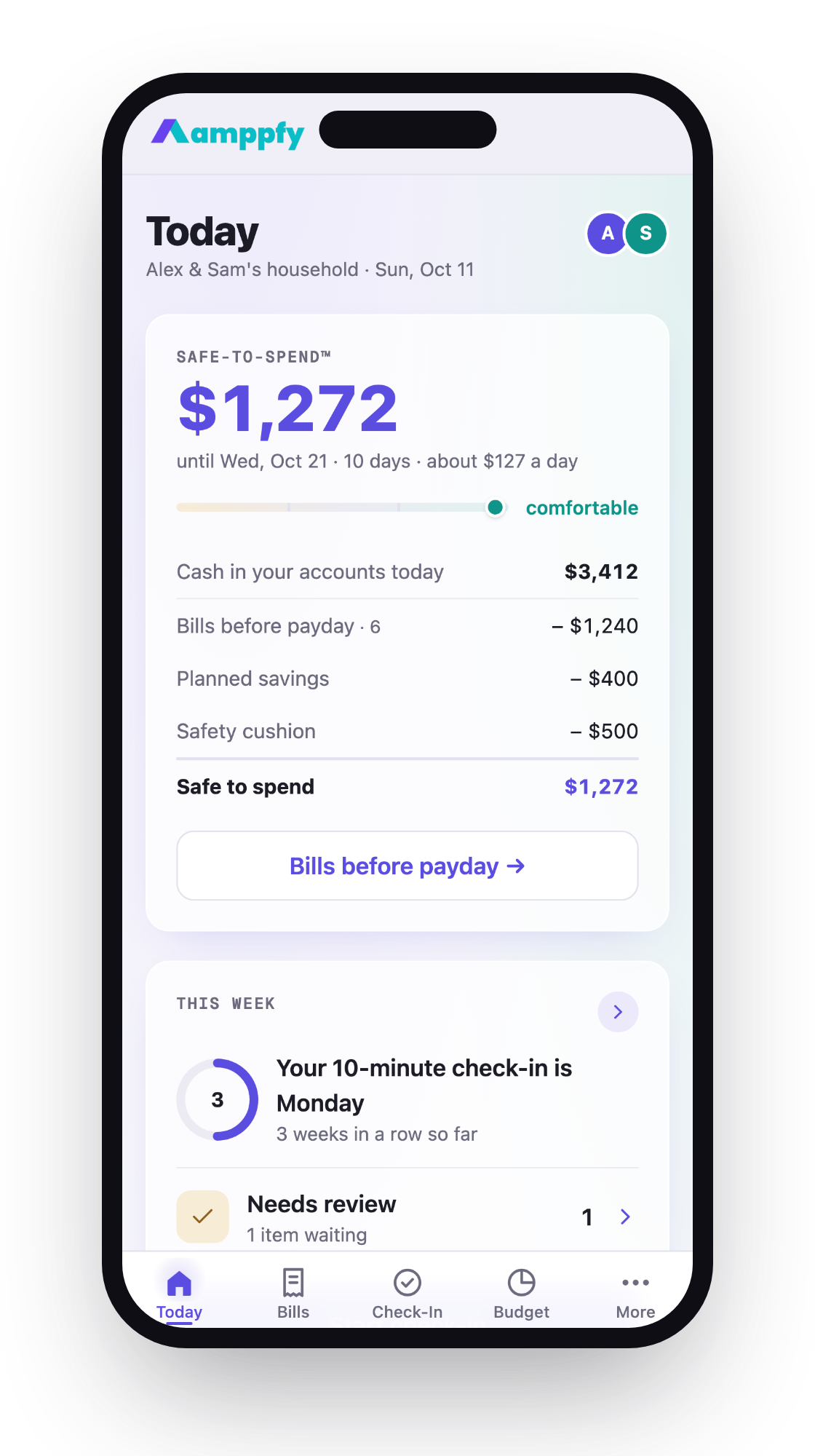
A better opening move is a single number both of you can verify. Take your available cash, subtract the bills due before your next payday, subtract what you want to save, and subtract a safety cushion. What’s left is what you can actually spend.
Here’s what that looks like:
$4,200 cash − $1,800 bills − $300 savings − $400 cushion = $1,700
That $1,700 is your Safe-to-Spend™ number. It’s not a budget category. It’s not a guilt trip. It’s just what’s left after your obligations are covered. When both partners see the same figure, the conversation shifts from “you spent too much” to “we have $1,700 until Friday.”
You don’t need a spreadsheet for this. You need your bank balance, a list of upcoming bills, and about two minutes of arithmetic. The point is to anchor every money conversation in a fact, not a feeling. Feelings still matter. But they land differently when you’re both staring at the same number instead of arguing over whose memory of the electric bill is correct.
Start your next conversation with this line: “Here’s what we have left before payday.” Then show the math. That’s it. No lecture, no history lesson, no blame.
Ten minutes, one screen, same view
The biggest reason couples avoid talking about finances together is time. A full budget review sounds like a Sunday afternoon project. Nobody wants that. The fix is a weekly check-in that takes ten minutes or less.
What to cover in those ten minutes
- Current cash balance across your accounts
- Bills due before the next paycheck
- Any savings transfers you’ve committed to
- The resulting Safe-to-Spend number
That’s four items. You read them off, confirm they match reality, and you’re done. No deep analysis. No pie charts. If something looks off, you flag it and move on. The goal is awareness, not accounting.
Why one screen matters
When each partner checks a different app, a different spreadsheet, or a different mental model, you’re not having the same conversation. You’re having two parallel ones. Amppfy is built for exactly this: both partners log in with their own account and see the same Safe-to-Spend number. Private balances stay private. Shared obligations stay visible. Nobody has to hand over a password or screenshot their bank app.
Picking the right moment
Don’t do this on a Friday night or during a stressful morning. Pick a calm, boring window: Sunday after coffee, Wednesday after the kids are in bed, whatever works. Put it on a shared calendar. Treat it like taking out the trash. It’s a small chore that prevents a much bigger mess.
The ten-minute format works because it removes the excuse. You’re not asking your partner to sit through a financial summit. You’re asking for the length of two songs.
Scripts for the hard version of the conversation
Easy weeks handle themselves. The hard weeks are the ones where someone spent more than expected, a bill surprised you, or one partner feels like the other isn’t pulling their weight. These conversations need structure, not spontaneity.
The “unexpected expense” script
Try this format:
| Step | What to say |
|---|---|
| 1. State the fact | “An extra $380 went out this week for the car repair.” |
| 2. Show the impact | “That drops our Safe-to-Spend from $1,700 to $1,320.” |
| 3. Propose a next step | “Want to split the difference from next week’s cushion, or trim dining out?” |
No blame. No “why didn’t you tell me.” Just fact, impact, next step.
The “different priorities” script
This one comes up when one partner wants to save for a trip and the other wants to pay down a credit card. Neither is wrong. The script looks like this:
- Each person states what they want and why, in two sentences max.
- You both look at the Safe-to-Spend number.
- You ask: “Can we do a smaller version of both?”
Often the answer is yes. $200 toward the trip and $200 toward the card is better than a standoff where nothing moves.
The “I messed up” script
If you’re the one who spent beyond what was planned, own the number. Say: “I spent $150 more than we discussed. Here’s where it came from. Here’s my idea for adjusting.” That’s it. Your partner’s job is to hear the plan and respond to the plan, not to the mistake.
These scripts aren’t magic. They’re guardrails. They keep the conversation on the math and off the character judgments.
No red, no blame: heads-ups instead of audits
Most budgeting tools use red numbers, warning icons, and language that reads like a report card. That design choice turns every check-in into a pass/fail moment. It’s the fastest way to make someone avoid the app entirely.
A better approach is what you might call a “heads-up” system. Instead of flagging what went wrong, you flag what’s coming. Your electric bill posts tomorrow. Your car insurance renews next Tuesday. Your Safe-to-Spend drops to $430 on the 22nd, which is the lowest point before payday.
| Audit approach | Heads-up approach |
|---|---|
| “You went over budget in dining” | “Three bills land Thursday, so Safe-to-Spend drops to $890” |
| “Savings goal missed this month” | “Payday hits Friday: want to move $200 to savings first?” |
| “Subscription costs up 12%” | “Netflix renews Tuesday at $17.99, Spotify on the 28th at $11.99” |
The difference is timing and tone. An audit looks backward. A heads-up looks forward. One makes you feel judged. The other helps you prepare.
This matters even more for couples. When you talk about money with your partner using a heads-up frame, you’re teammates reading the same weather forecast. Nobody caused the rain. You’re just deciding whether to bring an umbrella.
Amppfy takes this approach by design: it shows a heads-up the day before a bill posts and marks the lowest-cash day on a month calendar. No red. No shame. Just information you can act on together.
Making it a weekly habit
A single good conversation about money doesn’t fix anything long-term. The habit is what matters. Here’s how to make it stick.
Week one: the setup
Pick your check-in day. Open Amppfy or whatever tool you use. Enter your balances, upcoming bills, and any savings goals. This first session takes about ten minutes. Every session after that takes less.
Weeks two through four: the rhythm
Follow the same pattern each week:
- Update your cash balances (about 30 seconds per account).
- Confirm upcoming bills are correct.
- Read your Safe-to-Spend number out loud.
- Ask: “Anything coming up this week we should plan for?”
- Done.
If both partners do this together, it becomes a shared ritual rather than one person’s chore. That’s the key. The moment it feels like homework assigned by one partner to the other, it dies.
After a month: what changes
Most couples report that the weekly check-in actually reduces how often they think about money during the rest of the week. That sounds backward, but it works the same way a weekly grocery list reduces how often you wonder what’s for dinner. The decision is made. You move on.
A 2023 CFPB report on household financial decision-making found that couples who discussed finances regularly were more likely to report relationship satisfaction than those who avoided the topic. The habit itself is the fix, not any single conversation.
Frequently Asked Questions
What if my partner refuses to talk about money at all?
Start with the number, not the conversation. Show them a single figure: what’s safe to spend before payday. You’re not asking them to budget. You’re not asking them to confess. You’re showing them one fact. Most resistance comes from fear of judgment. Remove the judgment and you remove most of the resistance. If they still won’t engage, consider whether a neutral third party like a financial counselor could help bridge the gap.
Should we combine all our accounts or keep them separate?
There’s no single right answer. Many couples in 2026 use a hybrid model: one shared account for bills and goals, separate accounts for personal spending. What matters is that both of you can see the shared obligations and the resulting Safe-to-Spend number. The structure of your accounts is less important than the visibility of your shared commitments.
How do we handle income differences without resentment?
Proportional contributions tend to feel fairer than 50/50 splits when incomes differ. If one partner earns 60% of the household income, they cover 60% of shared bills. Run the math together so both people see how the split works. The formula matters less than the transparency.
What if we disagree about how much to save?
Put both numbers on the table. If one partner wants to save $500 a month and the other wants $200, look at what each scenario does to your Safe-to-Spend. Often the disagreement shrinks when you see the actual trade-off in dollars, not in abstract principles.
Your Next Ten Minutes
Every couple argues about money sometimes. The goal isn’t to eliminate disagreement. It’s to give disagreement a structure that leads somewhere useful. Start with one number. Show the math. Talk for ten minutes. Do it again next week.
If you want a simple place to start, Amppfy is free and built for exactly this: one Safe-to-Spend number, two logins, ten minutes a week. Open it this Sunday, enter your balances, and have your first check-in before the coffee gets cold.