

Two paychecks, one rent payment, and a credit union app that shows a different balance every time you open it. If you and your partner bank with Navy Federal, adding them to your account can make shared money easier to see.
A Navy Federal joint account is a simple tool once you know the rules. The rules live in a few places: the eligibility page, the Add Joint Owner form, the Important Disclosures booklet, and the fee schedule. This guide pulls them together, with links to Navy Federal’s own pages.
You’ll find who qualifies, how adding a partner differs from opening something new, and what each owner can do. You’ll also see the fees and waivers as of October 2026, and how couples split joint and separate money.
Joint accounts at Navy Federal: what they are and who can be on one
A joint account has two or more owners. Each owner has their name on it and shares the money in it. At Navy Federal, the account sits inside a membership, so eligibility comes first.
Navy Federal publishes its membership eligibility rules[1] as of October 2026. Membership is open to:
- Active Duty, Retired & Veterans: Active Duty members of the Army, Marine Corps, Navy, Air Force, Coast Guard, National Guard and Space Force; Delayed Entry Program (DEP); DoD Officer Candidate/ROTC; DoD Reservists; and veterans, retirees and annuitants
- Family Members: parents, grandparents, spouses, siblings, children (including adopted and stepchildren), grandchildren, and household members
- Department of Defense Civilians: DoD civilian employees, U.S. Government employees assigned to DoD installations, DoD contractors assigned to U.S. Government installations, and DoD civilian retirees and annuitants
If you’re a member, a spouse qualifies as a family member, and the list also includes household members. Navy Federal doesn’t publish a “domestic partner” category; a partner who lives with you would look to the household members line.
Does the joint owner need to be eligible? No. Navy Federal’s Important Disclosures say non-members may be designated as joint owners, that a joint owner designation doesn’t grant membership, and that non-member joint owners get ownership rights and access to funds equal to the account owner, though not every member service, as of October 2026[2]. So your partner can be on your account without joining.
Add a partner to an existing account vs open a new joint account
You have two paths. Each one suits a different couple.
Adding your partner to an account you already have keeps your history in place. Your direct deposit, automatic bill payments, and account number stay the same.
Opening a new joint account gives you a clean start. Your existing account stays yours alone, and the new one becomes the shared bucket.
A quick way to decide: if most shared bills already come out of your account, add your partner. If you want to keep a fully private account, open a new joint one. Neither path is wrong.
Step by step
Navy Federal uses a form to add an adult joint owner to an existing account: Form 97AJO, “Add Joint Owner,” for primary account holders 18 and over[3]. Its savings FAQ adds that a joint owner present when you first join must be there to verify their identity; otherwise you add them later with this form[4].
- Decide whether your partner also joins. They don’t need to be eligible to be a joint owner. If they want their own membership, check the eligibility page first.
- Open the form. Download Form 97AJO from Navy Federal’s site.
- Fill in both owners’ details. The form asks for the primary holder’s name and access number, and the joint owner’s name, SSN or ITIN, date of birth, address, phone, and government ID (access number only if they already bank with Navy Federal).
- Choose survivorship. If you don’t mark an option, the form designates the accounts “Joint With Survivorship.” You’d only mark “No Survivorship” if you want something different.
- Pick the accounts. Section D asks which accounts the joint owner goes on, whether to enroll them in Online Banking, and whether to issue a debit card.
- Sign. Both owners sign the form.
- Submit. The form lists four ways: upload it through Online Banking’s Message Center (topic “General,” reason “Add/Remove Joint Owner”), fax it to 703-206-4600, mail it to PO Box 3002, Merrifield, VA 22116-9887, or bring it to a branch. Then check your account to confirm the new owner shows up.
The rules that apply once you’re both owners live in Navy Federal’s Important Disclosures booklet[2], which the form says you accept by signing. Navy Federal doesn’t publish a processing time on these forms. If you need the change done by a certain date, call and ask rather than guess.
What each of you can see, move, and close
Joint ownership means real, equal access. That’s the point, and it’s also the part worth talking through before you sign.
The Important Disclosures say a joint account is co-owned equally, and that the shares and dividends “may be withdrawn or transferred by you or the joint owner” at any time, as of October 2026[2]. A joint owner can also close the account, unless it’s the Membership Savings Account. If one of you withdraws the full balance, the account allows it.
Removing a joint owner needs their written consent (Form 596), per the savings FAQ; if they refuse, you can close the account and open a new one as long as it isn’t overdrawn[4]. NCUA share insurance covers joint accounts up to $250,000 per joint owner.
The survivorship choice decides what happens if one owner dies. Under the default “Joint With Survivorship” setting, the money passes to the surviving owner. You’d have to pick “No Survivorship” on Form 97AJO to change that.
There’s one more rule to know. In the Important Disclosures, and on the 97AJO form itself, the owner and joint owner pledge Navy Federal a statutory lien on their shares and dividends in all joint and individual accounts, to the extent of any loan made and charges payable, as of October 2026[2]. In plain terms, if either owner defaults on a Navy Federal loan, the credit union can use money in the joint account to cover it, whoever took out the loan. The lien doesn’t reach IRA shares.
It’s a reason to talk. If one of you carries a car loan or credit card at Navy Federal, decide together how much sits in the shared account. Keep the rest in individual accounts.
Fees, minimums, and waivers
Navy Federal’s two everyday checking options for couples are Free Active Duty Checking and Free Everyday Checking. Both have “Free” in the name, and the checking page says there are no monthly service fees on Navy Federal checking accounts, as of October 2026[5]. The overdraft rules come from the fees and charges schedule[6].
The overdraft rule is the one most couples feel, so here it is plainly. Under its Optional Overdraft Protection Service, Navy Federal charges $20 each time it pays an overdraft, as of October 2026. No fee applies on transactions of $20 or less, none applies if the overdrawn amount after end-of-day processing is less than $50, and it charges at most one overdraft fee per day per account.
| Item | Amount or rule | Waiver (as of October 2026) |
|---|---|---|
| Overdraft fee | $20 per overdraft, as of October 2026 | Waived for transactions of $20 or less, as of October 2026 |
| Free Active Duty Checking monthly fee / minimum | No monthly service fee, as of October 2026[5]; requires a qualifying military direct deposit, which must post within 180 days of opening | ATM fee rebates up to $20 per statement period, as of October 2026 |
| Free Everyday Checking monthly fee / minimum | No monthly service fee and no minimum balance, as of October 2026[5] | No requirements; open to all members |
| Membership Savings Account | $5 minimum balance to establish and maintain membership, as of October 2026[4] | Applies to the member, not to a non-member joint owner |
Say the joint balance is $40. One of you buys groceries for $55, and the other pays a $15 app charge. The account ends the day $30 overdrawn. That’s under $50, so the fee is waived. If it ended $60 overdrawn instead, a $20 fee could apply, at most one per day.
Joint, separate, or both: how couples actually use it
Most couples land in one of three setups.
Fully joint means both paychecks land in the joint account and everything comes out of it. It’s simple to see, and nobody has to settle up.
Fully separate means you each keep your own accounts and split bills by transfer. Someone has to do the splitting each month.
The hybrid is the most common middle ground. You each send a set amount into the joint account for rent, utilities, groceries, and shared savings. The rest stays in your own accounts. Here’s a simple version:
- Partner A earns $2,400 per paycheck and sends $1,200 to joint.
- Partner B earns $1,800 per paycheck and sends $900 to joint.
- Joint gets $2,100 per pay period, which covers the shared bills.
That’s a 50% split of each paycheck, so it’s fair by income, not by dollar. Military households often time this around the 1st and 15th. If that’s you, this guide to budgeting around military pay dates and bills shows how to line up bills with each payday.
One number for two people
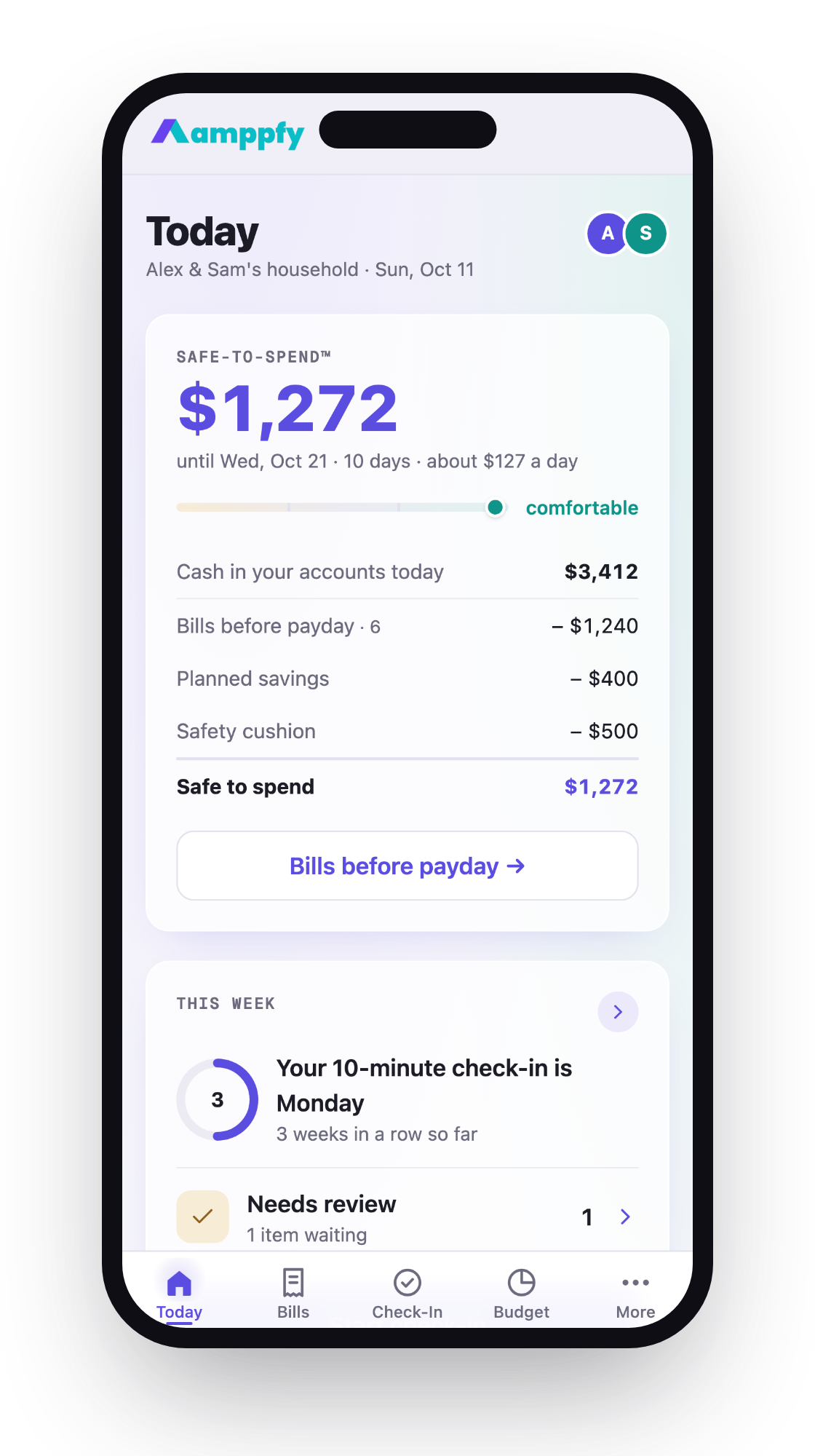
A shared account solves where the money sits. It doesn’t answer the question you both ask before buying anything: how much can we spend before payday?
The bank app shows a balance, not a plan. Rent might come out Thursday, so the number on screen looks bigger than what’s actually free.
Here’s the arithmetic that answers it:
- Available cash in the account
- Minus bills due before the next payday
- Minus planned savings
- Minus a safety cushion you choose
What’s left is your Safe-to-Spend™ number. Amppfy shows that number with the four lines printed right under it, so you both see the math. Each partner gets their own login and sees the same number, while private accounts stay private. You type in balances yourself, about 30 seconds per account, with no bank login. A 10-minute weekly check-in keeps it honest, and a bills calendar marks your lowest-cash day before payday.
You can set up Amppfy for couples this week: enter your joint balance, add the shared bills, and invite your partner. It takes about ten minutes.
FAQ
Can my partner join Navy Federal through me?
A spouse can join as a family member, and the eligibility list also includes household members, as of October 2026. Your partner doesn’t need to join to be a joint owner on your account.
Which form adds a joint owner?
Form 97AJO, “Add Joint Owner.” Both owners fill it in and sign, and you can submit it through Online Banking’s Message Center, by fax, by mail, or at a branch. Read the Important Disclosures booklet alongside it so you know the shared rules.
What happens to the money if one owner dies?
Under the default “Joint With Survivorship” setting, the funds pass to the surviving owner. You’d need to choose “No Survivorship” on Form 97AJO to change that.
Can Navy Federal take joint funds for one partner’s loan?
Yes. The Important Disclosures have both owners pledge Navy Federal a statutory lien on their shares in joint and individual accounts. If either owner defaults on a Navy Federal loan, money in the joint account can be used to cover it, as of October 2026.
Three choices: who’s on it, which survivorship option you pick, and how much you keep in it together. Make them together, check the fee page once, and let the shared number do the daily work.