

If you and your partner bank with TD, you’ve probably wondered how shared money works there. Can you add someone to the account you already have? Does your partner need to come in? Who can close it? This guide covers TD Bank, N.A., the US bank only, not TD Canada.
Everything below comes from TD’s own published pages. Where TD doesn’t publish something, you’ll see that stated plainly. Two people, one account, clear rules: here’s how it works.
Joint accounts at TD Bank: what they are and who can be on one
A TD Bank joint account has more than one owner. That’s the whole definition. TD says each owner can make deposits and withdrawals, see all activity, and get their own debit card[1]. Each of you can write checks, and both names print on them. Each of you can also set up your own Online Banking and app profile with full access.
TD’s learning center puts it simply. A joint account “functions much like an individual account, but with the added benefit of co-ownership.”[2]
Who can be on one? Spouses, unmarried partners, a parent and adult child, or roommates splitting rent. TD’s Personal Deposit Account Agreement also says anyone under 18 must open jointly with a parent or guardian. If you’re not married, the rules are the same at the bank. What changes is mostly outside it. Our guide to joint bank accounts for unmarried couples covers that side.
Add a partner to an existing account vs open a new joint account
You have two paths. Both end in the same place: an account with two owners.
| Option | What it means | Good fit if |
|---|---|---|
| Add a partner | Your current account becomes joint | Your direct deposit and autopays already point there |
| Open new joint | A fresh account, both names from day one | You want shared bills separate from personal spending |
Adding someone keeps your account number. That means no updating payroll or billers. The trade-off is that your partner sees all past activity too.
Opening a new account gives you a clean slate. Many couples prefer it. Your personal account stays yours, and the joint one handles rent, groceries, and utilities.
Either way, the process is the same. TD states that “whether you’re opening a new account or adding someone to your TD account, both owners will need to bring the required info.” TD publishes no online or phone route for adding an owner. Plan on a branch visit.
Step by step
TD says the best way to open a joint account is to book an appointment for both account owners to visit a TD Bank. Here’s the sequence.
- Book one appointment for both of you. Pick a time you can both make. One visit, two people. TD’s own joint-account page calls this the best way to open one.
- Gather ID for each person. A driver’s license, state ID, or passport.
- Bring personal details for both. Date of birth, Social Security number, and current address.
- Bring funding. TD lists funding at opening as part of what’s needed.
- Fund within 45 days. There’s no minimum opening deposit. TD says the account closes automatically if you don’t make a deposit within 45 days.
- Set up your own logins. Each owner creates a separate Online Banking and app profile.
TD doesn’t publish how long the appointment takes. It also doesn’t publish a timeline for when a newly added owner’s card arrives. Ask at the branch if you need a date.
Once you’re set up, check when pay lands. Our piece on what time TD Bank direct deposit hits walks through posting times.
What each of you can see, move, and close
This is the part couples should read twice. TD’s Personal Deposit Account Agreement sets the rules, as of October 2026:
- Survivorship. A joint account is a joint account with right of survivorship. If one owner dies, the other keeps the account.
- Ownership of deposits. All deposits belong to all owners. It doesn’t matter whose paycheck it was.
- Withdrawals and closing. Any one owner can withdraw the full balance or close the account alone.
- Overdrafts. Co-owners are jointly and severally liable. Either of you can be held responsible for the whole amount.
- No two-signer option. TD doesn’t offer accounts that need both signatures.
That last point matters. A private agreement between you doesn’t change what the bank will honor. One signature moves money.
None of this is a reason to panic. It’s a reason to agree on ground rules first. Decide what the account pays for. Decide a threshold, say $300, above which you check in before spending. Simple rules work because both of you can see the same balance.
Fees, minimums, and waivers
TD publishes these checking account fees and waivers. Every line is as of October 2026.
| Account | Monthly fee | How to waive it |
|---|---|---|
| TD Complete Checking | $15 | $500+ in direct deposits per statement cycle, or $500 minimum daily balance, or $5,000 combined across linked deposit accounts, or primary owner aged 17-23 |
| TD Beyond Checking | $25 | $5,000 in direct deposits, or $2,500 minimum daily balance, or $25,000 combined |
| TD Essential Banking | $4.95 | Waived for ages 13-17; no overdraft fees |
There’s no minimum opening deposit on these, as of October 2026. The 45-day funding rule still applies.
Here’s the arithmetic for a typical couple. Say each of you sends $400 per paycheck into a joint TD Complete account. That’s $800 in direct deposits per cycle, above the $500 waiver line. The $15 fee is waived.
Now say only one of you deposits $400. That falls short by $100. Unless the account holds $500 every single day, you’d pay $15 a month, or $180 a year. The fix is small: route a little more pay there, or split deposits so both count.
Joint, separate, or both: how couples actually use it
Most couples land in one of three setups. None is “correct.” The right one is the one you’ll both keep up with.
Fully joint means both paychecks go into one TD account. Everything is paid from it. It’s simple, and the direct deposit waiver is easy to hit. The downside is zero privacy on small purchases.
Fully separate means you each keep your own account and settle up. It’s private but takes more back-and-forth. Someone always owes someone a Venmo.
Hybrid is the common middle ground. Each of you keeps a personal account. You both send a set amount into a joint TD account for shared bills. For example, if rent and utilities run $2,400 a month, you might each contribute $1,200. Or split by income, 60/40, if pay differs.
For a full walkthrough, see our guide to bank accounts for couples: joint, separate, or both. If you’d rather skip the branch trip entirely, we’ve also covered online banks that offer joint accounts.
One number for two people
A joint account solves where the money sits. It doesn’t answer the question you both ask most: what can we spend before payday?
Your TD app shows a balance. That balance doesn’t know rent comes out Thursday. It doesn’t know you’re saving $200 for a trip. So two people glance at the same $1,900 and reach two different conclusions.
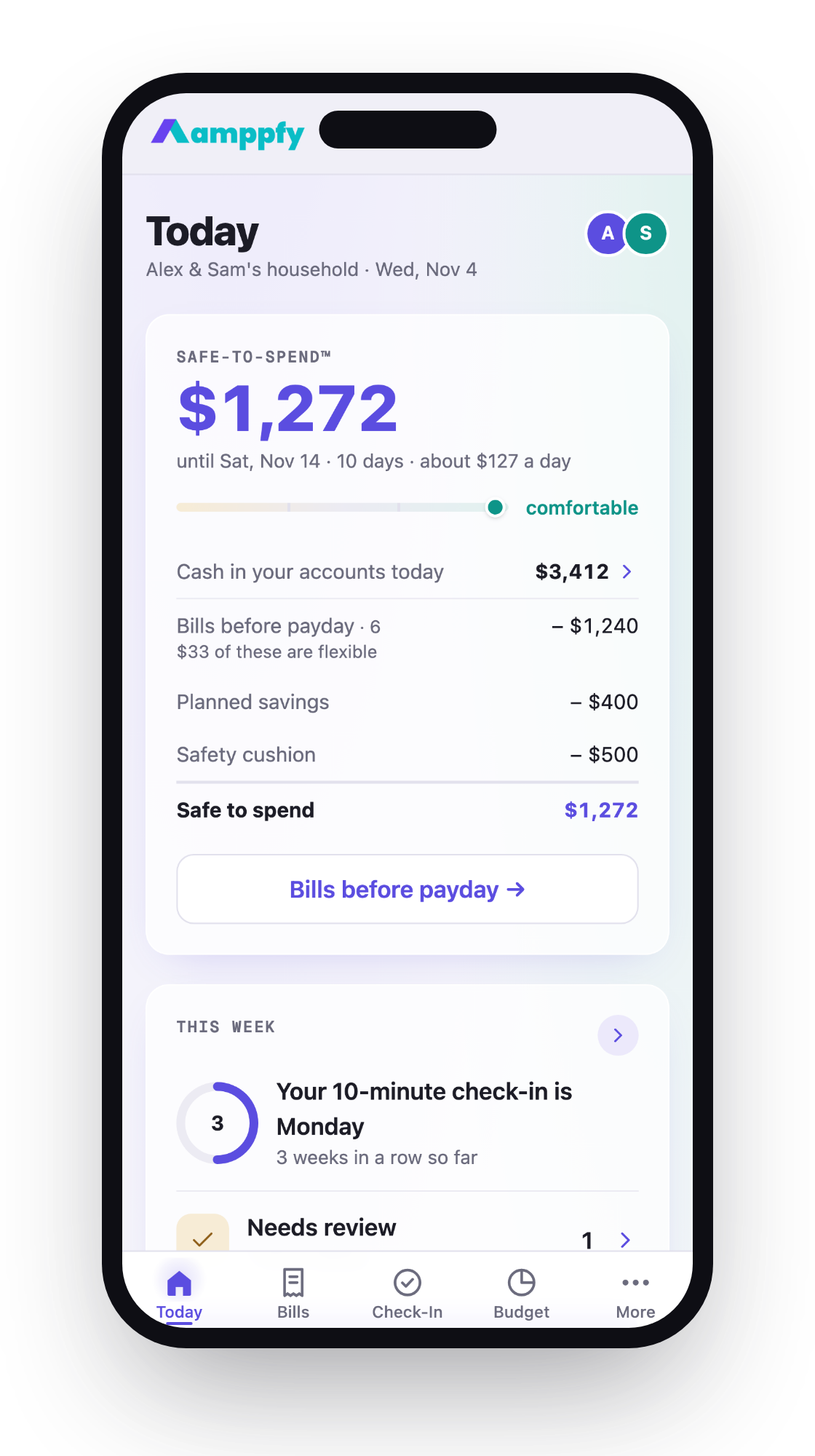
Amppfy gives you one Safe-to-Spend™ number instead. It’s available cash, minus bills due before payday, minus planned savings, minus a cushion you choose. The four-line math sits right under the number, so neither of you has to guess. Each partner gets their own login and sees the same number. Personal accounts you don’t share stay private.
There’s no bank login. You type in balances, about 30 seconds per account, during a 10-minute weekly check-in. It’s free on iPhone, Android, and the web, so a partner on either phone has an app and a laptop can use the browser.
Take ten minutes this week. Book the TD appointment, agree on what the joint account pays for, then set up Amppfy for couples so you’re both reading the same number.
FAQ
Can I add my partner to my TD Bank account online?
No. TD publishes no online or phone route for adding an owner. Both of you bring ID, Social Security numbers, dates of birth, and current addresses to a branch.
Can my partner withdraw money without my approval?
Yes. Under TD’s agreement, any one owner can withdraw funds or close the account, as of October 2026. TD doesn’t offer two-signer accounts.
Do we both need our own debit card and app login?
You each can have one. TD says every owner gets their own debit card and their own Online Banking and app profile with full access.
What happens if we open the account but don’t fund it?
There’s no minimum opening deposit, as of October 2026. TD says the account closes automatically if you don’t make a deposit within 45 days. Move even a small amount in early to keep your TD Bank joint account open.