

Payday is Friday, but you’re checking your Current app on Wednesday morning. Maybe the money is there. Maybe it says pending. Maybe there’s nothing at all, and rent is due tomorrow.
You probably want one answer: what time does Current direct deposit hit on Wednesday? The honest answer is that Current doesn’t publish a clock time. What it does publish, plus how the ACH system moves payroll files, gives you enough to plan around. Once you know the mechanism, a quiet Wednesday stops feeling like a problem. It becomes a timing question with a logical answer.
This guide covers what Current says about early pay as of October 2026, why Wednesday is often the early day, what pending means, and what to do if payday passes empty. It ends with the step most people skip: deciding how much of that deposit is actually yours to spend.
What time Current posts direct deposits
Start with who you’re dealing with. Current is a financial technology company, not a bank. Its banking services are provided by Choice Financial Group and/or Cross River Bank, Members FDIC (as of October 2026). That matters because your money moves through those partner banks and the ACH network.
Current does not publish a posting time. There’s no “funds arrive by 6 AM” line on its site as of October 2026. If someone tells you an exact hour, that’s anecdote, not policy.
Here’s the mechanism behind the Wednesday pattern. Your employer’s payroll provider usually sends a payment file to the ACH network a day or two before the official pay date. For a Friday payday, that file often arrives Wednesday. The settlement date is still Friday. “Early” means a provider releases the money when the file shows up, instead of waiting for settlement.
So, what time does a Current deposit land on Wednesday? It depends on when your employer’s file reaches the network. If your payroll submits Tuesday night, a Wednesday morning deposit is common. If payroll submits Thursday, Wednesday stays empty. That’s not Current breaking a promise. It’s the file arriving later.
For comparison across institutions, see bank-by-bank posting times in 2026.
Does Current pay early? The policy as published
Yes, with a condition. Current’s faster direct deposit page makes three claims as of October 2026:
- “Get paid up to 2 days early.” Up to is the key phrase. Two days is the ceiling, not a guarantee.
- “Direct deposits are released as soon as your employer sends them.” Current doesn’t hold the file until settlement.
- Early availability “is subject to timing of payer’s submission of deposits.” Your employer controls the start of the clock.
Put those together and the logic is simple. Current can only release what it has received. If your payroll file arrives two days before payday, you can see money two days early. If it arrives one day early, you get one day. If it arrives on payday, you get it on payday.
What Current doesn’t publish, as of October 2026: a posting time, a written rule for how long deposits stay pending, or special rules for a first deposit. Any claim about those is not coming from Current’s own policy pages.
How does this compare? Chime runs a similar model with its own catch on first paychecks. You can read how early Chime direct deposit lands and the first-paycheck catch to see the two side by side.
| Question | What Current publishes (as of October 2026) |
|---|---|
| How early? | Up to 2 days |
| What controls it? | Timing of payer’s submission |
| Posting time | Not published |
| Pending rules | Not published |
| First-deposit rules | Not published |
Weekends, holidays, and the first deposit from a new employer
Weekends and holidays shift the whole calendar. The ACH network does not settle funds[1] on Saturdays, Sundays, or Federal Reserve holidays. Payroll providers know this, so they often move pay dates around them.
When payday falls on a holiday
Say your normal Friday payday lands on a federal holiday. Many employers pay Thursday instead. The payroll file then moves back too, so your early window might open Tuesday rather than Wednesday. Check your employer’s payroll calendar. It answers this faster than any app.
When a weekend sits in the middle
A Monday payday is the tricky one. The file might arrive Friday, but nothing settles Saturday or Sunday. Your early money could show Friday afternoon, or it might not. It depends on when your employer submits.
Your first deposit from a new employer
Current publishes no special rules for first deposits as of October 2026. What’s common everywhere: a new payroll setup can run slow. Your employer may send a test deposit, a paper check for the first cycle, or a late file while they verify your account numbers.
The calm move is to plan your first paycheck around the official pay date, not the early one. If it comes early, that’s a bonus. If it doesn’t, your bills are still covered.
Why a deposit shows as pending
Pending means the deposit is known but not finished. Your bank has the payroll information. Settlement hasn’t completed. Current doesn’t publish rules for how long a direct deposit stays pending as of October 2026.
Think of it like a package marked “out for delivery.” You know it’s coming. It isn’t on your porch yet.
A rule change helps here. As of September 18, 2026, Nacha requires receiving banks[2] to make non-Same Day ACH credits available by 9:00 AM local time on the settlement date. That’s an industry rule, and as of October 2026 it’s in effect. In plain terms: on the official pay date, the money should be usable by morning. Nacha’s announcement of the new funds availability rules[3] explains the reasoning.
Early pay sits before that line. Any money released before settlement is an advance on a file that hasn’t settled yet. Most of the time, that’s fine. Occasionally a payroll file gets corrected or reversed.
So treat pending this way:
- Pending, before payday: Don’t schedule a bill against it.
- Posted: Spendable.
- Settlement date morning: Should be available under the Nacha rule.
If spending against a pending deposit gets reversed, you can end up with a negative balance. For a fuller walkthrough, see what a pending direct deposit means and when you can spend it.
What to do if payday passed and nothing landed
A missing paycheck is stressful. It’s usually also fixable, and the first steps take minutes. Work through this in order.
- Check the date. Is today the actual settlement date, or only the day you hoped for early pay? If it’s Wednesday and payday is Friday, nothing is late yet.
- Check for holidays. A Federal Reserve holiday this week pushes settlement back a business day.
- Look at your pay stub. Most payroll portals show the deposit account and the last four digits. A typo in a routing or account number is the most common cause of a missing first deposit.
- Ask payroll when the file went out. Use those words. “When was the ACH file submitted?” gets a faster answer than “where’s my money?”
- Contact Current support after the settlement date has passed. Give them the amount, the employer name, and the pay date.
While you wait, protect the next few days. List the bills due before the money arrives. Move or pause anything that can shift. Most billers allow a short delay if you call before the due date, not after.
A useful rule of thumb: until the settlement date passes, “nothing yet” is a timing question. After it passes, it’s a payroll question. Either way, there’s a clear next step.
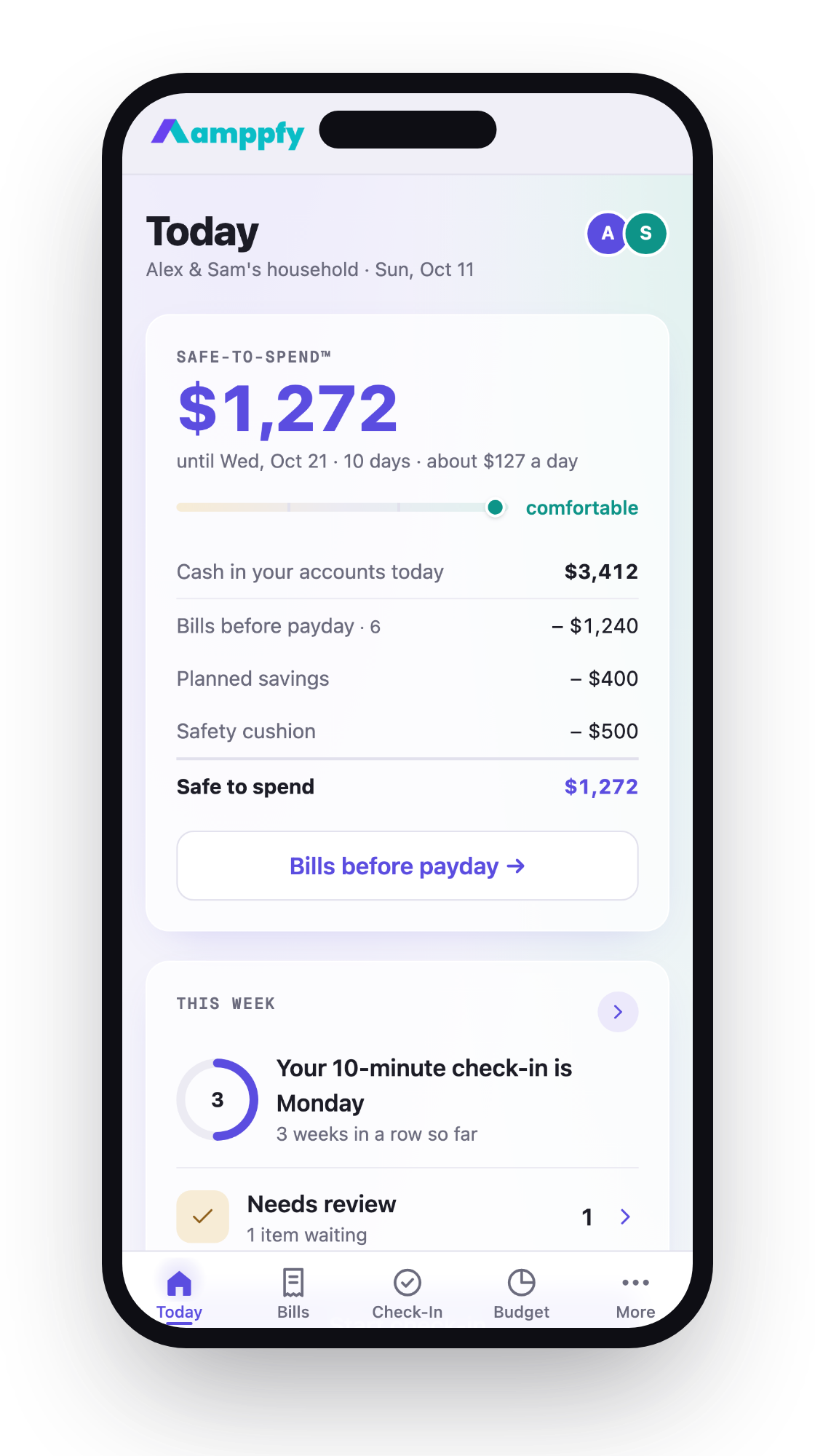
The deposit landed. What is actually safe to spend?
Your balance jumped. It’s tempting to treat that number as spending money. It isn’t, quite.
Here’s the math with a real example. You get paid $2,400 every other Friday. The deposit lands Wednesday. Before your next payday, you owe:
- Rent: $1,350
- Phone: $65
- Car insurance: $142
- Streaming and apps: $38
That’s $1,595 in bills before the next check. You also want to put $150 toward savings and keep a $200 cushion for surprises.
| Line | Amount |
|---|---|
| Deposit | $2,400 |
| Minus bills before next payday | -$1,595 |
| Minus planned savings | -$150 |
| Minus cushion | -$200 |
| What’s left to spend | $455 |
Your balance says $2,400. Your real spending room is $455. That gap is why people feel broke a week after payday, even when nothing went wrong.
Early pay can widen the gap. Money that arrives Wednesday feels like an extra two days of freedom. But the bills don’t move. Rent is still due on the 1st. The early deposit just gives you more days to spend from the same total.
The fix is ordinary arithmetic, done once per paycheck. Bills first. Savings second. Cushion third. Spend what remains.
FAQ
What time does Current direct deposit hit on Wednesday?
Current doesn’t publish a posting time as of October 2026. Wednesday deposits happen when your employer’s payroll file for a Friday payday arrives early. Current releases funds as soon as your employer sends them, so the time depends on your payroll’s submission.
Is Current a bank?
No. Current is a financial technology company. Banking services are provided by Choice Financial Group and/or Cross River Bank, Members FDIC, as of October 2026.
Why did my first Current deposit not come early?
Current publishes no first-deposit rules as of October 2026. Early availability depends on when your employer submits the payroll file. New payroll setups often submit later or run a verification cycle first. Plan around the official pay date for your first check.
Can I spend a pending deposit?
It’s safer to wait until it posts. A pending deposit that gets reversed can leave you with a negative balance. Under the Nacha rule in effect as of October 2026, non-Same Day ACH credits should be available by 9:00 AM local time on the settlement date.
So that’s the Current picture: up to two days early, depending on your employer, with no published posting time, pending window, or first-deposit rule. Wednesday money is a common pattern, not a promise.
One step remains once the deposit lands. Your balance is not what’s safe to spend. Bills due before the next payday come out first, then planned savings, then a cushion. Whatever’s left is yours. Amppfy does that arithmetic for you as one Safe-to-Spend™ number, with the four lines printed underneath so you can check it. You type in your balances, and a 10-minute weekly check-in keeps it current. Take ten minutes this week and set up your number in Amppfy, free on iPhone and the web. Next Wednesday, you’ll know what that deposit really covers.