Your tax refund hits your bank account, and within a few weeks, you can’t point to where it went. That’s not a character flaw. It’s a pattern almost everyone follows when a lump sum shows up outside the normal paycheck rhythm. The average federal refund for the 2025 filing season was $3,207, according to the IRS. That’s real money, enough to change your next few months if you give it a job before it arrives. Figuring out what to do with your tax refund before it lands is the difference between a windfall that works and one that evaporates.
Why Refunds Disappear Faster Than Paychecks
A paycheck feels like it belongs to your bills. A refund feels like a bonus. That mental gap is the whole problem. Behavioral economists call it “mental accounting”: money gets treated differently depending on where it comes from, even though a dollar is a dollar.
Your paycheck arrives on a schedule. You’ve already mentally assigned chunks of it to rent, groceries, car payments. A refund has no pre-assigned purpose, so it drifts toward whatever catches your eye first.
The speed problem
Refunds tend to land as one deposit. A single $3,000 hit to your checking account feels enormous on day one. By day ten, small purchases have chipped it down. A dinner out here, a cart full of “why not” items there, a quick subscription upgrade. None of these feel like big decisions in the moment.
The visibility problem
Your checking balance goes up, but your bills haven’t changed. You glance at the app and see a bigger number than usual. That bigger number whispers “you can afford it” every time you’re about to tap your card. Without a system that subtracts upcoming bills and goals from that balance, the number lies to you.
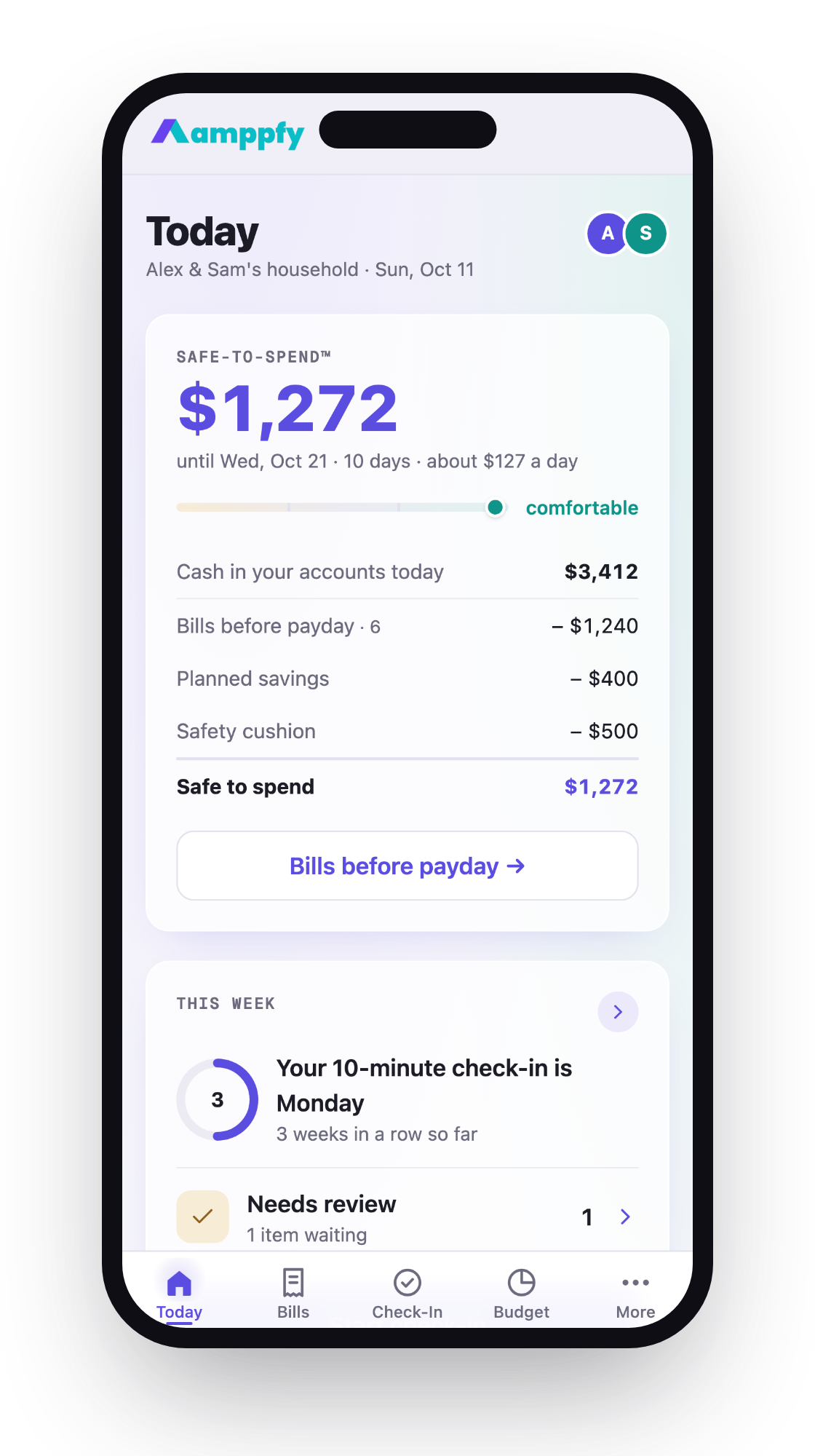
This is exactly why a single Safe-to-Spend™ figure matters more than a raw bank balance. When you see cash minus bills minus savings minus a cushion, the real number is almost always smaller than what your bank app shows. And that smaller number keeps you honest.
First Stop: The Cushion You Never Quite Built
Before you split your refund into fun categories, ask one question: do you have at least $1,000 set aside that you haven’t touched in months? If not, that’s your first move.
A cushion isn’t an emergency fund that covers six months of expenses. That’s a longer-term project. A cushion is the buffer between you and a surprise bill: a flat tire, an urgent vet visit, a broken phone screen. It keeps those moments from landing on a credit card.
How much to set aside
| Your situation | Suggested cushion from refund |
|---|---|
| No savings at all | $1,000 or half the refund, whichever is smaller |
| Under $500 saved | Enough to reach $1,000 |
| $1,000+ already saved | Skip this step, move to the next |
Put it in a separate savings account, not your checking. The point is friction. You want one extra step between you and that money so it doesn’t get absorbed into daily spending.
A worked example
Say your refund is $2,800 and you have $300 in savings. Move $700 into savings to hit $1,000. That leaves $2,100 for everything else. Write that number down. It’s your working refund from here on.
If you already have a solid cushion, skip ahead. No need to over-pad savings when the money could do more work somewhere else.
Then the Annual Bills You Know Are Coming
Some bills don’t show up monthly. They show up once or twice a year, and they always seem to land at the worst time. Car insurance premiums. Annual subscriptions. Property taxes. Vehicle registration. Back-to-school costs if you have kids.
These aren’t surprises. They’re predictable expenses you just haven’t pre-funded yet. Your refund is a chance to get ahead of them.
Build a quick list
Grab your calendar or your last year of bank statements. Pull out every non-monthly bill you paid. Common ones include:
- Car insurance (semi-annual or annual premium)
- Amazon Prime, software licenses, or annual app renewals
- HOA dues (if billed quarterly or annually)
- Holiday and birthday gifts (they happen every year, same months)
- School fees or summer camp deposits
Add them up. If the total is $1,800 and you have ten months until the biggest ones hit, you now know the number. Set aside a portion of your refund to cover the next one or two on the calendar.
Why this matters more than it looks
Paying a $900 insurance premium from money you already set aside feels like nothing. Paying it from a checking account you thought had breathing room feels like a crisis. Pre-funding these bills with your refund removes that gut-punch moment entirely.
Using a tool like Amppfy, you can drop these bills into your bill list with their due dates. The app’s Safe-to-Spend number then accounts for them automatically, so you’re never blindsided by a charge you technically knew was coming.
A Share for Goals, a Share for a Planned Treat
Here’s where most advice gets preachy. “Put it all toward debt.” “Invest every cent.” That’s fine in theory. In practice, if you don’t enjoy any of it, you’ll resent the plan and abandon it next year.
A better approach: split what’s left into two buckets.
| Bucket | Purpose | Suggested share |
|---|---|---|
| Goal money | Debt payoff, investment, or a specific savings target | 60-75% of remaining refund |
| Treat money | Something you actually want, guilt-free | 25-40% of remaining refund |
Making the goal bucket count
Pick one goal, not five. Spreading $1,500 across five priorities means none of them move meaningfully. Choose the one that will change your daily stress the most.
- If you’re carrying a credit card balance at 22% APR, throw the goal bucket at that card. Every $500 you pay off saves you roughly $110 in interest over a year.
- If you’re debt-free but have no retirement savings, open or fund a Roth IRA. The 2026 contribution limit is $7,000 if you’re under 50.
- If you’re saving for a specific purchase (a car down payment, a move, a certification), label the money and park it.
Making the treat bucket real
Decide what the treat is before the refund lands. “I’ll spend it on whatever” is how the whole refund disappears. Instead, pick something specific: a weekend trip, a piece of gear you’ve been eyeing, a nice dinner with your partner.
The key is that the treat has a price tag and a plan. You’re not restricting yourself. You’re choosing in advance so the spending feels intentional, not accidental.
A worked example, start to finish
Say your refund is $2,800:
- $700 goes to your cushion (bringing savings to $1,000)
- $500 pre-funds your car insurance due in June
- $960 hits your credit card balance (60% of the remaining $1,600)
- $640 is your treat fund for a weekend away
That’s $2,800 with a job for every dollar. No guilt. No mystery. No “where did it go” moment in April.
Putting the Refund Into Your Number the Day It Lands
The refund hits your account. Now what? You need to move the money within 24 hours. Not because it’ll vanish literally, but because every day it sits in your checking account looking like spendable cash, the plan gets harder to follow.
Step-by-step on refund day
- Confirm the deposit amount matches your return.
- Transfer the cushion portion to your savings account.
- Transfer the annual-bill portion to savings or a separate holding spot.
- Make the debt payment or investment contribution.
- Move the treat money to a checking sub-account or label it mentally.
- Update your balances in Amppfy so your Safe-to-Spend number reflects reality.
That last step takes about 30 seconds. You type in your new balances, and the app recalculates what’s actually available before your next paycheck. No bank login needed. Just the numbers from your accounts.
What if you’re filing jointly or splitting finances?
If you and a partner share bills, talk about the split before the refund arrives. Decide together how much goes to shared goals (the cushion, bills) and how much each person gets for individual goals or treats. Having a shared Safe-to-Spend number helps here because both of you see the same math. No one has to guess what the other spent.
The real win
A week after your refund lands, check your Safe-to-Spend number. If it looks about the same as it did before the refund (because you moved the money into the right buckets), you did it right. The refund isn’t inflating your daily spending. It’s working in the background, covering future bills, shrinking debt, and funding one thing you actually wanted.
Frequently Asked Questions
Should I use my entire refund to pay off debt?
Only if you already have a cash cushion. Paying off a high-interest credit card with your refund is one of the highest-return moves you can make. But if wiping out the card leaves you with zero savings, the next surprise expense goes right back on that card. Cover your cushion first, then attack the debt with what’s left.
Is it better to invest my refund or save it?
That depends on your timeline. Money you’ll need within two years belongs in a savings account. Money you won’t touch for five or more years can go into a brokerage or retirement account. If you don’t have a Roth IRA yet, your refund is a clean way to open one and make your first contribution for 2026.
What if my refund is small, like under $500?
Small refunds still deserve a plan. A $400 refund can top off your cushion, pre-pay one annual bill, or knock out a nagging small debt. The habit of assigning the money a purpose matters more than the dollar amount. Even $200 moved to savings on refund day is $200 that won’t drift into random purchases.
How do I stop myself from spending the refund impulsively?
Move the money out of your checking account within 24 hours. Split it into the buckets described above. If you use an app that shows what’s safe to spend after bills and goals, your checking balance won’t trick you into thinking you have more than you do. The plan you made before the refund arrived is your best defense against impulse.
Make Your Refund the Easiest Financial Win of 2026
Your refund is one deposit that can quietly improve the next six months. Cushion, annual bills, one goal, one treat. That’s the whole framework. No complicated spreadsheet. No Sunday afternoon lost to budgeting.
If you want a place to see the math in one number, Amppfy is free and takes about ten minutes to set up. Drop in your balances, your bills, and your next payday. The app shows you what’s truly safe to spend, so your refund stays where you put it instead of leaking out by March.
Take 15 minutes this week: write down your refund amount, pick your split, and set up the transfers. That’s it. Future-you will notice.